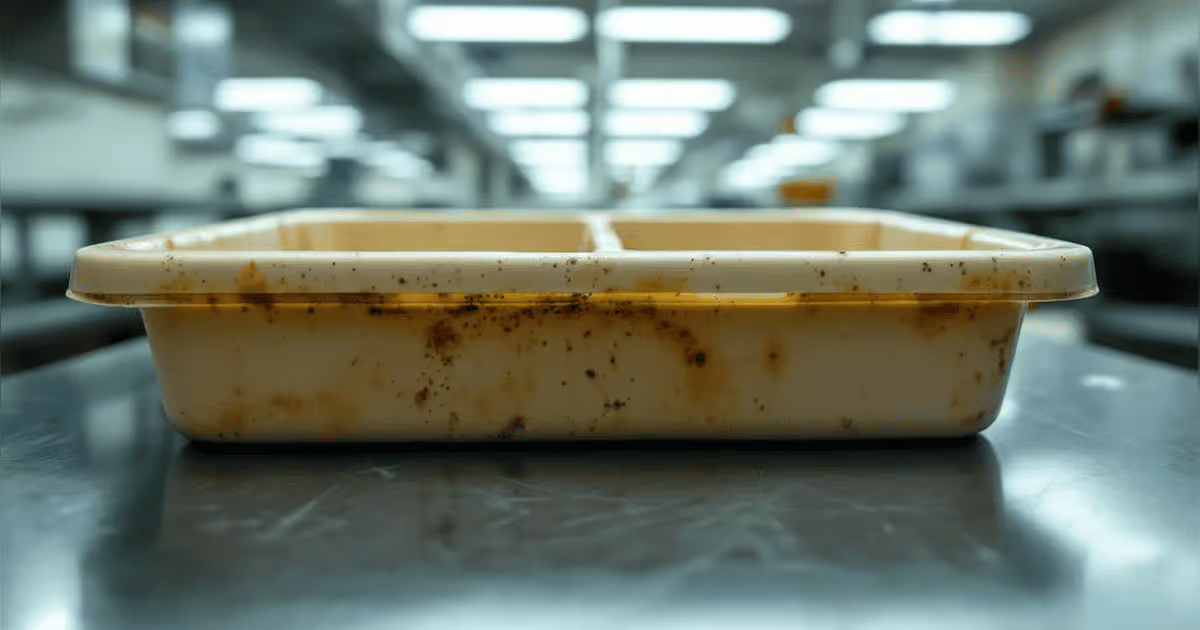
A family advocate reached out to GPS this week with photographs from Johnson State Prison that tell a story Georgia’s Department of Corrections would rather you didn’t see. The breakfast tray shows scrambled eggs, grits, canned fruit, and bread — standard institutional fare. But look closer. The tray itself is coated in dark residue along the compartment seams. Brown and black buildup clings to the edges. Stains that no amount of rinsing will remove are baked into the plastic.
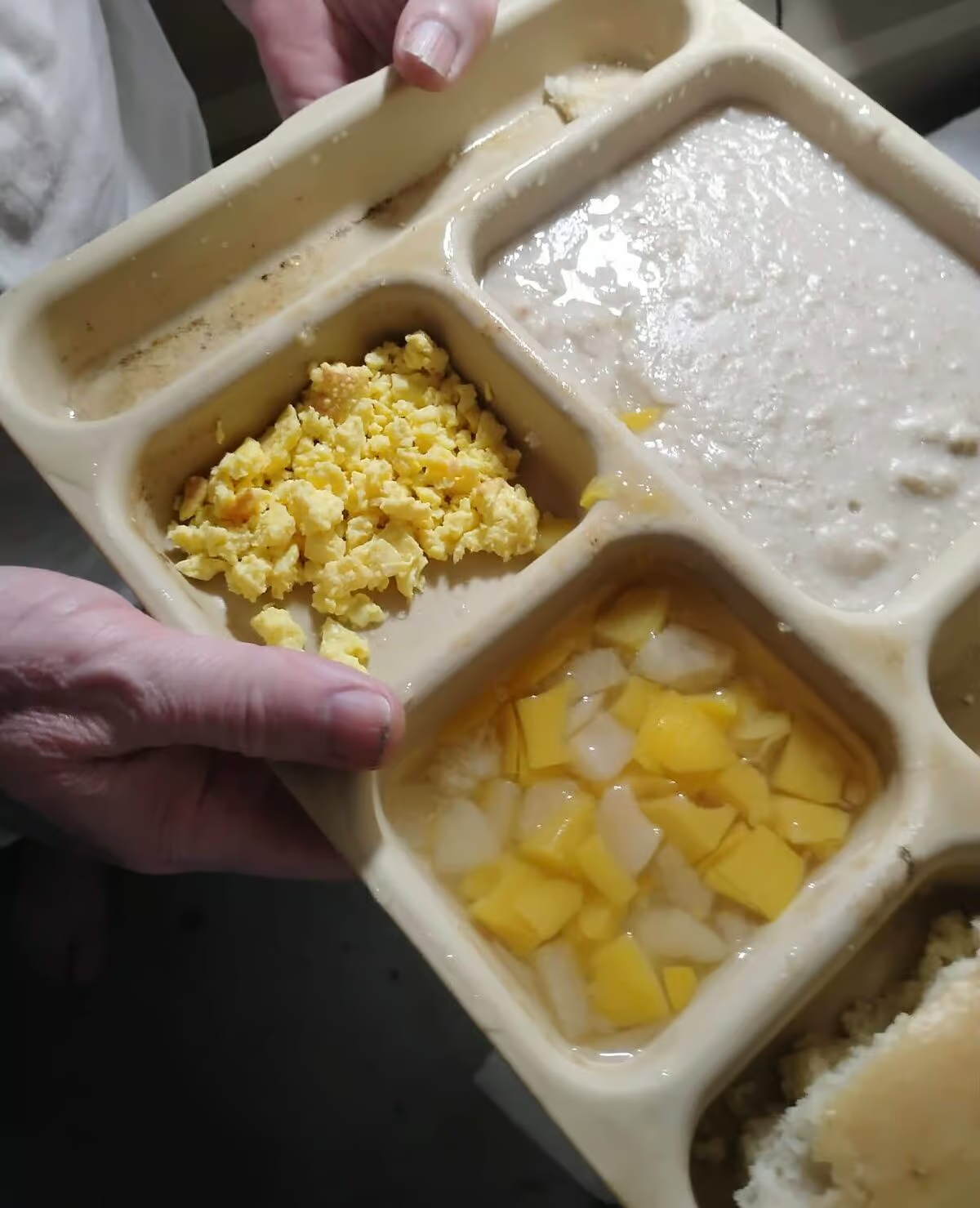
“People are getting sick,” the advocate told GPS. “The dorm reps have tried to address it themselves, to no avail.”
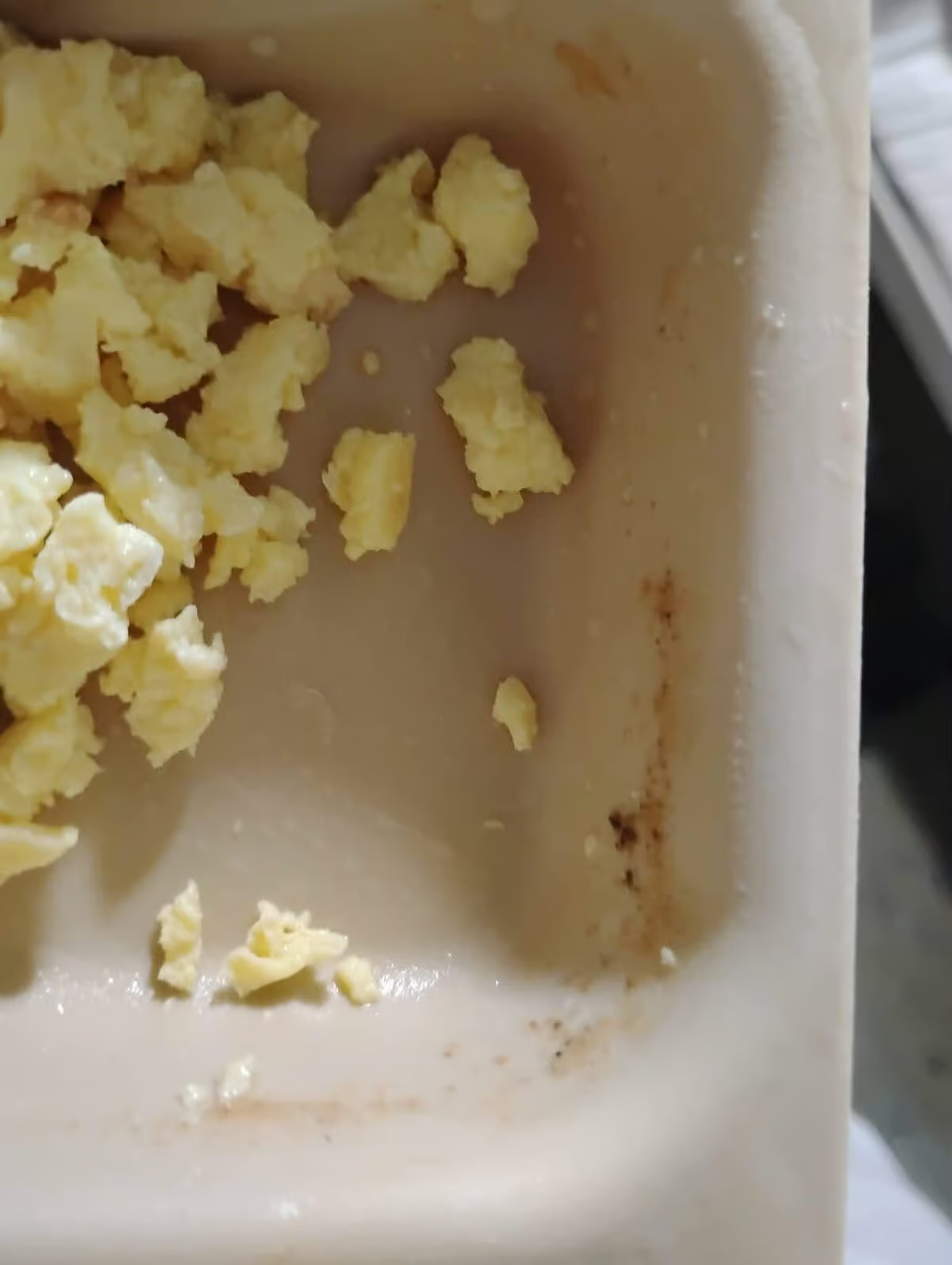
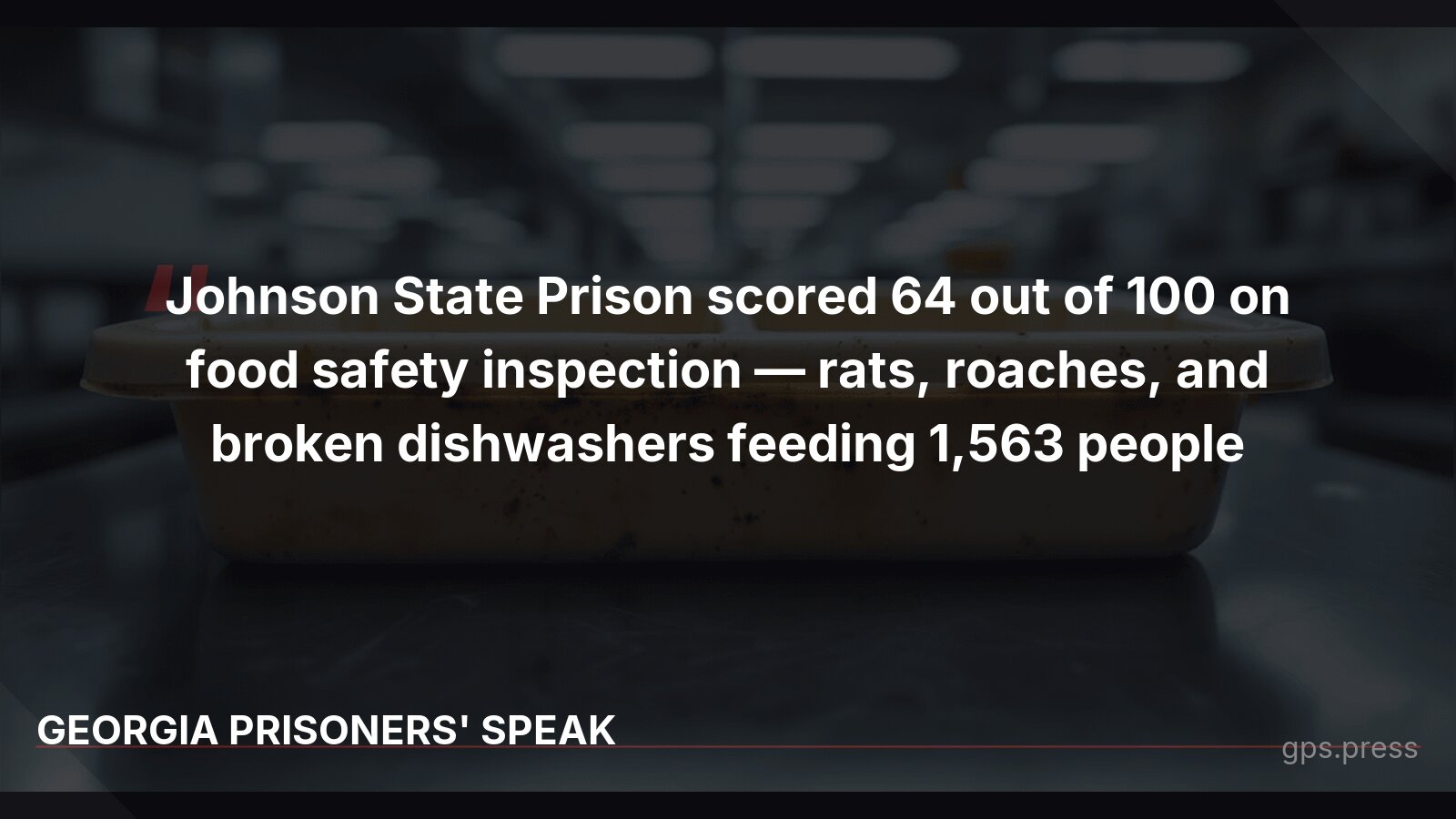
These photographs are not an anomaly. They are the predictable result of a system that has allowed kitchen infrastructure to decay for more than three decades while the population it feeds has only grown. Johnson State Prison — built in 1991, currently holding 1,563 people at 208% of its original design capacity — received the lowest documented food safety inspection score of any Georgia prison: a 64 out of 100 in December 2023. 1 A score below 70 is a failing grade.
The inspector found rats and roaches throughout the kitchen — a problem described as ongoing “with little to no change.” Bulk food including oil, flour, and rice bran had holes gnawed through the bags with visible rat droppings and urine. Five cooking ovens, one tilting skillet, one cooking kettle, one griddle, one freezer unit, and one bulk ice machine were all broken. 2
But the inspection report doesn’t mention the dishwasher. And that’s the part of the story nobody is telling.
The Dishwasher Problem Nobody Talks About
Most of Georgia’s state prisons were built between 1989 and 1993. The kitchen equipment installed at that time — including commercial dishwashing machines — is now more than 30 years old. According to multiple sources across several GDC facilities who have worked in prison kitchens, the dishwashers at most institutions have either broken down entirely or operate in a degraded state where critical functions no longer work.
At facilities where the dishwasher has failed completely, kitchen workers wash trays by dunking them in a barrel of chemical solution, then dunking them in a rinsing barrel, and stacking them for the next meal. There is no 140-degree wash cycle. There is no hot-air drying. The trays are stacked wet.
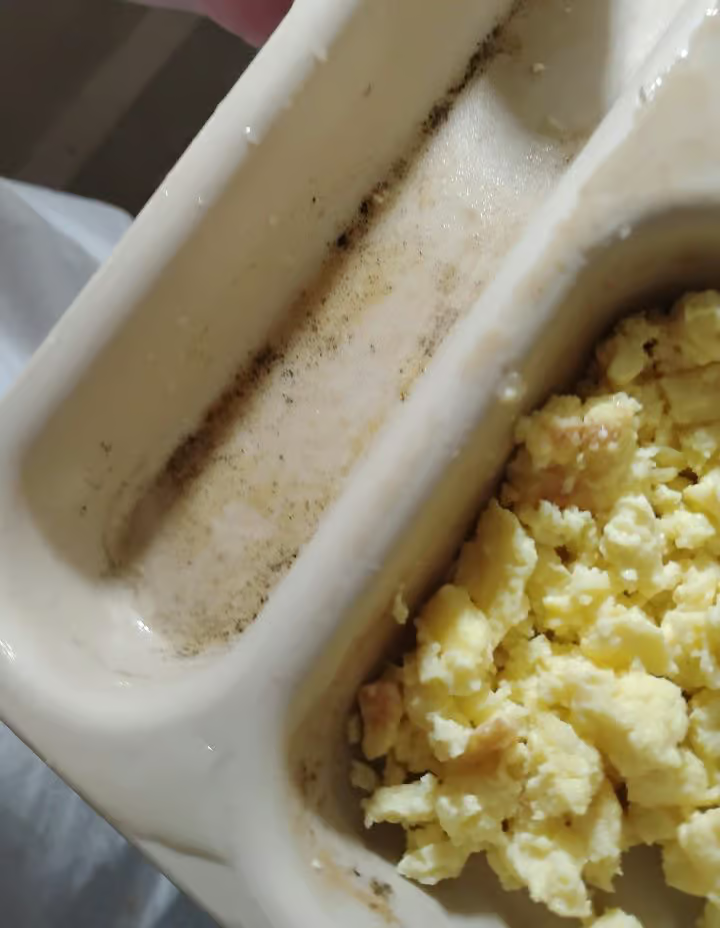
Many prisons operate with only a quarter to half the number of trays needed to feed their entire population. That means the same trays cycle through the chemical-dunk process multiple times per day. After the last wash of the evening, they sit stacked overnight — wet, warm, and in the dark. These are ideal conditions for bacterial and fungal growth.
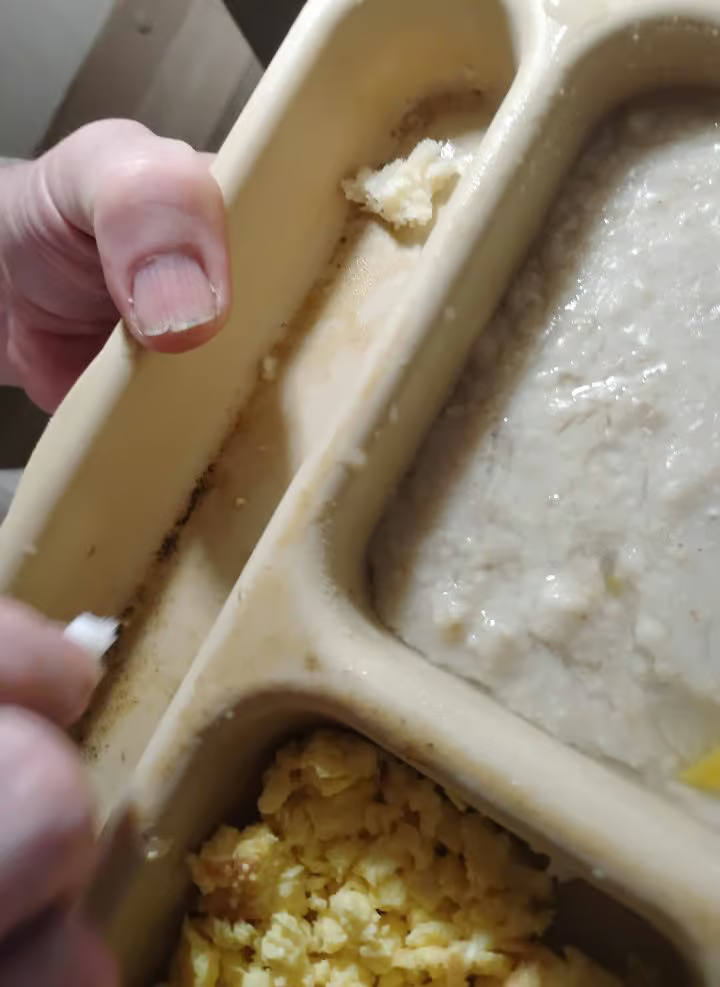
At some institutions, the dishwasher partially works: it may rinse the trays, but the soap dispenser is broken and the hot-dry cycle no longer functions. The result is the same — trays that never reach sanitization temperature and never fully dry.
GPS has confirmed that only one GDC facility — Macon State Prison — has actually replaced its dishwashing machine. Everywhere else, maintenance staff attempt to keep decades-old equipment running by cobbling together parts from other broken machines.
The same pattern applies to the boilers that heat water throughout these facilities. When boilers fail — which is frequent — GDC rents portable boilers at significant expense rather than replacing the aging units. Without functioning boilers, there is no hot water for the dishwashers, for the kitchen, or sometimes even for the housing units.
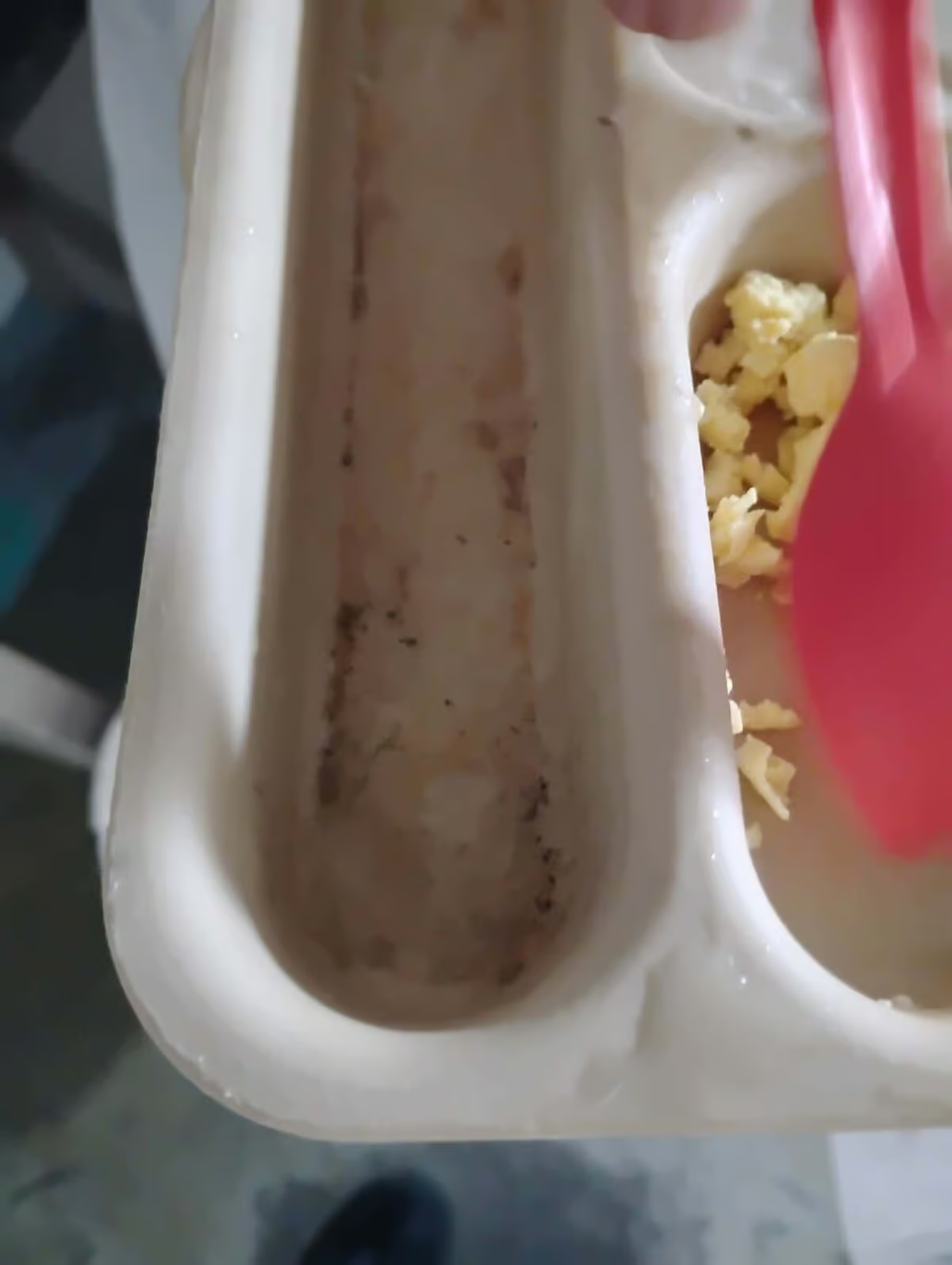
This is something health inspectors routinely miss. It is easy for staff to make a dishwasher appear operational during a scheduled inspection. And because Georgia’s prison kitchen inspections are arranged in advance due to security protocols, facilities have time to prepare. 3
A Pattern of Failure Across the System
Johnson State Prison is not an isolated case. Three GDC facilities have scored below the 70-point passing threshold on Georgia Department of Public Health food safety inspections since 2022:
- Johnson State Prison (Wrightsville): 64 in December 2023 — rats, roaches, broken equipment, food contamination
- Pulaski State Prison (Hawkinsville): 67 in January 2026 — sewage backing up through floor drains (repeat violation), the only handwashing sink had been ripped from the wall, and hot-holding food temperatures were dangerously low 4
- Smith State Prison (Glennville): 68 in May 2022 — rodent activity documented in every inspection from 2022 through 2025, with roach activity, broken plumbing, and mildew on walls, floors, and ceiling all marked as repeat violations 5
The pattern is consistent: broken equipment, vermin, inadequate sanitation, and violations that repeat from one inspection to the next because nothing is actually fixed.
At the same time, some facilities demonstrate that compliance is achievable. Central State Prison scored a perfect 100 on both its June and November 2025 inspections. Baldwin State Prison scored 100 in June 2025. The wide variance — from 64 to 100 — proves this is not an inherent impossibility. It is a matter of management, maintenance, and whether anyone in authority cares enough to act.
Sixty Cents a Meal
The infrastructure crisis exists within a food system that was already operating at the margins. Georgia spends an estimated $1.77 to $2.20 per prisoner per day on food — roughly $0.60 per meal. 2 The USDA’s Thrifty Plan — the absolute minimum the federal government considers an adequate diet — costs approximately $10 per day for an adult male. The National School Lunch Program spends $3.66 per meal for a child. Georgia spends less than one-sixth of what the federal government considers the bare minimum.
Georgia Correctional Industries serves over 39 million meals annually. The state’s Board of Corrections rules permit only two meals on weekends and holidays at the warden’s discretion. Until 2024, most facilities actually served just two meals on those days. The legislature’s solution that year was $1.2 million for “additional meals on weekends” — which in practice meant adding a peanut butter sandwich.
The CDC documents that incarcerated people are six times more likely to contract foodborne illness than the general population. 6 When you combine rock-bottom spending, aging equipment, inadequate sanitation, and overcrowded facilities cycling trays through chemical barrels instead of commercial dishwashers, the result is exactly what these photographs show.
What the DOJ Already Found
The U.S. Department of Justice released its findings on October 1, 2024, after a three-year civil rights investigation of 17 GDC prisons. The 93-page report concluded that Georgia engages in a pattern of violating incarcerated people’s constitutional rights under the Eighth Amendment. 7 Among the documented violations: repeated instances of people being restrained, raped, and deprived of food by their cellmates over extended periods. At one facility, a man was found dead and decomposing after being denied food and water for days.
No consent decree has been reached with GDC as of April 2026.
Federal Judge Marc Treadwell, in a separate contempt proceeding, stated that his court had “long passed the point where it can assume that even sworn statements from the defendants are truthful.”
And in February 2026, Federal Judge Self rebuked GDC Commissioner Oliver for ignoring court orders, saying the agency has “little credibility” and acts as if it is “above the law.”
What Needs to Happen
The photographs from Johnson State Prison show what happens when a system built in the early 1990s is never maintained, never updated, and never held accountable. The trays are not dirty because the kitchen workers are lazy. They are dirty because the equipment that is supposed to sanitize them broke years ago and was never replaced.
Georgia’s prison food crisis is not a mystery. The causes are documented. The failures are inspected and scored. The constitutional violations have been identified by the Department of Justice. What is missing is the will to act.
The people eating off these trays have no choice. They cannot go to another restaurant. They cannot file a health complaint that leads to a kitchen shutdown — because there is no alternative food source. They are captive consumers of a system that spends sixty cents a meal and expects nothing to go wrong.
Something is going wrong. People are getting sick. And until Georgia replaces the equipment, funds the maintenance, and subjects its kitchens to genuine accountability, every tray served is a roll of the dice.
Call to Action: What You Can Do
When people are eating off trays washed in chemical barrels because Georgia won't replace broken dishwashers, silence becomes complicity. Share this investigation — the families of 47,000 incarcerated Georgians need you to care about rats in the kitchen and $0.60 meals.
Spread the Word — It Takes 15 Seconds
Awareness without action changes nothing. Here’s how you can help push for accountability and real reform:
Join the GPS Advocacy Network — Sign up at https://gps.press/become-an-advocate/ and we’ll advocate on your behalf every week. GPS identifies your state legislators, crafts personalized letters on the most pressing prison issues, and sends them directly to the representatives who represent you. You receive a copy of every letter. It takes two minutes to sign up — we handle the rest.
Tell My Story — Are you or a loved one affected by Georgia’s prison system? GPS publishes first-person accounts from incarcerated people and their families. Submit your story at https://gps.press/category/tellmystory/ and help the world understand what’s really happening behind the walls.
Contact Your Representatives — Your state legislators control GDC’s budget, oversight, and the laws that created these failures. Find your Georgia legislators at https://gps.press/find-your-legislator/ or call Governor Kemp at (404) 656-1776 or the GDC Commissioner at (478) 992-5246.
Demand Media Coverage — Contact newsrooms at the AJC, local TV stations, and national criminal justice outlets. More coverage means more pressure.
Amplify on Social Media — Share this article and tag @GovKemp, @GDC_Georgia, and your local representatives. Use #GAPrisons, #PrisonReform, #GeorgiaPrisonerSpeak.
File Public Records Requests — Georgia’s Open Records Act gives every citizen the right to request incident reports, death records, staffing data, medical logs, and financial documents at https://georgiadcor.govqa.us/WEBAPP/_rs/SupportHome.aspx.
Attend Public Meetings — The Georgia Board of Corrections and legislative committees hold public meetings. Your presence is noticed.
Contact the Department of Justice — File civil rights complaints at https://civilrights.justice.gov. Federal oversight has forced abusive systems to change before.
Support Organizations Doing This Work — Donate to or volunteer with Georgia-based prison reform groups fighting for change on the ground.
Vote — Research candidates’ positions on criminal justice. Primary elections often determine outcomes in Georgia.
Contact GPS — If you have information about conditions inside Georgia’s prisons, reach us securely at GPS.press.
Further Reading
Federal Nutrition Guidelines vs. Georgia Prison Food Reality
How the Trump administration’s new nutrition standards expose the gap between federal guidelines and Georgia’s $0.60-per-meal prison food system.
Starved and Silenced: The Hidden Crisis Inside Georgia Prisons
An in-depth investigation into how chronic food deprivation endangers lives and fuels violence across Georgia’s correctional facilities.
Feeding Injustice: The Inhumane Quality and Quantity of Prison Meals in Georgia
A nutritional analysis revealing how Georgia prison meals fail to meet basic dietary standards and contribute to chronic disease.
Mealtime and Food Service in Georgia Prisons
Photographic documentation of the meals served in Georgia’s prisons, revealing the gap between official menus and what actually reaches the tray.
Mission Failure: Georgia Spends $1.8 Billion on Prisons and $52 Per Person on Rehabilitation
How Georgia’s prison budget prioritizes surveillance and control over basic human needs including nutrition and healthcare.
Research Explainers
GPS Research Explainers distill complex data and legal research into accessible briefings. These explainers are directly relevant to the issues covered in this article:
Food Safety Inspections in Georgia State Prisons
A comprehensive review of DPH inspection scores, legal frameworks, and documented violations at GDC kitchen facilities from 2022 to 2026.
Prison Malnutrition Crisis: Health Costs, Violence, and Economic Impact
National research documenting how prison malnutrition drives healthcare costs, fuels violence, and creates lasting public health consequences.
Explore the Data
GPS makes GDC statistics accessible to the public through several resources:
- GPS Statistics Portal — Interactive dashboards translating complex GDC reports into accessible formats, updated within days of official releases.
- GPS Lighthouse AI — Ask questions about Georgia’s prison system and get answers drawn from GPS’s investigative archive and data analysis.
- Machine-Readable Pages for Researchers — GPS maintains AI-optimized pages for data analysis:
- AI Content Index — https://gps.press/ai-index/
The AI Content Index has links to numerous machine readable pages, but this is all that is needed by an AI to fully understand all the data. You can learn more about using GPS Data with AI in are article on the topic:
How to Use GPS Data with AI Tools (https://gps.press/how-to-use-gps-data-with-ai-tools/)
A step-by-step guide showing researchers, advocates, families, and journalists how to use GPS’s machine-readable data pages with AI tools like ChatGPT, Claude, and Gemini to analyze Georgia prison conditions, statistics, and policy.
Contact GPS at media@gps.press for access to underlying datasets used in this analysis.
About Georgia Prisoners’ Speak (GPS)
Georgia Prisoners’ Speak (GPS) is a nonprofit investigative newsroom built in partnership with incarcerated reporters, families, advocates, and data analysts. Operating independently from the Georgia Department of Corrections, GPS documents the truth the state refuses to acknowledge: extreme violence, fatal medical neglect, gang-controlled dorms, collapsed staffing, fraudulent reporting practices, and unconstitutional conditions across Georgia’s prisons.
Through confidential reporting channels, secure communication, evidence verification, public-records requests, legislative research, and professional investigative standards, GPS provides the transparency the system lacks. Our mission is to expose abuses, protect incarcerated people, support families, and push Georgia toward meaningful reform based on human rights, evidence, and public accountability.
Every article is part of a larger fight — to end the silence, reveal the truth, and demand justice.
Footnotes
- Repeat Violations Prompt Johnson State Prison to Fail Health Inspection, https://www.thegeorgiavirtue.com/local-news-south-georgia/repeat-violations-prompt-johnson-state-prison-to-fail-health-inspection/ [↩]
- GPS Research Library, Food Safety Inspections in Georgia State Prisons, https://gps.press/research/food-safety-inspections-in-georgia-state-prisons/ [↩][↩]
- The Big Business of Bad Prison Food, https://www.themarshallproject.org/2025/03/08/food-business-michigan-prison-mississippi [↩]
- 41NBC, Pulaski State Prison Kitchen Receives 67 in Food Service Inspection, https://www.41nbc.com/pulaski-state-prison-food-inspection-violations/ [↩]
- Smith State Prison Lands 72 on Health Inspection, https://www.thegeorgiavirtue.com/local-news-south-georgia/smith-state-prison-lands-72-on-health-inspection/ [↩]
- CDC Model Food Safety Practices for Correctional Facilities, https://www.cdc.gov/correctional-health/publications/food-safety.html [↩]
- DOJ Findings Report, Investigation of Georgia Prisons, https://www.justice.gov/d9/2024-09/findings_report_-_investigation_of_georgia_prisons.pdf [↩]