Public records. Source: 2026-06-03 GA DPH Open Records response (South Health District Environmental Health, Ashley Carlton) for Valdosta State Prison — whose kitchens are operated under contract by Aramark Corrections (permits FSP-092-000985 “Primary,” FSP-092-000984 “Annex,” 3259 Val-Tech Rd, Valdosta). Full complaint file + investigator record obtained by open-records request, 2026-06-04.
The complaints on file (Aramark Corrections Primary, Valdosta SP)
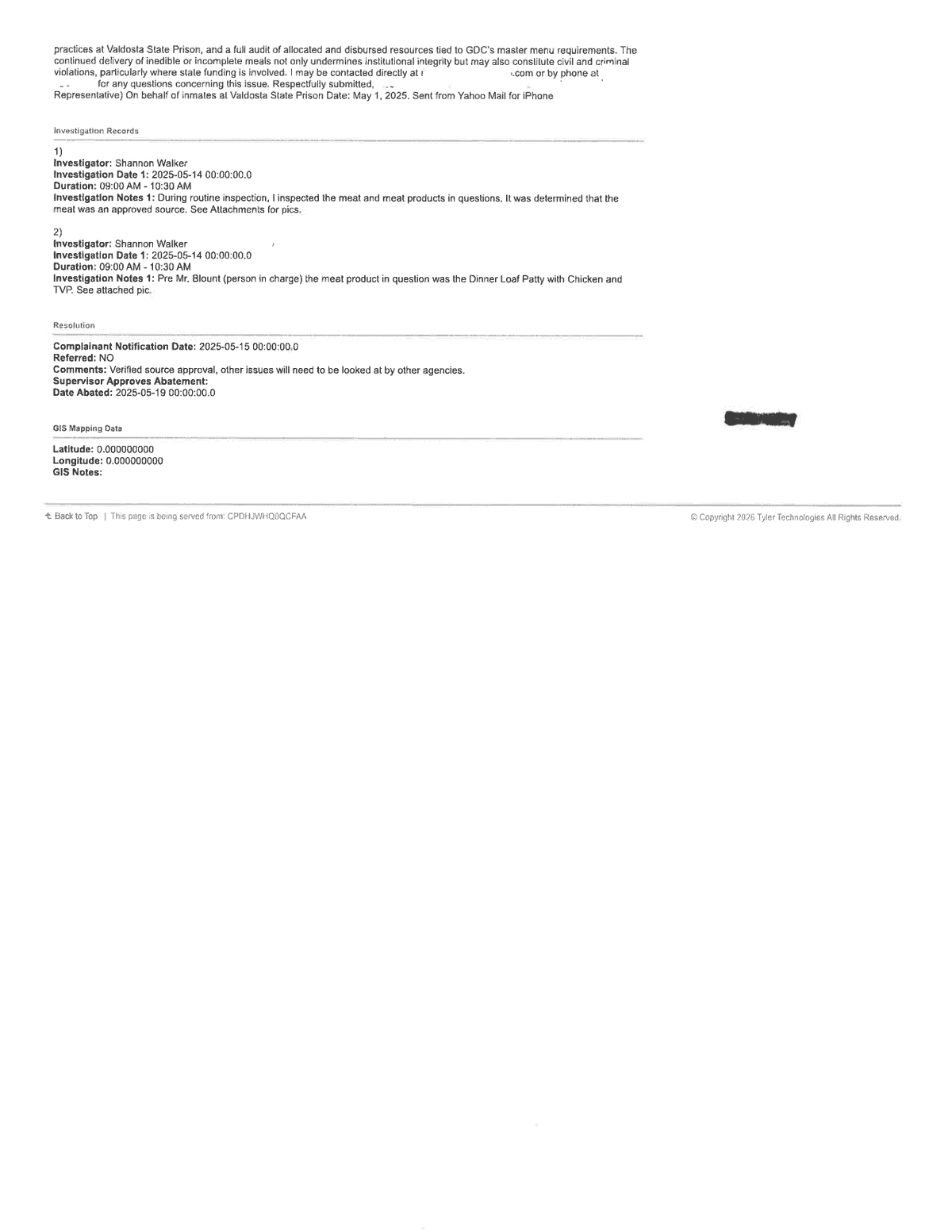
Complaint #73921884 (filed May 1, 2025, by a person identifying as a clerical assistant writing “on behalf of inmates”) alleged “continued delivery of inedible or incomplete meals,” including a “meat patty of questionable animal origin… [that] bears no resemblance to any known beef, pork, or poultry product,” withheld condiments, meals served without beverages, and possible “civil and criminal violations, particularly where state funding is involved,” demanding a full audit of resources tied to GDC’s master-menu requirements. DPH investigator Shannon Walker (investigated 2025-05-14) narrowed the inquiry to a meat-sourcing check — identifying the patty as the GoodSource “Dinnerloaf Patty made with Chicken and TVP” — and closed the file as “approved source,” while noting that “other issues will need to be looked at by other agencies.” Complaint #73931133 (2026) was abated 2026-05-06 for “no complainant contact information provided.” Separately, the inspection record documents a chronic roach and rodent infestation across both kitchens from 2020 through May 2026.
What’s on the labels — and who makes it
Transcribed from the product-case photographs in the DPH file (Primary kitchen). All are institutional packs marked “not labeled for retail sale.”
- GoodSource “Dinnerloaf Patty, made with Chicken and TVP—Beef and Caramel Color Added” (#3492-30, 3 oz; packed for GoodSource Solutions, Carlsbad, CA — a national correctional-foodservice distributor): Mechanically Separated Chicken, Water, Textured Vegetable Protein (Soy Flour, Caramel Color), Modified Corn Starch, 2% or less of each of: Beef, Salt, Sodium Phosphate, Natural Flavors, Caramel Color, Sugar, Bell Peppers, Onions, Tomato Powder. Contains: Soy. — this is the “meat patty of questionable origin” from the complaint above.
- Heartland’s Best turkey line — Cured Dark Turkey (#680213), Turkey Salami (#680212), Turkey Bologna (#680211) — a private brand of West Liberty Foods, L.L.C. (West Liberty, Iowa): Mechanically Separated Turkey / turkey skin, water, modified food starch, corn syrup solids, smoke flavor, and curing chemistry including sodium nitrite.
- Gold Creek Boneless Skinless Ground Chicken Meat (#00001A-CGI; “may contain up to 12% retained water,” for further processing) — Gold Creek Processing, LLC, Dawsonville, GA. The “-CGI” product-code suffix suggests this case may be packed for the state’s correctional-industries program — a lead we are confirming.
- Chicken & Beef Patty Bulk — packed by the G.C.I. Food Distribution Unit, Milledgeville (Georgia Correctional Industries, the state’s own statewide food distributor): Chicken, Water, Textured Vegetable Protein (Soy Flour), then a block of synthetic vitamins (B-1, B-2, B-6, B-12, iron, zinc, vitamin A…), Beef Fat, Beef (last).
Two supply chains, one kitchen — and why we keep them separate
Valdosta’s kitchen is run by a private contractor, Aramark Corrections — not by the state’s own food operation. The labels show two parallel supply chains feeding it at once: outside national vendors (GoodSource Solutions, a national corrections-foodservice distributor, and West Liberty Foods, the Iowa maker of the Heartland’s Best line) and the State of Georgia’s own product — the GCI Chicken & Beef Patty packed in Milledgeville.
An important distinction we preserve: only the GCI-packed Chicken & Beef Patty is confirmed to be the state’s own, statewide-distributed product. The GoodSource and Heartland’s Best / West Liberty brands were observed at an Aramark-operated facility and should not be assumed to be what the state’s GCI-supplied kitchens serve at other prisons. We document them here as Aramark’s procurement at Valdosta — kept separate from the GCI/state-menu nutrition data elsewhere in this investigation — until open records establish otherwise. The open question we are now pursuing through GDC and GCI: does the state’s own food operation distribute these same outside brands, or different ones?
The common formula. Across all of these — Aramark’s outside brands and the state’s GCI patty alike — the recipe is the same: mechanically-separated meat slurry + added water + textured vegetable protein (soy) + modified-starch filler + curing/flavor chemistry. The state’s GCI patty even layers on a stack of synthetic vitamins — fortification added precisely because the soy-extended base is nutritionally deficient on its own.
What the contract shows: Georgia pays Aramark more, and serves less
In July 2026, Georgia Prisoners’ Speak obtained the Department of Corrections’ food-service contract with Aramark Correctional Services through an open-records request (Reference # R030073-070126). The documents put the state’s own numbers behind what families at Valdosta and five other prisons have described.
Aramark runs the kitchen at a specific set of prisons — not all of them. Under contract 46700-019-GDC0000990 (awarded May 11, 2022), Aramark operates food service at six facilities: Hays, Phillips, Valdosta, Coastal, and Arrendale State Prisons, and the Metro Reentry Facility (the Metro Reinvestment Center was added later). Every other GDC prison is fed by Georgia Correctional Industries or the Department itself. Valdosta — the subject of this investigation — is an Aramark facility.
The state pays a flat rate per person, per day. The contract price is a “per diem” — a set amount per incarcerated person per day for a fixed 28-day menu. When the contract began, that rate was $3.108 per person per day. Effective July 1, 2023, it rose to $3.963 per person per day. That figure is the all-in contractor rate — food, kitchen labor, management, and Aramark’s margin — for the facilities Aramark runs; it is not the state’s raw food cost.
And on the same day that rate went up, the menu went down. Effective July 1, 2023, the department and Aramark signed Amendment 4, which modified the menu “to yield anticipated savings.” In the contract’s own words, the approved changes were:
Reduce Fruit/Canned Fruit at Breakfast to 3X per week — ($0.084)
Replace Fruit/Canned Fruit at Lunch with a variety of dessert items — ($0.077)
Replace canned vegetable recipes with frozen vegetables — ($0.035)
Replace fortified fruit drink at Dinner with a tea beverage — ($0.005)
Total Savings from Menu Changes (Per Diem) — ($0.201)
Fruit at breakfast cut to three days a week. Fruit at lunch replaced with dessert. A vitamin-fortified drink swapped for tea. These are not allegations — they are the signed terms of the contract, adopted the same day the price rose. The people best positioned to notice the difference were the ones eating the result.
Two things the records also settle. GDC confirmed in writing that it has no agreement with Trinity Services Group — Aramark is the state’s only outside prison food-service contractor. And the most recent contract term in the records the department produced runs only through June 30, 2024; we are seeking the current-year renewal and pricing.
Photos (complaint attachments)

Source documents (full DPH records)
- DPH records — Valdosta SP, Part 1 (Primary kitchen inspections + both complaints + product-label photos)
- DPH records — Valdosta SP, Part 2 (Annex kitchen inspections)
- GDC–Aramark Correctional Food Service contract (executed, 2022) — obtained via ORR R030073-070126
- GDC–Aramark Contract Amendment 4 — Menu Modifications (2023): the signed menu cuts
The oversight gap: we asked the state to look. Here is what came back.
The Valdosta records above are one half of a pattern. The other half is what happens when an outside body is asked to examine it. In April 2026, Georgia Prisoners’ Speak (through the GDC Accountability Project) wrote to the Georgia Office of the State Inspector General — the office the legislature created to investigate fraud, waste, abuse, and corruption in the executive branch — laying out the prison-food spending pattern and asking that it be reviewed for procurement and contract-administration concerns in the Department of Corrections’ food-service and commissary contracts. This is the letter, and the reply.
What we asked the State Inspector General (mailed April 2026)
I am writing on behalf of Georgia Prisoners’ Speak — a Georgia-based investigative journalism organization documenting conditions inside the Georgia Department of Corrections — to bring to the Office of the Inspector General a documented spending pattern within the Department of Corrections that we believe warrants OIG review under the Office’s mandate to examine fraud, waste, and abuse in state agencies.
The State of Georgia spends $0.53 per meal feeding 53,000 incarcerated adults. By the state’s own budget, the Department of Corrections will spend $31 million next year on food and $432 million on medical care for the people it has malnourished. The medical line has grown 33% in four years. The food line has grown 1%. Per inmate per year: $583 on food, $8,074 on medical — a ratio of roughly fourteen to one.
To put $0.53 in context: the U.S. Department of Agriculture currently reimburses Georgia public schools approximately $4.40 for a single free school lunch. The State of Georgia feeds the children of its citizens at roughly eight times the per-meal rate it feeds the adults it has taken into custody.
These are not abstractions. The photographs on the next page are real meals served on real days at real Georgia state prisons — one from each of the three daily services. A typical lunch: wilted iceberg lettuce, a sealed mayonnaise packet, a slice of processed cheese with a mustard packet, and a tortilla folded around a small portion of diced lunchmeat. A typical dinner: canned vegetables, white rice, and two pieces of unidentifiable meat. A typical breakfast: a few spoonfuls of scrambled eggs, a portion of grits, and a slab of yellow cake — cake because sugar adds calories cheaply.
What the state itself does not provide is supplemented only by what families and inmates can afford to purchase from the prison commissary. There, a package of ramen noodles that retails outside the wall for roughly twenty cents costs ninety cents — a markup of roughly 350 percent on the cheapest staple in the American grocery store. The available items are overwhelmingly sugar, refined flour, and salt: honey buns, snack pies, chips, soda, processed pastries. Meaningful protein is effectively absent from the commissary inventory. The state under-feeds the population, then sells junk food to the families of the incarcerated at usurious markup, and then bills the public for the diabetes, hypertension, and cardiovascular disease that follow. This is the cost cascade in three steps.
We respectfully request that the Office consider opening a review of GDC food-service and commissary contract administration, and the broader fiscal pattern in which the Department’s food line has grown 1% in four years while its medical line has grown 33% during the same period. The fourteen-to-one ratio between per-inmate medical and food spending — with documented downstream chronic-disease consequences — is the kind of preventable-cost pattern OIG mandates require be examined. We will furnish the underlying budget citations, photographs from inside GDC kitchens, mortality cross-checks, and source access on request.
The full body of our reporting on Georgia prison food, nutrition, and the cost cascade is collected at gps.press/food/. Thank you for your attention to this record. We will follow up by email within fourteen days.
— Georgia Prisoners’ Speak / GDC Accountability Project, Inc., letter to the Office of the State Inspector General (mailed April 27, 2026; received by OIG May 6, 2026)
What the Inspector General sent back (June 1, 2026)
This letter is in response to your correspondence which was received by our office on May 6, 2026.
Pursuant to O.C.G.A. § 45-12-212, the duties of the Office of the State Inspector General include the investigation of fraud, waste, abuse, and corruption in the executive branch of state government.
After reviewing your complaint, OIG considers this matter to be beyond our legal authority to investigate. We suggest you contact the Georgia Department of Corrections Ombudsman and Inmate Affairs Office at (478) 992-5358 or ombudsman@gdc.ga.gov to discuss your concerns about your application.
— Richard Schneider, Deputy Inspector General, Georgia Office of the State Inspector General (June 1, 2026)
The documents
- GPS’s letter to the Georgia Office of the State Inspector General (PDF, mailed April 2026)
- The Inspector General’s reply (PDF, June 1, 2026)
The pattern
Two different oversight bodies, the same result. The Department of Public Health investigated a complaint that Valdosta State Prison was serving “inedible or incomplete meals” with possible “civil and criminal violations, particularly where state funding is involved” — and closed it by confirming the meat came from an “approved source.” The State Inspector General — whose entire mandate is fraud, waste, and abuse in state agencies — declined to look at a fourteen-to-one food-versus-medical spending gap and a $0.53 meal, and referred the matter to the Department of Corrections’ own internal Ombudsman: the very agency whose spending was the subject of the request. In Georgia, the external checks on prison conditions defer back to the institution being examined. That absence of independent oversight is itself the story.