This explainer is based on Legal Access in Georgia Prisons: Constitutional Standards, GDC Regulations, and Reform Models. All statistics and findings are drawn directly from this source.
TL;DR
People in Georgia prisons have almost no way to fight their cases. The state’s own rules say each person gets just 2 hours a week in the law library. But many people report getting only 30 minutes every two weeks. There are no lawyers, no trained helpers, and no legal aid. COVID shut down libraries for up to 4 years — but legal deadlines kept ticking. A fix would cost less than 0.6% of the prison budget.
Why This Matters
If your loved one is in a Georgia prison, they may have almost no way to get legal help. Even if they were wrongly convicted or got an illegal sentence, they face huge barriers.
Here’s what this means for families:
- No lawyers are provided. People must try to handle complex legal work alone.
- Library time is tiny. Even the 2 hours a week the rules promise is rarely given.
- Deadlines don’t stop. Georgia does not pause legal deadlines, even when the prison blocks access to the library.
- COVID made it worse. Some prisons shut their libraries for almost 4 years. People may have lost their chance to file forever.
This isn’t just a policy problem. Real people are losing their right to go to court. Families are losing hope for justice.
Key Takeaway: Georgia fails to give people in prison any real way to fight their cases — and families pay the price.
What the DOJ Found — and What It Missed
In October 2024, the U.S. Department of Justice (DOJ) released a major report on Georgia prisons. It found serious safety failures:
- 142 people were killed in Georgia prisons between 2018 and 2023
- More than half of all guard jobs are empty (50%+ vacancy rates)
But here’s what the DOJ did not look at: law libraries and legal access. The DOJ only studied physical safety. It did not study whether people could get to court.
This matters because the staffing crisis the DOJ found is the same reason libraries can’t stay open. When there aren’t enough guards, library hours get cut first.
Key Takeaway: The DOJ found 142 deaths and over 50% staff vacancies — but never looked at whether people could access legal help.
What the Rules Say vs. What Really Happens
Georgia’s prison rules (called SOP 227.03) lay out what legal access should look like. Here’s what the rules promise:
- Each person can request 2 hours per week in the law library
- The library must be open at least 20 hours per week for the whole prison
- Access must be set up within 7 calendar days of a written request
- People can get up to 5 free copies of legal forms each month
But the rules also have big gaps:
- No legal advice from any staff — not library workers, not prison staff, not even clerk helpers
- No trained legal helpers or programs of any kind
- Extra time for court deadlines is called “a privilege and not a right”
- A warning about “frivolous” (meritless) lawsuits must be posted where people can see it
What really happens is far worse. People in prison report getting as little as 30 minutes every two weeks. Staff shortages, lockdowns, and emergencies cancel library time over and over. The rules on paper mean little when no one can enforce them.
Key Takeaway: The rules promise 2 hours a week, but people report getting as little as 30 minutes every two weeks.
COVID Shut Down Libraries for Up to 4 Years
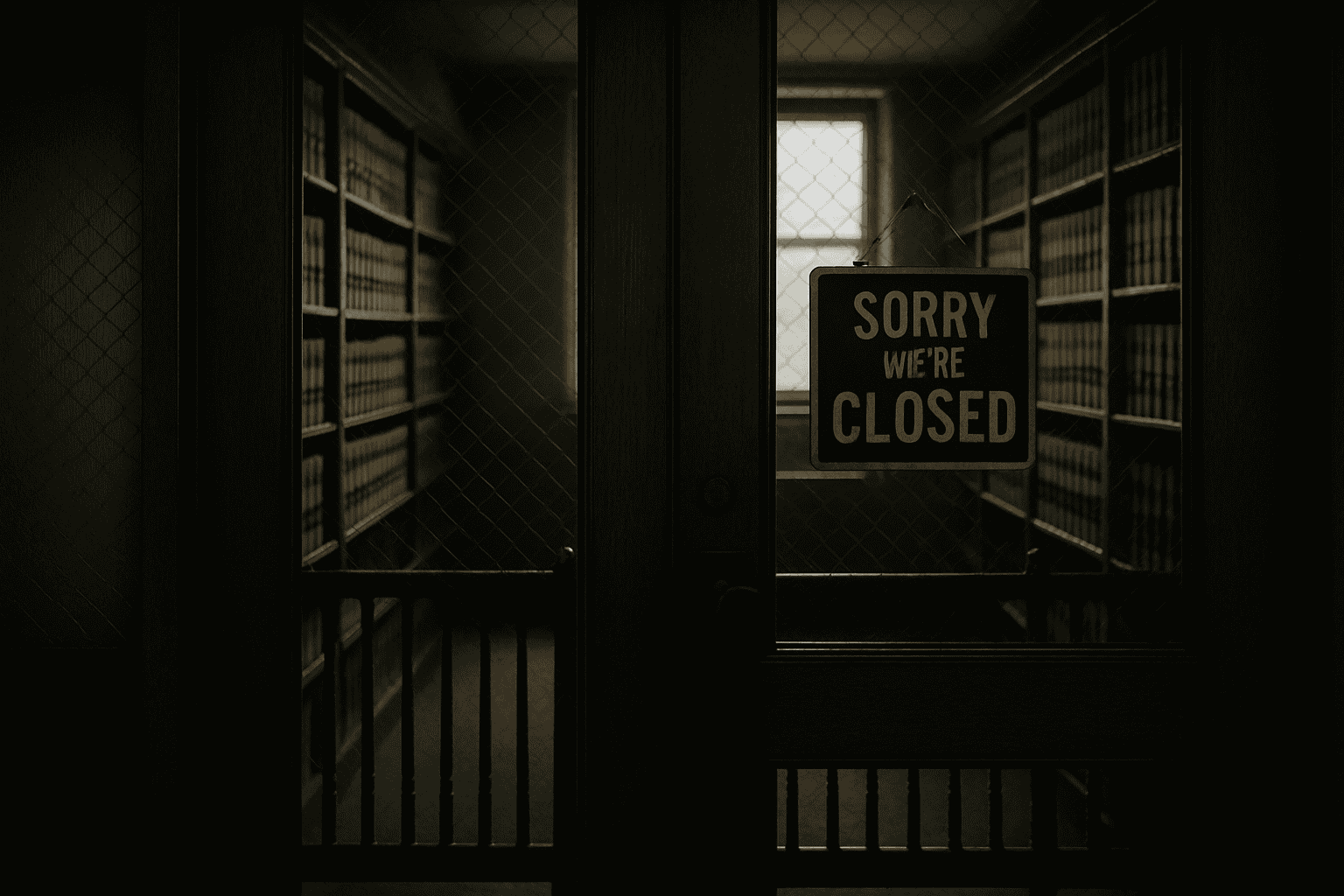
When COVID hit in March 2020, prison libraries closed. At many prisons, they never fully came back. Evening hours have never been restored at many sites.
From March 2020 to early 2024, that’s nearly four years of little or no library access.
Here’s the cruel part: Georgia does not pause legal deadlines. A court ruling called Stubbs v. Hall (2020) says the clock keeps running on habeas (say: HAY-bee-us) cases. Habeas is the main legal tool people use to challenge their conviction.
So people lost years of library access. But their deadlines to file didn’t move. Many may have lost their right to go to court forever — through no fault of their own.
Key Takeaway: Libraries closed for up to 4 years during COVID, but Georgia refused to extend legal deadlines — trapping people with no path to court.
What the Constitution Requires — and How Georgia Falls Short
In 1977, the U.S. Supreme Court ruled in Bounds v. Smith that prisons must help people file legal papers. The court said this could be done through:
- Law libraries, OR
- Trained legal helpers like paralegals (people trained in law but not lawyers), law students, or volunteer lawyers
The court was clear: access to justice must be real, not just on paper.
Georgia chose only law libraries. It has never set up any of the other options the court listed. No paralegal programs. No legal aid workers. No trained helpers of any kind.
Then in 1996, the Supreme Court made things harder. In Lewis v. Casey, the court said people must prove “actual injury.” This means they must show that bad library access blocked a real legal case.
This creates a trap: people who can’t get to the library can’t build a case to prove the library failed them. It’s a Catch-22 that only a new law can fix.
Key Takeaway: Georgia uses only law libraries with no trained legal help — and has never set up any of the alternatives the Supreme Court endorsed.
Federal Courts Have Closed the Door — Only State Action Can Help
In 2012, the Supreme Court gave people a small opening. In Martinez v. Ryan, the court said federal courts could review some cases where post-conviction lawyers failed.
But in 2022, the court took it back. In Shinn v. Martinez Ramirez, the court gutted that protection. Now federal courts will rarely step in.
This means state laws are the only real path left. If Georgia doesn’t act, people in its prisons have nowhere to turn.
Key Takeaway: The Supreme Court closed the federal door in 2022 — only Georgia’s own laws can fix this now.
Other States Show It Can Be Done — and It Saves Money
Other states already provide legal help after conviction. Here are models that work:
North Carolina set up a state-funded legal services group (called NCPLS). Its lawyers review cases and take the strongest ones. The results:
- Saved taxpayers over $12 million by fixing illegal sentences
- Won more than 500 years of freedom for people held on bad convictions
Pennsylvania gives every person a lawyer for their first post-conviction case if they can’t afford one.
Connecticut runs a state legal office just for habeas cases.
Experts suggest Georgia could combine these ideas. The estimated cost: $3 to $10 million per year. That’s only 0.17% to 0.56% of the prison budget — less than 0.6%.
When North Carolina spends money on this, it saves money. Illegal sentences cost taxpayers more than legal help does.
Key Takeaway: North Carolina’s program saved over $12 million and won 500+ years of freedom — Georgia could do this for less than 0.6% of its prison budget.
What Needs to Change
This research supports Bill 4 of the Georgia Post-Conviction Justice Act. Here’s what the evidence shows Georgia must do:
- Provide real legal help — not just a library with no guidance
- Fund trained legal workers — paralegals, lawyers, or legal aid staff
- Stop treating deadline extensions as a “privilege” — people facing court deadlines need guaranteed access
- Address the staffing crisis — when half the guard jobs are empty, no program can work
- Create a state-funded legal services program — modeled on what works in other states
The cost is small. The human cost of doing nothing is enormous.
Key Takeaway: Bill 4 of the Georgia Post-Conviction Justice Act would bring Georgia in line with what the Constitution requires and other states already provide.
Glossary
- Habeas corpus — A legal filing that lets people challenge whether they are held in prison lawfully. It’s the main tool for fighting a wrongful conviction after trial.
- SOP (Standard Operating Procedure) — The written rules that Georgia prisons must follow.
- CRIPA — A federal law that lets the DOJ look into conditions in state prisons.
- Equitable tolling — When a court pauses a legal deadline because something beyond a person’s control blocked them from filing. Georgia does not allow this for habeas cases.
- 42 USC 1983 — A federal law that lets people sue the government for violating their rights. Often used to challenge prison conditions.
- Post-conviction — Legal steps taken after a person has been found guilty and sentenced. This is different from the first appeal.
- Paralegal — A person trained in legal work who helps lawyers. They are not lawyers themselves.
- Catch-22 — A no-win trap where each step to solve the problem requires first solving the problem.
- IAC (Ineffective Assistance of Counsel) — A legal claim that a person’s lawyer did such a poor job that it violated their rights.
- NCPLS — North Carolina Prisoner Legal Services. A state-funded group that provides legal help to people in prison.
- IOLTA — Interest on Lawyers’ Trust Accounts. A program that uses interest from lawyer-held funds to pay for legal services for people who can’t afford them.
- Triage — A system for deciding which cases need help first, based on urgency and strength.
Read the Source Document
This post is based on GPS research titled Legal Access in Georgia Prisons: Constitutional Standards, GDC Regulations, and Reform Models.
Read the full source document (PDF)
Other Versions of This Analysis
We publish each analysis in four versions for different audiences:
- For Legislators — Policy-focused with bill language and fiscal notes
- For Media — Key findings, quotes, and story angles
- For Advocates — Deep legal analysis and organizing tools
- For Families & Public — You’re reading it now
Sources & References
- DOJ October 2024 Report. U.S. Department of Justice (2024-10-01) Official Report
- GPS Legal Access Analysis. Georgia Prisoners’ Speak (2024-01-01) GPS Original
- GDC SOP 501.01 — Library Services Administration and Operation. Georgia Department of Corrections (2022-01-05) Official Report
- Shinn v. Martinez Ramirez (2022). U.S. Supreme Court (2022-01-01) Legal Document
- GDC SOP 227.03 — Access to Courts. Georgia Department of Corrections (2020-06-30) Official Report
- Stubbs v. Hall (2020). Georgia Courts (2020-01-01) Legal Document
- Martinez v. Ryan (2012). U.S. Supreme Court (2012-01-01) Legal Document
- Lewis v. Casey, 518 U.S. 343 (1996) — Justice Scalia. U.S. Supreme Court (1996-01-01) Legal Document
- Pennsylvania v. Finley (1987). U.S. Supreme Court (1987-01-01) Legal Document
- Bounds v. Smith, 430 U.S. 817 (1977) — Justice Marshall. U.S. Supreme Court (1977-01-01) Legal Document
- 18 U.S.C. § 3599. U.S. Code Legislation
- Connecticut Division of Public Defender Services. Connecticut Division of Public Defender Services Official Report
- Georgia Board of Corrections Rule 125-2-4-.17. Georgia Board of Corrections Legislation
- Georgia Board of Corrections Rule 125-4-2-.08. Georgia Board of Corrections Legislation
- North Carolina Prisoner Legal Services. NC Prisoner Legal Services Official Report
- Pennsylvania PCRA Statute. Pennsylvania General Assembly Legislation
Source Document
You just read about people suffering in state custody. The least you can do is make sure other people read it too. Share this story.