
In 1765, English jurist Sir William Blackstone articulated what would become the most revered principle in criminal law: “It is better that ten guilty persons escape than that one innocent suffer.” This was not a new idea. It echoed through 550 years of legal tradition before him — from Sir John Fortescue in the 1400s to Sir Matthew Hale in the 1600s — and it was not merely an aspiration. It was the reason the American legal system exists in its current form. Blackstone’s ratio gave rise to the presumption of innocence, the requirement of proof beyond a reasonable doubt, and the constitutional guarantee of due process. The U.S. Supreme Court first invoked it in 1895 to justify the presumption of innocence and again in 1970 to justify the beyond-a-reasonable-doubt standard under the Fourteenth Amendment. 1
One scholar called it “the Mount Everest of legal mantras.” It is, quite literally, the foundation upon which American justice was built. 2
In Georgia, that foundation is rubble.
On March 4, 2026, Georgia Supreme Court Chief Justice Nels Peterson issued a concurring opinion that laid bare what anyone trapped inside the state’s criminal justice system already knew: the post-conviction legal system is “a mess” — broken by decades of the court’s own decisions, impossible for defendants to navigate, and requiring legislative intervention to fix. Seven of the court’s nine justices supported his assessment. 3
But Peterson only described one piece of the trap. The full picture is far worse. Georgia has not merely broken its post-conviction system — it has systematically dismantled every safeguard Blackstone’s principle was meant to protect. From a procedural maze that bars legitimate claims on technicalities, to an unconstitutional four-year deadline on habeas corpus, to the denial of legal counsel for anyone trying to prove their innocence from behind bars — Georgia has built a machine designed to keep people locked up regardless of guilt or innocence.
And that machine is killing people.
The Chief Justice Speaks: “We Did a Lot of the Breaking”
The case that prompted Peterson’s remarkable admission involved Joshua Sanders, convicted in 2023 in Toombs County for the murders of Latorey Harden and her mother Pamela Harden in Vidalia. Sanders was sentenced to life without parole. On appeal, he argued that his trial lawyer, Lew Tippett, was ineffective — in part for letting him testify about dealing crack cocaine in front of the jury, damaging his character in ways that had nothing to do with the charges. 4
Sanders also alleged that his subsequent lawyer, Rodrequez Burnett, failed him by not raising Tippett’s incompetence when arguing for a new trial. The Georgia Supreme Court rejected the claim — not because it lacked merit, but because Georgia law requires ineffective assistance of counsel (IAC) claims to be raised during the Motion for New Trial stage. Sanders missed that window. His claim was “procedurally barred.” 5
The unanimous opinion, authored by Justice Verda Colvin, upheld the conviction. But Peterson’s concurrence turned the court’s own mirror back on itself.
“Georgia’s post-conviction litigation system is a mess. It’s a mess in large part because of a series of well-meaning but shortsighted decisions this Court made over the course of several decades. Those decisions had a worthy goal: seeking to ensure that indigent defendants were entitled to appointed counsel for litigating claims of ineffective assistance of counsel. But the means we used to pursue that goal have made things worse, not better.”
Peterson traced the problem to the 1980s, when Georgia justices — without citing any legal authority — created a rule requiring IAC claims to be filed before appeal rather than through habeas corpus proceedings, as the federal government and most states do. The result, he wrote, is a system that “prioritizes ineffectiveness claims (which have a low success rate) in exchange for imposing serious costs.” 3
Those costs are not abstract. Substituting new counsel and relitigating a motion for new trial takes years. During that time, the original trial attorney is barred from handling the direct appeal — which means claims of preserved trial court error, which actually have a higher success rate, get delayed or lost entirely. And when a conviction is eventually reversed, the passage of time has made retrial harder or impossible: witnesses have died, memories have faded, evidence has been lost.
Peterson’s conclusion was blunt: “In short, the system is broken. We did a lot of the breaking. But it will require legislative action to fix it.”
Sanders’ current attorney, Joshua Smith, told the AJC he believed Peterson understood the human cost. “I think the chief justice, if you read between the lines, I think he felt bad,” Smith said.
The Procedural Trap: How It Actually Works
To understand why Peterson’s admission matters, consider what happens to a defendant in Georgia after conviction.
You are found guilty. Your trial lawyer — who may have been overworked, underprepared, or simply incompetent — has just lost your case. Under Georgia’s rules, you now have a narrow window during the Motion for New Trial to argue that this same lawyer was ineffective. But here is the catch: you need a new lawyer to make that argument, because your trial lawyer is not going to stand up in court and admit to their own incompetence.
If your new motion-for-new-trial lawyer also fails to raise the IAC claim — as Burnett failed to do for Sanders — you are finished. Georgia courts have consistently held that you cannot recast a claim against your trial lawyer as a claim against a subsequent lawyer. The window has closed. The merits of your claim no longer matter.
Peterson described Georgia as “an outlier” for this reason. The federal government and most states handle IAC claims through habeas corpus proceedings — a separate track that does not delay direct appeals and allows claims to be raised when evidence of ineffectiveness actually surfaces. Georgia chose a different path, and as Peterson acknowledged, that path has created “serious problems for the criminal justice system in Georgia.”
“No rational person would have chosen the system we have today if presented with it as a whole,” Peterson wrote. “But because this system evolved slowly over decades, we haven’t paused to consider the brokenness of the system. We should.”
The Second Lock: Georgia’s Unconstitutional Habeas Deadline
Even if a defendant somehow navigates the IAC procedural trap, Georgia has a second lock on the door.
In 2004, the Georgia General Assembly passed O.C.G.A. § 9-14-42, imposing — for the first time in state history — a four-year deadline on felony habeas corpus petitions. Before this law, there was no time limit. For over 800 years, from the Magna Carta in 1215 through the American founding and through two centuries of Georgia statehood, habeas corpus operated without a clock. A prisoner could challenge unlawful detention whenever evidence of injustice emerged. 6
This was not a bug in the system — it was the entire point. Wrongful convictions take time to uncover. Evidence surfaces slowly. Witnesses recant. Forensic science advances. Prosecutorial misconduct gets exposed. The average time from conviction to exoneration for DNA cases is 14 years. Death row exonerations average 38.7 years. 7
Georgia’s four-year deadline slams the courthouse door shut on anyone who discovers evidence of their innocence after that window closes. The statute includes narrow exceptions for “newly discovered evidence,” but Georgia courts have interpreted those exceptions so restrictively they are nearly meaningless. If a prosecutor concealed Brady material for a decade, courts may rule the defendant should have “discovered it earlier with due diligence.” The victim of prosecutorial misconduct gets blamed for not uncovering the misconduct faster.
The U.S. Constitution’s Suspension Clause is explicit: habeas corpus “shall not be suspended, unless when in Cases of Rebellion or Invasion the public Safety may require it.” Georgia is not experiencing rebellion. Georgia is not being invaded. Yet Georgia has effectively suspended the Great Writ for anyone who runs out of time — and the state itself makes running out of time almost inevitable. 8
The Third Lock: No Lawyer, No Law Library, No Chance
Once convicted and imprisoned, you lose the right to legal counsel. The Sixth Amendment guarantees a lawyer at trial and on direct appeal. After that, you are on your own. 6
To challenge your conviction, you must teach yourself constitutional law, research your case, draft legal documents that meet strict procedural requirements, and file a petition — all from inside a prison system the U.S. Department of Justice found violates the Eighth Amendment’s prohibition on cruel and unusual punishment. 9
Your primary tool is the prison law library. Most Georgia prisons have replaced printed legal books with law library computers running legal software that was designed for trained attorneys, not for people who may have never used a computer. To access the library, you must first walk to the library to sign up for a session scheduled a week or two in the future. The night before, you receive a call-out for a time slot. The next day, you wait for block movement, show your pass, and walk to the gates. Movement is frequently called 20-30 minutes late. Gates take another 10-15 minutes to open. The session still ends on time. What is scheduled as a two-hour block becomes, in practice, 37 to 45 minutes of actual research time — if you get there at all.
During the COVID-19 pandemic, Georgia prisons locked down law libraries entirely. Not for weeks or months — for three to four years. The GDC’s facility-wide and statewide lockdowns, driven by both the pandemic and the violence that followed it, shut down all programming, including legal access. For someone with a four-year habeas deadline, those three to four years of zero access consumed virtually the entire window. The clock kept running. The courthouse door kept closing.
Even outside of lockdowns, chronic understaffing means library sessions are regularly canceled. When the DOJ investigated Georgia’s prisons, it documented severely restricted access to legal resources as part of the system’s broader constitutional failures.
The Fourth Lock: The Records Wall
Suppose you overcome everything. You teach yourself the law during your 37-45 minutes per week. You identify the legal issues in your case. You know your trial lawyer was ineffective, or the prosecutor withheld evidence, or the forensic science used against you has been discredited.
Now you need records. Police investigative files. The DA’s case file. Witness statements. Lab reports. Court transcripts.
Getting these records from inside a prison is extraordinarily difficult. Open records requests require specific formatting, correct agencies, filing fees, and often months of back-and-forth correspondence. Many agencies simply ignore requests from prisoners. District attorneys’ offices have been known to claim records were destroyed or cannot be located. Even when records are provided, they may be incomplete — and a prisoner has no way to know what is missing.
This is not an oversight. It is a structural feature that ensures the people most likely to have been wronged by the system are the least able to prove it.
The Math of Innocence
How many people are trapped behind these locked doors who should not be there at all?
Nobody knows the exact number. But the research is consistent and alarming.
The Georgia Innocence Project estimates that between 4-6% of people incarcerated in U.S. prisons are actually innocent. A 2018 study by Penn criminologist Charles Loeffler, surveying nearly 3,000 state prisoners, found that 6% reported being wrongfully convicted — a figure the researchers called an “upper-bound estimate.” A 2017 study examining Virginia convictions from the 1970s and 1980s using post-conviction DNA analysis estimated a wrongful conviction rate of 11.6%. The Innocence Project itself has estimated between 2-5%, while noting that DNA testing — the gold standard for proving innocence — applies to only 5-10% of all criminal cases. For the vast majority of convictions, there is simply no biological evidence to test. 10 11 7
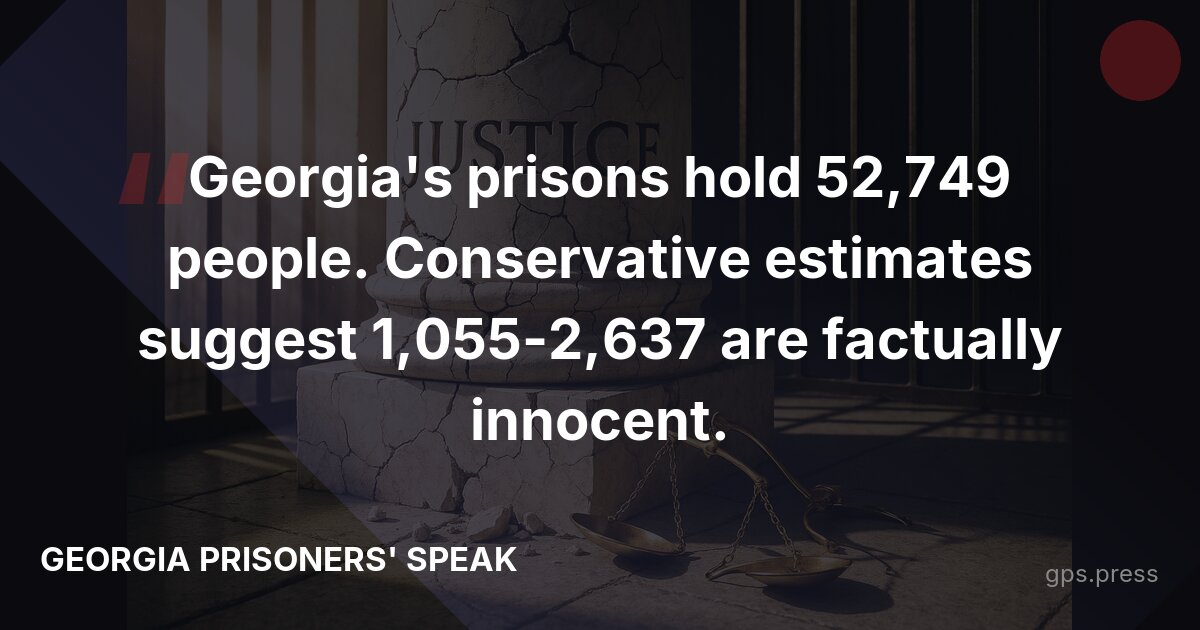
Applied to Georgia’s current GDC population of 52,749:
- At the most conservative estimate of 1%: approximately 527 people — though this floor is almost certainly too low, as it derives from DNA exonerations that represent only a tiny fraction of cases
- At the Innocence Project’s 2-5% range: 1,055 to 2,637 people
- At the Georgia Innocence Project’s 4-6% range: 2,110 to 3,165 people
- At the academic consensus of 6%: approximately 3,165 people
- At 10%, which accounts for plea-coerced convictions and system failures that standard exoneration data cannot capture: approximately 5,275 people
As law professor Samuel Gross has pointed out, death penalty cases receive far more scrutiny than other convictions, and even there the wrongful conviction rate is estimated at 4.1%. For lesser felonies — drug offenses, property crimes, assaults — where cases routinely end in plea bargains and never enter the appeals pipeline, the true rate of wrongful conviction is almost certainly higher than what exonerations alone reveal. 12
These numbers represent the factually innocent — people who simply did not commit the crime. But there is a far larger population of people who may have committed an offense but received wildly disproportionate sentences because of ineffective counsel, prosecutorial overcharging, coerced pleas, or a court system that processed them like inventory. The IAC trap Peterson described does not just hurt the innocent — it hurts everyone who got a raw deal from an incompetent lawyer and has no mechanism to prove it.
This shadow population — the over-sentenced — likely numbers in the tens of thousands.
The Overcrowding Connection
Every person who cannot get out — whether innocent or over-sentenced — is occupying a bed in a prison system that is already in crisis.
Georgia’s prisons currently hold 52,749 people, with another 2,304 backed up in county jails awaiting transfer. Many facilities operate at 200-300% of their original design capacity, achieved not by building new infrastructure but by triple-bunking dormitories while kitchens, medical facilities, and staffing levels remain sized for populations half or one-third the current count. 13
In 2024, over 100 people were killed by homicide inside Georgia’s prisons. Total deaths exceeded 330. GDC’s own statistics claim 301 people died while serving state sentences in 2025 — though the official mortality list contains only 295 names, a discrepancy GDC has refused to explain. 14
The DOJ’s October 2024 investigation found conditions so extreme they violate the Eighth Amendment: collapsed staffing (with as few as 5-6 officers covering 69 security posts during major incidents), gang-controlled housing units, endemic sexual violence, and fatal medical neglect. A federal judge has rebuked GDC Commissioner Tyrone Oliver for ignoring court orders, stating the department has “little credibility” and acts “above the law.” 15
Every innocent person who cannot prove their innocence because of the IAC trap, the habeas deadline, or the denial of legal resources is one more body in an overcrowded, unconstitutional system. Every over-sentenced person serving 20 years for what should have been 5 is consuming resources — beds, food, medical care, security — that the system cannot provide even for the people who are there legitimately.
The broken legal system does not just fail individuals. It feeds the crisis that is killing everyone inside.
The Compound Failure: Every Branch Failed
What makes Georgia’s situation uniquely catastrophic is that every branch of government has contributed to the trap — and no branch is fixing it.
The courts created the IAC procedural maze. Peterson himself acknowledges this. For decades, Georgia’s Supreme Court issued rulings that made the post-conviction process more complex, more expensive, and less effective. The current Chief Justice says the system they built is broken and cannot be fixed by the courts alone.
The legislature imposed the four-year habeas deadline in 2004, effectively suspending the most fundamental protection against wrongful imprisonment. Legislators have not repealed it. They have not expanded it. They have not even discussed it — despite the fact that other states like Texas, California, New York, and Michigan manage to balance finality with fairness by using “reasonable time” or “good cause” standards rather than arbitrary deadlines.
The executive branch — through GDC — runs the prisons where all of this plays out. It restricts law library access. It canceled legal programming for years during COVID. It operates facilities so dangerously overcrowded and understaffed that the federal government found them unconstitutional. And it has defied every institution — courts, DOJ, legislators, the press — that has tried to hold it accountable.
The result is a closed loop. The courts broke the appeals process. The legislature broke habeas. GDC broke the prisons. And the people trapped at the center — including thousands who are innocent or over-sentenced — have no way out.
Blackstone’s Warning
Blackstone did not simply assert that it is “better that ten guilty persons escape than that one innocent suffer.” He explained why. The passage that followed his famous ratio, often omitted in citation, contained a warning that reads as if it were written about Georgia in 2026:
“The reason is, because it’s of more importance to community, that innocence should be protected, than it is, that guilt should be punished… But when innocence itself is brought to the bar and condemned… the subject will exclaim, it is immaterial to me, whether I behave well or ill; for virtue itself is no security. And if such a sentiment as this should take place in the mind of the subject, there would be an end to all security whatsoever.”
Blackstone understood that wrongful conviction does not just destroy one life — it destroys the social contract. When people see that innocence provides no protection, that the system punishes regardless of guilt, they stop believing the system is worth obeying. The legitimacy of law itself collapses. 16
Georgia is living Blackstone’s warning. Inside its prisons, where gang governance has replaced institutional authority and where violence is the only reliable currency, the social contract is already dead. The people trapped there — guilty, innocent, and over-sentenced alike — have learned that the system does not distinguish between them. Justice is not blind in Georgia. It is absent.
The question Georgia’s lawmakers must answer — on Crossover Day, in committee hearings, and at the ballot box — is whether they intend to restore it.
Explore the Data
GPS makes GDC statistics accessible to the public through several resources:
- GPS Statistics Portal — Interactive dashboards translating complex GDC reports into accessible formats, updated within days of official releases.
- GPS Lighthouse AI — Ask questions about Georgia’s prison system and get answers drawn from GPS’s investigative archive and data analysis.
- Machine-Readable Pages for Researchers — GPS maintains AI-optimized pages for data analysis:
- AI Content Index — https://gps.press/ai-index/
- Facilities Data — https://gps.press/facilities-data/
- Statistics Data — https://gps.press/statistics-data/
- Release Statistics Data — https://gps.press/release-statistics-data/
- Mortality Data — https://gps.press/mortality-data/
- Blog Data — https://gps.press/blog-data/
- GPS News Data — https://gps.press/gps-news-data/
- FAQ Index — https://gps.press/faq-index/
- FAQ (alternate) — https://gps.press/faqs/
- Featured Articles Index — https://gps.press/featured-index/
- Length of Stay Data — https://gps.press/los-data/
- Drug Admission Profiles — https://gps.press/drug-data/
- Commissary Pricing Data — https://gps.press/commissary-data/
- GDC Standard Operating Procedures — https://gps.press/sop-data/
- GPS Research Library — https://gps.press/research/
- Research Explainer Data — https://gps.press/explainer-data/
- GPS Quote Bank — https://gps.press/quotes-data/
- Research Explainers for Families — https://gps.press/research-for-families/
- Research Explainers for Legislators — https://gps.press/research-for-legislators/
- Research Briefings for Media — https://gps.press/research-for-media/
- Research Explainers for Advocates — https://gps.press/research-for-advocates/
Contact GPS at media@gps.press for access to underlying datasets used in this analysis.
Call to Action: What You Can Do
Thousands of potentially innocent people are dying in Georgia's unconstitutional prisons while courts, prosecutors, and politicians ignore a crisis they created. If you just read about Georgia's systematic destruction of justice and do nothing, you're choosing to let it continue. Share this investigation — silence is complicity when lives are at stake.
Spread the Word — It Takes 15 Seconds
Awareness without action changes nothing. Here’s how you can help push for accountability and real reform:
Use Impact Justice AI — Our free tool at https://impactjustice.ai lets you instantly draft and send personalized emails to lawmakers, journalists, and agencies. No expertise required.
Tell My Story — Are you or a loved one affected by Georgia’s prison system? GPS publishes first-person accounts from incarcerated people and their families. Submit your story at https://gps.press/category/tellmystory/ and help the world understand what’s really happening behind the walls.
Contact Your Representatives — Your state legislators control GDC’s budget, oversight, and the laws that created these failures. Find your Georgia legislators at https://open.pluralpolicy.com/ga/ or call Governor Kemp at (404) 656-1776 or the GDC Commissioner at (478) 992-5246.
Demand Media Coverage — Contact newsrooms at the AJC, local TV stations, and national criminal justice outlets. More coverage means more pressure.
Amplify on Social Media — Share this article and tag @GovKemp, @GDC_Georgia, and your local representatives. Use #GAPrisons, #PrisonReform, #GeorgiaPrisonerSpeak.
File Public Records Requests — Georgia’s Open Records Act gives every citizen the right to request incident reports, death records, staffing data, medical logs, and financial documents at https://georgiadcor.govqa.us/WEBAPP/_rs/SupportHome.aspx.
Attend Public Meetings — The Georgia Board of Corrections and legislative committees hold public meetings. Your presence is noticed.
Contact the Department of Justice — File civil rights complaints at https://civilrights.justice.gov. Federal oversight has forced abusive systems to change before.
Support Organizations Doing This Work — Donate to or volunteer with Georgia-based prison reform groups fighting for change on the ground.
Vote — Research candidates’ positions on criminal justice. Primary elections often determine outcomes in Georgia.
Contact GPS — If you have information about conditions inside Georgia’s prisons, reach us securely at GPS.press.
Further Reading
The Death of Habeas Corpus Is Killing Innocent People
GPS’s comprehensive investigation into how Georgia’s four-year habeas deadline traps the innocent in unconstitutional prisons.
A Constitutional Betrayal: Georgia’s Deadline on Freedom
How Georgia broke from 800 years of legal tradition to impose an arbitrary deadline on the most fundamental protection against wrongful imprisonment.
The pretrial system that feeds Georgia’s prisons by coercing guilty pleas from people who may be innocent.
Above the Law: GDC Defies Courts, DOJ, and Legislators
A documented pattern of institutional defiance across every oversight mechanism meant to hold Georgia’s prisons accountable.
Decarceration IS Inevitable — Georgia Can Choose How, or Let the Courts Decide
Why reducing Georgia’s prison population is not a policy preference but a constitutional necessity.
Guilty Until Proven Innocent: You WILL Be Found Guilty
How Georgia’s system has inverted the presumption of innocence into a machine for convictions.
About Georgia Prisoners’ Speak (GPS)
Georgia Prisoners’ Speak (GPS) is a nonprofit investigative newsroom built in partnership with incarcerated reporters, families, advocates, and data analysts. Operating independently from the Georgia Department of Corrections, GPS documents the truth the state refuses to acknowledge: extreme violence, fatal medical neglect, gang-controlled dorms, collapsed staffing, fraudulent reporting practices, and unconstitutional conditions across Georgia’s prisons.
Through confidential reporting channels, secure communication, evidence verification, public-records requests, legislative research, and professional investigative standards, GPS provides the transparency the system lacks. Our mission is to expose abuses, protect incarcerated people, support families, and push Georgia toward meaningful reform based on human rights, evidence, and public accountability.
Every article is part of a larger fight — to end the silence, reveal the truth, and demand justice.
Footnotes
- Blackstone’s Ratio, Wikipedia https://en.wikipedia.org/wiki/Blackstone%27s_ratio [↩]
- Error Aversions and Due Process, Michigan Law Review https://michiganlawreview.org/journal/error-aversions-and-due-process/ [↩]
- WSB-TV, Georgia’s Top Judge Says ‘System is Broken’ https://www.wsbtv.com/news/local/atlanta/georgias-top-judge-says-system-is-broken-needs-lawmakers-help-fix-it/NDH3ZTUGQFH23IO6L2W4FZU2DQ/ [↩][↩]
- AJC, ‘It’s a Mess:’ Chief Justice Asks Lawmakers to Fix Criminal Court Rules, March 4, 2026 https://www.ajc.com/news/2026/03/its-a-mess-chief-justice-asks-lawmakers-to-fix-criminal-court-rules/ [↩]
- The Georgia Virtue, Georgia Supreme Court Upholds Conviction in 2022 Toombs County Double Murder https://www.thegeorgiavirtue.com/georgia-courts/georgia-supreme-court-upholds-conviction-in-2022-toombs-county-double-murder/ [↩]
- GPS, The Death of Habeas Corpus Is Killing Innocent People https://gps.press/the-death-of-habeas-corpus-is-killing-innocent-people/ [↩][↩]
- Innocence Project, Research Resources https://innocenceproject.org/research-resources/ [↩][↩]
- GPS, A Constitutional Betrayal: Georgia’s Deadline on Freedom https://gps.press/a-constitutional-betrayal-georgias-deadline-on-freedom/ [↩]
- DOJ Findings Report, Investigation of Georgia Prisons, October 2024 https://www.justice.gov/d9/2024-09/findingsreport-investigationofgeorgiaprisons.pdf [↩]
- Georgia Innocence Project, Beneath the Statistics https://www.georgiainnocenceproject.org/general/beneath-the-statistics-the-structural-and-systemic-causes-of-our-wrongful-conviction-problem/ [↩]
- Penn Today, Wrongful Convictions Reported for 6 Percent of Crimes https://penntoday.upenn.edu/news/first-estimate-wrongful-convictions-general-prison-population [↩]
- Proceedings of the National Academy of Sciences, Rate of False Conviction https://www.pnas.org/doi/10.1073/pnas.1306417111 [↩]
- GPS, Georgia Prison Population vs. Capacity: 2025 Data https://gps.press/georgia-prison-population-vs-capacity-2025-data/ [↩]
- GPS, The Six Who Disappeared: Georgia’s Prison Death Cover-Up https://gps.press/the-six-who-disappeared-georgias-prison-death-cover-up/ [↩]
- GPS, Above the Law: GDC Defies Courts, DOJ, and Legislators https://gps.press/above-the-law-gdc-defies-courts-doj-and-legislators/ [↩]
- Blackstone’s Commentaries on the Laws of England, Book IV, Chapter 27 https://en.wikipedia.org/wiki/Blackstone%27s_ratio [↩]
6 thoughts on “Blackstone Is Dead: Georgia Abandoned American Justice”