DOOLY STATE PRISON
Facility Information
- Original Design Capacity
- 500 (at 342% capacity)
- Bed Capacity
- 1,702 beds
- Current Population
- 1,711
- Active Lifers
- 711 (41.6% of population) · Oct 2026 GDC report
- Life Without Parole
- 1 (0.1%)
What the courts held in Brown v. Plata, and how Georgia compares →
- Address
- 1412 Plunkett Road, Unadilla, GA 31091
- Phone
- (478) 627-2000
- Fax
- (478) 627-2140
- Mailing Address
- P.O. Box 750, Unadilla, GA 31091
- County
- Dooly County
- Opened
- 1994
- Operator
- GDC (Georgia Dept. of Corrections)
Security Classification
Last updated: September 23, 2026
601 of the 1,701 people held here are classified Close security (35.3%), as of September 23, 2026.
| Security level | People | Share |
|---|---|---|
| Close | 601 | 35.3% |
| Medium | 1,088 | 64.0% |
| Minimum | 12 | 0.7% |
| Total | 1,701 |
Earlier count (undated table, produced October 22, 2025): 455 of 1,590 Close (28.6%).
Source: Georgia Department of Corrections records produced to GPS under the Open Records Act (R031471-090226, R024615-101925). A person's security level is GDC's classification of that person, which can differ from the prison's own designation.
Follow Dooly State Prison
Leadership & Accountability (as of 2026 records)
Officials currently holding positional authority at this facility, with deaths attributed to GPS-tracked records during their leadership tenure. Inclusion reflects role-based accountability, not legal findings of personal culpability. Death counts shown as facility / career.
| Role | Name | Since | Deaths this facility / career |
|---|---|---|---|
| Warden (facility lead) | Agbaosi, Mark | 2025-02-16 | 11 / 35 |
| Deputy Warden of Care and Treatment (facility deputy) | Chaney, Mable Larose | 2016-01-01 | 51 / 51 |
| Deputy Warden of Administration (facility deputy) | Nicholson, Nequeva | 2025-01-16 | 12 / 12 |
| Deputy Warden of Security (facility deputy) | Major, LEE | 2025-01-16 | 12 / 12 |
| Deputy Warden of Security (facility deputy) | Kendrick, Lameka A | 2026-08-16 | 1 / 1 |
About
Last updated October 25, 2026.(DS)
Dooly State Prison: A Medium-Security Facility Run Like Something Else
Dooly State Prison sits in Unadilla, in Dooly County, a medium-security men's facility that opened in 1994 on a design capacity of 500 and today carries a rated capacity of 1,702. GPS's facility record puts the current population at roughly 1,711 — about 100.5 percent of rated capacity, and more than three times what the plant was built to hold. The prison consists of nine main housing units with triple-bunked and double-bunked cells, an open living unit, an isolation and segregation block, and a Fast Track unit. It receives men who cannot be housed in county prisons, including many sex-offense and medically limited populations, and it offers GED and basic education, limited vocational and religious programming.
What follows is the record GPS has assembled on what happens inside those nine housing units: a death registry of 51 people since January 2020, nine of them classified as homicides; a documented pattern of gang-related mass stabbings that twice put the entire state prison system on lockdown; a staffing collapse described under oath by a former GDC emergency-response commander; and a food-safety record that reads as a case study in why inspection scores cannot be taken at face value.
Fifty-One Deaths, Nine of Them Homicides
GPS's mortality registry records 51 deaths at Dooly State Prison since January 1, 2020. Twenty are coded Natural/Medical, thirteen Unknown/Pending, nine Homicide, five Overdose, three Suicide, and one Other. The full list is maintained at GPS's facility death page; the most recent entries show what the range of causes looks like in practice.
Jerry Jerome Smith died August 21, 2026, at Dooly State Prison at age 61; GPS's registry lists the cause as Unknown/Pending. Jerry Mccaster died August 11, 2026, at age 60, cause Unknown/Pending. Martez Desmond Terry died April 29, 2026, at 42, Natural/Medical. Samuel Jacob Blackmon died January 19, 2026, at 40, Overdose. Dexter Andres Levy died November 16, 2025, at 32, Overdose. Darrow Brown died November 7, 2025, at 58, Homicide. Paul Counts died October 30, 2025, at 60, Unknown/Pending. Willie Mote died October 14, 2025, at 70, Unknown/Pending. Marshall Davis Crews died September 19, 2025, at 69, Unknown/Pending. Orlando Perez Glass died August 17, 2025, at 49, Unknown/Pending. Timothy Glenn Williams died April 17, 2025, at 56, Overdose. Horatio Philmore died February 2, 2025, at 58, Homicide. Joshua Parrott died January 12, 2025, at 45, Homicide. Michael Hutchins died December 21, 2024, at 75, Unknown/Pending. David Smith died November 20, 2024, at 53, Natural/Medical. Thomas Adrian Chamblee died November 18, 2024, at 32, Suicide. Ancion Leroy Wallace died September 27, 2024, at 25, Natural/Medical. Zeary Davante Davis died September 26, 2024, at 31, Homicide. Terry J Davis died July 5, 2024, at 52, Unknown/Pending. Carlito Omar Soldiew-Acosta died June 22, 2024, at 38, Homicide. Horace Rico Mosley died May 15, 2024, at 57, Unknown/Pending. Ricky Lee Denney died May 7, 2024, at 68, Unknown/Pending. Dwight Junior Lance died April 13, 2024, at 55, Overdose. Raquon Javeyonte Tucker died March 22, 2024, at 26, Homicide. Brian Lee Wainwright died January 4, 2024, at 59, Homicide.
Where the registry says Unknown/Pending, GPS does not yet know the cause. That category is the second-largest in the facility's record — thirteen of 51 — and it is not a neutral gap. The Atlanta Journal-Constitution's homicide-tracking coverage documented several Dooly deaths that the registry now codes as homicides, including Brian Lee Wainwright, who died January 4, 2024, in a manner the AJC reported was ruled a homicide; Raquon Ja'Veyonte Tucker, 26, who died March 22, 2024, from complications of blunt force head trauma; Carlito Omar Soldiew-Acosta, 38, who died June 22, 2024, from complications due to blunt force trauma, with a coroner telling a TV station he may have been dead for more than 24 hours before his body was found; and Zeary Davis, 31, who died September 26, 2024, and whose stabbing death a county coroner confirmed to a TV station. The AJC also documented the January 3, 2023 stabbing death of Dimitri Merci Jackson, 36, and the October 27, 2023 death of Chad Taylor Roadifer, 45, from delayed complications of blunt force head trauma sustained months earlier.
The non-homicide deaths carry their own record. Georgia Public Broadcasting reported the account of Cody Bailey, who alleges that medical staff at Dooly put his father's treatment "on the back burner," contributing to his death from sepsis. GPS's registry records James Michael Bailey, 44, dying April 8, 2023, of Natural/Medical causes; GPB reported he died from sepsis contracted from pneumonia caused by an infected insect bite roughly four months into his sentence. The AJC reported that James Yarbrough suffered from uncontrolled diabetes for months at Dooly before dying of ketoacidosis in a case alleging medical malpractice — a death that produced a $700,000 state liability payout, the largest settlement in the facility's record.
The Stabbing That Came Three Days After the Warning Letter
The most documented single death at Dooly is Zeary Davis's, and the record around it is unusually complete. GPS reporting describes a sequence in which a private citizen wrote to Commissioner Tyrone Oliver on September 23, 2024, warning that two named Bloods leaders were running an extortion ring in Dorm E1. The letter named Dekito Champ and Marcus Taylor by GDC ID number and asked the Commissioner to move them; it stated that a close-security Blood was living alone in room 215 at the medium-security prison after forcibly removing his roommate, and that another Bloods member was sleeping in a room he was not assigned to. GPS reporting indicates the letter reached Oliver's government email address.
Three days later, on September 26, 2024 — Davis's birthday — Davis was stabbed. GPS reporting describes what the facility looked like in that moment: no officer was in Dorm E1 when it happened; Dooly has no panic buttons, and the only way to summon help from E1 was a contraband cellphone; two prisoners kept pressure on Davis's wounds; the prisoners' own volunteer fire crew reached him before the shift supervisor did; and no officer had the keys to the three gates between the dorm and outside medical help. Qwinterrious Dodson allegedly stabbed Davis through the heart, and has never been charged in the case.
The staffing picture that produced that sequence was not a secret inside GDC. Tyler Ryals, a former GDC Correctional Emergency Response Team commander with nearly ten years of service across five state prisons, swore out a witness statement on August 1, 2024, warning GDC leadership that prisons were collapsing under staffing shortages, climbing violence, and contraband. He wrote that he knew he could face discipline for making the warning. GDC records state Ryals resigned twelve days later, on or about August 13, 2024; he did not write a resignation letter. In his statement he warned that posts once staffed by several officers were being worked alone or not at all, and that an officer might not set foot in a building for five hours at a stretch. He described gangs running housing units — telling officers "we're moving so-and-so into this cell" and getting the cell moves approved — and officers so scarce that inmates had to save them.
When GDC human resources balked at firing Ryals for raising the alarm, the agency sent Assistant Commissioner for the Facilities Division Ahmed Holt to meet with him in August 2024. Ryals recorded the meeting and gave the recording to GPS. On it, Holt disputed essentially none of what Ryals had put in his sworn statement, did not deny that lone female officers were holding male prisons, reframed the crisis as "not just a GDC issue… a nationwide issue," asked Ryals whether he was "venting," and — when told there were not enough officers — said: "If you can figure out how to get 3,000 men into the Georgia Department of Corrections, I'm gonna go get them." He offered no plan to address the crisis. The AJC's 2022 investigation of a Special Management Unit, cited by GPS, reported that Holt had sworn to facts about the unit that the evidence contradicted — two entire wings with no televisions at all.
The same month as Ryals's warning, GPS reporting describes an assault in Dorm E1 in which Qwinterrious Dodson broke a man's jaw on August 3, 2024, and then admitted it to Warden Sampson's face without being disciplined. Inmate accounts collected by GPS describe a broader pattern at the facility in which assaults reported to the warden and to regional leadership produced no removal from the dorm, no disciplinary report, and no criminal charge.
Gang Control, Mass Stabbings, and the Statewide Lockdown
Dooly's violence is not only individual. In 2026 the facility produced a series of group altercations that escalated into system-wide consequences. On March 23, 2026, five inmates were injured in what GDC described as a gang-related fight involving multiple offenders, contained to one dormitory; all five were transported to an outside medical facility with non-life-threatening injuries, and GDC said it was investigating. Just over a week later, early on the morning of April 1, 2026, six Dooly inmates were taken to local hospitals — three by Life Flight — with non-life-threatening injuries from another gang-related altercation.
Then, on May 22, 2026, nine inmates were taken to local hospitals after an altercation GDC characterized as gang-related and contained to two dorms; seven had returned by the following day. GDC placed all of its facilities on lockdown "out of an abundance of caution," and Dooly, Washington State Prison, Ware State Prison and Hancock State Prison canceled visitation over the Memorial Day weekend. A further altercation involving three inmates occurred June 7, 2026, sending one to a local hospital with non-life-threatening injuries; GDC said those found responsible would be held accountable.
The pattern is corroborated at scale in GPS's own records. Over the past twelve months, GPS records 36 distinct sources reporting alleged inmate-on-inmate assaults at Dooly, concentrated heavily in the spring — twelve sources in May 2026 alone, eleven in April, and continued reports through the summer and into October. GPS has additionally received recurring reports of stabbings in the housing units, of rival group tensions that the facility does not separate, and of a tactical squad that incarcerated people at Dooly call the "masked face squad" moving through the compound overnight. GPS has documented reports of an in-custody death at the facility in 2026 as well.
The gang dynamic at Dooly is not a Dooly-only story, and GPS treats it as structural. GPS's systemic finding is that officer vacancies across Georgia's prisons have run between 49.3 and 60 percent for multiple years against a national standard of no more than 10 percent, that the hiring pipeline cannot close the gap, and that the October 2024 DOJ findings letter concluded that "the leadership of the Georgia Department of Corrections has lost control of its facilities" while faulting GDC for placing "too much blame on gangs and insufficient emphasis on understaffing." Roughly 31 percent of the system's incarcerated population are validated members of 315 different security threat groups — more than double the national average — and both DOJ and the Guidehouse 2024 consultant assessment concluded that gangs effectively run multiple facilities, controlling access to phones, showers, food, and bed assignments. Dooly's 2026 altercations are what that looks like at the dormitory level.
Contraband, Corruption, and the Staff Who Carry It In
Dooly's contraband record is distinctive in one respect that GPS has documented across the system: the frequency with which GDC's own staff appear in it. By incidents involving a staff-class person as GDC itself categorized them, Dooly leads the state — 29 staff-class people in 77 incidents, ahead of Calhoun State Prison (28 in 159), Wilcox State Prison (26 in 131), Valdosta State Prison (25 in 56), Telfair State Prison (23 in 132), and Smith State Prison (20 in 105).
The clearest single case is Julius Deshawn Williams Jr., 29, a GDC cadet. WGXA reported that during a routine search, GDC officers found four packages of methamphetamine hidden in Williams's pants; a subsequent vehicle search uncovered four more packages and a pistol, for a total of 640 grams of 100 percent pure methamphetamine that Williams intended to bring into the prison to give to an inmate. He pleaded guilty in December to one count of possession with intent to distribute methamphetamine, according to the U.S. Attorney's Office for the Middle District of Georgia, and was sentenced to 10 years in prison followed by five years of supervised release.
Contraband also runs the other direction — out of the facility as a tool of crime. The AJC reported that Magnum Jelani Neely, an inmate at Dooly, used contraband cellphones to lead an Augusta-area drug ring, contacting drug couriers to deliver methamphetamine inside and outside Georgia prisons; he was sentenced to 278 months. Separately, WALB, WESH and other Florida outlets reported that Abraham Rivas, incarcerated at Dooly, allegedly impersonated a Flagler County Sheriff's Office deputy to defraud a Florida victim into sending two $500 payments intended for bond and an ankle monitor — funds traced to his prison commissary account. A Flagler County detective obtained an arrest warrant charging Rivas with organized scheme to defraud and grand theft. Rivas admitted using proceeds from the fraud to purchase marijuana inside the prison, and claimed that other inmates were running similar scams and that correctional staff at Dooly were aware of the activity. That claim is Rivas's, reported by the outlets that quoted him; GPS has not independently established it.
GPS's systemic finding on contraband is that the state's $50 million deployment of cell-phone blocking technology at most of Georgia's prisons coincided with a quadrupling of homicides, with violence erupting within weeks at every facility where GPS confirmed activation dates. Dooly is among the facilities where GDC has deployed Managed Access Systems.
Kitchen Scores of 100 and What the Workers Describe
The Georgia Department of Public Health has inspected Dooly's kitchen eight times in GPS's records, and every inspection returned a perfect score of 100, Grade A: June 23, 2023 (twice, inspectors Joshua Jones); June 18, 2024 (twice, Brenna Maize); March 14, 2025 (twice, Nicole Hays-Morrison); and May 8 and May 13, 2026 (Chris Warren). All were routine inspections.
Those scores cannot be read as evidence of clean conditions, and GPS's own reporting explains why. Inmate-maintenance workers at Dooly have told GPS that opening kitchen equipment — including tray-prep tables — reveals active and severe roach infestations, with thousands of roaches inside the equipment. GPS has documented this as part of a systemic pattern across GDC kitchens in which tray-sanitizing dishwashers sit broken for sustained periods, roach and rodent infestation persists in kitchen and serving areas, and meals are served on visibly contaminated trays. The pattern is hidden from DPH scores because inspections are scheduled walkthroughs that do not assess equipment under load, and because GPS has documented professional overlap between inspectors and facility staff in small-county settings — the regulatory-capture dynamic developed in GPS's scores-without-sanitation reporting. The Marshall Project's May 16, 2026 investigation, "Rats, Insects and Mold," independently reported rats in kitchens, insects in food, moldy trays, and visible malnutrition across Georgia facilities.
The economics behind that pattern are documented. GPS's systemic finding is that GDC spends approximately $1.69 per person per day on food (2024) and proposed $1.60 per day in FY27 — under 60 cents per meal — against the FDA Thrifty Food Plan estimate of roughly $10 per day for an adult man's nutritionally adequate diet, while the state spends roughly 14 times more on medical care for incarcerated people than on their food. At Dooly, GPS's analysis of meal timing on Saturday, October 10, 2026 found the last meal of the day served at 12:10 p.m. and the next meal at breakfast between 5 and 6 a.m. — a gap of about 17 hours, roughly three to four hours beyond the 14-hour maximum set by GDC's own food-service policy, SOP 409.04.02, which applies even on weekend days when only two meals are served. GPS records four distinct sources reporting food-quality complaints at Dooly in the past year.
What People Inside Describe
Two accounts published in Georgia Prisoners' Speak's Tell My Story series give the facility its human texture. In "I'll Take Care of It," an author writing as Elvis describes Dooly in 2022, when a warden came into his dorm for an inspection and an incarcerated man spoke up about conditions. The warden, he writes, said something like "I'll take care of it" — and then, on her way out, huddled with about ten gang members for roughly a minute before leaving. The gang walked the man to his room, four went inside, and he did not come out for the rest of the day. "A couple days later I saw him, and he could barely walk," the author writes. "His face was swollen, his eyes down. He kept away from everyone. The man had done nothing wrong." He adds that he learned the warden had told the gang they could handle the problem or everybody would suffer, and that female officers at the facility do not move without a gang escort.
In "Tylenol and Empty Promises," an author writing as Thomas55 describes eight years at Dooly and a cellmate who grew sicker over two years with what was obviously cancer while medical staff repeatedly promised a specialist and sent him back with Tylenol. "I heard him at night when the pain was worst," he writes. "I watched him go from a person who could function to someone who could barely move. And every time, they sent him back with Tylenol and another empty promise about a specialist." Only when the family retained a lawyer who threatened a lawsuit did the facility take the man to a hospital; he died shortly after. Thomas55 writes that he has seen two people murdered at Dooly and knew three others who were murdered.
These are firsthand narratives published as their authors told them, not findings GPS has independently corroborated. They are consistent, however, with the documented record: the medical-neglect deaths, the settlements, the staffing collapse Ryals described under oath, and the pattern of gang authority operating inside the housing units.
Accountability, Settlements, and the Leadership Record
Georgia's DOAS Risk Management settlement ledger records seven payouts tied to Dooly since 2016. The largest by far is the $700,000 settlement in the James R. Yarbrough matter, an incident dated August 14, 2020 and linked to a documented death record. The others are smaller but trace a line: $25,000 to Shon L. Miller (2016), $5,000 to Eddie J. King (2017), $1,000 to Anthony T. Hill (2019), $3,100 to Rodney McCrary (2020), $3,500 to Thomas Andrew Whittle (2023), and $1,000 to Amos Westmoreland (2023).
The facility's current leadership, per GPS's personnel records, is Warden Mark Agbaosi, in post since February 16, 2025; Deputy Warden of Administration Nequeva Nicholson (since January 2025); Deputy Warden of Care and Treatment Mable Larose Chaney (since 2016); Deputy Warden of Security Lee Major (since January 2025); and Deputy Warden of Security Lameka A. Kendrick (since August 2026).
At the agency level, Commissioner Tyrone Oliver told legislative committees that the AJC's reporting on undisclosed homicides and record deaths was "propaganda," and said of the dead: "One is bad. But it's not as bad when you look at the population we're dealing with." GPS has independently tracked 1,918 deaths in GDC custody since 2020.
One further note on the record: GPS's reporting describes accounts of a mentoring program at Dooly — the FORGE program — that people inside described as effective, and that collapsed after the staff member who ran it was promoted and transferred and administrative support was withdrawn. GPS has received accounts of staff-on-inmate use of force at Dooly as well. Both are registered here as reports GPS holds, not as established findings.
Sources
This analysis draws on Georgia Department of Public Health food-safety inspection records for Dooly State Prison; the Georgia Department of Administrative Services Risk Management settlement ledger obtained through open records; GPS's mortality registry and personnel records; GDC's own published contraband reports; and reporting by the Atlanta Journal-Constitution, Georgia Public Broadcasting, WGXA, WALB, WESH, and other outlets. It draws heavily on GPS's own investigative reporting, including the sworn witness statement and recorded meeting of former GDC CERT commander Tyler Ryals, and on two firsthand narratives published in Georgia Prisoners' Speak's Tell My Story series. It also draws on inmate and family accounts collected by GPS staff, which inform the aggregate observations above without being attributed individually.
Mortality Statistics
54 deaths documented at this facility from 2020 to present.
Deaths by Year
- 2026: 6
- 2025: 10
- 2024: 12
- 2023: 9
- 2022: 5
- 2021: 4
- 2020: 8
County Public Health Department
Food service and sanitation at DOOLY STATE PRISON fall under the jurisdiction of the Dooly County Environmental Health Department. Incarcerated people cannot choose where they eat — public health inspectors carry an elevated responsibility to hold this kitchen to the same standards applied to any restaurant.
Contact
- Title
- EH Specialist
- Name
- Joshua Jones
- Address
-
204 W. Union Street
Vienna, GA 31092 - Phone
- (833) 337-1749
- Joshua.Jones@dph.ga.gov
- Website
- Visit department website →
Why this matters
GPS has documented black mold on chow-hall ceilings, cold and contaminated trays, spoiled milk, and pest contamination at Georgia prisons. The Department of Justice's 2024 report confirmed deaths from dehydration and untreated diabetes tied to food and water deprivation. Advance-notice inspections let facilities stage temporary fixes that disappear once inspectors leave.
Unannounced inspections by the county health department are one of the few outside checks on kitchen conditions behind the fence.
How you can help
Write to the county inspector and request an unannounced inspection of the kitchen and food service operation at this facility. A short, respectful letter citing Georgia food-safety regulations is more powerful than you think — inspectors respond to public concern.
Sample Letter
This is the letter Georgia Prisoners' Speak mailed to all county environmental health inspectors responsible for GDC facilities. Feel free to adapt it.
October 25, 2026
RE: Request for Unannounced Public Health Inspection of Food Service Operations at DOOLY STATE PRISON
Dear Joshua Jones,
I am writing to respectfully request that your office conduct a thorough, unannounced inspection of food service and sanitation practices at DOOLY STATE PRISON, located in Dooly County.
Documented concerns
Georgia Prisoners' Speak, a 501(c)(3) nonprofit investigative newsroom, has published extensive investigative reporting on food safety and nutrition failures across Georgia's prison system, including:
- Dangerous sanitation conditions — black mold on chow hall ceilings and air vents, contaminated food trays, and spoiled milk served to inmates.
- Severe nutritional deficiency — roughly 60 cents per meal; inmates receive only 40% of required protein and less than one serving of vegetables per day.
- Preventable deaths — the U.S. Department of Justice's 2024 report confirmed deaths from dehydration, renal failure, and untreated diabetes following food and water deprivation.
- Staged compliance — advance-notice inspections allow facilities to stage temporary improvements, then revert once inspectors leave.
Firsthand testimony
In Surviving on Scraps: Ten Years of Prison Food in Georgia, a person who has spent more than ten years in GDC custody describes no functional dishwashing sanitation, chronic mold on food trays, and roaches found on the undersides of trays at intake facilities. Full account: gps.press/surviving-on-scraps-ten-years-of-prison-food-in-georgia.
Specific requests
- Conduct an unannounced inspection of the kitchen and food service operations at this facility, with particular attention to dishwashing equipment, tray sanitation procedures, and food storage conditions.
- Evaluate compliance with applicable Georgia food safety regulations, including O.C.G.A. § 26-2-370 and the Georgia Food Service Rules and Regulations (Chapter 511-6-1).
- Verify permit status and confirm whether the facility is subject to the same inspection schedule as other institutional food service establishments in the county.
- Make inspection results available to the public, as permitted under Georgia's Open Records Act (O.C.G.A. § 50-18-70).
Incarcerated individuals cannot advocate for their own health and safety in the way a restaurant patron can — they cannot choose to eat elsewhere. This places an elevated responsibility on public health officials to ensure these facilities meet the same sanitation standards applied to any food service establishment.
Thank you for your attention to this important public health matter.
Sincerely,
[Your name]
Food Safety Inspections
Georgia Department of Public Health
What the score doesn't measure. DPH grades kitchen compliance on inspection day — food storage, temperatures, pest control. It does not grade whether today's trays are clean. GPS reporting has found broken dishwashers at most Georgia state prisons we've documented; trays go out wet, stacked, and visibly moldy — including at facilities with recent scores near 100.
Who inspects. Most Georgia state prisons sit in rural counties — often with fewer than 20,000 people, several with fewer than 10,000. The environmental health inspector lives in that community and often knows the kitchen staff personally. Rural inspection regimes don't have the structural independence you'd expect in a city-sized health department. Read the scores accordingly.
Read the investigation: “Dunked, Stacked and Served: Why Georgia Prison Trays Are Making People Sick”
Recent inspections
| Date | Score | Purpose | |
|---|---|---|---|
| May 8, 2026 | 100 | Routine | |
| Mar 14, 2025 | 100 | Routine | |
| Jun 18, 2024 | 100 | Routine | |
| Jun 23, 2023 | 100 | Routine |
May 8, 2026 — Score 100
Routine · Inspector: Chris Warren
No violations recorded for this inspection.
March 14, 2025 — Score 100
Routine · Inspector: Nicole Hays-Morrison
No violations recorded for this inspection.
June 18, 2024 — Score 100
Routine · Inspector: Brenna Maize
No violations recorded for this inspection.
June 23, 2023 — Score 100
Routine · Inspector: Joshua Jones
No violations recorded for this inspection.
Recent reports (27)
Source-attributed observations and allegations from news coverage and reports submitted to GPS. Each entry credits its source.
- ALLEGATION According to WGXA Published: Aug 20, 2026Williams attempted to bring methamphetamine to an inmate while undergoing cadet training.
"Federal prosecutors said Williams admitted he was attempting to bring the drugs to an inmate while undergoing cadet training."
Read source → - ALLEGATION According to WGXA Published: Aug 20, 2026Williams smuggled 640 grams of 100% pure methamphetamine into Dooly State Prison.
"The Drug Enforcement Administration determined the packages contained 640 grams of 100% pure meth."
Read source → - ALLEGATION According to Wesh.com Published: Apr 20, 2026Rivas claimed that other inmates were running similar scams and that correctional staff were aware of the activity.
"Rivas stated that other inmates were running similar scams and claimed that correctional staff were aware of the activity."
Read source → - ALLEGATION According to Wesh.com Published: Apr 20, 2026Rivas admitted to using proceeds from the fraud to purchase marijuana inside the prison.
"He also admitted to using proceeds from the fraud to purchase marijuana inside the prison."
Read source → - ALLEGATION According to News-journalonline.com Recorded by GPS: May 26, 2026Inmate Rivas claimed that correctional staff at Dooly State Prison were aware of inmate scams.
"claimed that correctional staff were aware of the activity"
Read source →
Timeline (71)
Source Articles (30)
Former leadership
Officials who previously held leadership roles at this facility.
| Role | Name | Tenure | Deaths this facility / career |
|---|---|---|---|
| WARDEN 1 (facility lead) | Sampson, Gregory L | 2023-07-01 → 2024-12-31 | 18 / 51 |
| Warden (facility lead) | Sales, Timothy Deshaun | 2022-01-01 → 2023-06-30 | 8 / 54 |
| DEPUTY WARDEN (facility deputy) | Hudson, Charles Leonard | 2024-08-16 → 2025-12-31 | 14 / 15 |
| DEPUTY WARDEN (facility deputy) | King, Sheneca | 2019-01-01 → 2021-12-31 | 12 / 90 |
| DEPUTY WARDEN (facility deputy) | Graham, Michael | 2020-01-01 → 2021-12-31 | 12 / 37 |
| Deputy Warden (facility deputy) | Grace, Kenneth A | 2023-11-22 → 2023-11-22 | — / — |
| Deputy Warden (facility deputy) | Jones, Allison M | 2023-11-22 → 2023-11-22 | — / — |
| Deputy Warden (facility deputy) | Reeves, Calvin | 2023-11-22 → 2023-11-22 | — / — |
| Deputy Warden of Security (facility deputy) | Caldwell, Antoine Galen | 2004-01-01 → 2005-12-31 | — / 61 |
| Chaplain (specialty lead) | Potts, Windel | 2023-11-22 → 2023-11-22 | — / — |
Location
Aerial View
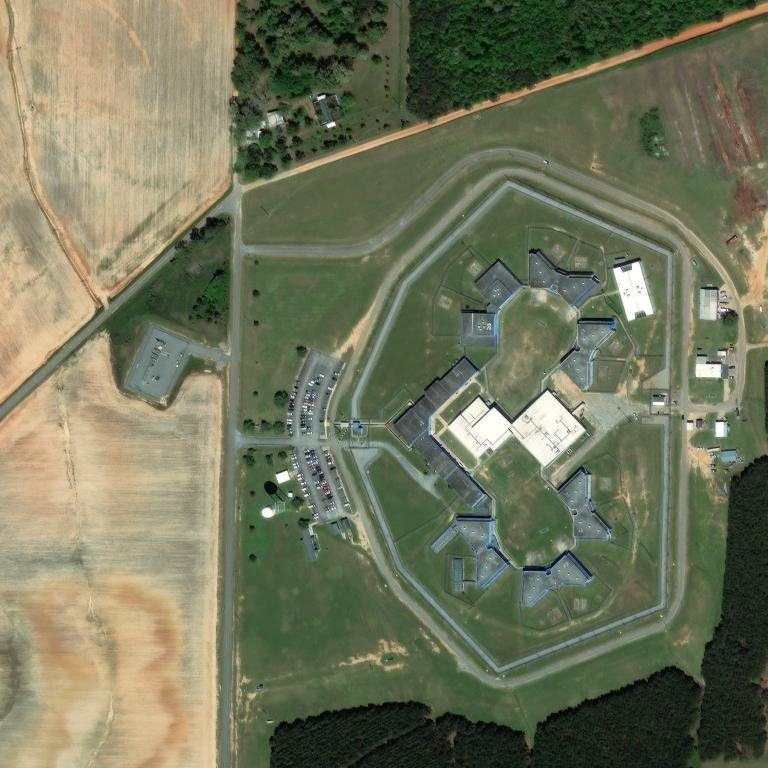
Satellite image: Esri World Imagery. Architecture documents what the building was designed to hold. See the system-wide receipts at gps.press/warehouse.
Then and now

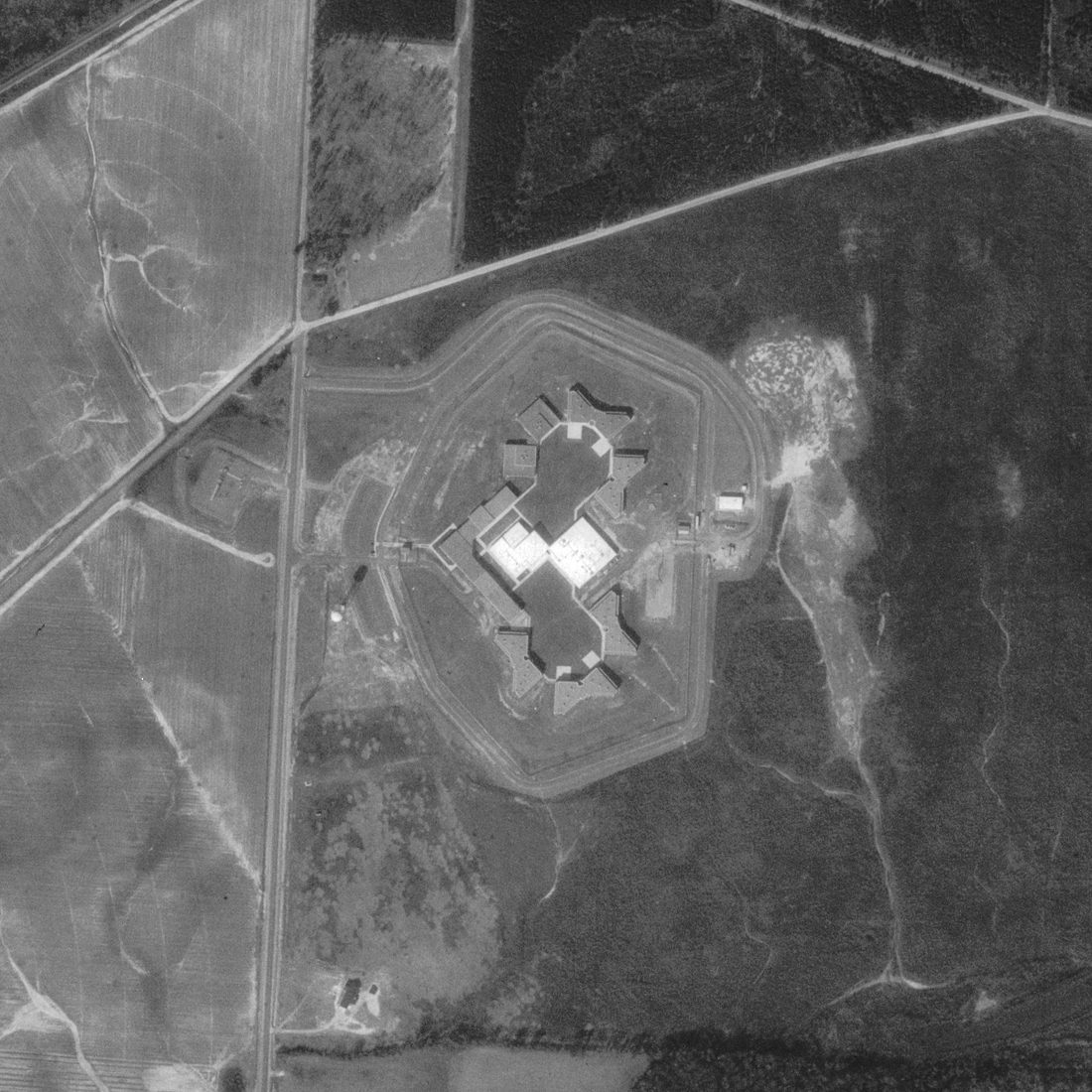
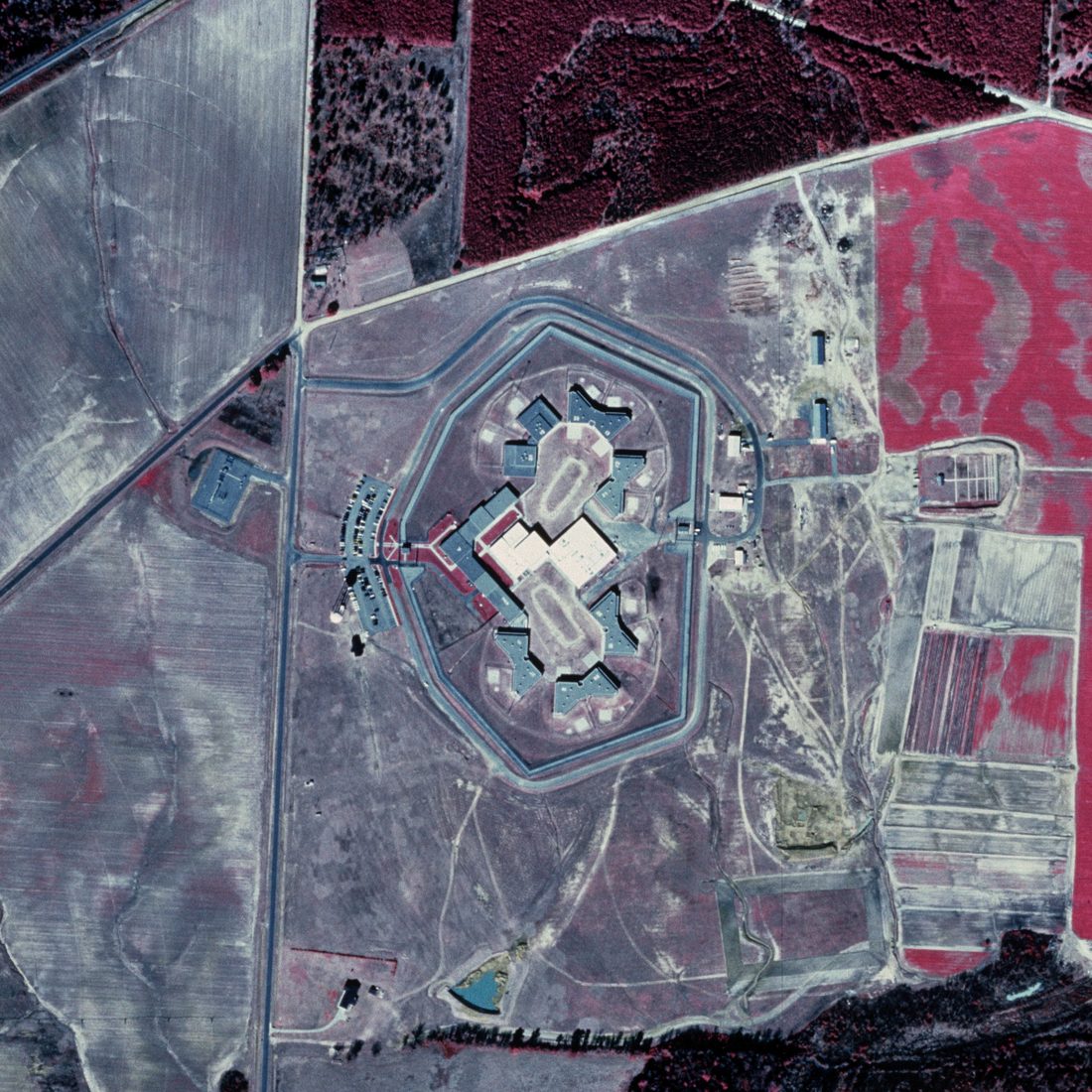
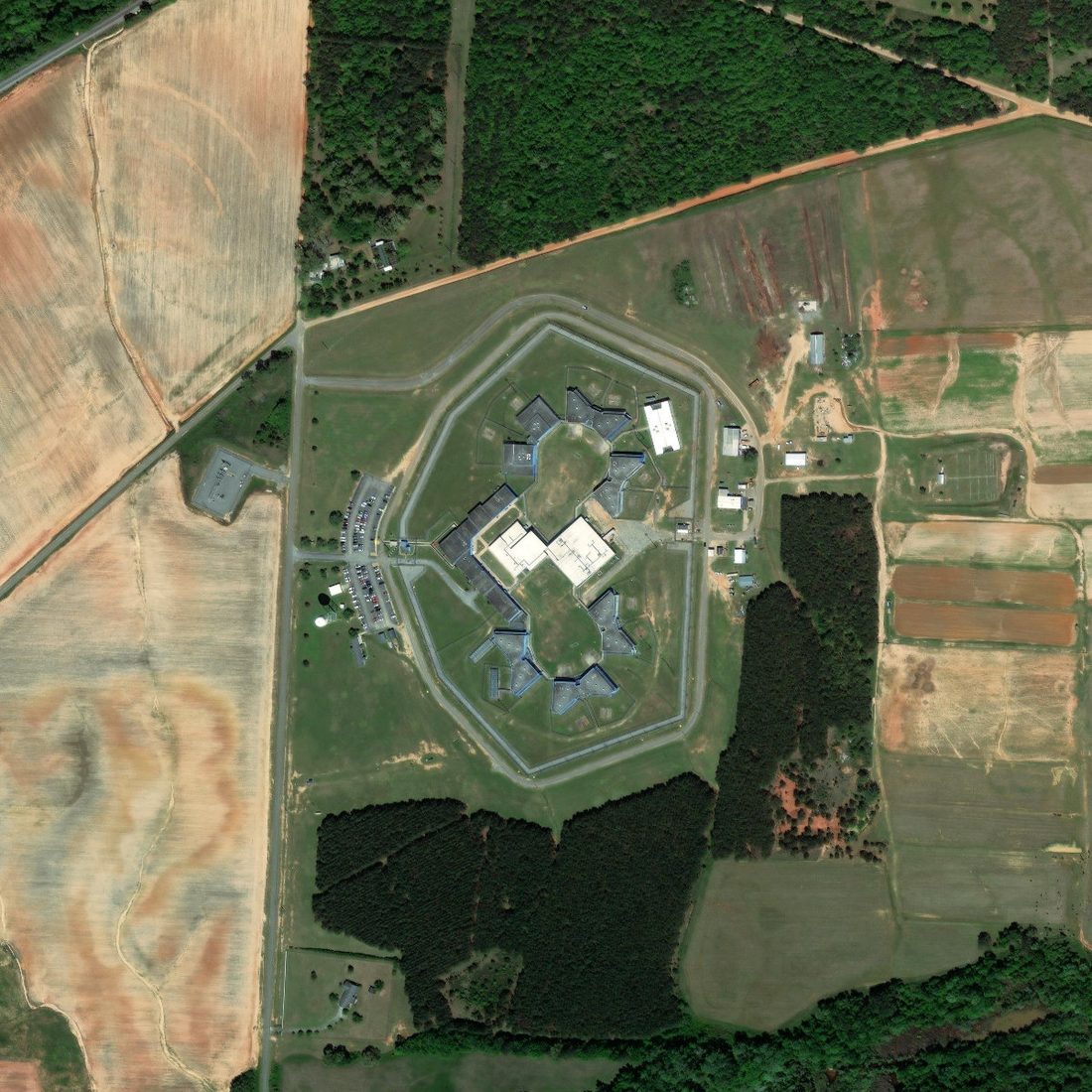
Each photo shows the same 1.2 km square, north up, so buildings line up from one year to the next. The older photos are U.S. Geological Survey aerial photographs. The photos from 1988 and earlier were taken on film and lined up with the later ones by their roads, so their positions are approximate. The early-1980s photos were taken from very high up and are less sharp. Select a photo to see it full size.