MACON STATE PRISON
Facility Information
- Original Design Capacity
- 500 (at 354% capacity)
- Bed Capacity
- 1,762 beds
- Current Population
- 1,768
- Active Lifers
- 565 (32.0% of population) · Oct 2026 GDC report
- Life Without Parole
- 521 (29.5%)
What the courts held in Brown v. Plata, and how Georgia compares →
- Address
- 2728 Hwy 49 South, Oglethorpe, GA 31068
- Phone
- (478) 472-3400
- Fax
- (478) 472-3524
- Mailing Address
- P.O. Box 426, Oglethorpe, GA 31068
- County
- Macon County
- Opened
- 1994
- Operator
- GDC (Georgia Dept. of Corrections)
Security Classification
Last updated: October 2, 2026
1,552 of the 1,750 people held here are classified Close security (88.7%), as of September 23, 2026.
| Security level | People | Share |
|---|---|---|
| Close | 1,552 | 88.7% |
| Medium | 192 | 11.0% |
| Minimum | 6 | 0.3% |
| Total | 1,750 |
Earlier count (undated table, produced October 22, 2025): 1,582 of 1,773 Close (89.2%).
Restrictive housing beds
| Program | Beds | Occupied |
|---|---|---|
| Tier II | 121 | 119 |
| STEP | 20 | 20 |
Source: Georgia Department of Corrections records produced to GPS under the Open Records Act (R031471-090226, R024615-101925, R031710-091426). A person's security level is GDC's classification of that person, which can differ from the prison's own designation.
Follow Macon State Prison
Leadership & Accountability (as of 2026 records)
Officials currently holding positional authority at this facility, with deaths attributed to GPS-tracked records during their leadership tenure. Inclusion reflects role-based accountability, not legal findings of personal culpability. Death counts shown as facility / career.
| Role | Name | Since | Deaths this facility / career |
|---|---|---|---|
| Warden (facility lead) | Peoples, Delvin Rasaunn | 2025-01-01 | 32 / 51 |
| Deputy Warden of Administration (facility deputy) | Jones, Deserre' | 2018-01-01 | 87 / 87 |
| Deputy Warden of Security (facility deputy) | McDaniel, Derrick B | 2022-01-01 | 67 / 67 |
| Deputy Warden of Security (facility deputy) | Lawson, Nancy LEE | 2024-01-01 | 48 / 48 |
| Deputy Warden of Care and Treatment (facility deputy) | Jeffries, Curtis | 2026-07-16 | 4 / 4 |
About
Last updated October 25, 2026.(DS)
Macon State Prison: Deaths, Vacancy, and a Facility That Outgrew Its Design
Macon State Prison sits on roughly 300 acres in Oglethorpe, in Macon County, a large close-security men's facility built in 1993 and opened in 1994. Its original design capacity was 500. Its current rated capacity is 1,762, and GPS's facility records put the population at 1,768 — 100.3 percent of rated capacity and more than three and a half times what the plant was built to hold. It houses some of the system's highest-risk prisoners across multiple cellblock buildings, including double-bunked general population, isolation and segregation units, and a 10-bed medical infirmary. The prison offers GED and adult basic education, limited vocational and substance-abuse programming, and religious services.
What follows is an attempt to read the facility's public record as one continuous story rather than a stack of incidents: a mortality curve that has climbed rather than fallen, a staffing collapse documented in the state's own reporting and in the accounts of the people who worked there, a physical plant whose locks and cameras are described as failing, and a set of deaths that families say were foreseeable and that the state has, in several cases, paid to settle.
A Mortality Curve That Has Not Flattened
GPS's mortality registry records 93 deaths at Macon State Prison since January 1, 2020. That figure is a floor, not a ceiling — GDC reports deaths roughly two months late, so the most recent entries are always incomplete. The yearly distribution is the analytical center of this page: 16 deaths in 2020, 4 in 2021, 12 in 2022, 7 in 2023, 20 in 2024, 24 in 2025, and 10 already recorded in 2026. The trend bends upward in the second half of the period, not down.
By cause, the registry codes 36 deaths as homicides, 14 as natural or medical, 5 as suicides, and 38 as unknown or pending. That last category is the largest single bucket, and it is itself a finding: at Macon, more than four in ten recorded deaths have no determined cause in GPS's data.
The most recent entries in the registry, in reverse order:
- John Doe died October 23, 2026, at Macon State Prison; GPS's registry lists the cause as Unknown/Pending.
- Veasna Johnathan Bun died October 22, 2026, at Macon State Prison; GPS's registry lists the cause as Unknown/Pending.
- Juld Gerald Carter died October 21, 2026, at Macon State Prison; GPS's registry lists the cause as Homicide.
- Tony Horne died August 20, 2026, at Macon State Prison; GPS's registry lists the cause as Unknown/Pending.
- Brett Michael Scudder died June 20, 2026, at Macon State Prison; GPS's registry lists the cause as Unknown/Pending.
- Anthony Williams died May 2, 2026, at Macon State Prison; GPS's registry lists the cause as Unknown/Pending.
- Allan Sharpe died April 10, 2026, at Macon State Prison; GPS's registry lists the cause as Unknown/Pending.
- Eric Roberts died February 9, 2026, at Macon State Prison; GPS's registry lists the cause as Homicide.
- Joe Dywane Rayton died January 2, 2026, at Macon State Prison; GPS's registry lists the cause as Unknown/Pending.
- Gregory Brent Scott died January 1, 2026, at Macon State Prison; GPS's registry lists the cause as Unknown/Pending.
- Randall Allen Cleveland died November 30, 2025, at Macon State Prison; GPS's registry lists the cause as Unknown/Pending.
- Michael Tony Cooper died November 20, 2025, at Macon State Prison; GPS's registry lists the cause as Unknown/Pending.
- Marquis Young died October 22, 2025, at Macon State Prison; GPS's registry lists the cause as Homicide.
- Gary Simpson died October 8, 2025, at Macon State Prison; GPS's registry lists the cause as Unknown/Pending.
- Clifton B Boston died August 26, 2025, at Macon State Prison; GPS's registry lists the cause as Unknown/Pending.
- Calvin Earl Noble died August 26, 2025, at Macon State Prison; GPS's registry lists the cause as Suicide.
- Cassiem Mahlon Johnson died August 25, 2025, at Macon State Prison; GPS's registry lists the cause as Suicide.
- Pierre Cedric Scott died August 22, 2025, at Macon State Prison; GPS's registry lists the cause as Homicide.
- Xavier Anthony Adams died July 22, 2025, at Macon State Prison; GPS's registry lists the cause as Homicide.
- Niko Lamar Swann died June 27, 2025, at Macon State Prison; GPS's registry lists the cause as Unknown/Pending.
- Lukas Lance Way died June 22, 2025, at Macon State Prison; GPS's registry lists the cause as Homicide.
- Sanchez Jackson died June 19, 2025, at Macon State Prison; GPS's registry lists the cause as Homicide.
- Terell Rasheen Everett died May 22, 2025, at Macon State Prison; GPS's registry lists the cause as Unknown/Pending.
- Cornelius Lee Mason died May 20, 2025, at Macon State Prison; GPS's registry lists the cause as Unknown/Pending.
- Douglas Wayne Medearis died May 19, 2025, at Macon State Prison; GPS's registry lists the cause as Unknown/Pending.
The full registry for the facility is published at https://gps.press/georgia-prison-deaths/facility/macon-state-prison/.
The Homicide Record, Named
The Atlanta Journal-Constitution's running documentation of Georgia prison homicides supplies the circumstances behind many of those registry entries, and taken together it reads as a decade-long pattern at a single address.
In 2020 alone the AJC documented Johnny Eugene Young, 24, who died January 27 from a sharp-force injury to the mouth and tongue; Rafael Blas Becerra, 36, who died March 7 of stab wounds to the upper torso, with an incident report showing seven other inmates involved and six injured; Carrington Juwon Frye, 23, who died March 20 of stab wounds to the neck and chest — his mother later told Georgia lawmakers he bled for more than half an hour before help arrived; David Travis Alexander Dennis, 35, who died May 13 of multiple sharp-force injuries; Coty Dustin Silvers, 39, who died May 23 from asphyxia; Bobby Edward Lee Jr., 38, who died July 13 from ligature strangulation; Robbie B. Brower, 58, who died October 4 of blunt and sharp-force injuries to the head and neck; and Raul Villegas, 37, who died December 13 of a stab wound to the torso, with three other inmates named in the incident report.
The pattern continued without interruption. Ryan Weston Darville, 37, died December 29, 2021, of stab wounds to the chest; Carlos Maurice Fisher Jr., 30, died May 10, 2021, of multiple sharp-force injuries. In 2022 the AJC documented Joseph Walter Brown, 36, who died July 26 of multiple stab wounds; Dan Brooks Jr., 50, who died August 21 of a stab wound to the neck; Kendrick Malik Brown, 25, who died October 16 of blunt-force head injury — his mother said he was due for release in a month but had been placed in a cell with a prisoner known to be dangerous; and James Cornelius McLeroy III, 26, who died December 19 of stab wounds to the torso, with an incident report showing two other prisoners involved were gang members.
In 2023: Sabino Carlos Ramos, 34, died March 22 of multiple stab wounds — the DOJ report states that four gang members ran past an officer to the kitchen area and fatally stabbed a prisoner, with eleven prisoners ultimately stabbed. Kevin Deshawn Lamar, 44, died August 10 of sharp-force chest trauma; his cellmate was charged with murder. Taurean Hardy, 41, died December 10 after an altercation with his cellmate, per the DOJ report.
In 2024 the deaths came faster. Kenneth Keith Malcom, 38, died February 12 of sharp-force trauma to the head, neck, torso and upper extremities. Reginald Lamonte Ginn, 31, died March 13 of blunt-force head trauma; the AJC reported he was apparently beaten to death by an inmate wielding a fan motor tied to a belt. Devontae Marquez Young, 28, died May 10 from cardiac arrest and sharp-force chest trauma after being assaulted with a sharp instrument. Mathis Lee Ward, 37, died June 8 of sharp-force chest and neck trauma, assaulted with a homemade instrument made of two pieces of sharpened metal. Jarraad Quayshawn Williams, 32, died July 17 from an inmate-to-inmate assault. Shannon Pickett, 49, died July 21 from exsanguination and sharp-force trauma following an inmate-to-inmate assault. Keith Antwone Green, 44, died August 30 from an inmate-to-inmate assault.
The AJC reported that GDC investigated 66 prisoner deaths deemed homicides in 2024 statewide, and that a tally of all prisoner deaths reached a record 332, up about 27 percent from the prior year. Thirteen prison deaths between January 1 and February 4, 2025, were being investigated as homicides — the bloodiest start to a year going back at least a decade, according to the AJC's analysis.
At Macon, that winter included Henry Finley, who died January 18, 2025, after being stabbed, as confirmed by Macon County Coroner Eddie T. Hosley. Jonathan Mitchell died at a hospital after being beaten by fellow prisoner Jon Edward Pippin, who was accused of using his foot, knee and fist to beat Mitchell's head and face and reportedly confessed to the assault.
Two-Thirds of the Posts Were Empty
The single most important document in Macon State Prison's recent public record is a number: about two-thirds of correctional officer jobs at the facility were not filled as of October 2024, according to the Atlanta Journal-Constitution. The same reporting found that staffing vacancies at the majority of Georgia's 34 prisons had reached "emergency levels," making it impossible to keep up with even basic protocols such as routine counts of prisoners.
The consequence at Macon is captured in a detail the AJC obtained from the county coroner: when responding to deaths at the facility, the coroner reported finding only five to eight officers staffing the entire prison.
That figure sits inside a documented systemwide collapse. GPS has documented officer vacancies running between 49.3 and 60 percent across Georgia's prisons for multiple years, against a national standard of no more than 10 percent; at Valdosta State Prison the rate reached 80 percent by April 2024. The hiring pipeline cannot close the gap — an acceptance rate under 15 percent, with 82.7 percent of new hires leaving in their first year — and Georgia ranks last of 50 states for correctional-officer pay. The October 2024 DOJ findings letter concluded that "the leadership of the Georgia Department of Corrections has lost control of its facilities" and faulted GDC for placing "too much blame on gangs and insufficient emphasis on understaffing."
The on-record corroboration for that picture comes from people who ran these facilities. Russell Zirkle, a former GDC assistant warden, testified on the record to vacancy rates of 70 to 80 percent at major prisons — testimony that corroborates both the documented six-officers-on-duty open-records production and the DOJ's October 2024 findings on staffing collapse and loss of facility control. GPS published that testimony in "Two Commanders Say Georgia Hides Its Prison Staffing Crisis."
The AJC's reporting connects the vacancy rate directly to what happens on the tier: low staffing allows gangs to exert influence, and violence is enhanced by poorly maintained facilities where most locks don't work and prisoners can easily make shanks from wall and ceiling materials. GPS has documented the same dynamic systemwide — approximately 31 percent of the system's roughly 49,000 incarcerated people are validated members of 315 different security threat groups, more than double the national average, and both DOJ and the Guidehouse 2024 consultant assessment independently concluded that gangs effectively run multiple facilities, controlling access to phones, showers, food, and bed assignments.
Locks That Don't Lock, and the Paper That Says Otherwise
The lock failure the AJC describes in general terms is documented at Macon in unusual mechanical detail. Inmate accounts collected by GPS describe slide bolts used throughout the facility, with carabiners serving in place of locks on those bolts; an electronic locking system defeated not by malfunction but by incarcerated people rigging the locks with strips of plastic bottles; and a lock override affecting the entire compound. The same accounts describe the clearing process — staff moving incarcerated people to the gym for roughly five to six hours while covers are removed and the plastic taken off by hand — and report that rigged locks are re-rigged within about 20 minutes of people returning to a dorm. GPS has received accounts that incarcerated people in a housing unit cut two or three locks off doors, and that people have cut windows in cell doors so they can reach through and slide their own bolts.
GPS treats infrastructure collapse as a force multiplier for the violence, classification, gang-control, and mortality crises it has documented at the facility level. Most GDC facilities are 30 to 40-plus years old, with documented patterns of deferred maintenance that have produced systemwide failures: broken cell-door locks (a 2012 audit found roughly 42 percent non-functional at Hays, confirmed by Guidehouse in 2024), inoperative surveillance and fire-alarm systems, mold and water failures, broken kitchen sanitization equipment, and pest infestations. The DOJ October 2024 findings, the Guidehouse 2024 assessment, and Commissioner Oliver's public "end of life" statements all corroborate the pattern.
Food, Water, and the Inspection Score That Doesn't Capture It
The Georgia Department of Public Health inspected Macon State Prison's food service three times in the period GPS holds records for. On June 10, 2024, the facility scored 91, Grade A, with one violation cited for food in good condition, safe, and unadulterated. On March 25, 2025, the score fell to 80, Grade B, with three violations including food in good condition, safe, and unadulterated, proper cold holding temperatures, and proper hot holding temperatures. On April 29, 2026, the facility scored 87, Grade B, with three violations including proper cold holding temperatures; utensils, equipment and linens properly stored, dried, and handled; and warewashing facilities installed, maintained, and used, with test strips.
GPS has documented a systemic pattern of food-service sanitation failure across GDC kitchens that DPH inspection scores systematically fail to capture: tray-sanitizing dishwashers broken for sustained periods, sustained roach and rodent infestation in kitchen and serving areas, and meals served on visibly contaminated trays. The pattern is hidden from DPH scores because inspections are scheduled walkthroughs that do not assess equipment under load, and because GPS has documented professional overlap between inspectors and facility staff in small-county settings. High DPH scores at GDC facilities coexist with sustained witness reports of equipment failure and food contamination — the contradiction at the center of GPS's investigation "Dunked, Stacked, and Served."
The economics behind that pattern are stark. GDC spends approximately $1.69 per person per day on food (2024) and has proposed $1.60 per day in FY27 — under 60 cents per meal — against the FDA Thrifty Food Plan estimate of roughly $10 per day for an adult man's nutritionally adequate diet. The state spends approximately 14 times more on medical care for incarcerated people ($432 million) than on their food. The Marshall Project independently reported on May 16, 2026, on rats in kitchens, insects in food, moldy trays, and visible malnutrition across Georgia facilities, and quoted GPS connecting chronic underfeeding to the violence pattern the DOJ documented in October 2024.
What the State Has Paid
Georgia's own liability ledger is the most concrete accountability record for the facility, because a settlement is a fact the state has conceded in dollars. According to the GA DOAS Risk Management settlement ledger obtained through open records, the state has paid out at Macon State Prison across more than a decade:
- Bobby Edward Lee (2020 incident): $1,375,000, linked to a documented death record.
- Coty Silvers (2020 incident): $750,000, linked to a documented death record.
- Javante Harris-Evans (2021 incident): $98,000.
- William Stoner (2013 incident): $50,000.
- Robin Kimbrel (2022 incident): $32,500.
- William Colton Courtney (2015 incident): $20,000.
- Bavarious Nelson (2022 incident): $6,250.
- Willie Frank Wright (2013 incident): $5,000.
- Hjalmar Rodriquez Jr (2015 incident): $750.
- Jerome Anthony Williams (2015 incident): $500.
- Frank Gillis (2021 incident): $450.
The two seven-figure payouts both trace to 2020 deaths. Bobby Edward Lee Jr., 38, died July 13, 2020, from ligature strangulation. A federal lawsuit alleges Lee was strangled by his cellmate, a convicted murderer, and blames his death on understaffing and indifference by prison officials. The AJC reported the allegation in greater detail: that officials placed Lee in a cell with a prisoner who had previously killed a fellow parolee despite Lee's pleas for protection, and that no officers responded until after he was strangled to death. Coty Dustin Silvers, 39, died May 23, 2020, from asphyxia.
Contraband, Cell Phones, and the Corruption Ledger
GDC's own published contraband reports record 36 incidents at Macon State Prison between 2010 and 2025, with 32 arrests reported. The actor breakdown is the analytically interesting part: nine staff-class actors, thirteen visitor-class actors, and seven civilian-class actors across the period. By role as GDC printed it, eight of the staff-class actors were listed as "Officer" and one as "Correctional Officer." GDC publishes no dispositions — an arrest is not a conviction.
The AJC reported in March 2025 that hundreds of GDC employees have been arrested and fired for smuggling drugs and other contraband into prisons. At Macon, four correctional officers were arrested in September 2024 on charges of violating their oath as public officers and providing false statements.
Contraband cell phones have made the facility a launch point for crimes committed entirely outside its walls. Rodney Edward Smith, a 39-year-old inmate at Macon State Prison, was extradited to Florida on August 16, 2025, to face charges for an alleged hunting lease fraud scheme; he allegedly used smuggled cell phones and multiple online aliases to post fake hunting lease advertisements for properties he did not own, collecting deposits from hunters across 15 Florida counties between July 1, 2025, and April 30. Devito Duran Young pleaded guilty to one count of conspiracy to distribute fentanyl and one count of conspiracy to distribute a controlled substance for his role in a drug trafficking operation coordinated from Macon State Prison; he was later sentenced to 327 months in federal prison for directing a fentanyl and synthetic cannabinoid trafficking scheme from prison using a contraband cellphone. Trace Davrin Works pleaded guilty to one count of conspiracy to distribute fentanyl and received a 262-month sentence. Prosecutors seized $170,000 in cryptocurrency from Xin Wang during the course of that case.
The October 2026 Cluster
The registry's most recent entries cluster tightly. Juld Gerald Carter, 47, was found dead on Wednesday, October 21, 2026 — an inmate at Macon State Prison serving a life sentence for a Toombs County murder. GDC said its Office of Professional Standards was investigating the death as a homicide under standard procedure, and the body was turned over to the county coroner for transport to the GBI crime lab. No additional details were available due to the ongoing investigation.
The next day, October 22, Veasna Johnathan Bun died at the facility; GPS's registry lists the cause as Unknown/Pending. On October 23, a registry entry recorded as John Doe lists the cause as Unknown/Pending.
Tyler Ryals, a former GDC officer, wrote in the Ga. Prisons Exposed Facebook group on October 23, 2026, that a "Man found deceased at Macon State Prison" — one line in a broader bulletin that also referenced a TB outbreak at Pulaski State Prison, more than 30 pounds of drugs and contraband intercepted en route to Hancock State Prison, and a planned protest at Smith State Prison. Solomon Rowland posted the same bulletin text in the same group that day. An anonymous member wrote in the same group on October 22, 2026, that "last night an inmate known to many inmates as J C was found dead in G 1, he was stuffed an a mattress for a couple days while Macon State prison's administration went in that dorm and inspected," and alleged that a unit manager "went around bullying a number of inmates with threats." These are members' public assertions, not GPS findings.
GPS records show the October 2026 concentration clearly: 10 distinct sources reporting death-in-custody in that month alone, alongside 8 reporting alleged assault by another incarcerated person. Across the trailing twelve months, GPS's intelligence system records 20 sources reporting alleged inmate-on-inmate assault, 19 reporting death in custody (with GBI among the external entities referenced), 8 reporting named staff misconduct, 6 reporting external complaints filed to federal court, the GBI, and Georgia Prisoners' Speak, and 6 reporting family fear for an incarcerated person's life at critical severity. GPS has additionally received recurring reports of grievance obstruction, inadequate climate control, medical neglect, and sanitation failure at the facility.
Families, Isolation, and the Grievance Wall
GPS has received accounts from families of people held at Macon describing a facility where the formal channels do not work. Multiple family members report that grievances are repeatedly not accepted by staff, that incarcerated people have taken to documenting their own submission attempts, and that legal mailings have been blocked by citing funds available in the person's account. GPS has received accounts of a medication error at the facility that a family member says caused a serious neurological episode, and of an incarcerated person held in isolation in conditions a family member describes as lacking electricity and air conditioning.
These are allegations from families, not adjudicated findings. But they describe a mechanism, and the mechanism matters analytically: if the grievance process does not function, the record of what happens inside Macon State Prison is produced only by the people willing to call a newspaper or a family member — which is precisely the record this page is built from.
Leadership and the Record Going Forward
Delvin Rasaunn Peoples is the warden at Macon State Prison. The deputy wardens of security are Nancy Lee Lawson and Derrick B. McDaniel; Deserre' Jones is deputy warden of administration; Curtis Jeffries is deputy warden of care and treatment. Gregory Sampson, the former warden at Dooly State Prison, became the new warden at Macon State Prison on February 1, 2025, the AJC reported — a transition that places the 2025 and 2026 death clusters under new command.
The wider policy environment has not been static. Citing consultant findings, Gov. Kemp proposed allocating an additional $600 million over 18 months to address staffing, emergency repairs and infrastructure improvements in Georgia prisons. Whether that money reaches Oglethorpe, and whether it changes the number at the top of this page, is the question the next several years of the registry will answer.
GPS has independently tracked 1,918 deaths in GDC custody since 2020.
Sources
This analysis draws on the Atlanta Journal-Constitution's multi-year documentation of Georgia prison homicides and staffing, including its reporting on the October 2024 Department of Justice findings and the Guidehouse consultant assessment; Georgia Department of Public Health food-service inspection records for Macon State Prison; the Georgia Department of Administrative Services Risk Management settlement ledger obtained through open records; GDC's published contraband reports; federal court filings in the litigation over the death of Bobby Edward Lee Jr.; reporting by Solitary Watch and CBS News; The Marshall Project's May 2026 investigation of Georgia prison food; GPS's own mortality registry and facility records; first-person narratives published in Georgia Prisoners' Speak — Tell My Story; public Facebook posts by Tyler Ryals, Solomon Rowland, and an anonymous member of the Ga. Prisons Exposed group; and inmate and family accounts collected by GPS staff.
Mortality Statistics
97 deaths documented at this facility from 2020 to present.
Deaths by Year
- 2026: 14
- 2025: 24
- 2024: 20
- 2023: 7
- 2022: 12
- 2021: 4
- 2020: 16
County Public Health Department
Food service and sanitation at MACON STATE PRISON fall under the jurisdiction of the Macon County Environmental Health Department. Incarcerated people cannot choose where they eat — public health inspectors carry an elevated responsibility to hold this kitchen to the same standards applied to any restaurant.
Contact
- Title
- Environmental Health Director
- Address
-
P.O. Box 729
Oglethorpe, GA 31068 - Phone
- (833) 337-1749
- macon.eh@dph.ga.gov
- Website
- Visit department website →
Why this matters
GPS has documented black mold on chow-hall ceilings, cold and contaminated trays, spoiled milk, and pest contamination at Georgia prisons. The Department of Justice's 2024 report confirmed deaths from dehydration and untreated diabetes tied to food and water deprivation. Advance-notice inspections let facilities stage temporary fixes that disappear once inspectors leave.
Unannounced inspections by the county health department are one of the few outside checks on kitchen conditions behind the fence.
How you can help
Write to the county inspector and request an unannounced inspection of the kitchen and food service operation at this facility. A short, respectful letter citing Georgia food-safety regulations is more powerful than you think — inspectors respond to public concern.
Sample Letter
This is the letter Georgia Prisoners' Speak mailed to all county environmental health inspectors responsible for GDC facilities. Feel free to adapt it.
October 26, 2026
RE: Request for Unannounced Public Health Inspection of Food Service Operations at MACON STATE PRISON
Dear County Environmental Health Director,
I am writing to respectfully request that your office conduct a thorough, unannounced inspection of food service and sanitation practices at MACON STATE PRISON, located in Macon County.
Documented concerns
Georgia Prisoners' Speak, a 501(c)(3) nonprofit investigative newsroom, has published extensive investigative reporting on food safety and nutrition failures across Georgia's prison system, including:
- Dangerous sanitation conditions — black mold on chow hall ceilings and air vents, contaminated food trays, and spoiled milk served to inmates.
- Severe nutritional deficiency — roughly 60 cents per meal; inmates receive only 40% of required protein and less than one serving of vegetables per day.
- Preventable deaths — the U.S. Department of Justice's 2024 report confirmed deaths from dehydration, renal failure, and untreated diabetes following food and water deprivation.
- Staged compliance — advance-notice inspections allow facilities to stage temporary improvements, then revert once inspectors leave.
Firsthand testimony
In Surviving on Scraps: Ten Years of Prison Food in Georgia, a person who has spent more than ten years in GDC custody describes no functional dishwashing sanitation, chronic mold on food trays, and roaches found on the undersides of trays at intake facilities. Full account: gps.press/surviving-on-scraps-ten-years-of-prison-food-in-georgia.
Specific requests
- Conduct an unannounced inspection of the kitchen and food service operations at this facility, with particular attention to dishwashing equipment, tray sanitation procedures, and food storage conditions.
- Evaluate compliance with applicable Georgia food safety regulations, including O.C.G.A. § 26-2-370 and the Georgia Food Service Rules and Regulations (Chapter 511-6-1).
- Verify permit status and confirm whether the facility is subject to the same inspection schedule as other institutional food service establishments in the county.
- Make inspection results available to the public, as permitted under Georgia's Open Records Act (O.C.G.A. § 50-18-70).
Incarcerated individuals cannot advocate for their own health and safety in the way a restaurant patron can — they cannot choose to eat elsewhere. This places an elevated responsibility on public health officials to ensure these facilities meet the same sanitation standards applied to any food service establishment.
Thank you for your attention to this important public health matter.
Sincerely,
[Your name]
Food Safety Inspections
Georgia Department of Public Health
What the score doesn't measure. DPH grades kitchen compliance on inspection day — food storage, temperatures, pest control. It does not grade whether today's trays are clean. GPS reporting has found broken dishwashers at most Georgia state prisons we've documented; trays go out wet, stacked, and visibly moldy — including at facilities with recent scores near 100.
Who inspects. Most Georgia state prisons sit in rural counties — often with fewer than 20,000 people, several with fewer than 10,000. The environmental health inspector lives in that community and often knows the kitchen staff personally. Rural inspection regimes don't have the structural independence you'd expect in a city-sized health department. Read the scores accordingly.
Read the investigation: “Dunked, Stacked and Served: Why Georgia Prison Trays Are Making People Sick”
Recent inspections
| Date | Score | Purpose | |
|---|---|---|---|
| Apr 29, 2026 | 87 | Routine | |
| Mar 25, 2025 | 80 | Routine | |
| Jun 10, 2024 | 91 | Routine |
April 29, 2026 — Score 87
Routine · Inspector: Cory Jackson
| Code | Violation | Pts | Inspector notes |
|---|---|---|---|
| 1A | proper cold holding temperatures Corrected Repeat | 9 | Observed pineapples, potato salad, and salad mix cold holding at temperatures greater than 41*F. (See temp log) xcept during preparation, cooking, or cooling, or when time is used as the public health control, time/temperature control for safety food shall be maintained at 41°F (5°C) or below. PIC discarded food items. |
| 14B |
utensils, equipment and linens: properly stored, dried, handled 511-6-1.05(10)(a) - equipment & utensils, air-drying required (c) Corrected | 1 | Observed several food trays wetstacking in dishwashing area. After cleaning and sanitizing, equipment and utensils:1. Shall be air-dried or used after adequate draining before contact with food; and2. May not be cloth dried except that utensils that have been air-dried may be polished with cloths that are maintained clean and dry.COS: PIC had employee separate trays to allow for proper air-drying. |
| 15B |
warewashing facilities: installed, maintained, used; test strips 511-6-1.05(3)(h),(i),(j) - temperature measuring device, manual warewashing; sanitizing solutions, testing device (pf) Corrected | 1 | Observed facility using expired chlorine test strips. A test kit or other device that accurately measures the concentration in mg/L of sanitizing solutions shall be provided. Must correct within 10 days. |
March 25, 2025 — Score 80
Routine · Inspector: Nathaniel Wilkey
| Code | Violation | Pts | Inspector notes |
|---|---|---|---|
| 1C |
food in good condition, safe, and unadulterated 511-6-1.04(1) - safe, unadulterated and honestly presented (p) Corrected Repeat | 9 | Observed many damaged/dented cans stored in the dry storage room ready to be used. Food shall be safe, unadulterated, and honestly presented. Person in charge discarded damaged canned goods. |
| 1A |
proper cold holding temperatures 511-6-1.04(6)(f) - time/temperature control for safety; cold holding (p) Corrected | 9 | Observed several TCS food items reaching temperatures greater than 41*F. (See Temp Log). Except during preparation, cooking, or cooling, or when time is used as the public health control, time/temperature control for safety food shall be maintained at 41°F (5°C) or below. Person in charge voluntarily discarded food items. |
| 1B |
proper hot holding temperatures 511-6-1.04(6)(f) - time/temperature control for safety; hot holding (p) Corrected | 9 | Observed several TCS food items reaching temperatures less than 135*F on the serving line in the main kitchen. (See Temp Log). Except during preparation, cooking, or cooling, or when time is used as the public health control, time/temperature control for safety food shall be maintained at 135°F (57°C) or above. Person in charge directed food workers to reheat food items to greater than 135*F. |
June 10, 2024 — Score 91
Routine · Inspector: Nathaniel Wilkey
| Code | Violation | Pts | Inspector notes |
|---|---|---|---|
| 1C |
food in good condition, safe, and unadulterated 511-6-1.04(1) - safe, unadulterated and honestly presented (p) Corrected | 9 | Observed many canned goods stored in the dry storage area of the main kitchen with visual damages and dents and not stored in a designated area for damaged goods. Food shall be safe, unadulterated, and honestly presented. Person in charge had food employee place dented/damaged canned goods in a designated area for damaged goods. |
Recent reports (27)
Source-attributed observations and allegations from news coverage and reports submitted to GPS. Each entry credits its source.
- ALLEGATION According to Cbsnews.com Published: Aug 20, 2026Smith allegedly used smuggled cell phones and multiple online aliases to run a hunting lease fraud scheme from prison, collecting deposits from hunters across 15 Florida counties.
"The FWC alleges Smith used smuggled cell phones and multiple online aliases to post fake hunting lease advertisements for properties he did not own, collecting deposits from hunters across 15 Florida counties between July 1, 2025, and April 30."
Read source → - ALLEGATION According to 13WMAZ Published: Apr 1, 2026Young coordinated a drug trafficking operation from behind bars using contraband cellphones to import drugs from China.
"Prosecutors said Young, who was incarcerated in Macon State Prison, coordinated the trafficking from behind bars. According to a previous press release, Young had used contraband cellphones to arrange shipments of synthetic cannabis products from China to the U.S."
Read source → - ALLEGATION According to 13WMAZ Published: Apr 1, 2026Oliver Sr. orchestrated drug shipments to a Cordele address controlled by his son.
"According to a previous release, Young and Oliver Sr. orchestrated the drug shipments, sending them to a Cordele address — dubbed "the Lab" — that was controlled by Oliver Jr."
Read source → - ALLEGATION According to Ftp.nestcollaborative.com Published: May 25, 2026Four officers arrested for violating their oath and providing false statements.
"Four correctional officers at Macon State Prison in Georgia were arrested in September 2024 on charges of violating their oath as public officers and providing false statements"
Read source (archived) → - ALLEGATION According to Atlanta Journal-Constitution Published: Jan 21, 2025Carrington Juwon Frye's mother alleged that after being stabbed, her son bled for more than half an hour before help arrived.
"Frye's mother told Georgia lawmakers that he was stabbed and bled for more than half an hour before help arrived."
Read source →
Timeline (90)
Source Articles (27)
Former leadership
Officials who previously held leadership roles at this facility.
| Role | Name | Tenure | Deaths this facility / career |
|---|---|---|---|
| Warden (facility lead) | Sales, Timothy Deshaun | 2013-01-01 → 2025-01-31 | 46 / 54 |
| WARDEN 3 (facility lead) | Smith, Tarmarshe A | 2020-01-01 → 2023-06-30 | 36 / 36 |
| Warden (facility lead) | Sampson, Gregory L | 2025-02-01 → 2026-01-15 | 23 / 51 |
| Warden (facility lead) | Peoples, Delvin | 2026-07-05 → present | 4 / 4 |
| DEPUTY WARDEN (facility deputy) | McKenzie, Lachaka Nicole | 2017-01-01 → 2022-12-31 | 32 / 43 |
| Deputy Warden (facility deputy) | Jefferies, Curtis Leroy | 2026-08-27 → 2026-08-27 | — / — |
| Deputy Warden (facility deputy) | Jefferies Jr, Curtis Leroy | 2023-11-22 → 2023-11-22 | — / — |
| Deputy Warden (facility deputy) | Fuller, Gary Napoleon | 2023-11-22 → 2023-11-22 | — / — |
| Chaplain (specialty lead) | Walker, Donald | 2023-11-22 → 2026-08-27 | — / — |
Location
Aerial View
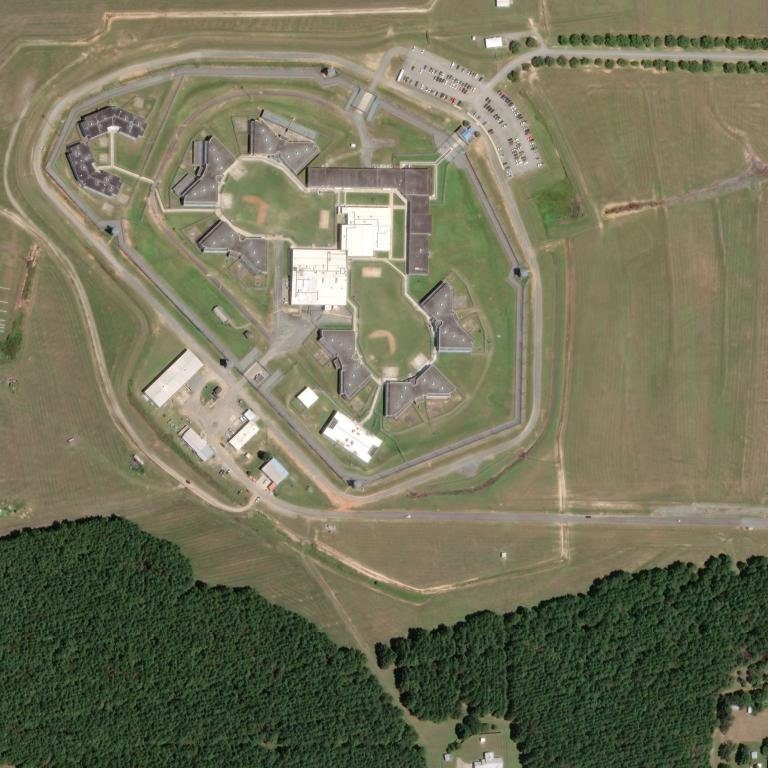
Satellite image: Esri World Imagery. Architecture documents what the building was designed to hold. See the system-wide receipts at gps.press/warehouse.
Then and now
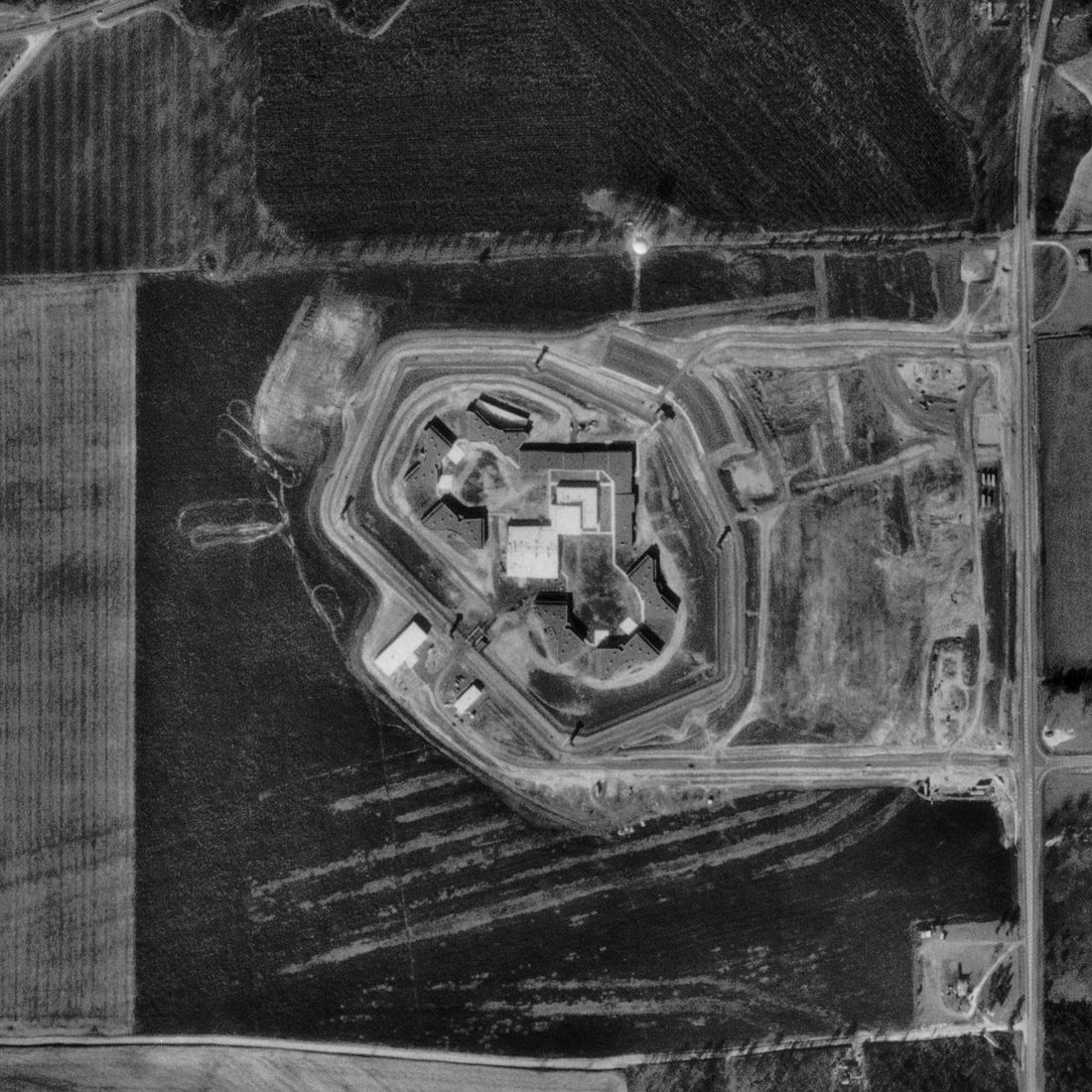
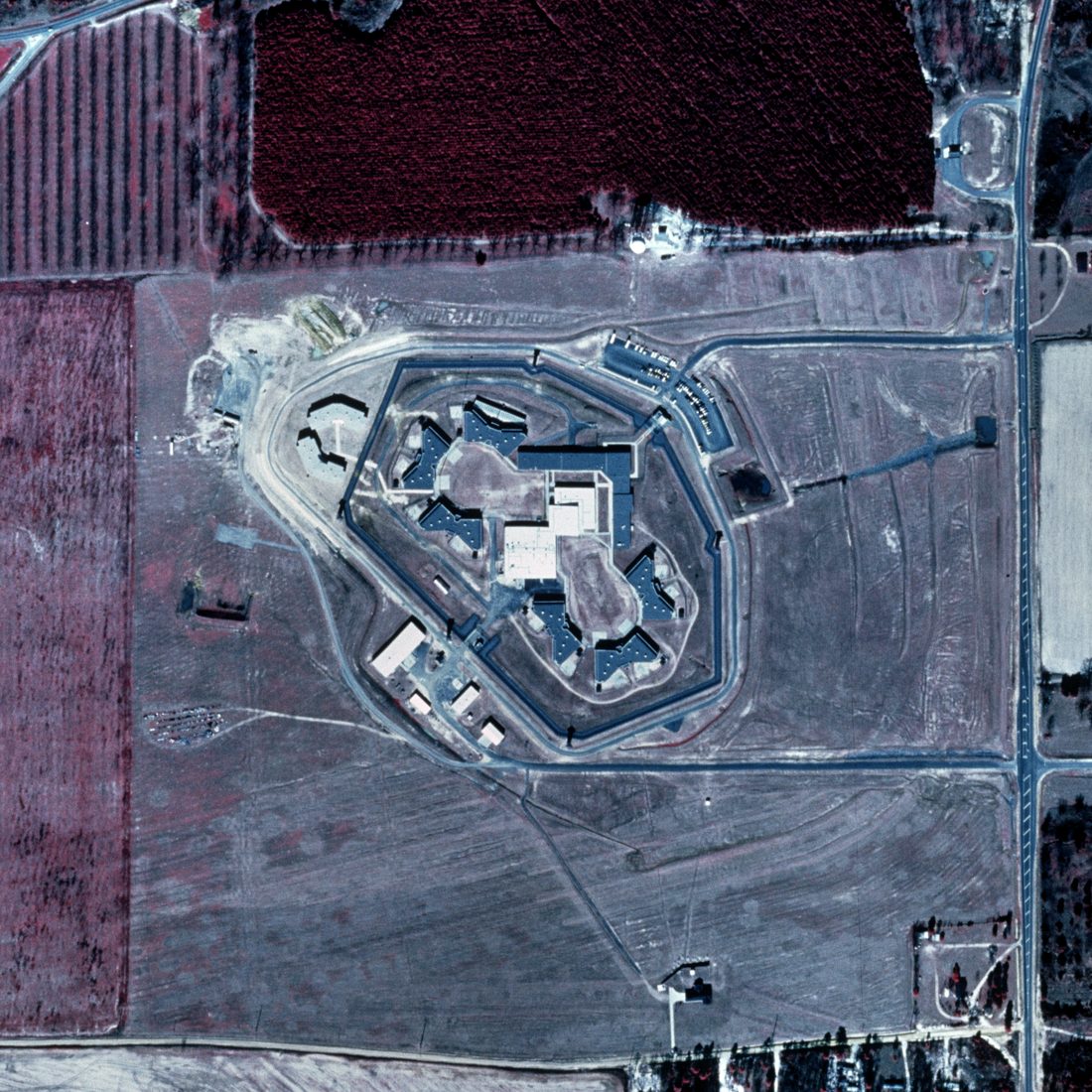
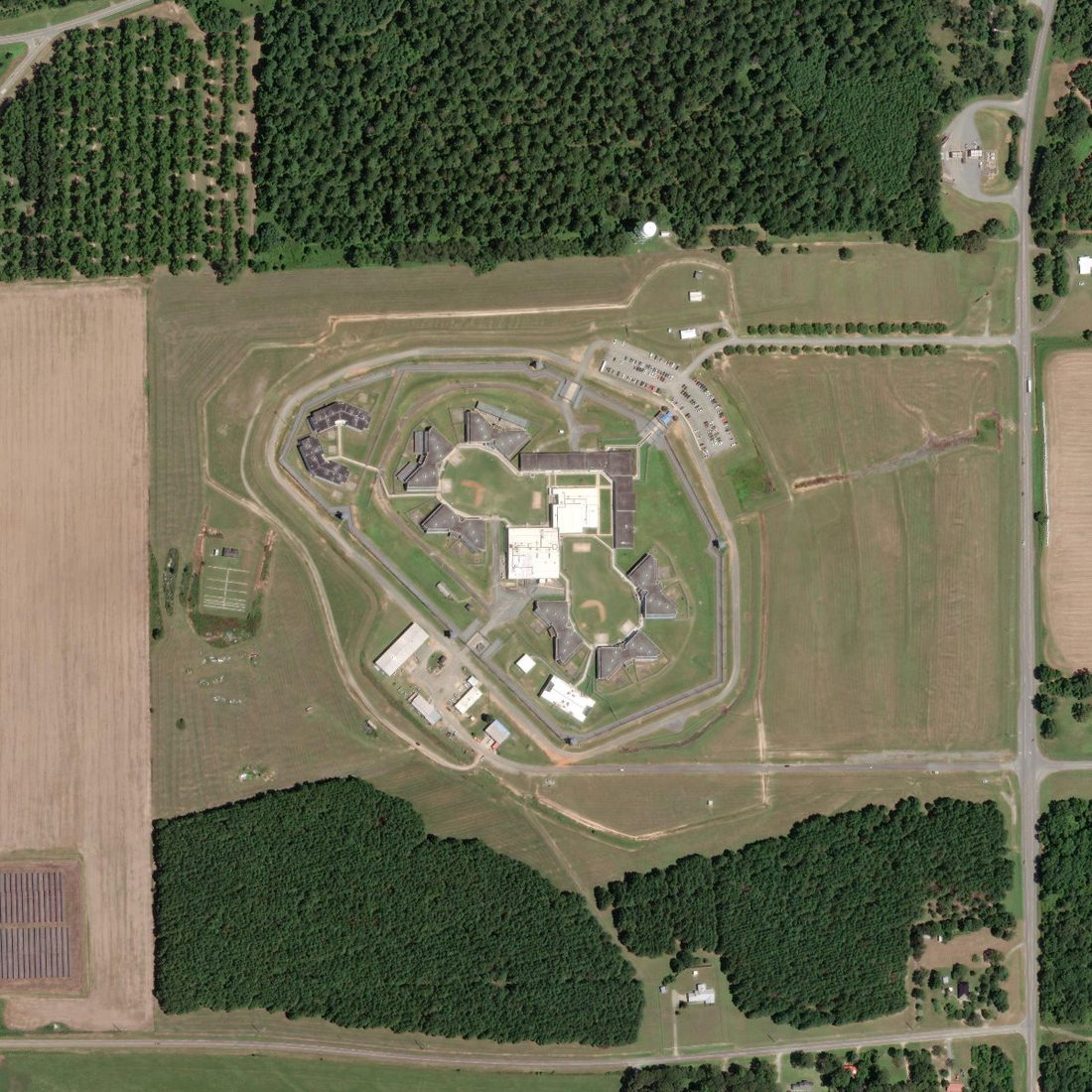
Each photo shows the same 1.2 km square, north up, so buildings line up from one year to the next. The older photos are U.S. Geological Survey aerial photographs. The photos from 1988 and earlier were taken on film and lined up with the later ones by their roads, so their positions are approximate. The early-1980s photos were taken from very high up and are less sharp. Select a photo to see it full size.