TELFAIR STATE PRISON
Facility Information
- Original Design Capacity
- 480 (at 246% capacity)
- Bed Capacity
- 1,400 beds
- Current Population
- 1,182
- Active Lifers
- 392 (33.2% of population) · Oct 2026 GDC report
- Life Without Parole
- 329 (27.8%)
What the courts held in Brown v. Plata, and how Georgia compares →
- Address
- 170 Longbridge Road, Helena, GA 31037
- Phone
- (229) 868-7721
- Fax
- (229) 868-6509
- Mailing Address
- P.O. Box 549, Helena, GA 31037
- County
- Telfair County
- Opened
- 1992
- Operator
- GDC (Georgia Dept. of Corrections)
Security Classification
Last updated: October 2, 2026
1,042 of the 1,166 people held here are classified Close security (89.4%), as of September 23, 2026.
| Security level | People | Share |
|---|---|---|
| Close | 1,042 | 89.4% |
| Medium | 119 | 10.2% |
| Minimum | 5 | 0.4% |
| Total | 1,166 |
Earlier count (undated table, produced October 22, 2025): 1,163 of 1,273 Close (91.4%).
Restrictive housing beds
| Program | Beds | Occupied |
|---|---|---|
| Tier II | 117 | 117 |
Source: Georgia Department of Corrections records produced to GPS under the Open Records Act (R031471-090226, R024615-101925, R031710-091426). A person's security level is GDC's classification of that person, which can differ from the prison's own designation.
Following Telfair State Prison?
Leadership & Accountability (as of 2026 records)
Officials currently holding positional authority at this facility, with deaths attributed to GPS-tracked records during their leadership tenure. Inclusion reflects role-based accountability, not legal findings of personal culpability. Death counts shown as facility / career.
| Role | Name | Since | Deaths this facility / career |
|---|---|---|---|
| WARDEN 3 (facility lead) | McFarlane, Andrew M | 2023-07-01 | 36 / 53 |
| Deputy Warden of Care and Treatment (facility deputy) | Keith, Tonja T | 2019-01-01 | 59 / 59 |
| Deputy Warden of Security (facility deputy) | Wilcox, Rickey W | 2023-11-22 | 34 / 34 |
| Deputy Warden of Security (facility deputy) | Foster, Denisha Gauze | 2025-01-16 | 21 / 21 |
| Deputy Warden of Administration (facility deputy) | Wooten, Darrell | 2026-07-16 | — / — |
About
Last updated October 4, 2026.(DS)
A Prison Built for 480, Holding 1,182
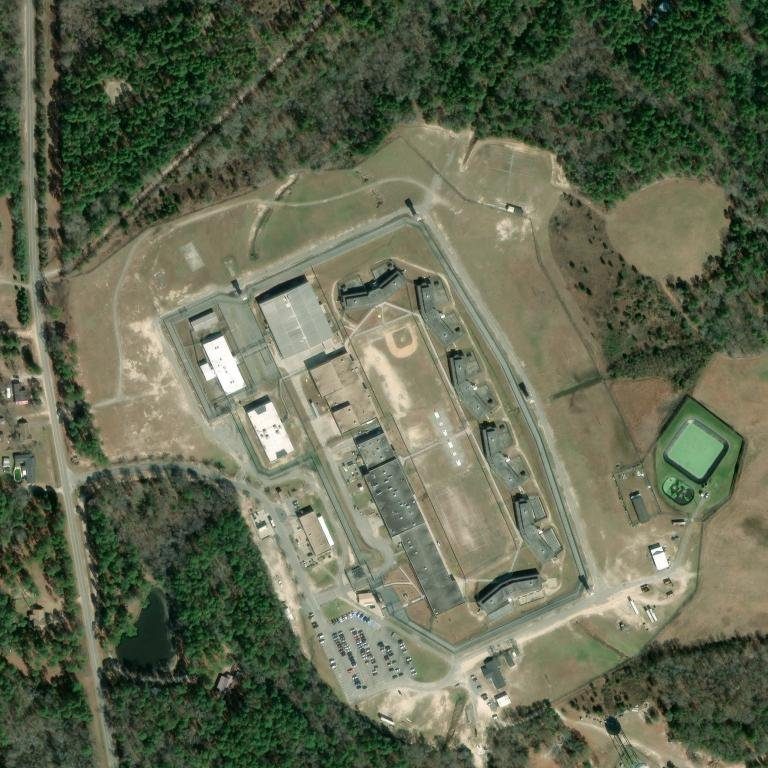
Telfair State Prison opened in 1992 in Helena, in Telfair County, as a close-security institution for adult men. Its original design capacity was 480. Its current rated capacity is 1,400, and GPS's facility records put the current population at 1,182 — about 84 percent of rated capacity, and nearly two and a half times what the plant was built to hold. The physical layout combines open-dorm housing with multiple double-bunked cell units, plus segregation and isolation cells for people classified as high-risk or hard-to-manage. The warden is Andrew M. McFarlane, who has held the post since July 2023; the deputy wardens are Rickey W. Wilcox, Tonja T. Keith, and Denisha Gauze Foster, the deputy warden of security since January 2025.
The facility's public record is dominated by two things that are not usually discussed in the same sentence: a homicide rate that has made Telfair the subject of national scrutiny for extreme violence, and a staffing collapse so severe that the people supervising its dormitories have at times numbered in the low thirties. Those two facts are not coincidental, and the evidence assembled below treats them as a single structural problem rather than two separate ones.
Fifty-Nine Deaths, Nineteen of Them Homicides
GPS's mortality registry has recorded 59 deaths at Telfair State Prison since January 1, 2020. Nineteen are classified as homicides — roughly one in three. Sixteen are recorded as Unknown/Pending, meaning GPS does not yet know the cause. Nine are Natural/Medical, six Overdose, four Suicide, two Accident, two Other, and one Medical Neglect. Every count is a floor: GDC reports deaths roughly two months late, so the true figure is higher.
The most recent deaths in the registry include Kwame Conte Mccombs, who died July 25, 2026, at Telfair State Prison; GPS's registry lists the cause as Unknown/Pending. Antwane Shanfiel Robinson died July 13, 2026, at Telfair State Prison, cause Unknown/Pending. Franciso Samuel Cruz-Castro died June 12, 2026, at Telfair State Prison, cause Unknown/Pending. Timothy Wilson died June 7, 2026, at Telfair State Prison, cause Unknown/Pending. Tavares Zavoyd Atwell died March 10, 2026, at Telfair State Prison, cause Unknown/Pending. Eric Bernard Haynes died January 21, 2026, at Telfair State Prison; the registry lists the cause as Natural/Medical. Kenneth George Hinton died January 2, 2026, at Telfair State Prison, cause Unknown/Pending. Elvis Noe Garcia-Nelasco died December 29, 2025, at Telfair State Prison, cause Unknown/Pending. Preston C. Phelps died December 13, 2025, at Telfair State Prison; the registry lists the cause as Homicide. Robert Baker died October 12, 2025, at Telfair State Prison; the registry lists the cause as Suicide. Gary Chad Thomason died September 14, 2025, at Telfair State Prison, cause Unknown/Pending. Robert Wayne Messer died September 11, 2025, at Telfair State Prison; the registry lists the cause as Overdose. Henry L. Gadson died September 10, 2025, at Telfair State Prison, cause Unknown/Pending. David Lane Campbell died July 22, 2025, at Telfair State Prison; the registry lists the cause as Overdose. Malindzo Eddy Hatcher died July 21, 2025, at Telfair State Prison; the registry lists the cause as Homicide. Thaddeus Jovell Perry died July 17, 2025, at Telfair State Prison, cause Unknown/Pending. Tony Morales Adame died June 26, 2025, at Telfair State Prison; the registry lists the cause as Overdose. Lester James Smith died June 2, 2025, at Telfair State Prison; the registry lists the cause as Homicide. William Clinton Worley died April 12, 2025, at Telfair State Prison, cause Unknown/Pending. Ezra Dangelo Ford died March 25, 2025, at Telfair State Prison; the registry lists the cause as Homicide. Deandre Moody died January 28, 2025, at Telfair State Prison; the registry lists the cause as Homicide. Guillermo Nava died December 27, 2024, at Telfair State Prison, cause Unknown/Pending. Aaron Joshua Smith died December 19, 2024, at Telfair State Prison; the registry lists the cause as Homicide. Eric Leigh Whitehead died September 18, 2024, at Telfair State Prison; the registry lists the cause as Homicide. Henry Earl Crump died September 2, 2024, at Telfair State Prison; the registry lists the cause as Homicide.
The full list is maintained at GPS's facility death registry: https://gps.press/georgia-prison-deaths/facility/telfair-state-prison/
The Cage, the Heat, and the Death That Reached the DOJ
The single most documented death at Telfair is that of Juan Carlos Ramirez Bibiano, 27, who died July 20, 2023. According to reporting by 13WMAZ, officers placed him in a roughly 12-by-8.5-foot fenced-in outdoor cage with no shade while the heat index reached about 105°F. He was left there roughly five hours and arrived at the hospital with an internal body temperature of 107°F. GPS's registry lists his cause of death as Other. A separate 13WMAZ account describes an officer allegedly responding "if he dies, he dies" when the man pleaded for help while suffering in the extreme heat.
The state paid for that death. According to the Georgia Department of Administrative Services Risk Management settlement ledger, obtained through an open records request, the state made a liability payout of $3,249,873 to the family or estate of Juan Carlos Ramirez Bibiano, tied to Telfair State Prison and the 2023 incident. It is by an order of magnitude the largest settlement in Telfair's ledger.
The settlement ledger documents a longer tail of smaller payouts tied to the facility: $500 to Deante Gholston (2024), $1,750 to Ryan Frank DeMon (2023), $2,600 to Derrell Ruth (2021), $5,361 to Darryl Thomas (2021), $1,850 to David Morris (2021), $14,000 to Trevio Head (2018), $2,500 to Ricardo Jamal Strozier (2016), and $8,311 to Shawn Wayne Whatley (2012). Read together, they describe a facility that has been generating liability claims for more than a decade.
Thirty-Two Officers for 1,400 People
In March 2024, the Atlanta Journal-Constitution reported that Telfair State Prison was missing 76 percent of its essential workforce, leaving only 36 correctional officers to supervise 1,400 prisoners. By the following spring, the number had gotten worse: the AJC reported in May 2025 that 79 percent of correctional officer positions at Telfair were unfilled, leaving 32 officers for a facility requiring at least 153.
That figure lands differently against the systemwide context. GPS has documented officer vacancy rates across Georgia's prisons running between 49.3 percent and 60 percent for multiple years, against a national standard of no more than 10 percent. The hiring pipeline cannot close the gap: acceptance rates sit under 15 percent, and 82.7 percent of new hires leave within their first year. Georgia ranks last of 50 states for correctional-officer pay. The October 2024 Department of Justice findings letter concluded that "the leadership of the Georgia Department of Corrections has lost control of its facilities" and faulted GDC for placing "too much blame on gangs and insufficient emphasis on understaffing."
Telfair is the extreme case of that pattern, and it has a named witness. Tyler Ryals, a former GDC sergeant forced out in 2024 after whistleblowing, told GPS he had personally been the only security person on the entire Telfair compound of roughly 1,250 maximum-security inmates. Ryals's account is one of two on-record commander testimonies in GPS's reporting "Two Commanders Say Georgia Hides Its Prison Staffing Crisis," in which two former GDC commanders — a CERT commander pushed out after a sworn warning, and a deputy warden of security who quit rather than comply — independently say Georgia hides its prison staffing collapse by manipulating the numbers it reports to the public.
A Dorm Fight, a Statewide Lockdown, and a Warden Stabbed
The violence at Telfair is not abstract. On March 25, 2024, the AJC reported that the warden at Telfair State Prison was stabbed by an inmate during a shakedown by officials looking to unearth contraband in a dorm — an incident the paper described as underscoring the dire state of Georgia's prison system. That same month, the state Senate authorized the Senate Supporting Safety and Welfare of All Individuals in the Department of Corrections Facilities Study Committee, headed by Sen. Randy Robertson, to conduct a deep dive into the system.
On September 18, 2026, a gang-related fight involving numerous offenders broke out at Telfair State Prison, contained to a single dorm, injuring three inmates who were treated at local hospitals for non-life-threatening injuries before returning to the facility. GDC placed all of its facilities under lockdown out of what it called an abundance of caution; Telfair and Calhoun state prisons and specific dorms at Hancock and Wilcox prisons remained on lockdown as of Friday afternoon. The Telfair fight followed an inmate death in an altercation at the facility on July 21.
That July 21 death was Malindzo Eddy Hatcher, 42, whose registry entry lists the cause as Homicide. Earlier, on June 11, 2026, inmate Timothy Wilson died after an altercation with another inmate at Telfair State Prison; his body was sent to the GBI Crime Lab for autopsy, and the GDC Office of Professional Standards opened an investigation. GPS's registry lists Wilson's cause as Unknown/Pending. On December 13, 2025, 28-year-old Preston Cato Phelps died after an altercation with multiple inmates at Telfair State Prison; the GDC's Office of Professional Standards investigated the death as a homicide, and his body was taken to the county coroner's office and sent to the GBI Crime Lab to determine cause of death.
The pattern extends back through the decade. Eric Whitehead died September 18, 2024, after a fight with another inmate. Henry Crump died September 2, 2024; incident report data shows a homicide. Zoumana Madiou Sarre, 23, died July 5, 2024, from multiple sharp force injuries to the neck and torso. Lamar Wilson, 32, died June 1, 2024, of injuries suffered during a fight. Joey Lebron Kilgore, 46, died February 29, 2024, in a homicide. Kwesi Jamal Stultz, 24, died December 22, 2023, from multiple injuries to the head. De'ahmoz Oshmic Floyd, 29, died April 18, 2023, from exsanguination caused by a stab wound to the side of the neck; a claim filed against the state alleged he was stabbed by several prisoners at a time when no prison staff were present in the dorm, and that he had renounced his gang affiliation while in prison, making him a target of previous attacks. Xavier LaMar Warren, 32, died December 28, 2022, from a stab wound to the torso, with incident reports showing four other inmates involved. Juan Carlos Arguelles-Reveles, 37, died May 7, 2021, from a stabbing, with 11 other inmates involved. Luis Garcia Palacio, 41, died July 28, 2020, from blunt impact injuries to the head. Marcus Derrelle Pearson Jr., 28, died May 29, 2020, from multiple stab wounds. Aldrich Norval Cain, 26, died April 23, 2020, from multiple stab wounds. Cedric La'Troy Johnson Sr., 35, died March 13, 2020, by strangulation.
GPS records show that over the past twelve months the facility generated ten distinct sources reporting alleged inmate-on-inmate assaults across six months, and six sources reporting deaths in custody across three months, all at critical severity. Inmate accounts collected by GPS describe large-scale fights between rival groups in Telfair housing units, chemical-agent deployments into dorms during disturbances, and at least one account of a person trapped in an open cell when agents were deployed. GPS has received accounts of a killing in the facility's segregation unit in 2026. These are receipt acknowledgments, not verified findings; GPS publishes them because the volume and consistency of the reporting is itself a data point.
A Sergeant, a Meth Pipeline, and the Ghost Face Gangsters
In January 2026, the Atlanta Journal-Constitution reported that Sergeant Desiree Briley helped prisoner James Dylon NeSmith smuggle meth into Telfair State Prison and distribute it for at least two years. She was sentenced to 18 months in prison after pleading guilty to her role in a massive drug trafficking network. The network was the target of an ongoing federal prosecution known as Operation Ghost Busted, which targeted a drug operation controlled by the Ghost Face Gangsters white supremacist gang, extending to at least 10 South Georgia counties both inside and outside prisons.
The AJC's March 2024 coverage framed the Briley case within a broader pattern: guards, especially those caught smuggling contraband, are often young job jumpers with financial problems. That is the same hiring pipeline GPS has documented systemwide — an acceptance rate under 15 percent, 82.7 percent of new hires gone within a year, and last-in-the-nation pay. The staffing crisis and the contraband crisis are the same crisis viewed from two ends.
GPS records show four distinct sources reporting named staff misconduct at Telfair over the past twelve months, spanning three months and carrying severity ratings from low to critical.
Heat, Cold, and the Tier
Telfair's heat problems predate the Ramirez Bibiano death by more than a decade. In December 2010, Solitary Watch reported that prison administration shut off heat at Telfair State Prison when daytime temperatures were in the 30s, and that prisoners responded by screening their cells with blankets. The same outlet reported that tactical officers allegedly rampaged through the facility, destroying inmate personal property and severely beating at least six prisoners — an account attributed to inmate families and other sources, not to any official finding.
A GPS-authored Tell My Story account, "The Man Who Turned On the Heat," describes working in Telfair's tier unit during a sweltering July. The author writes that the unit manager intentionally turned on the heat in cells already baking from metal-plated windows, telling staff these men were "supposed to be punished," and notes that the same officer now runs Georgia's largest prison. The account is GPS-published and has not yet completed GPS's fact-check process; it is presented here as a firsthand narrative, not a verified finding. A Spanish-language companion piece describes the tier as a special confinement unit used for serious punishments, where most people are in single cells, ventilation is restricted, and windows are covered with black metal plate.
GPS has documented the broader constitutional question in "Heat, Humidity, and the Constitution," which notes that recent federal court rulings in Texas declared similar conditions unconstitutional.
Food Safety: High Scores, Contested Meaning
The Georgia Department of Public Health has inspected Telfair's food service 21 times since 2023, all under inspector Victoria Thornton. The scores range widely. On March 26, 2026, the facility received a 91 (Grade A) with one violation for proper hot holding temperatures, and a 93 (Grade A) with two violations covering cooling methods and wiping-cloth storage. On November 4, 2025, it scored 99 (Grade A). But on May 13, 2025, it scored 74 (Grade C) with four violations including cold holding temperatures and food separation. On September 19, 2023, it scored 78 (Grade C) with five violations. On August 8, 2024, it scored 81 (Grade B) with eight violations, including two separate citations for inadequate handwashing facilities. Follow-up inspections in June 2025 (89, Grade B) and October 2023 (84, Grade B) suggest the facility has repeatedly needed a second visit to correct deficiencies.
GPS has documented a systemic pattern of food-service sanitation failure across GDC kitchens that DPH inspection scores systematically fail to capture: tray-sanitizing dishwashers broken for sustained periods, sustained roach and rodent infestation in kitchen and serving areas, and meals served on visibly contaminated trays. The pattern is hidden from DPH scores, in GPS's analysis, because inspections are scheduled walkthroughs that do not assess equipment under load. High DPH scores at GDC facilities coexist with sustained witness reports of equipment failure and food contamination. The Marshall Project corroborated the broader pattern on May 16, 2026, in an investigation by Beth Schwartzapfel, "Rats, Insects and Mold," independently reporting rats in kitchens, insects in food, moldy trays, and visible malnutrition across Georgia facilities, and quoting GPS connecting chronic underfeeding to the violence pattern the DOJ documented in October 2024. GPS has documented that GDC spends approximately $1.69 per person per day on food — under 60 cents per meal — against an FDA Thrifty Food Plan estimate of roughly $10 per day for an adult man's nutritionally adequate diet.
What the Record Shows
Telfair State Prison is a facility designed for 480 people that now holds 1,182, staffed at roughly a fifth of its authorized strength, with 59 deaths recorded since 2020 and 19 of them homicides. Its warden was stabbed during a contraband shakedown in 2024. Its sergeant ran a meth pipeline for two years. A man died in an outdoor cage at 107 degrees, and the state paid $3.25 million for it.
The DOJ's October 2024 findings letter concluded that sexual assault in Georgia prisons is "rampant" and that GDC does not reasonably protect incarcerated people from sexual harm; of 456 sexual-abuse allegations recorded in 2022, only 35 were substantiated. GDC's own consultants reviewed 388 PREA investigation files in May 2022 and found that not one met the law's standards. Georgia has never submitted a PREA certification of full compliance to the U.S. Department of Justice. GPS treats these findings as the analytical frame for facility-level violence narratives rather than as facility-isolated incidents.
Across the system, GPS has independently tracked 1,896 deaths in GDC custody since 2020. Telfair's 59 are a disproportionate share of that total for a facility of its size.
Sources
This analysis draws on reporting from the Atlanta Journal-Constitution, 13WMAZ, Solitary Watch, and Yahoo News; Georgia Department of Public Health food-safety inspection records; the Georgia Department of Administrative Services Risk Management settlement ledger obtained through open records request; Georgia Department of Corrections public statements and Office of Professional Standards notifications; GPS's mortality registry and intelligence records; GPS-authored reporting including "Two Commanders Say Georgia Hides Its Prison Staffing Crisis," "Heat, Humidity, and the Constitution," and the Tell My Story narratives "The Man Who Turned On the Heat" and its Spanish-language companion; and inmate, family, and anonymous accounts collected by GPS staff.
Mortality Statistics
62 deaths documented at this facility from 2020 to present.
Deaths by Year
- 2026: 9
- 2025: 15
- 2024: 11
- 2023: 8
- 2022: 5
- 2021: 3
- 2020: 11
County Public Health Department
Food service and sanitation at TELFAIR STATE PRISON fall under the jurisdiction of the Telfair County Environmental Health Department. Incarcerated people cannot choose where they eat — public health inspectors carry an elevated responsibility to hold this kitchen to the same standards applied to any restaurant.
Contact
- Title
- EH Specialist
- Name
- Victoria Thornton
- Address
-
P.O. Box 55328
McRae, GA 31055 - Phone
- (229) 868-7404
- Victoria.Thornton@dph.ga.gov
- Website
- Visit department website →
Why this matters
GPS has documented black mold on chow-hall ceilings, cold and contaminated trays, spoiled milk, and pest contamination at Georgia prisons. The Department of Justice's 2024 report confirmed deaths from dehydration and untreated diabetes tied to food and water deprivation. Advance-notice inspections let facilities stage temporary fixes that disappear once inspectors leave.
Unannounced inspections by the county health department are one of the few outside checks on kitchen conditions behind the fence.
How you can help
Write to the county inspector and request an unannounced inspection of the kitchen and food service operation at this facility. A short, respectful letter citing Georgia food-safety regulations is more powerful than you think — inspectors respond to public concern.
Sample Letter
This is the letter Georgia Prisoners' Speak mailed to all county environmental health inspectors responsible for GDC facilities. Feel free to adapt it.
October 9, 2026
RE: Request for Unannounced Public Health Inspection of Food Service Operations at TELFAIR STATE PRISON
Dear Victoria Thornton,
I am writing to respectfully request that your office conduct a thorough, unannounced inspection of food service and sanitation practices at TELFAIR STATE PRISON, located in Telfair County.
Documented concerns
Georgia Prisoners' Speak, a 501(c)(3) nonprofit investigative newsroom, has published extensive investigative reporting on food safety and nutrition failures across Georgia's prison system, including:
- Dangerous sanitation conditions — black mold on chow hall ceilings and air vents, contaminated food trays, and spoiled milk served to inmates.
- Severe nutritional deficiency — roughly 60 cents per meal; inmates receive only 40% of required protein and less than one serving of vegetables per day.
- Preventable deaths — the U.S. Department of Justice's 2024 report confirmed deaths from dehydration, renal failure, and untreated diabetes following food and water deprivation.
- Staged compliance — advance-notice inspections allow facilities to stage temporary improvements, then revert once inspectors leave.
Firsthand testimony
In Surviving on Scraps: Ten Years of Prison Food in Georgia, a person who has spent more than ten years in GDC custody describes no functional dishwashing sanitation, chronic mold on food trays, and roaches found on the undersides of trays at intake facilities. Full account: gps.press/surviving-on-scraps-ten-years-of-prison-food-in-georgia.
Specific requests
- Conduct an unannounced inspection of the kitchen and food service operations at this facility, with particular attention to dishwashing equipment, tray sanitation procedures, and food storage conditions.
- Evaluate compliance with applicable Georgia food safety regulations, including O.C.G.A. § 26-2-370 and the Georgia Food Service Rules and Regulations (Chapter 511-6-1).
- Verify permit status and confirm whether the facility is subject to the same inspection schedule as other institutional food service establishments in the county.
- Make inspection results available to the public, as permitted under Georgia's Open Records Act (O.C.G.A. § 50-18-70).
Incarcerated individuals cannot advocate for their own health and safety in the way a restaurant patron can — they cannot choose to eat elsewhere. This places an elevated responsibility on public health officials to ensure these facilities meet the same sanitation standards applied to any food service establishment.
Thank you for your attention to this important public health matter.
Sincerely,
[Your name]
Food Safety Inspections
Georgia Department of Public Health
What the score doesn't measure. DPH grades kitchen compliance on inspection day — food storage, temperatures, pest control. It does not grade whether today's trays are clean. GPS reporting has found broken dishwashers at most Georgia state prisons we've documented; trays go out wet, stacked, and visibly moldy — including at facilities with recent scores near 100.
Who inspects. Most Georgia state prisons sit in rural counties — often with fewer than 20,000 people, several with fewer than 10,000. The environmental health inspector lives in that community and often knows the kitchen staff personally. Rural inspection regimes don't have the structural independence you'd expect in a city-sized health department. Read the scores accordingly.
Read the investigation: “Dunked, Stacked and Served: Why Georgia Prison Trays Are Making People Sick”
Recent inspections
| Date | Score | Purpose | |
|---|---|---|---|
| Mar 26, 2026 | 93 | Routine | |
| Oct 21, 2025 | 87 | Routine | |
| May 13, 2025 | 90 | Routine | |
| Aug 8, 2024 | 81 | Routine | |
| Mar 19, 2024 | 88 | Routine | |
| Oct 16, 2023 | 84 | Followup | |
| Sep 19, 2023 | 78 | Routine |
March 26, 2026 — Score 93
Routine · Inspector: Victoria Thornton
| Code | Violation | Pts | Inspector notes |
|---|---|---|---|
| 11A |
proper cooling methods used: adequate equipment for temperature control 511-6-1.04(6)(e) - cooling methods (pf, c) Corrected | 3 | Cut cabbage in the walk in cooler was covered and not cooling faster as it should.CA: Cooling shall be accomplished in accordance with the time and temperature criteria by loosely covered or uncovered if protected from overhead contamination during the cooling period to facilitate heat transfer from the surface of the food.COS: Uncovered during inspection. |
| 12C |
wiping cloths: properly used and stored 511-6-1.04(4)(m) - wiping cloths, use limitation (c) Repeat | 3 | Observed 3 wiping cloths at the baking station wet and not stored in a bucket of sanitizer.CA: Wiping cloths must be stored in a sanitizer bucket in between uses. |
October 21, 2025 — Score 87
Routine · Inspector: Victoria Thornton
| Code | Violation | Pts | Inspector notes |
|---|---|---|---|
| 1A |
proper cold holding temperatures 511-6-1.04(6)(f) - time/temperature control for safety; cold holding (p) Corrected | 9 | Box of single carton milks sitting on the counter in the baking stating temperature at 63F-65F. Several milks stored in the walk-in of the baking area at 45F. Time/temperature control for safety food must be cold held at 41F or below. COS: Milks discarded. |
| 12C |
wiping cloths: properly used and stored 511-6-1.04(4)(m) - wiping cloths, use limitation (c) Repeat | 3 | Wiping cloth chlorine sanitizing solution not at proper minimum strength. |
May 13, 2025 — Score 90
Routine · Inspector: Victoria Thornton
| Code | Violation | Pts | Inspector notes |
|---|---|---|---|
| 2B | proper eating, tasting, drinking, or tobacco use Corrected Repeat | 4 | Observed open personal drinks on the prep line; observed multiple opened drinks in the kitchen and back walk-in cooler. COS - Discussed designated areas for personal drinks. Drinks removed. |
| 12C |
wiping cloths: properly used and stored 511-6-1.04(4)(m) - wiping cloths, use limitation (c) | 3 | Wet wiping cloth not stored in sanitizing solution between uses. |
| 17D |
adequate ventilation and lighting; designated areas used 511-6-1.07(4)(b) - designated areas for employee activity, located to prevent contamination of food, equipment, utensils, linens, & single service articles (c) | 1 | Personal coats stored on top of boxes in dry storage; personal items must be stored in designated areas. |
August 8, 2024 — Score 81
Routine · Inspector: Victoria Thornton
| Code | Violation | Pts | Inspector notes |
|---|---|---|---|
| 2B |
proper eating, tasting, drinking, or tobacco use 511-6-1.03(5)(k)1&2 - eating, drinking, or using tobacco (c) Corrected | 4 | Observed open personal drinks on the prep line; observed multiple opened drinks in the kitchen and back walk-in cooler. Personal drinks must be in a cup with a lid and straw in food preparation areas. COS - Drinks discarded. |
| 2D |
adequate handwashing facilities supplied & accessible 511-6-1.07(3)(a) - handwashing cleanser, availability (pf) Corrected | 4 | Observed multiple handwash sinks without soap and papertowels. COS - Soap and papertowels provided by PIC. |
| 2D |
adequate handwashing facilities supplied & accessible 511-6-1.07(3)(b) - hand drying provision (pf) Corrected | 4 | Observed multiple handwash sinks without soap and papertowels. COS - Soap and papertowels provided by PIC. |
| 2A |
food stored covered 511-6-1.04(4)(c)1(iv) - packaged & unpackaged food, food stored covered(c) Corrected | 4 | Biscuit mix found stored in dry storage found uncovered and subject to contamination. COS- The damaged bags were discarded at the time of inspection. |
| 2 |
proper date marking and disposition 511-6-1.04(6)(g) - ready-to-eat time/temperature control for safety food, date marking (pf) Corrected Repeat | 4 | Found food in the vegetarian cooler stored past disposal dates in June. Potentially hazardous food must be discarded by the 7 day discard date or use-by day, whichever first. COS - Food discarded. |
| 2 |
proper date marking and disposition 511-6-1.04(6)(g) - ready-to-eat time/temperature control for safety food, date marking (pf) Corrected | 4 | Bologna in the walk-in cooler not datemarked. Time/temperature control for safety food must be properly dated if held over 24 hours. COS - Person-in-charge did know the items were prepared yesterday and dated accordingly. |
| 12A |
contamination prevented during food preparation, storage, display 511-6-1.04(4)(q) - food storage (c) | 3 | Box of food in the vegan cooler on the floor; box of broccoli in the walk-in freezer on the floor. Food must be 6" off of the floor. |
| 16B |
plumbing installed; proper backflow devices 511-6-1.06(2)(r) - system maintained in good repair (p, c) Corrected | 2 | Walk-in cooler storing eggs and milk has water all over the floor from leaking/broken pipes. Plumbing must be maintained in good repair. |
March 19, 2024 — Score 88
Routine · Inspector: Victoria Thornton
| Code | Violation | Pts | Inspector notes |
|---|---|---|---|
| 2B |
food-contact surfaces: cleaned & sanitized 511-6-1.05(6)(n) - manual and mechanical warewashing equipment, chemical sanitization-temperature, ph, concentration, hardness (p,pf) Corrected | 4 | Chlorine sanitizer not at proper minimum strength for manual warewashing. COS - PIC put correct concentration at time of inspection. Dishes sent back to dishwashing. |
| 2 |
proper date marking and disposition 511-6-1.04(6)(h) - ready-to-eat time/temperature control for safety food, disposition (p) | 4 | Found food in the vegetarian cooler stored past disposal dates in February. Found milk in the other walk-in cooler dated 3-15-24 discard date. Potentially hazardous food must be discarded by 7 day discard date or use-by day, whichever first. COS - Food discarded. |
| 12B |
personal cleanliness 511-6-1.03(5)(g) - jewelry (c) Repeat | 3 | Observed an inmate preparing food while wearing jewelry (watch) other than a plain ring on their hands/arms. |
October 16, 2023 — Score 84
Followup · Inspector: Victoria Thornton
| Code | Violation | Pts | Inspector notes |
|---|---|---|---|
| 1B |
proper hot holding temperatures 511-6-1.04(6)(f) - time/temperature control for safety; hot holding (p) Corrected | 9 | Observed hot potentially hazardous food (fish) not held at 135F or above. COS - Fish made in the last two hours quickly reheated to above 165F for hot holding. |
| 2 |
proper date marking and disposition 511-6-1.04(6)(g) - ready-to-eat time/temperature control for safety food, date marking (pf) Corrected | 4 | Observed bologna sandwiches prepared last Saturday without a date of preparation or discard date. COS - Sandwiches discarded. Time/temperature control for safety food must be properly dated if held in the facility over 24 hours. |
| 12C |
wiping cloths: properly used and stored 511-6-1.04(4)(m) - wiping cloths, use limitation (c) | 3 | Wiping cloth bucket had no sanitizer in it. Wet wiping cloths must be a bucket of sanitizer between uses. |
| 12C |
wiping cloths: properly used and stored 511-6-1.04(4)(m) - wiping cloths, use limitation (c) | 3 | Wiping cloth bucket had no sanitizer in it. Wet wiping cloths must be a bucket of sanitizer between uses. |
September 19, 2023 — Score 78
Routine · Inspector: Victoria Thornton
| Code | Violation | Pts | Inspector notes |
|---|---|---|---|
| 2A |
food stored covered 511-6-1.04(4)(c)1(iv) - packaged & unpackaged food, food stored covered(c) Corrected | 4 | Flour and oatmeal found uncovered and subject to contamination. Food must be stored covered. COS - PIC informed and items covered. |
| 1A |
proper cold holding temperatures 511-6-1.04(6)(f) - time/temperature control for safety; cold holding (p) Corrected | 9 | Observed formally frozen potentially hazardous food (turkey)(eggs) slacking and cold held at greater than 41 degrees Fahrenheit. The walk-in cooler they are stored in is not working. COS - Out of temperature items discarded. |
| 11C |
approved thawing methods used 511-6-1.04(6)(c) - thawing (c) | 3 | Observed potentially hazardous food (turkey/chicken) thawed in an improper manner (in a cooler that is not holding at 41F or below). |
| 12B |
personal cleanliness 511-6-1.03(5)(g) - jewelry (c) | 3 | Observed an inmate serving food wearing jewelry (bracelets) other than a plain ring on their hands/arms. |
| 18 |
insects, rodents, and animals not present 511-6-1.07(5)(k) - controlling pests (pf, c) | 3 | Observed roach activity as evidenced by live roaches found. |
Recent reports (21)
Source-attributed observations and allegations from news coverage and reports submitted to GPS. Each entry credits its source.
- ALLEGATION According to Yahoo.com Published: Aug 26, 2026Stevens is accused of making a bomb threat against an Atkinson County school in an effort to disrupt school operations.
"An inmate serving a life-without-parole sentence is accused of making a bomb threat against a school, according to the Georgia Bureau of Investigation."
Read source → - ALLEGATION According to 13WMAZ Recorded by GPS: Jun 29, 2026An officer allegedly responded 'if he dies, he dies' when the inmate pleaded for help while suffering in extreme heat.
"the lawsuit alleges an officer responded "if he dies, he dies.""
Read source → - ALLEGATION According to Atlanta Journal-Constitution Published: Jan 21, 2025A claim filed against the state alleged that De'ahmoz Oshmic Floyd was stabbed by several prisoners at a time when no prison staff were present in the dorm.
"A claim filed against the state said he was stabbed by several other prisoners at a time when no prison staff were in the dorm."
Read source → - ALLEGATION According to Atlanta Journal-Constitution Published: Jan 21, 2025A claim filed against the state alleged that De'ahmoz Oshmic Floyd had renounced his gang affiliation while in prison, which made him a target of previous attacks.
"The claim also says he had renounced his gang affiliation while in prison, which made him a target of previous attacks."
Read source → - ALLEGATION According to Atlanta Journal-Constitution Published: Mar 25, 2024Guards, especially those caught smuggling contraband, are often young job jumpers with financial problems.
"A powerful series of stories written by the AJC's Carrie Teegardin and Danny Robbins found that guards — especially those caught smuggling in contraband — are often young job jumpers with financial problems."
Read source →
Timeline (65)
Source Articles (32)
Former leadership
Officials who previously held leadership roles at this facility.
| Role | Name | Tenure | Deaths this facility / career |
|---|---|---|---|
| Warden (facility lead) | White, Jermaine M | 2020-01-01 → 2023-06-30 | 23 / 23 |
| DEPUTY WARDEN (facility deputy) | Stewart, Veronica M | 2021-01-01 → 2023-12-31 | 16 / 40 |
| DEPUTY WARDEN (facility deputy) | Beasley, Jacob | 2019-01-01 → 2021-12-31 | 14 / 42 |
| DEPUTY WARDEN (facility deputy) | Jackson, Kendric | 2023-01-01 → 2023-12-31 | 8 / 23 |
| Deputy Warden (facility deputy) | Wooten, William Darrell | 2023-11-22 → 2026-08-27 | — / — |
| Clinical Chaplain (specialty lead) | Land, Henry T | 2023-11-22 → 2026-08-27 | — / — |
Location
Aerial View
Architecture documents what the building was designed to hold. See the system-wide receipts at gps.press/warehouse.