WASHINGTON STATE PRISON
Facility Information
- Original Design Capacity
- 500 (at 196% capacity)
- Bed Capacity
- 1,548 beds
- Current Population
- 980
- Active Lifers
- 329 (33.6% of population) · Oct 2026 GDC report
What the courts held in Brown v. Plata, and how Georgia compares →
- Address
- 13262 Hwy 24 East, Davisboro, GA 31018
- Phone
- (478) 348-5814
- Fax
- (478) 348-5613
- Mailing Address
- P.O. Box 206, Davisboro, GA 31018
- County
- Washington County
- Opened
- 1991
- Operator
- GDC (Georgia Dept. of Corrections)
Security Classification
Last updated: September 23, 2026
241 of the 980 people held here are classified Close security (24.6%), as of September 23, 2026.
| Security level | People | Share |
|---|---|---|
| Close | 241 | 24.6% |
| Medium | 704 | 71.8% |
| Minimum | 35 | 3.6% |
| Total | 980 |
Earlier count (undated table, produced October 22, 2025): 418 of 1,511 Close (27.7%).
Source: Georgia Department of Corrections records produced to GPS under the Open Records Act (R031471-090226, R024615-101925). A person's security level is GDC's classification of that person, which can differ from the prison's own designation.
Follow Washington State Prison
Leadership & Accountability (as of 2026 records)
Officials currently holding positional authority at this facility, with deaths attributed to GPS-tracked records during their leadership tenure. Inclusion reflects role-based accountability, not legal findings of personal culpability. Death counts shown as facility / career.
| Role | Name | Since | Deaths this facility / career |
|---|---|---|---|
| WARDEN 1 (facility lead) | Stewart, Veronica M | 2024-06-16 | 25 / 41 |
| Deputy Warden of Care and Treatment (facility deputy) | Jackson, Tarra L Tomlin | 2021-01-01 | 30 / 30 |
| Deputy Warden of Security (facility deputy) | Whipple, Tamishia V | 2024-01-01 | 16 / 16 |
| Deputy Warden of Administration (facility deputy) | King, Tywanda F | 2026-08-01 | 1 / 1 |
| Deputy Warden of Security (facility deputy) | Powell, Tiauna F | 2026-09-16 | — / — |
About
Last updated October 18, 2026.(DS)
Washington State Prison: A Gang War, a Lockdown That Never Ended, and Forty Deaths
Washington State Prison sits on the edge of Davisboro in Washington County, a medium-security facility for adult male felons that opened in 1991. Its original design capacity was 500; its current rated capacity is 1,548, and GPS's facility record puts the population at 980 — roughly 63 percent of rated capacity. It houses minimum- and medium-custody prisoners in dormitories and cellblocks, along with segregation and support units, and it provides work details for surrounding communities plus limited educational, vocational, and faith-based programming. That last item is itself a finding: the public record of what the facility offers the people held there is thin, and former residents describe it as having gotten thinner.
What the record shows instead is a facility where the violence is not episodic but structural. On January 11, 2026, a gang-affiliated disturbance that began during visitation hours killed three men at the scene and injured more than a dozen others; a fourth died six days later. GPS has recorded 40 deaths at Washington State Prison since January 1, 2020 — 12 classified as homicides, 11 natural or medical, six overdoses, six of unknown or pending cause, and one each of accident, suicide, use of force, medical neglect, and other. The threads below — the riot and its criminal aftermath, the deaths that surround it, the staffing and classification failures that preceded it, the medical system that residents describe as collapsing, and the lockdown that followed — are not separate stories. They are one story told from different angles.
January 11, 2026: The Riot and the Week Around It
The Atlanta Journal-Constitution reported that a fight started among several incarcerated men on a sidewalk and spilled into a visitation area of Washington State Prison around 1:25 p.m. on January 11, 2026. Prison staff deployed nonlethal weapons and had the facility under control by roughly 3 p.m. By then, three men were dead: Ahmod Hatcher, 23, and Jimmy Trammell, 42, both pronounced dead at the scene, and Teddy Jackson, 27, who died hours later at Wellstar MCG hospital. Thirteen other incarcerated people and one correctional officer were injured. The Georgia Department of Corrections characterized the disturbance as gang-affiliated — a characterization multiple outlets, including WGXA and 13WMAZ, reported as suspected rather than established.
Trammell was days from release. He was serving a 20-year sentence for first-degree burglary out of Fulton County. Hatcher was serving 20 years for aggravated assault out of Richmond County; Jackson, 10 years for aggravated assault out of Bibb County. WGXA reported that Trammell's brother alleged the prison was responsible for his death and demanded answers.
A fourth man, Silas Westbrook, 42, had been hospitalized for minor injuries from the disturbance and was transferred to Metro Reentry Facility, where he suffered a medical emergency upon arrival on January 17 and was pronounced dead. The GDC's Office of Professional Standards investigated. GPS's registry classifies Westbrook's death as a homicide.
The week's death count began before the riot. Dajhmere Ladaveon Hall, 30, died at Washington State Prison on January 9, 2026, of an overdose, two days before the disturbance. Five deaths in nine days at a single facility is the frame in which the riot should be read — not as a spontaneous eruption but as the visible crest of a wave.
Twelve Charged, and a Facility That Never Reopened
By late April 2026, the GDC had confirmed that 12 incarcerated men were charged with felony murder, aggravated assault, gang participation, and unlawful acts of violence in a penal institution in connection with the disturbance. The AJC and 13WMAZ both reported the charges; WFXL described the 12 as alleged participants. The GDC's investigation remained active as of late April, and the agency had not responded to questions about staffing levels, conditions, or programming, according to reporting at the time.
Three days after the riot, a Washington State Prison officer was arrested. Adriana Carnelio, 27, was taken into custody around January 14 in an operation involving the Georgia Bureau of Investigation and the Ocmulgee Drug Task Force, on charges including possession of cocaine and methamphetamine with intent to distribute and firearms offenses, with a co-defendant identified as Q. Peacock. The arrest is documented in GPS's event records; it belongs in the same paragraph as the riot because it happened in the same week, at the same facility, and because it is the kind of detail that complicates any account of the disturbance as purely an inmate problem.
Then the facility closed in on itself. Washington State Prison was placed on lockdown following the brawl, and according to GPS's event records the facility never reopened — continuous lockdown extending more than five months past the riot. Tyler Ryals, a former GDC officer who says he was the instructor at Washington State Prison when he blew the whistle and called for action on August 1, 2024, wrote on Facebook on September 7, 2026: "The inmates inside haven't felt the sun touch their skin since that (preventable) riot took place early this January. They needed intervention in 2024, and they still need intervention now." Ryals's account is his own; what it describes — a facility held in indefinite lockdown — is consistent with the pattern GPS records.
Faye Pressley, writing in the Ga. Prisons Exposed Facebook group on October 8, 2026, asked whether visitation was being allowed at "the Washington State prison in davisboro Georgia," noting it had been "almost a year since they've allowed visitation there." GPS records five visitation-obstruction signals at this facility over the past twelve months, and five contact-with-family-severed signals. The aggregate is what matters: whatever the precise visitation status on any given week, families have been reporting for months that they cannot get in.
Forty Deaths Since 2020
GPS's mortality registry records 40 deaths at Washington State Prison since January 1, 2020. That figure is a floor — GDC reports deaths roughly two months late — and the full list is maintained at gps.press/georgia-prison-deaths/facility/washington-state-prison/. The 25 most recent:
- Joseph Earl Adams died August 30, 2026, at Washington State Prison; GPS's registry lists the cause as Unknown/Pending. He was 58.
- Isreal Moses Jones died June 14, 2026, at Washington State Prison; GPS's registry lists the cause as Homicide. He was 68.
- Courtney Davis died June 13, 2026, at Washington State Prison; GPS's registry lists the cause as Unknown/Pending. He was 43.
- Deshawn Poole died June 9, 2026, at Washington State Prison; GPS's registry lists the cause as Homicide. He was 34.
- Frank Smith died May 6, 2026, at Washington State Prison; GPS's registry lists the cause as Unknown/Pending. He was 75.
- Silas Rodrigioeuz Westbrook died January 17, 2026, at Washington State Prison; GPS's registry lists the cause as Homicide. He was 42.
- Teddy Dewayne Jackson died January 11, 2026, at Washington State Prison; GPS's registry lists the cause as Homicide. He was 27.
- Jimmy Lee Trammell died January 11, 2026, at Washington State Prison; GPS's registry lists the cause as Homicide. He was 42.
- Ahmod Dewayne Hatcher died January 11, 2026, at Washington State Prison; GPS's registry lists the cause as Homicide. He was 23.
- Dajhmere Ladaveon Hall died January 9, 2026, at Washington State Prison; GPS's registry lists the cause as Overdose. He was 30.
- Taylor Allen Howard died December 16, 2025, at Washington State Prison; GPS's registry lists the cause as Natural/Medical. He was 66.
- Benjamin Horne died December 15, 2025, at Washington State Prison; GPS's registry lists the cause as Overdose. He was 51.
- Wayne Krier died November 5, 2025, at Washington State Prison; GPS's registry lists the cause as Natural/Medical. He was 77.
- Darrin Gresham died August 8, 2025, at Washington State Prison; GPS's registry lists the cause as Unknown/Pending. He was 60.
- William Earl Long died July 16, 2025, at Washington State Prison; GPS's registry lists the cause as Accident. He was 52.
- Michael Lareco Daniel died June 20, 2025, at Washington State Prison; GPS's registry lists the cause as Homicide. He was 44.
- Lamontez Winkfield died May 11, 2025, at Washington State Prison; GPS's registry lists the cause as Homicide. He was 22.
- Yoncey Jallah died April 23, 2025, at Washington State Prison; GPS's registry lists the cause as Natural/Medical. He was 49.
- Robert Washington died January 14, 2025, at Washington State Prison; GPS's registry lists the cause as Natural/Medical.
- Dontavious Carter died January 7, 2025, at Washington State Prison; GPS's registry lists the cause as Homicide.
- Devonte Tiger Williams died August 9, 2024, at Washington State Prison; GPS's registry lists the cause as Homicide. He was 26.
- Torrey Wayne Forrester died July 1, 2024, at Washington State Prison; GPS's registry lists the cause as Natural/Medical. He was 41.
- Johntavis Jermaine Kellom died May 2, 2024, at Washington State Prison; GPS's registry lists the cause as Overdose. He was 36.
- Jacob Cole Henson died April 23, 2024, at Washington State Prison; GPS's registry lists the cause as Use of Force. He was 31.
- Jimmy Lee Reed died April 2, 2024, at Washington State Prison; GPS's registry lists the cause as Unknown/Pending. He was 66.
Several of these deaths carry detail beyond the registry line. The AJC reported that Devonte Tiger Williams, 26, died August 9, 2024, from multiple sharp force injuries to the torso, head, and neck. Michael Lee Jackson, 60, died August 17, 2022, from multiple blunt force injuries in the setting of hypertensive cardiovascular disease, with an incident report showing two other inmates involved. Marquis Reshawn Jefferson, 26, died May 12, 2022, from stab wounds to the torso and arm, with an incident report dated the previous day indicating four other inmates were involved. And Jacob Cole Henson, 31, died April 23, 2024, from multiple gunshot wounds after getting into a fight with a GDC officer who had taken him to a hospital to be treated for injuries from a stabbing earlier that day — the only use-of-force death in GPS's registry for this facility.
The June 2026 deaths of Jones and Davis drew GDC statements that the causes were undetermined, with no reports of altercation and no signs of foul play; both bodies were turned over to the county coroner and taken to the GBI Crime Lab. GPS's registry classifies Jones's death as a homicide and Davis's as unknown or pending. The discrepancy between an agency statement issued within days and a registry classification is not necessarily a contradiction — classifications get updated — but it is the kind of gap that only an autopsy and a case file can close, and Georgia law classifies the inmate file as confidential.
Six Officers on Duty: Staffing Collapse and the Whistleblower Record
The single most concrete number attached to the January 11 riot comes from an open records response: GDC's reply to a GPS open records request shows six officers were on duty at Washington State Prison when the gang war broke out. Six officers for a compound holding hundreds of men.
That figure lands inside a systemwide finding GPS has documented and treats as structural. Officer vacancies in Georgia's prisons have run between 49.3 percent and 60 percent systemwide for multiple years, against a national standard of no more than 10 percent; at Valdosta State Prison the rate reached 80 percent by April 2024. The hiring pipeline cannot close the gap — acceptance rate under 15 percent, 82.7 percent of new hires leaving in their first year — and Georgia ranks last of 50 states for correctional-officer pay. The October 2024 DOJ findings letter concluded that "the leadership of the Georgia Department of Corrections has lost control of its facilities" and faulted GDC for placing "too much blame on gangs and insufficient emphasis on understaffing."
The on-record corroboration for what that vacancy rate means at the post level comes from Tyler Ryals, the former GDC sergeant forced out in 2024 after whistleblowing, who told GPS he had personally been the only security person on the entire Telfair compound of roughly 1,250 maximum-security inmates. Ryals signed his witness statement at Washington State Prison, and his public account places him at this facility as instructor in 2024. His testimony and the six-officers-on-duty record describe the same condition from two directions: a facility staffed far below the level at which supervision is possible.
Residents and former residents describe the consequences in plain terms. Earl White, a former inmate, told 13WMAZ that dorms house more than 50 men with just two televisions, no education programs, no job training, no recreation, mold in showers, rats, insects, poor medical care, and sometimes spoiled food — and that overcrowded dorms, chronic staffing shortages, and little to no supervision create an environment ripe for riots and inmate-on-inmate violence. Another former inmate identified as Brandon told the same outlet that Washington State Prison was the worst prison he attended, a place where people carry and use deadly knives daily with no intervention, where gangs commit robberies and stabbings regularly, and where he personally was robbed, beaten, and stabbed multiple times. Brandon also alleged that incarcerated people are left entirely alone and that no staff come to help even in life-or-death situations. These are former inmates' accounts as reported by 13WMAZ, not GPS findings — but they describe a facility consistent with a six-officer shift.
GPS records 17 staffing-shortage signals at this facility over the past twelve months, spanning seven months and including critical-severity reports, with the U.S. Department of Justice named among the external entities involved. GPS has additionally received recurring reports of severe security staffing problems at Washington State Prison, including accounts that as few as one officer has supervised all three East-side housing units on weekends and holidays.
Classification Drift, Gang Control, and the Buildings Themselves
The DOJ's October 2024 findings and the Guidehouse 2024 consultant assessment independently concluded that gangs effectively run multiple Georgia facilities, controlling access to phones, showers, food, and bed assignments. Approximately 31 percent of the system's roughly 49,000 incarcerated population are validated members of 315 different security threat groups — more than double the national average.
At Washington State Prison, the physical plant and the classification system appear to have converged on the same failure. The AJC reported that buildings with maintenance issues enabled prisoners to strip materials to make weapons, that locks didn't work, allowing easy cell escapes, and that understaffing left movements unmonitored. The same findings appear in the consultant study commissioned by Gov. Brian Kemp in June 2024, which found that officers working alone feared retribution for enforcing rules. State Rep. Billy Hitchens, as reported by 41NBC, alleged the prison system is not making meaningful progress toward preventing inmates from jamming or disabling cell-door locks, which allows inmates to roam freely and commit attacks.
GPS treats infrastructure collapse as a force multiplier for the violence, classification, gang-control, and mortality crises documented at the facility level, and the systemwide pattern is well established: most GDC facilities are 30 to 40-plus years old, with deferred maintenance producing broken cell-door locks, inoperative surveillance and fire-alarm systems, mold and water failures, broken kitchen sanitization equipment, and pest infestations. Washington State Prison opened in 1991 and is now in its fourth decade.
Physical evidence submitted to GPS from the facility shows overcrowded or cramped cell conditions. GPS staff who assessed a photographed cell described it as appearing consistent with a standard general population housing unit — a neutral observation that is itself telling, because it means the conditions documented are not aberrational for this facility. GPS records 14 overcrowding signals here over the past twelve months across six months, and 12 equipment-failure-or-installation signals across eight months, with the Department of Justice named among the external entities.
The classification picture is murkier and more consequential. GPS has received recurring reports that a large proportion of the population at this medium-security facility is classified at the higher close-security level, and that individuals serving life sentences for violent offenses have been classified as medium security without clear explanation. GPS records eight due-process-violation signals at this facility over the past twelve months across six months. The facility's own leadership has turned over: Warden Veronica M. Stewart has held the post since June 16, 2024, and the deputy ranks have been rebuilt repeatedly, with Deputy Warden of Security Tiauna F. Powell starting September 16, 2026, Deputy Warden of Security Tamishia V. Whipple and Deputy Warden of Care and Treatment Tarra L. Tomlin Jackson both starting July 16, 2026, and Deputy Warden of Administration Tywanda F. King starting August 1, 2026. In November 2025, Commissioner Tyrone Oliver announced the appointment of Tamara Grier as Deputy Warden of Security, noting more than 22 years of experience in Georgia's correctional system.
The Medical System Residents Describe
GPS's registry lists 11 natural or medical deaths at Washington State Prison since 2020 and one death classified as medical neglect — Latavious Lanier Kirkland, 31, who died December 21, 2020. The registry is the floor. What families and residents describe is a medical department that has been hollowed out.
GPS records 12 medical-neglect signals at this facility over the past twelve months, spanning eight months and including critical-severity reports. GPS has received recurring accounts describing gaps in medication of days to weeks, prescribed diets and accommodations cancelled without examination, and a facility without round-the-clock medical coverage. These are accounts GPS has received; they are not independently verified findings, and they are described here at the level of category rather than incident.
The structural context is documented. GDC spends approximately $1.69 per person per day on food (2024) and has proposed $1.60 per day in FY27 — under 60 cents per meal — against the FDA Thrifty Food Plan estimate of roughly $10 per day for an adult man's nutritionally adequate diet. The state spends approximately 14 times more on medical care for incarcerated people ($432 million) than on their food. The Marshall Project corroborated the food pattern on May 16, 2026, independently reporting rats in kitchens, insects in food, moldy trays, and visible malnutrition across Georgia facilities, and quoting GPS connecting chronic underfeeding to the violence pattern the DOJ documented in October 2024.
At Washington State Prison specifically, physical evidence submitted to GPS shows a meal served to incarcerated persons consisting of rice and a tomato-based sauce in a styrofoam bowl. Physical documentation shows commissary restriction notices imposing spending caps and item-level limits — on rice, soup, water, drink mix, chips, candy bars, soda, cupcakes, pies, cookies, and meat. Families have described those limits as leaving people hungry, and GPS records seven food-quality-complaint signals and seven sanitation-failure signals at this facility over the past twelve months. An anonymous tip received by GPS put it bluntly: "There giving us spoiled milk at washington! Only 30 in store for the last 6 months we are losing weight rapidly! Help us! Please!"
The DPH inspection record tells a different story, and the contradiction is the point. Georgia Department of Public Health food-safety inspections at Washington State Prison scored 100 and 88 on June 1, 2026; 91 and 91 on November 7, 2025; 94 and 98 on December 30, 2024; 97 and 95 on March 22, 2024; and 77 and 88 on June 29, 2023 — all routine inspections conducted by inspector Justin Jones. The 2023 scores included violations for food separated and protected, food-contact surfaces cleaned and sanitized, and proper cold holding temperatures. GPS has documented a systemic pattern of food-service sanitation failure across GDC kitchens that DPH inspection scores systematically fail to capture: tray-sanitizing dishwashers broken for sustained periods, sustained roach and rodent infestation in kitchen and serving areas, and meals served on visibly contaminated trays. The pattern is hidden from DPH scores because inspections are scheduled walkthroughs that do not assess equipment under load, and because GPS has documented professional overlap between inspectors and facility staff in small-county settings. High DPH scores at GDC facilities coexist with sustained witness reports of equipment failure and food contamination.
Fire Safety, Deadbolts, and the Question of Who Is in Charge
One of the most serious categories of report GPS has received from Washington State Prison concerns how people are locked in their rooms. GPS has received accounts describing staff locking incarcerated people inside dorm rooms using deadbolts with D-rings drilled through the door, a practice the accounts characterize as a fire-safety violation and a deprivation of basic liberties. GPS records 12 equipment-failure-or-installation signals at this facility over the past twelve months. These accounts are unverified, and GPS presents them as accounts.
The same theme appears in the aggregate record: GPS records four PREA-violation signals at this facility over the past twelve months, at critical and high severity, with the DOJ Civil Rights Division and the U.S. Department of Justice named among the external entities. Sexual violence in GDC facilities is systemic — the October 2024 DOJ findings letter concluded that sexual assault is "rampant" and that GDC does not reasonably protect incarcerated people, including LGBTI individuals, from sexual harm. Of 456 sexual-abuse allegations recorded in 2022, only 35 were substantiated, 7.7 percent. GDC's own consultants reviewed 388 PREA investigation files in May 2022 and found that not one met the law's standards. Georgia has never submitted a PREA certification of full compliance to the U.S. Department of Justice in the law's two-decade history.
GPS records 19 external-complaint filings tied to this facility over the past twelve months, spanning seven months, with named recipients including the GDC Ombudsman, the GBI, the DOJ Civil Rights Division, a fire marshal, State Representative Billy Hitchens, and GDC's Assistant Commissioner. GPS records 15 family-safety-concern signals and four family-fear-for-life signals over the same period. And GPS records 19 named staff-misconduct signals and 15 unnamed staff-misconduct signals across eight and seven months respectively, at severities running from low to critical. These are aggregates; they describe a volume of complaint, not a set of proven facts.
Contraband, Cellphones, and the Economy Inside
Contraband is the connective tissue between the staffing failure and the violence. GDC's own published contraband reports record incidents at Washington State Prison going back to 2010, and the pattern the agency documents is one of repeated seizures without published dispositions — an arrest is not a conviction, and GDC publishes no outcomes.
The larger cases show what a contraband economy can become. The AJC reported that Jeffery White, serving a 20-year sentence, led a methamphetamine network believed to have distributed more than 200 pounds of crystal meth in Volusia County, Florida, in one year, with nearly 40 arrest warrants issued. In May 2026, WGXA reported that Luis Alfonso Ramirez directed a drug trafficking network from Washington State Prison using contraband cellphones; a federal investigation led by Homeland Security Investigations and the GBI resulted in Ramirez's indictment along with six accomplices for conspiracy to possess with intent to distribute and distribute controlled substances, with seizures of 35 kilograms of methamphetamine and 3.5 kilograms of fentanyl valued at $225,000, plus $145,000 in cash.
The DOJ's 2024 findings describe the same architecture at system scale: sophisticated gangs running prison black markets trafficking in drugs, weapons, and electronic devices such as drones and smartphones. GPS records 12 equipment-failure-or-installation signals at this facility over the past twelve months, and GPS staff have acknowledged reports of a wifi jamming device in use at Washington State Prison — a detail that sits oddly beside the cellphone-trafficking cases, and which GPS records without resolving.
A Facility Under Continuous Lockdown
The most consequential fact about Washington State Prison in the year since the riot is that it has not reopened. GPS's event records describe continuous lockdown from January 11, 2026 forward, extending more than five months. GPS records five visitation-obstruction signals and five contact-with-family-severed signals over the past twelve months, and three phone-access-restricted signals concentrated in June and October 2026.
Families describe what lockdown means in practice. GPS has received recurring accounts of commissary access withheld from the general population, of outdoor access denied, of televisions removed, of law library and religious services curtailed, and of visitation cancelled at short notice. GPS records ten inadequate-climate signals at this facility over the past twelve months across five months, and five water-contamination signals across three months. GPS has received accounts of water quality concerns at the facility; these are accounts, not test results.
Tyler Ryals, writing on Facebook on September 19, 2026, described a case in which a family learned of a loved one's condition from a hospital intern rather than from the prison, and noted that a Georgia rule has required since December 4, 1984 that the warden notify a prisoner's next of kin when he is severely injured. "GDC has a seventeen-page written procedure for what it tells reporters," Ryals wrote. "It has written none for what it tells a mother." Ryals's post is his own account and advocacy; what it points at — a notification system that families describe as unreliable — is corroborated in kind by the aggregate record of contact severed and visitation obstructed.
What the Record Establishes
Washington State Prison is a 1,548-bed medium-security facility that opened in 1991 with a design capacity of 500, holding roughly 980 men as of GPS's current records. In the past six years, 40 people have died there, 12 of them by homicide. On January 11, 2026, six officers were on duty when a gang war broke out during visitation hours; three men died at the scene, a fourth died six days later, and 12 men were charged with felony murder. A fifth man had died of an overdose two days before. The facility has been on continuous lockdown since, and a former officer who blew the whistle there in 2024 says the men inside have not felt the sun since.
The DOJ found in 2024 that Georgia prison officials are "deliberately indifferent" to unchecked deadly violence, widespread drug use, extortion, and sexual abuse at state lockups. Georgia lawmakers responded by allocating more than $600 million in new funding to the GDC for staffing, salaries, and maintenance, including repairing locks. That allocation is the measure of how far the state knows it has fallen behind. At Washington State Prison, the record GPS has assembled — 40 deaths, 12 homicides, six officers on a shift, a lockdown without an end date, and a medical system families describe as having stopped delivering — is what the gap looks like from inside.
Sources
This analysis draws on reporting from the Atlanta Journal-Constitution, 13WMAZ, WGXA, 41NBC, WFXL, WTOC, and 11Alive; statements and records from the Georgia Department of Corrections, including its contraband reports, Office of Professional Standards statements, and open records responses; Georgia Department of Public Health food-safety inspection reports for Washington State Prison; the U.S. Department of Justice's October 2024 findings letter and the 2024 consultant assessment commissioned by Gov. Brian Kemp; federal court and indictment records in the Ramirez drug-trafficking case; the GA DOAS Risk Management settlement ledger; GPS's mortality registry and event records; public Facebook posts by former GDC officer Tyler Ryals and by Faye Pressley; and inmate, family, and staff accounts collected by GPS. GPS has independently tracked 1,918 deaths in GDC custody since 2020.
Mortality Statistics
51 deaths documented at this facility from 2020 to present.
Deaths by Year
- 2026: 21
- 2025: 10
- 2024: 5
- 2023: 6
- 2022: 8
- 2021: 0
- 2020: 1
County Public Health Department
Food service and sanitation at WASHINGTON STATE PRISON fall under the jurisdiction of the Washington County Environmental Health Department. Incarcerated people cannot choose where they eat — public health inspectors carry an elevated responsibility to hold this kitchen to the same standards applied to any restaurant.
Contact
- Title
- Environmental Health Director
- Address
-
201 Morningside Drive
Sandersville, GA 31082 - Phone
- (478) 552-3210
- washington.eh@dph.ga.gov
- Website
- Visit department website →
Why this matters
GPS has documented black mold on chow-hall ceilings, cold and contaminated trays, spoiled milk, and pest contamination at Georgia prisons. The Department of Justice's 2024 report confirmed deaths from dehydration and untreated diabetes tied to food and water deprivation. Advance-notice inspections let facilities stage temporary fixes that disappear once inspectors leave.
Unannounced inspections by the county health department are one of the few outside checks on kitchen conditions behind the fence.
How you can help
Write to the county inspector and request an unannounced inspection of the kitchen and food service operation at this facility. A short, respectful letter citing Georgia food-safety regulations is more powerful than you think — inspectors respond to public concern.
Sample Letter
This is the letter Georgia Prisoners' Speak mailed to all county environmental health inspectors responsible for GDC facilities. Feel free to adapt it.
October 24, 2026
RE: Request for Unannounced Public Health Inspection of Food Service Operations at WASHINGTON STATE PRISON
Dear County Environmental Health Director,
I am writing to respectfully request that your office conduct a thorough, unannounced inspection of food service and sanitation practices at WASHINGTON STATE PRISON, located in Washington County.
Documented concerns
Georgia Prisoners' Speak, a 501(c)(3) nonprofit investigative newsroom, has published extensive investigative reporting on food safety and nutrition failures across Georgia's prison system, including:
- Dangerous sanitation conditions — black mold on chow hall ceilings and air vents, contaminated food trays, and spoiled milk served to inmates.
- Severe nutritional deficiency — roughly 60 cents per meal; inmates receive only 40% of required protein and less than one serving of vegetables per day.
- Preventable deaths — the U.S. Department of Justice's 2024 report confirmed deaths from dehydration, renal failure, and untreated diabetes following food and water deprivation.
- Staged compliance — advance-notice inspections allow facilities to stage temporary improvements, then revert once inspectors leave.
Firsthand testimony
In Surviving on Scraps: Ten Years of Prison Food in Georgia, a person who has spent more than ten years in GDC custody describes no functional dishwashing sanitation, chronic mold on food trays, and roaches found on the undersides of trays at intake facilities. Full account: gps.press/surviving-on-scraps-ten-years-of-prison-food-in-georgia.
Specific requests
- Conduct an unannounced inspection of the kitchen and food service operations at this facility, with particular attention to dishwashing equipment, tray sanitation procedures, and food storage conditions.
- Evaluate compliance with applicable Georgia food safety regulations, including O.C.G.A. § 26-2-370 and the Georgia Food Service Rules and Regulations (Chapter 511-6-1).
- Verify permit status and confirm whether the facility is subject to the same inspection schedule as other institutional food service establishments in the county.
- Make inspection results available to the public, as permitted under Georgia's Open Records Act (O.C.G.A. § 50-18-70).
Incarcerated individuals cannot advocate for their own health and safety in the way a restaurant patron can — they cannot choose to eat elsewhere. This places an elevated responsibility on public health officials to ensure these facilities meet the same sanitation standards applied to any food service establishment.
Thank you for your attention to this important public health matter.
Sincerely,
[Your name]
Food Safety Inspections
Georgia Department of Public Health
What the score doesn't measure. DPH grades kitchen compliance on inspection day — food storage, temperatures, pest control. It does not grade whether today's trays are clean. GPS reporting has found broken dishwashers at most Georgia state prisons we've documented; trays go out wet, stacked, and visibly moldy — including at facilities with recent scores near 100.
Who inspects. Most Georgia state prisons sit in rural counties — often with fewer than 20,000 people, several with fewer than 10,000. The environmental health inspector lives in that community and often knows the kitchen staff personally. Rural inspection regimes don't have the structural independence you'd expect in a city-sized health department. Read the scores accordingly.
Read the investigation: “Dunked, Stacked and Served: Why Georgia Prison Trays Are Making People Sick”
Recent inspections
| Date | Score | Purpose | |
|---|---|---|---|
| Jun 1, 2026 | 88 | Routine | |
| Nov 7, 2025 | 91 | Routine | |
| Dec 30, 2024 | 98 | Routine | |
| Mar 22, 2024 | 95 | Routine | |
| Jun 29, 2023 | 88 | Routine |
June 1, 2026 — Score 88
Routine · Inspector: Justin Jones
| Code | Violation | Pts | Inspector notes |
|---|---|---|---|
| 1B |
proper hot holding temperatures 511-6-1.04(6)(f) - time/temperature control for safety; hot holding (p) Corrected | 9 | Observed peas in Cambro unit at 99 F. Except during preparation, cooking, or cooling, or when time is used as the public health control, time/temperature control for safety food shall be maintained at 41°F (5°C) or below or 135°F (57°C) or above, except that roasts cooked to a temperature and for a time specified in subsection (5)(a)2 of this Rule and reheated using the same temperature and time conditions as cooking may be held at a temperature of 130°F (54°C) or above.PIC discarded food item. |
| 1B |
proper hot holding temperatures 511-6-1.04(6)(f) - time/temperature control for safety; hot holding (p) Corrected | 9 | Observed rice in Cambro unit at 125 F. Except during preparation, cooking, or cooling, or when time is used as the public health control, time/temperature control for safety food shall be maintained at 41°F (5°C) or below or 135°F (57°C) or above, except that roasts cooked to a temperature and for a time specified in subsection (5)(a)2 of this Rule and reheated using the same temperature and time conditions as cooking may be held at a temperature of 130°F (54°C) or above.Rice was removed from Cambro unit and reheated to 165 F. |
| 18 |
insects, rodents, and animals not present 511-6-1.07(5)(k) - controlling pests (pf, c) | 3 | Observed evidence of pests in WIC containing dry goods.The presence of insects, rodents, and other pests shall be controlled to minimize their presence on the premises by:1. Routinely inspecting incoming shipments of food and supplies;2. Routinely inspecting the premises for evidence of pests;3. Using methods, if pests are found, such as trapping devices or other means of pest control as specified under subsections (6)(e), (6)(m), and (6)(n) of this Rule; Pf and4. Eliminating harborage conditions. |
November 7, 2025 — Score 91
Routine · Inspector: Justin Jones
| Code | Violation | Pts | Inspector notes |
|---|---|---|---|
| 2B |
food-contact surfaces: cleaned & sanitized 511-6-1.05(7)(b) - food contact surfaces and utensils - cleaning frequency (p, c) | 4 | Observed bulk ice machines with black substance on deflector plates. In equipment such as ice bins and beverage dispensing nozzles and enclosed components of equipment such as ice makers, cooking oil storage tanks and distribution lines, beverage and syrup dispensing lines or tubes, coffee bean grinders, and water vending equipment:(I) At a frequency specified by the manufacturer; or(II) Absent manufacturer specifications, at a frequency necessary to preclude accumulation of soil or mold.Increase cleaning frequency of ice machines. Machine should be sanitized before being put back into use. |
| 17C |
physical facilities installed, maintained, and clean 511-6-1.07(5)(a),(b) - good repair, physical facilities maintained; cleaning, frequency & restrictions, cleaned often enough to keep them clean (c) Repeat | 1 | Observed broken pipe from 3-compartment sink in pots and pan area draining directly onto the floor. Observed floor tiles broken, missing throughout the facility. Some areas holding water. All areas should be maintained in good condition. This has been an ongoing issue for years. Some of the tiles have been removed in large areas. Continue efforts toward compliance. |
| 18 |
insects, rodents, and animals not present 511-6-1.07(5)(k) - controlling pests (pf, c) | 3 | Observed live pests and evidence of rodents and pests. The presence of insects, rodents, and other pests shall be controlled to minimize their presence on the premises by:1. Routinely inspecting incoming shipments of food and supplies;2. Routinely inspecting the premises for evidence of pests;3. Using methods, if pests are found, such as trapping devices or other means of pest control as specified under subsections (6)(e), (6)(m), and (6)(n) of this Rule; Pf and4. Eliminating harborage conditions. |
December 30, 2024 — Score 98
Routine · Inspector: Justin Jones
| Code | Violation | Pts | Inspector notes |
|---|---|---|---|
| 17C |
physical facilities installed, maintained, and clean 511-6-1.07(5)(a),(b) - good repair, physical facilities maintained; cleaning, frequency & restrictions, cleaned often enough to keep them clean (c) Repeat | 1 | Observed broken pipe from 3-compartment sink in pots and pan area draining directly onto the floor. Observed floor tiles broken, missing throughout the facility. Some areas holding water. All areas should be maintained in good condition. This has been an ongoing issue for years. Some of the tiles have been removed in large areas. Continue efforts toward compliance. |
March 22, 2024 — Score 95
Routine · Inspector: Justin Jones
| Code | Violation | Pts | Inspector notes |
|---|---|---|---|
| 10D |
food properly labeled; original container 511-6-1.04(4)(d) - food storage containers identified with common name of food (c) Corrected | 3 | Observed storage container with dry ingredients with no label. Could not determine if it was sugar or salt by looking at it. Except for containers holding food that can be readily and unmistakably recognized, such as dry pasta, working containers holding food or food ingredients that are removed from their original packages for use in the food establishment, such as cooking oils, flour, herbs, potato flakes, salt, spices, and sugar shall be clearly and legibly identified, in English, with the common name of the food. |
| 15A |
food and nonfood-contact surfaces cleanable, properly designed, constructed, and used 511-6-1.05(2)(a) - equipment and utensils, constructed of durable materials (c) | 1 | Observed dry goods being stored in broken storage bin in bakery area. Equipment and utensils shall be designed and constructed to be durable and to retain their characteristic qualities under normal use conditions. |
| 17C |
physical facilities installed, maintained, and clean 511-6-1.07(5)(a),(b) - good repair, physical facilities maintained; cleaning, frequency & restrictions, cleaned often enough to keep them clean (c) | 1 | Observed broken pipe from 3-compartment sink in pots and pan area draining directly onto the floor. Observed floor tiles broken, missing throughout the facility. Some areas holding water. All areas should be maintained in good condition. This has been an ongoing issue for years. Some of the tiles have been removed in large areas. Continue efforts toward compliance. |
June 29, 2023 — Score 88
Routine · Inspector: Justin Jones
| Code | Violation | Pts | Inspector notes |
|---|---|---|---|
| 1B |
proper hot holding temperatures 511-6-1.04(6)(f) - time/temperature control for safety; hot holding (p) | 9 | Observed several food items (see comments) being hot held below 135F in Cambro units . Except during preparation, cooking, or cooling, or when time is used as the public health control, time/temperature control for safety food shall be maintained at 41°F (5°C) or below or 135°F (57°C) or above, except that roasts cooked to a temperature and for a time specified in subsection (5)(a)2 of this Rule and reheated using the same temperature and time conditions as cooking may be held at a temperature of 130°F (54°C) or above. Reheated. |
| 18 |
insects, rodents, and animals not present 511-6-1.07(5)(k) - controlling pests (pf, c) | 3 | Observed live pests and evidence of rodents and pests. The presence of insects, rodents, and other pests shall be controlled to minimize their presence on the premises by:1. Routinely inspecting incoming shipments of food and supplies;2. Routinely inspecting the premises for evidence of pests;3. Using methods, if pests are found, such as trapping devices or other means of pest control as specified under subsections (6)(e), (6)(m), and (6)(n) of this Rule; Pf and4. Eliminating harborage conditions. |
Recent reports (29)
Source-attributed observations and allegations from news coverage and reports submitted to GPS. Each entry credits its source.
- ALLEGATION According to WGXA Published: May 27, 2026Luis Alfonso Ramirez directed a drug trafficking network from Washington State Prison using contraband cellphones.
"A Washington state prison inmate, Luis Alfonso Ramirez, has been indicted for allegedly directing a major fentanyl and methamphetamine trafficking network from inside Georgia’s Washington State Prison using contraband cellphones, according to federal prosecutors."
Read source → - ALLEGATION According to Atlanta Journal-Constitution Published: Jan 21, 2025A GDC officer fatally shot inmate Jacob Cole Henson during a fight at a hospital while transporting him for medical treatment.
"He was fatally shot after getting into a fight with a GDC officer who had taken him to a hospital to be treated for injuries he suffered in a stabbing incident earlier that day, according to police."
Read source → - ALLEGATION According to 11Alive Recorded by GPS: May 5, 2026GDC alleges the inmates involved in the deadly brawl were believed to be involved with gang activity.
"The inmates involved in Sunday's deadly brawl at Washington State Prison were believed to be involved with gang activity, according to a press release from the Georgia Department of Corrections."
Read source → - ALLEGATION According to 13WMAZ Recorded by GPS: May 5, 2026The GDC alleged that the inmates involved in the deadly brawl were believed to be involved with gang activity.
"The inmates involved in Sunday's deadly brawl at Washington State Prison were believed to be involved with gang activity, according to a press release from the Georgia Department of Corrections."
Read source → - ALLEGATION According to Atlanta Journal-Constitution Published: Jan 12, 2026Buildings with maintenance issues enabled prisoners to strip materials to make weapons, locks didn't work allowing easy cell escapes, and understaffing left movements unmonitored.
"Consultants hired for a yearlong study in June 2024 by Gov. Brian Kemp found that buildings with maintenance issues enabled prisoners to strip off materials from walls and ceilings to make weapons. They could also easily leave cells because the locks didn't work. Understaffing meant there often were no officers around to monitor the movements, the consultants reported, and officers working alone reported being fearful of retribution if they enforced the rules."
Read source →
Timeline (97)
Source Articles (55)
Former leadership
Officials who previously held leadership roles at this facility.
| Role | Name | Tenure | Deaths this facility / career |
|---|---|---|---|
| Warden (facility lead) | Wilkes, Scott W | 2022-04-01 → 2024-06-15 | 15 / 15 |
| Warden (facility lead) | Fort, Karl D | 2020-07-01 → 2022-03-31 | 3 / 3 |
| Warden 1 (facility lead) | Walker, Victor L | 2023-11-22 → 2023-11-22 | — / 69 |
| WARDEN 1 (facility lead) | White, Jermaine M | 2018-01-01 → 2019-12-31 | — / 23 |
| DEPUTY WARDEN (facility deputy) | Dogan, Helen R | 2016-01-01 → 2025-12-31 | 30 / 30 |
| Deputy Warden of Security (facility deputy) | Grier, Tamara | 2025-11-16 → 2026-09-15 | 15 / 15 |
| Deputy Warden (facility deputy) | Sanford, Paul Anthony | 2023-11-22 → 2023-11-22 | — / 12 |
| Deputy Warden (facility deputy) | Alexander, Ricky | 2023-11-22 → 2023-11-22 | — / — |
| Chaplain (specialty lead) | Harris, Warren | 2026-08-27 → 2026-08-27 | — / — |
| Chaplain (specialty lead) | Harris Sr., Warren | 2023-11-22 → 2023-11-22 | — / — |
Location
Aerial View
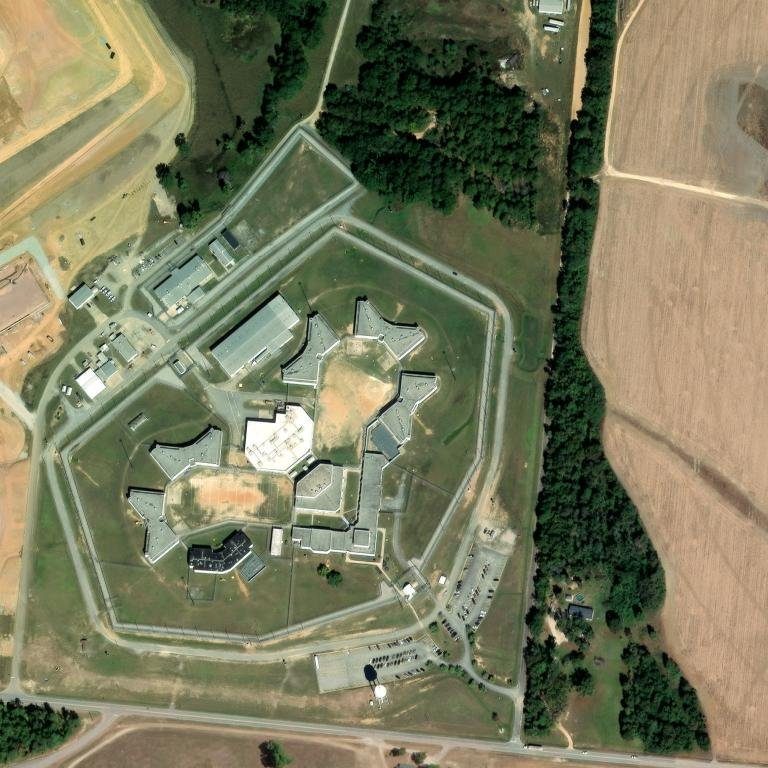
Satellite image: Esri World Imagery. Architecture documents what the building was designed to hold. See the system-wide receipts at gps.press/warehouse.
Then and now

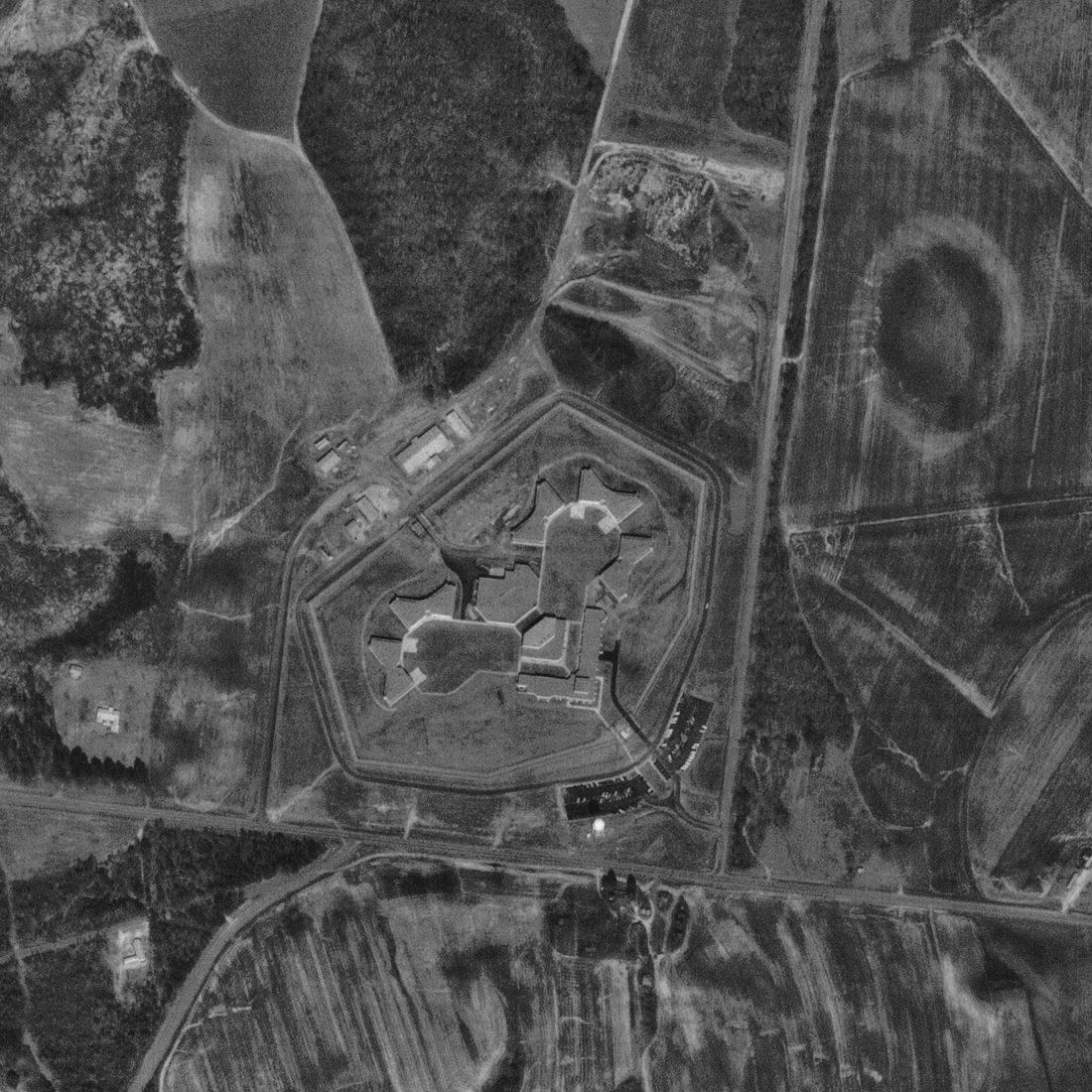
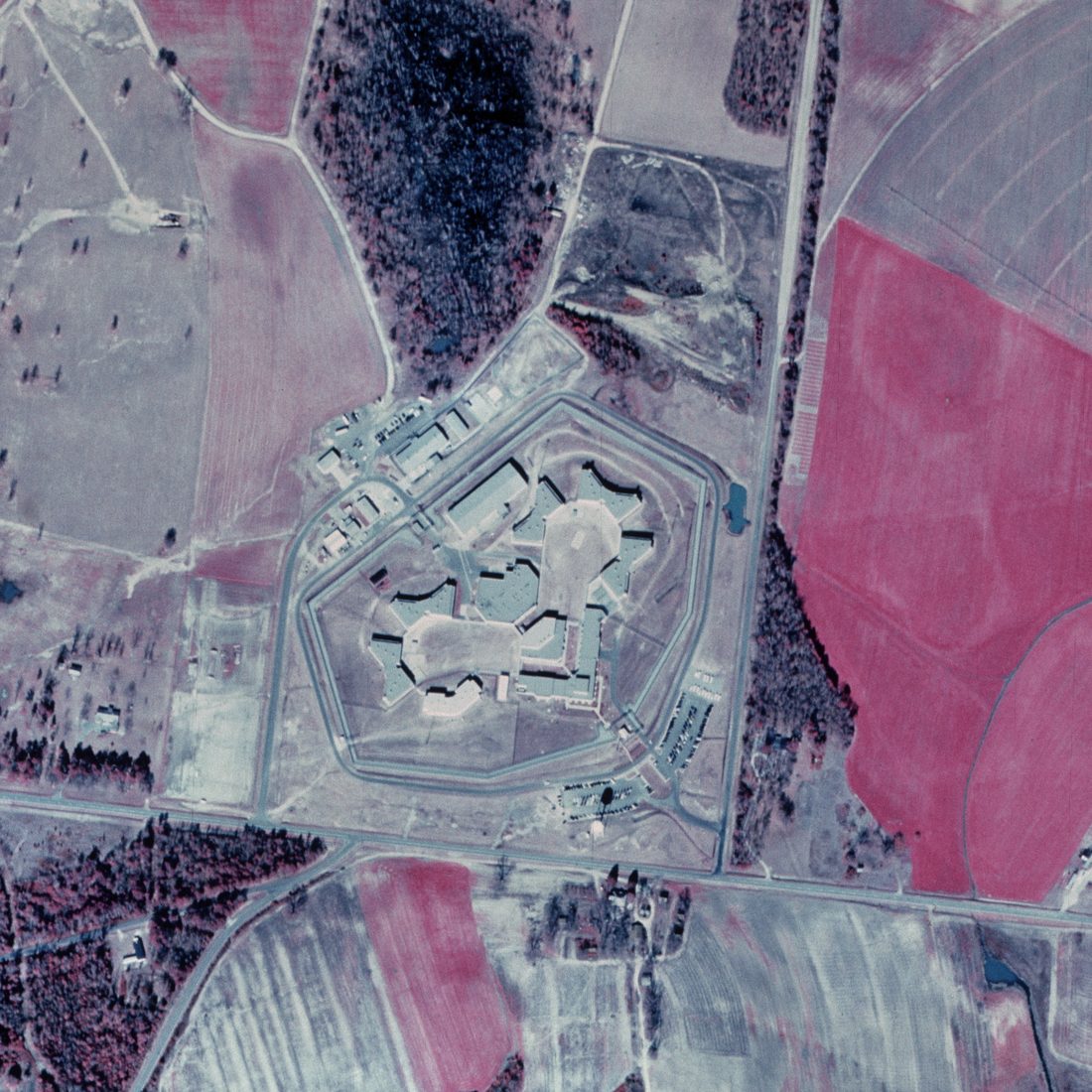
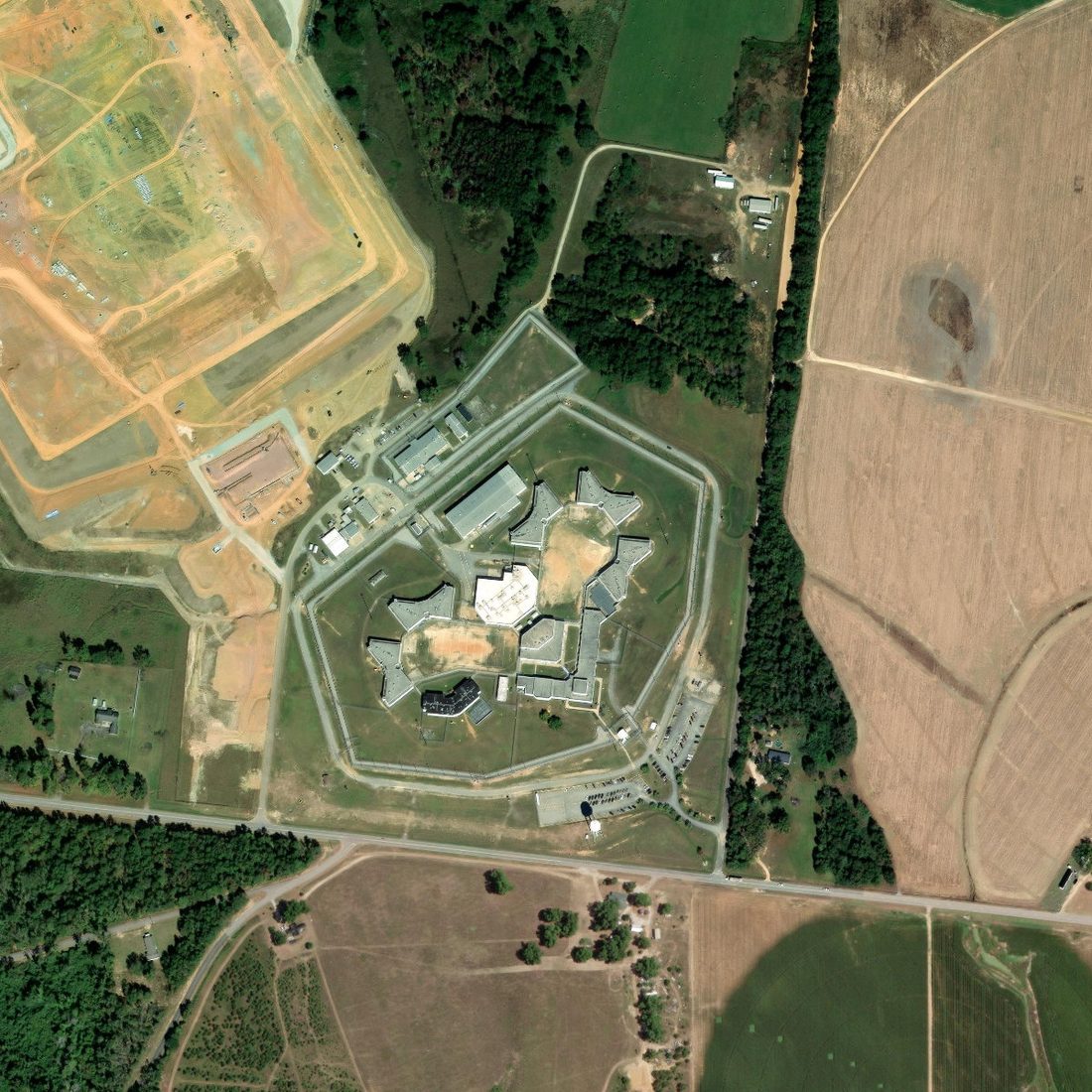
Each photo shows the same 1.2 km square, north up, so buildings line up from one year to the next. The older photos are U.S. Geological Survey aerial photographs. The photos from 1988 and earlier were taken on film and lined up with the later ones by their roads, so their positions are approximate. The early-1980s photos were taken from very high up and are less sharp. Select a photo to see it full size.