HANCOCK STATE PRISON
Facility Information
- Original Design Capacity
- 500 (at 234% capacity)
- Bed Capacity
- 1,191 beds
- Current Population
- 1,169
- Active Lifers
- 260 (22.2% of population) · Oct 2026 GDC report
- Life Without Parole
- 215 (18.4%)
What the courts held in Brown v. Plata, and how Georgia compares →
- Address
- 701 Prison Boulevard, Sparta, GA 31087
- Phone
- (706) 444-1000
- Fax
- (706) 444-1137
- Mailing Address
- P.O. Box 339, Sparta, GA 31087
- County
- Hancock County
- Opened
- 1992
- Operator
- GDC (Georgia Dept. of Corrections)
Security Classification
Last updated: October 2, 2026
867 of the 1,168 people held here are classified Close security (74.2%), as of September 23, 2026.
| Security level | People | Share |
|---|---|---|
| Close | 867 | 74.2% |
| Medium | 265 | 22.7% |
| Minimum | 36 | 3.1% |
| Total | 1,168 |
Earlier count (undated table, produced October 22, 2025): 885 of 1,195 Close (74.1%).
Restrictive housing beds
| Program | Beds | Occupied |
|---|---|---|
| Tier II | 83 | 82 |
Source: Georgia Department of Corrections records produced to GPS under the Open Records Act (R031471-090226, R024615-101925, R031710-091426). A person's security level is GDC's classification of that person, which can differ from the prison's own designation.
Follow Hancock State Prison
Leadership & Accountability (as of 2026 records)
Officials currently holding positional authority at this facility, with deaths attributed to GPS-tracked records during their leadership tenure. Inclusion reflects role-based accountability, not legal findings of personal culpability. Death counts shown as facility / career.
| Role | Name | Since | Deaths this facility / career |
|---|---|---|---|
| WARDEN 2 (facility lead) | Williams, JOE | 2025-01-01 | 11 / 13 |
| Deputy Warden of Security (facility deputy) | Sanford, Paul Anthony | 2023-01-01 | 12 / 12 |
| Deputy Warden of Administration (facility deputy) | Adams, Chequita | 2026-01-16 | 5 / 5 |
| Deputy Warden of Care and Treatment (facility deputy) | Mitchell, Rashedah Fayola | 2026-02-01 | 4 / 4 |
| Deputy Warden of Security (facility deputy) | Mahoney, Tamika | 2026-07-16 | 1 / 1 |
About
Last updated October 11, 2026.(DS)
Hancock State Prison: A Close-Security Facility Running on a Skeleton Crew
Hancock State Prison sits outside Sparta in Hancock County, a close-security men's facility that opened in 1992 and today holds 1,169 people against an original design capacity of 500 — 98.2% of its current rated capacity of 1,191. It was built around 1990 to house a general population; it now holds many of the state's highest-risk prisoners under Tier I and Tier II close-custody management, with multiple segregation and isolation units and an annex area alongside dormitory housing. GPS's registry records 27 deaths at the facility since January 1, 2020 — 17 of them classified as homicides. Against that mortality record stands a staffing figure that explains much of it: as of October 2024, 73.5% of Hancock's correctional officer positions were vacant, leaving roughly 49 officers to supervise more than 1,100 incarcerated men. The sections below trace the deaths, the staffing collapse, the classification pressures, and the infrastructure failures that GPS and outside investigators have documented at this facility.
The Deadliest Record: 27 Deaths Since 2020
GPS's mortality registry records 27 deaths at Hancock State Prison since January 1, 2020, a count that is a floor rather than a ceiling — GDC reports deaths roughly two months late, and the registry does not include the 791 deaths GPS separately holds from the 2015–2019 UCLA Law Behind Bars series. Of the 27, GPS classifies 17 as homicides, 4 as Unknown/Pending, 3 as Natural/Medical, 2 as Suicide, and 1 as Other. The full list is maintained at GPS's facility death registry.
The most recent entries are also the most concentrated. Albert Chapa died July 30, 2026, at Hancock State Prison; GPS's registry lists the cause as Unknown/Pending. Jacorey Derrelle Pearson died April 7, 2026, at Hancock State Prison; the registry lists the cause as Homicide. Jerrod Johnson died February 18, 2026, at Hancock State Prison; the registry lists the cause as Homicide. Jaylin Bell died February 6, 2026, at Hancock State Prison; the registry lists the cause as Homicide. Steven Monroe Wood died January 25, 2026, at Hancock State Prison; the registry lists the cause as Homicide.
Before them: Andre Rashad Weems died September 9, 2025, at Hancock State Prison; the registry lists the cause as Homicide. Brian Smith died July 24, 2025, at Hancock State Prison; the registry lists the cause as Unknown/Pending. Corey Jose July died June 17, 2025, at Hancock State Prison; the registry lists the cause as Homicide. John T Childree died April 9, 2025, at Hancock State Prison; the registry lists the cause as Unknown/Pending. William Holeman died January 30, 2025, at Hancock State Prison; the registry lists the cause as Homicide. Prince Porter died January 30, 2025, at Hancock State Prison; the registry lists the cause as Homicide. Travon Montrell Walthour died October 13, 2024, at Hancock State Prison; the registry lists the cause as Homicide. Ralph Thompson died October 8, 2024, at Hancock State Prison; the registry lists the cause as Unknown/Pending.
Further back, Timothy Dale Hicks died August 22, 2023, at Hancock State Prison; the registry lists the cause as Suicide. Francisco Melgar-Saldivar died August 12, 2023, at Hancock State Prison; the registry lists the cause as Homicide. Roland Lamont Phillips died June 28, 2023, at Hancock State Prison; the registry lists the cause as Homicide. Norman Jackson Samples died December 27, 2022, at Hancock State Prison; the registry lists the cause as Homicide. Zackery Phillip Brown died December 23, 2022, at Hancock State Prison; the registry lists the cause as Suicide. Terry Lee Bishop died October 18, 2022, at Hancock State Prison; the registry lists the cause as Homicide. Antione Lamar Bush died June 18, 2022, at Hancock State Prison; the registry lists the cause as Natural/Medical. Charles Tristen Mckee died May 23, 2022, at Hancock State Prison; the registry lists the cause as Homicide. Terrill Bernard Howard died October 17, 2021, at Hancock State Prison; the registry lists the cause as Other. Michael Anthony Brown died June 26, 2021, at Hancock State Prison; the registry lists the cause as Natural/Medical. Dwayne Zackery died February 12, 2021, at Hancock State Prison; the registry lists the cause as Homicide. Rashad Bolton died January 4, 2021, at Hancock State Prison; the registry lists the cause as Homicide.
For context on scale: GPS has independently tracked 1,913 deaths in GDC custody system-wide since 2020, a figure that is likewise a floor. Hancock's 27 deaths represent a disproportionate share of a system that the U.S. Department of Justice found in October 2024 to be operating in violation of the Eighth Amendment's prohibition on cruel and unusual punishment.
January 2025: Two Men Found Dead Fifteen Feet Apart
The single most documented incident at Hancock in the recent record is the January 30, 2025 gang-related violence that left two men dead in the same dormitory. The Atlanta Journal-Constitution reported that William Holeman, 34, and Prince Porter, 38, were found dead about 15 to 20 feet apart. Porter had a single puncture wound in his upper back; Holeman had no visible marks on his body. A third incarcerated person was hospitalized as a result of the violence, with no information available on his condition at the time. GPS's registry lists both deaths as homicides.
The AJC's broader reporting on Georgia's prison crisis, published January 31, 2025, placed the Hancock deaths inside a pattern: gang-related violence at the facility resulting in two prisoner deaths, with the coroner leaning toward homicide in at least one case. The same reporting documented that Hancock had one of the GDC's highest correctional officer vacancy rates — 73.5% of positions vacant as of October, leaving only 49 officers on staff for over 1,100 prisoners. Consultants cited in that coverage found staffing vacancies at 20 of Georgia's 34 prisons had reached "emergency levels," making it impossible to keep up with even basic protocols, and that cell locks at many prisons were broken.
The McKee Case: A Dorm Placement, a Machete, and a Federal Finding
Charles "Tristen" James McKee, 24, died May 23, 2022, at Hancock State Prison after being stabbed 13 times in the back and head; GPS's registry lists the cause as Homicide. The AJC reported that McKee, who identified as LGBTQ, was beaten and stabbed by multiple gang members after jumping through stair railings trying to escape. The day before, he had repeatedly asked to be moved, stating his life was in danger.
A lawsuit filed by McKee's family alleges he was placed in a dorm with known gang members who were hostile to LGBTQ inmates, contributing to his death, and that staff failed to act on his repeated requests to be moved the day before he was murdered. The U.S. Department of Justice investigation into McKee's death found that he tried to escape gang members who were beating and stabbing him by jumping through stair railings to the floor below, but the gang members continued to stab him there; another prisoner trying to stop the attack was seriously wounded.
Cleveland Gary was convicted in Hancock County for the slaying. The AJC reported that Gary struck McKee six times in the head with a 17-inch homemade machete after a fight had already ended. The Georgia DOAS Risk Management settlement ledger, obtained through open records, records a state liability payout of $424,710 tied to Hancock State Prison for the 2022 incident.
Settlements: What the State Has Paid Out
The DOAS Risk Management settlement ledger — a public record of state liability payouts — documents a series of payments tied to deaths at Hancock State Prison. The largest is $600,000, tied to the 2019 death of Geberyesus Yemane Selassie. The state paid $437,500 in connection with the January 4, 2021 death of Rashad Bolton, 29, who died from a puncture wound to the chest with a sharp object; his parents filed a lawsuit claiming he was stabbed to death. The state paid $424,710 in connection with McKee's 2022 death.
Smaller settlements trace further back: $13,800 tied to the 2016 death of Freedie Barnes; $250 tied to the 2016 death of Rico Sterling; and $2,000 tied to the 2015 death of Michael Bolick. The spread of figures — from a few hundred dollars to six figures — reflects the range of claims the state has resolved without trial.
Other Deaths in the Record
Several Hancock deaths have drawn specific documentation. Roland Lamont Phillips, 33, died June 28, 2023, from multiple sharp force injuries including 11 puncture wounds to the front torso and one to the neck, according to the AJC; a murder warrant was served against his cellmate. Francisco Zaldivar Melgar-Saldivar, 26, died August 12, 2023, from strangulation and blunt force injuries; a claim filed against the state alleges he was not provided appropriate medical care after being attacked by another prisoner. Norman Samples, 59, died December 27, 2022, from blunt force injuries to the head and torso. Terry Lee Bishop, 49, died October 18, 2022, from blunt force trauma, acute toxicity of methamphetamine, and acute toxicity of cannabinoids; death data show he was beaten to death by another prisoner. Dwayne Zackery Jr., 22, died February 12, 2021, from a stab wound to the chest with a homemade knife; death data state he was stabbed by his cellmate. Cesar Arnold Pastrana Morales, 33, died March 13, 2020, from a stab wound to the chest; an incident report shows five other inmates were involved.
In a separate matter, the AJC reported that prison officials placed Amanuel Selassie Geberyesus in a regular cell contrary to a counselor's advice after he expressed suicidal thoughts, and he subsequently hung himself. The DOAS ledger records a $600,000 settlement tied to the 2019 death of Geberyesus Yemane Selassie.
Violence That Did Not End in Death
Not every serious incident at Hancock has produced a fatality, and the record of non-lethal violence is itself substantial. The AJC reported that in September 2024, seven prisoners were disciplined for attacking an inmate in a gang-related assault at Hancock State Prison, according to records obtained by the outlet. In January 2026, at least two inmates were injured during a brawl inside the facility; officials did not detail the severity of the injuries or say whether the inmates were taken to a hospital.
GPS's own reporting has documented a mass-casualty stabbing event at Hancock in which five incarcerated people were stabbed with shanks and two were airlifted to hospitals. GPS records show that in the twelve months from October 2025 through October 2026, the facility generated 16 distinct sources reporting alleged inmate-on-inmate assaults across eight months, with severity ratings of critical and high, and one external complaint filed to the U.S. Department of Justice. Monthly concentration was heaviest in September 2026 (4 sources), August 2026 (3 sources), and May 2026 (3 sources). GPS has additionally received accounts of use-of-force incidents at the facility, and records 4 sources reporting alleged excessive force across three months in 2026, alongside 4 sources reporting unnamed staff misconduct.
The Corey July Killing and Its Aftermath
Corey Jose July, 33, died June 17, 2025, at Hancock State Prison; GPS's registry lists the cause as Homicide. Prosecutors said surveillance video showed Vershaun Smith chasing July, cornering him at a locked gate, and stabbing him multiple times in the prison yard. A Hancock County jury convicted Smith of malice murder, and Judge Alison T. Burleson sentenced him to life in prison without the possibility of parole. The Ocmulgee District Attorney's Office announced the conviction.
July's death is also the subject of GPS's own reporting. A GPS piece published in Spanish, "Muerte en una puerta cerrada," describes July as a 34-year-old from McDonough serving a Floyd County sentence for shoplifting, possession of a firearm by a convicted felon, and obstruction of law enforcement, with twenty months remaining and a latest possible release date of February 2027. That piece carries a "not yet checked" fact-check tag. A related GPS article, "Death at a Locked Gate," carries a GPS fact-check tag of UNRESOLVED ISSUES and is given no evidentiary weight here.
Staffing: 49 Officers for 1,100 Men
The staffing picture at Hancock is the structural fact that runs beneath every incident above. The AJC reported that 73.5% of correctional officer positions at the facility were vacant as of October 2024, leaving only 49 officers on staff for over 1,100 prisoners — one of the highest vacancy rates in the GDC system. A separate AJC report put the figure at more than 70% vacant as of the same period.
That figure sits inside a systemwide collapse. GPS has documented that officer vacancies in Georgia's prisons have run between 49.3% and 60% systemwide for multiple years, against a national standard of no more than 10%. The hiring pipeline cannot close the gap: acceptance rates are under 15%, and 82.7% of new hires leave in their first year. Georgia ranks last of 50 states for correctional-officer pay. The October 2024 DOJ findings letter concluded that "the leadership of the Georgia Department of Corrections has lost control of its facilities" and faulted GDC for placing "too much blame on gangs and insufficient emphasis on understaffing." GPS records show 8 distinct sources reporting staffing shortages at Hancock across five months in 2026, with severity ratings spanning critical, moderate, and low.
Classification Drift and the Annex
Hancock's population pressure is not only a function of headcount. GPS has documented a systemic pattern of classification drift across Georgia's prisons, in which medium-security facilities house close-security inmates without the staffing and infrastructure those classifications require. Hancock, designated close-security, holds many of the state's highest-risk prisoners under Tier I and Tier II close-custody management, with multiple segregation and isolation units and an annex area alongside dormitory housing.
The annex itself has drawn recurring accounts. GPS has received reports describing the annex as a metal building without insulation or ventilation, with interior temperatures reportedly rising above 105°F, and accounts alleging that HVAC systems at the facility were not functioning. These are family and witness accounts; GPS has not independently verified the physical conditions described.
Contraband, Corruption, and the Officer Who Smuggled Drugs
The AJC reported that short-staffing, safety problems, and corruption inside Georgia's prisons have allowed prisoners to operate large criminal enterprises from their cells, with 28 major drug-trafficking cases filed between 2015 and 2024. Federal prosecutors announced charges against dozens of people for conspiring to distribute cocaine, methamphetamine, oxycodone, and marijuana, including inmates at Wilcox, Telfair, and Macon state prisons, Georgia Diagnostic and Correctional Prison, and the privately operated Wheeler and Jenkins correctional facilities.
At Hancock specifically, the AJC reported that in January 2019, facility officer Jasmine Nicole Hall was caught with water bottles containing compartments filled with meth, pot, ecstasy, and hydrocodone; phone evidence revealed an ongoing drug distribution scheme across eight prisons totaling over $5,000 in transactions. The case illustrates the two-directional nature of the contraband problem: staff are not only the enforcement mechanism but sometimes the supply line.
Food Service: High Scores, Contested Conditions
Against the violence and staffing record, Hancock's food-safety inspections present a different picture. The Georgia Department of Public Health conducted routine inspections on October 13, 2023 (two inspections, both scoring 100, Grade A), June 25, 2024 (one at 100 and one at 93 with two violations for eating/drinking/tobacco use and personal cleanliness), December 31, 2024 (two at 100), May 27, 2025 (one at 100 and one at 96 with one violation for food-contact surfaces cleaned and sanitized), December 18, 2025 (two at 100), and June 25, 2026 (two at 100).
GPS has documented a systemic pattern in which DPH inspection scores fail to capture food-service sanitation failure across GDC kitchens — broken tray-sanitizing dishwashers, sustained roach and rodent infestation, and meals served on visibly contaminated trays. GPS's analysis attributes the gap to scheduled walkthroughs that do not assess equipment under load, and to professional overlap between inspectors and facility staff in small-county settings. The Marshall Project's May 16, 2026 investigation, "Rats, Insects and Mold," independently reported rats in kitchens, insects in food, moldy trays, and visible malnutrition across Georgia facilities. High DPH scores at GDC facilities coexist with sustained witness reports of equipment failure and food contamination; the contradiction is the analytical center of GPS's investigation "Dunked, Stacked, and Served."
The Wider System: Gang War and the Washington State Prison Riot
Hancock's violence is not isolated. On January 11, 2026, a gang-related riot at Washington State Prison, roughly 150 miles away, killed four people: Teddy Dewayne Jackson, 27; Ahmod Dewayne Hatcher, 23; and Jimmy Lee Trammell, 42, who was days from release, all killed at the scene, and Silas Rodrígioeuz Westbrook, 42, who was injured on January 11 and died January 17 after hospital release. Dajhmere Ladaveon Hall, 30, was found dead at Washington State Prison two days before the riot, on January 9, with cause held Unknown/Pending — part of a five-deaths week across the system. Washington State Prison was placed on continuous lockdown following the brawl and has not reopened. In April 2026, twelve inmates were charged with felony murder, aggravated assault, and gang participation in connection with the disturbance. GPS open-records production documented that six officers were on duty at Washington State Prison when the January 11 riot began.
GPS's reporting has described the January 2026 events as part of a coordinated "Blood on Blood" factional war between ROLACC and G-Shine sets, with multiple facilities locked down and life flights dispatched. A GPS article on the subject, "Blood on Blood: Georgia Statewide Prison Lockdown," carries a clean fact-check tag. The DOJ's October 2024 findings letter had already concluded that gangs effectively run multiple facilities, controlling access to phones, showers, food, and bed assignments; approximately 31% of the system's roughly 49,000 incarcerated population are validated members of 315 different security threat groups, more than double the national average.
What the Record Shows
Hancock State Prison opened in 1992 with a design capacity of 500. It now holds 1,169 people — 98.2% of its rated capacity of 1,191, and more than double its original design. It is led by Warden Joe Williams, with Deputy Wardens of Security Paul Anthony Sanford and Tamika Mahoney, Deputy Warden of Care and Treatment Rashedah Fayola Mitchell, and Deputy Warden of Administration Chequita Adams. Against a 27-death record since 2020, 17 of them homicides, the facility operates with roughly 49 officers for over 1,100 incarcerated men. The state has paid out more than $1.4 million in liability settlements tied to Hancock deaths since 2015. The pattern GPS has documented — staffing collapse, classification drift, gang control, and infrastructure failure — is not unique to Hancock, but the facility's mortality record places it among the most lethal in the system.
Sources
This analysis draws on reporting from the Atlanta Journal-Constitution, WGXA, and 41NBC; Georgia Department of Public Health food-safety inspection records; the Georgia Department of Administrative Services Risk Management settlement ledger obtained through open records; U.S. Department of Justice findings; Georgia Department of Corrections statements and incident data; GPS's mortality registry and intelligence records; and GPS's own investigative reporting, including its coverage of the January 2026 statewide gang violence and its analysis of food-service sanitation across GDC facilities.
Mortality Statistics
31 deaths documented at this facility from 2020 to present.
Deaths by Year
- 2026: 9
- 2025: 6
- 2024: 2
- 2023: 3
- 2022: 5
- 2021: 4
- 2020: 2
County Public Health Department
Food service and sanitation at HANCOCK STATE PRISON fall under the jurisdiction of the Hancock County Environmental Health Department. Incarcerated people cannot choose where they eat — public health inspectors carry an elevated responsibility to hold this kitchen to the same standards applied to any restaurant.
Contact
- Title
- Environmental Health Director
- Address
-
P.O. Box 398
Sparta, GA 31087 - Phone
- (706) 444-6616
- hancock.eh@dph.ga.gov
- Website
- Visit department website →
Why this matters
GPS has documented black mold on chow-hall ceilings, cold and contaminated trays, spoiled milk, and pest contamination at Georgia prisons. The Department of Justice's 2024 report confirmed deaths from dehydration and untreated diabetes tied to food and water deprivation. Advance-notice inspections let facilities stage temporary fixes that disappear once inspectors leave.
Unannounced inspections by the county health department are one of the few outside checks on kitchen conditions behind the fence.
How you can help
Write to the county inspector and request an unannounced inspection of the kitchen and food service operation at this facility. A short, respectful letter citing Georgia food-safety regulations is more powerful than you think — inspectors respond to public concern.
Sample Letter
This is the letter Georgia Prisoners' Speak mailed to all county environmental health inspectors responsible for GDC facilities. Feel free to adapt it.
October 15, 2026
RE: Request for Unannounced Public Health Inspection of Food Service Operations at HANCOCK STATE PRISON
Dear County Environmental Health Director,
I am writing to respectfully request that your office conduct a thorough, unannounced inspection of food service and sanitation practices at HANCOCK STATE PRISON, located in Hancock County.
Documented concerns
Georgia Prisoners' Speak, a 501(c)(3) nonprofit investigative newsroom, has published extensive investigative reporting on food safety and nutrition failures across Georgia's prison system, including:
- Dangerous sanitation conditions — black mold on chow hall ceilings and air vents, contaminated food trays, and spoiled milk served to inmates.
- Severe nutritional deficiency — roughly 60 cents per meal; inmates receive only 40% of required protein and less than one serving of vegetables per day.
- Preventable deaths — the U.S. Department of Justice's 2024 report confirmed deaths from dehydration, renal failure, and untreated diabetes following food and water deprivation.
- Staged compliance — advance-notice inspections allow facilities to stage temporary improvements, then revert once inspectors leave.
Firsthand testimony
In Surviving on Scraps: Ten Years of Prison Food in Georgia, a person who has spent more than ten years in GDC custody describes no functional dishwashing sanitation, chronic mold on food trays, and roaches found on the undersides of trays at intake facilities. Full account: gps.press/surviving-on-scraps-ten-years-of-prison-food-in-georgia.
Specific requests
- Conduct an unannounced inspection of the kitchen and food service operations at this facility, with particular attention to dishwashing equipment, tray sanitation procedures, and food storage conditions.
- Evaluate compliance with applicable Georgia food safety regulations, including O.C.G.A. § 26-2-370 and the Georgia Food Service Rules and Regulations (Chapter 511-6-1).
- Verify permit status and confirm whether the facility is subject to the same inspection schedule as other institutional food service establishments in the county.
- Make inspection results available to the public, as permitted under Georgia's Open Records Act (O.C.G.A. § 50-18-70).
Incarcerated individuals cannot advocate for their own health and safety in the way a restaurant patron can — they cannot choose to eat elsewhere. This places an elevated responsibility on public health officials to ensure these facilities meet the same sanitation standards applied to any food service establishment.
Thank you for your attention to this important public health matter.
Sincerely,
[Your name]
Food Safety Inspections
Georgia Department of Public Health
What the score doesn't measure. DPH grades kitchen compliance on inspection day — food storage, temperatures, pest control. It does not grade whether today's trays are clean. GPS reporting has found broken dishwashers at most Georgia state prisons we've documented; trays go out wet, stacked, and visibly moldy — including at facilities with recent scores near 100.
Who inspects. Most Georgia state prisons sit in rural counties — often with fewer than 20,000 people, several with fewer than 10,000. The environmental health inspector lives in that community and often knows the kitchen staff personally. Rural inspection regimes don't have the structural independence you'd expect in a city-sized health department. Read the scores accordingly.
Read the investigation: “Dunked, Stacked and Served: Why Georgia Prison Trays Are Making People Sick”
Recent inspections
| Date | Score | Purpose | |
|---|---|---|---|
| Jun 25, 2026 | 100 | Routine | |
| Dec 18, 2025 | 100 | Routine | |
| May 27, 2025 | 96 | Routine | |
| Dec 31, 2024 | 100 | Routine | |
| Jun 25, 2024 | 100 | Routine | |
| Oct 13, 2023 | 100 | Routine |
June 25, 2026 — Score 100
Routine · Inspector: William Minton
No violations recorded for this inspection.
December 18, 2025 — Score 100
Routine · Inspector: William Minton
No violations recorded for this inspection.
May 27, 2025 — Score 96
Routine · Inspector: William Minton
| Code | Violation | Pts | Inspector notes |
|---|---|---|---|
| 2B |
food-contact surfaces: cleaned & sanitized 511-6-1.05(7)(b) - food contact surfaces and utensils - cleaning frequency (p, c) Corrected | 4 | Observed black slimy substance in ice machine beside handwash station. Equipment Food-Contact Surfaces and Utensils.1. Equipment food-contact surfaces and utensils shall be cleaned:(i) Before each use with a different type of raw animal food such as beef, fish, lamb, pork, or poultry. It does not apply if the food-contact surface or utensil is in contact with a succession of different types of raw meat and raw poultry each requiring a higher cooking temperature as specified under DPH Rule 511-6-1.04(5)(a) than the previous type such as preparing raw pork followed by cutting raw poultry on the same cutting board; P(ii) Each time there is a change from working with raw foods to working with ready-to-eat foods; P(iii) Between uses with raw fruits and vegetables and with Time/Temperature Control for safety food; P(iv) Before using or storing a food temperature measuring device; P and(v) At any time during the operation when contamination may have occurred. P2. Except as specified in paragraph 3 of this subsection, if used with time/temperature control for safety food, equipment food-contact surfaces and utensils shall be cleaned at least every 4 hours throughout the day. P3. Surfaces of utensils and equipment contacting time/temperature control for safety food may be cleaned less frequently than every 4 hours if:(i) In storage, containers of time/temperature control for safety food and their contents are maintained at temperatures specified under DPH Rule 511-6-1-.04 and the containers are cleaned when they are empty;(ii) Utensils and equipment are used to prepare food in a refrigerated room or area that is maintained at one of the temperatures in the following chart and:(I) The utensils and equipment are cleaned at the frequency in the following chart that corresponds to the temperature:Temperature Cleaning Frequency41ºF (5.0ºC) or less 24 hours>41ºF - 45ºF (>5.0ºC - 7.2ºC) 20 hours>45ºF - 50ºF (>7.2ºC - 10.0ºC) 16 hours>50ºF - 55ºF (>10.0ºC - 12.8ºC) 10 hoursand(II) The cleaning frequency based on the ambient temperature of the refrigerated room or area is documented in the food service establishment.(iii) Temperature measuring devices are maintained in contact with food, such as when left in a container of deli food or in a roast, held at temperatures specified under DPH Rule 511-6-1- .04;(iv) Equipment is used for storage of packaged or unpackaged food, such as a reach-in refrigerator, and the equipment is cleaned at a frequency necessary to preclude accumulation of soil residues;(v) The cleaning schedule is approved based on consideration of:(I) Characteristics of the equipment and its use,(II) The type of food involved,(III) The amount of food residue accumulation, and(IV) The temperature at which the food is maintained during the operation and the potential for the rapid and progressive multiplication of pathogenic or toxigenic microorganisms that are capable of causing foodborne disease; or(vi) In-use utensils are intermittently stored in a container of water in which the water is maintained at 135ºF (57ºC) or more and the utensils and container are cleaned at least every 24 hours or at a frequency necessary to preclude accumulation of soil residues.4. Dining counters and table-tops shall be cleaned and sanitized routinely after removing all soiled tableware and food trays shall be cleaned and sanitized after each use by one of the following methods:(i) A two step method in which one cloth, rinsed in sanitizing solution is used to clean food debris from the surface and a second cloth in separate sanitizing solution is used to rinse;(ii) Sanitizing solution is sprayed onto the surface and the surface is then wiped clean with a disposable towel;(iii) If used for cleaning and sanitizing, single-use disposable sanitizer wipes shall be used in accordance with EPA-registered label use instructions; or(iv) Other methods approved by the Health Authority.(v) Food trays may be cleaned and sanitized the same as table ware.5. Except when dry cleaning methods are used as specified under subsection (7)(e) of this Rule, surfaces of utensils and equipment contacting food that is not time/temperature control for safety food shall be cleaned:(i) At any time when contamination may have occurred;(ii) At least every 24 hours for iced tea dispensers including nozzles and consumer self-service utensils such as tongs, scoops, or ladles;(iii) Before restocking consumer self-service equipment and utensils such as condiment dispensers and display containers; and(iv) In equipment such as ice bins and beverage dispensing nozzles and enclosed components of equipment such as ice makers, cooking oil storage tanks and distribution lines, beverage and syrup dispensing lines or tubes, coffee bean grinders, and water vending equipment:(I) At a frequency specified by the manufacturer; or(II) Absent manufacturer specifications, at a frequency necessary to preclude accumulation of soil or mold. Machine was turned off and employee began scrubbing. |
December 31, 2024 — Score 100
Routine · Inspector: William Minton
No violations recorded for this inspection.
June 25, 2024 — Score 100
Routine · Inspector: William Minton
No violations recorded for this inspection.
October 13, 2023 — Score 100
Routine · Inspector: William Minton
No violations recorded for this inspection.
Recent reports (25)
Source-attributed observations and allegations from news coverage and reports submitted to GPS. Each entry credits its source.
- ALLEGATION According to WGXA Recorded by GPS: Sep 21, 2026Vershaun Smith chased down and stabbed fellow inmate Corey Jose July multiple times, killing him, as shown in surveillance footage presented at trial.
"The jury was shown surveillance footage of Smith chasing down and stabbing July to death, according to the Oculmulgee District Attorney's Office."
Read source → - ALLEGATION According to 41NBC Published: Aug 13, 2026Smith chased July, cornered him at a locked gate, and stabbed him multiple times in the prison yard.
"Prosecutors said surveillance video showed Smith chasing July, cornering him at a locked gate, and stabbing him multiple times."
Read source → - ALLEGATION According to Atlanta Journal-Constitution Published: Jan 21, 2025A lawsuit alleges Charles 'Tristen' James McKee was placed in a dorm with known gang members who were hostile to LGBTQ inmates, contributing to his death.
"A lawsuit alleges he was placed in a dorm with known gang members who were hostile to LGBTQ inmates."
Read source → - ALLEGATION According to Atlanta Journal-Constitution Published: Jan 21, 2025A claim filed against the state alleges Francisco Zaldivar Melgar-Saldivar was not provided appropriate medical care after being attacked by another prisoner.
"A claim filed against the state alleges that he wasn't provided appropriate medical care after being attacked by another prisoner."
Read source → - ALLEGATION According to Atlanta Journal-Constitution Published: Jan 21, 2025Prison officials placed Amanuel Selassie Geberyesus in a regular cell contrary to a counselor's advice after he expressed suicidal thoughts, and he subsequently hung himself.
"He told counselors that he had thoughts of suicide but contrary to a counselor's advice prison officials placed him in in a regular cell, where he hung himself in March 2019."
Read source →
Timeline (70)
Source Articles (25)
Former leadership
Officials who previously held leadership roles at this facility.
| Role | Name | Tenure | Deaths this facility / career |
|---|---|---|---|
| Interim Warden (facility lead) | Ivey, George | 2010-01-01 → 2024-12-31 | 15 / 15 |
| Deputy Warden of Security (facility deputy) | Mahoney, Tamikia Nicole | 2013-01-01 → present | 27 / 28 |
| DEPUTY WARDEN (facility deputy) | Foston, Jeremy Andrew | 2019-01-01 → 2025-12-31 | 22 / 22 |
| Deputy Warden (facility deputy) | Washington, Calpurnia Frederica | 2023-11-22 → 2023-11-22 | — / — |
| DEPUTY WARDEN (facility deputy) | Wells, Katherine | 2018-01-01 → 2018-12-31 | — / — |
| Deputy Warden (facility deputy) | Ivey Jr, George | 2023-11-22 → 2023-11-22 | — / — |
| Chaplain (specialty lead) | Larkin, Rechard A | 2023-11-22 → 2026-08-27 | — / — |
Location
Aerial View
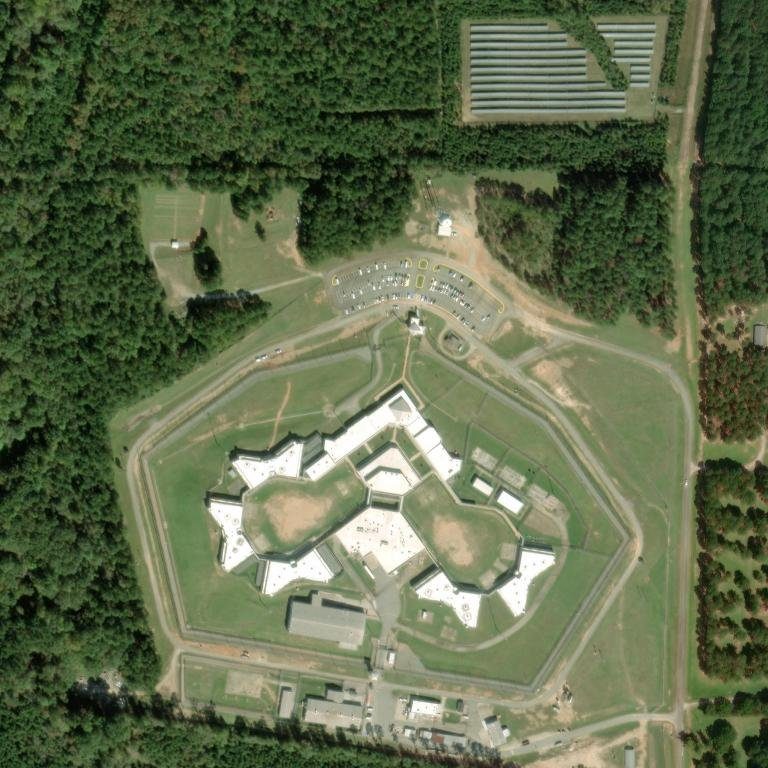
Architecture documents what the building was designed to hold. See the system-wide receipts at gps.press/warehouse.