
How Georgia Inflates “Early Release” While Forcing People to Serve Decades Longer
[Editor’s Note – Updated January 31, 2026]: Since this investigation was first published, GDC released CY2025 data confirming the pattern documented here. Of 13,724 people released from Georgia prisons in Calendar Year 2025, 54.55% served their full sentence with no parole. Only 31.21% received parole—and as our analysis shows, over a third of those were released within months of their max-out date anyway. The updated data has been incorporated into the article below.
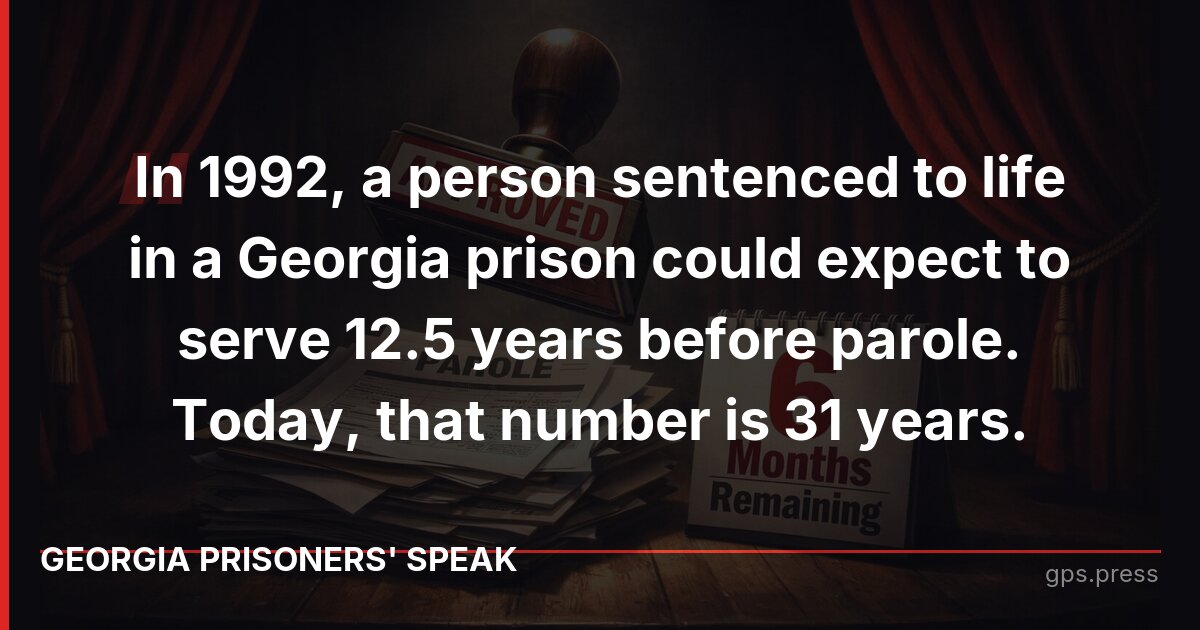
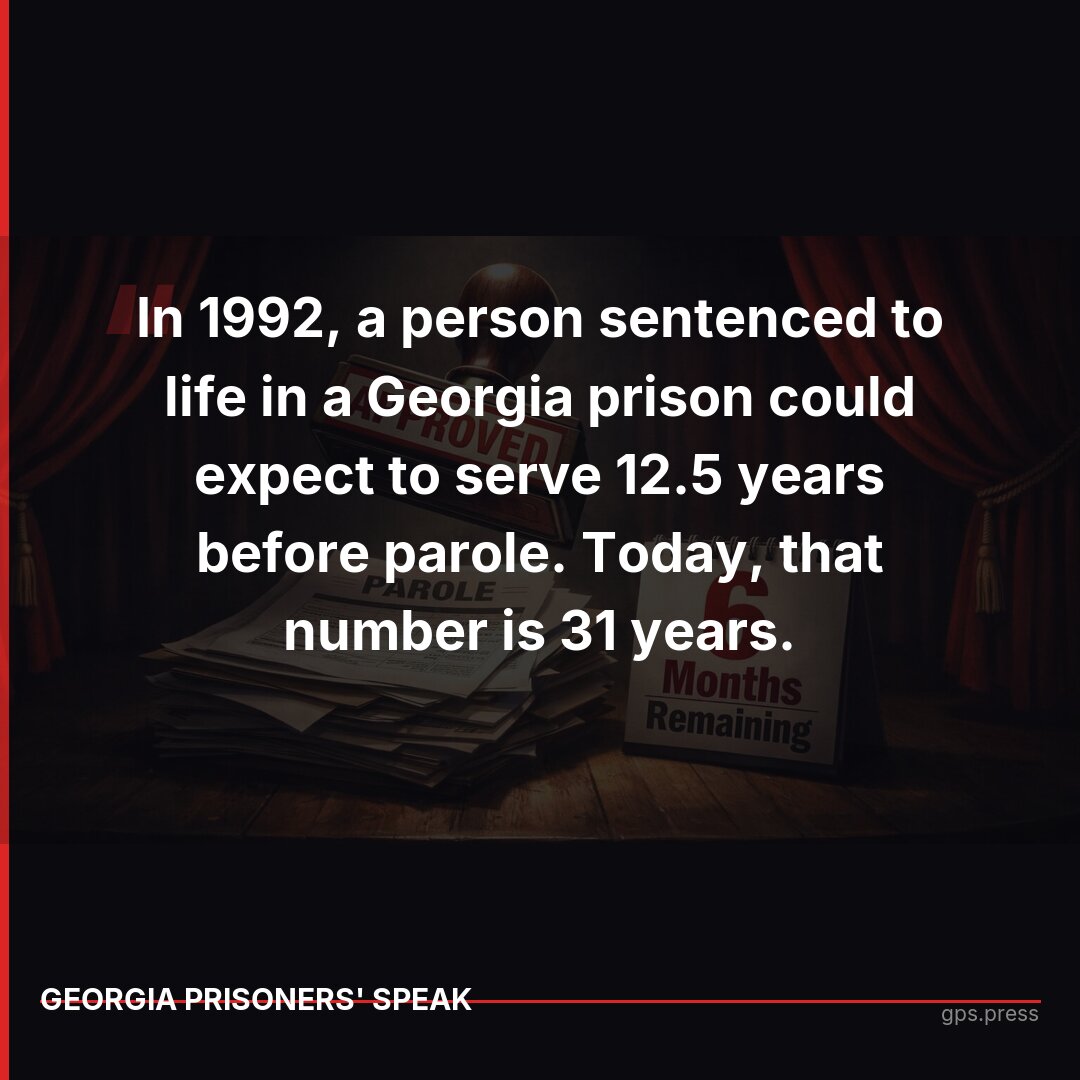
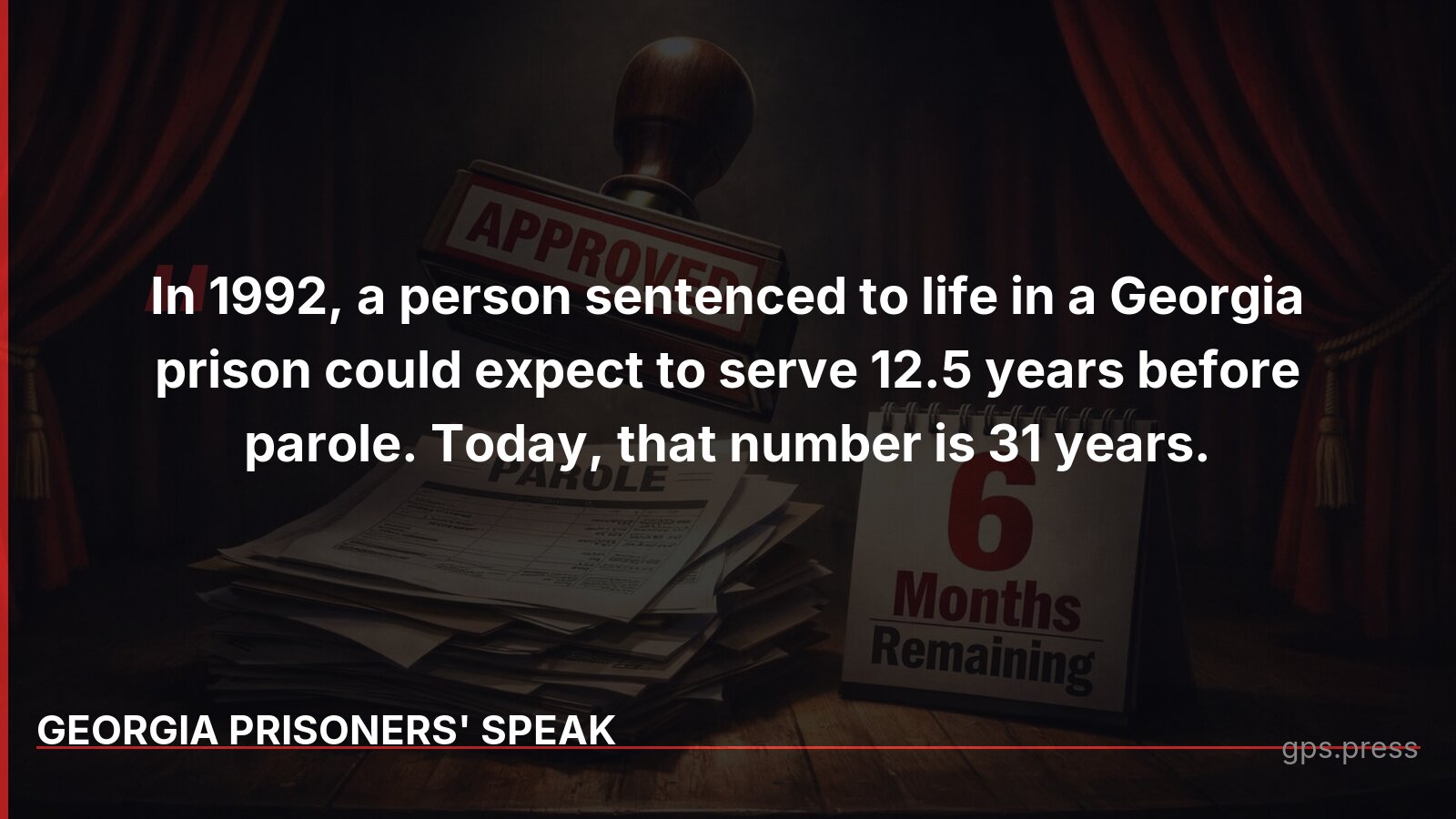
In 1992, a person sentenced to life in a Georgia prison could expect to serve 12.5 years before parole. Today, that number is 31 years.
That single statistic—buried in the Georgia Department of Corrections’ own Length of Stay report—captures what has happened to parole in Georgia over three decades. A system designed to provide meaningful early release for rehabilitation has been systematically dismantled, replaced by what can only be called parole theater: the appearance of clemency without the substance.
An analysis of 257,180 GDC records reveals the scope of the collapse. The Parole Board’s FY 2024 annual report touts 5,443 paroles granted—but of the 10,353 people currently on parole in Georgia, 37% were released within 12 months of their maximum release date (defined below as ‘near max-out). That means approximately 2,000 of those “paroles” each year save people less than a year—time they would have served anyway. Nearly 23% were released within just six months of when they would have walked out regardless.
The Parole Board publishes statistics showing thousands of paroles granted. What those statistics don’t reveal is how many were rubber stamps on inevitable releases. This creates the impression that they are releasing far more people on parole that they really are. For these thousands of Georgians, parole isn’t early release. It’s paperwork.
This is an institutional illusion.
The 30-Year Collapse
The transformation of Georgia’s parole system didn’t happen by accident. It was built, piece by piece, through legislation enacted between 1994 and 2006—and then accelerated by a Parole Board that, in the words of GDC’s own internal analysis, “on its own volition…sharply curtailed its use of clemency.”
The numbers from GDC’s Length of Stay report tell the story:1
| Year | Parole Release Rate | Avg. Years Served | Lifers: Years Before Release |
|---|---|---|---|
| 1993 | 69.9% | 1.9 years | 12.7 years |
| 2000 | 49.4% | 2.3 years | 13.8 years |
| 2010 | 58.1% | 2.8 years | 22.0 years |
| 2020 | 42.3% | 3.9 years | 27.8 years |
| 2024 | 34.3% | 4.1 years | 28.1 years |
| 2025 | 37.5% | 4.2 years | 31.1 years |
The disparity shown here is not marginal — it is structural.
In 1993, nearly 70% of people leaving Georgia prisons were released via parole. By 2024, that figure had collapsed to 34%—a 51% decline. The remaining two-thirds now serve until their max-out date with no early release at all.
Average time served has more than doubled, from 1.6 years in 1992 to 4.2 years in 2025—a 158% increase. But the most devastating change is what happened to lifers: from 12.5 years to 31 years, an increase of 148%.
Someone convicted at age 25 in 1992 could be home by 37 or 38—young enough to work, raise children, rebuild a life. Someone convicted at 25 today won’t be released until they’re 56 years old, emerging with decades of trauma, likely chronic health conditions, no work history, and into a world that has completely changed.
How Georgia Built This System
The architecture of parole’s destruction was erected in three phases.
Phase 1: The “Seven Deadly Sins” (1994-1995)
On January 1, 1995, Georgia’s “Seven Deadly Sins” law took effect. Senate Bill 441 designated seven crimes as “serious violent felonies”—murder, kidnapping, armed robbery, rape, aggravated sodomy, aggravated sexual battery, and aggravated child molestation—and imposed mandatory minimums of 10-25 years with no parole eligibility. Offenders must serve 100% of their sentence. A second conviction meant life without parole.
The law was sold as necessary to address a crime crisis. Georgia collected $82 million in federal grants between 1996 and 2001 for adopting these “truth in sentencing” provisions. 2
Phase 2: The 90% Policy (1997-1998)
Beyond statutory changes, the Parole Board implemented administrative policies that compounded the restrictions. In December 1997, the Board adopted a resolution requiring offenders convicted of 20 additional violent crimes to serve 90% of their sentence before parole eligibility.
The policy was applied with almost no exceptions. From January 1998 through June 2001, the Board deviated in exactly 10 cases out of 8,664—a rate of 0.12%. 3
Phase 3: HB 1059 (2006)
House Bill 1059, signed by Governor Sonny Perdue on April 7, 2006, delivered the final blow to meaningful lifer parole. The legislation increased parole eligibility for life sentences from 14 years to 30 years—a 114% increase affecting all serious violent felonies committed after July 1, 2006.
The result: three distinct eras of parole eligibility for life sentences.4
| Crime Committed | Parole Eligibility |
|---|---|
| Before January 1, 1995 | After 7 years |
| January 1, 1995 – June 30, 2006 | After 14 years |
| After July 1, 2006 | After 30 years |
The Southern Center for Human Rights called HB 1059 “a public policy disaster that will do irreparable damage to thousands of Georgia’s families.” 5
They were right.
The consequences of this shift are not evenly distributed.
The Two-Tier System
The GPS analysis of current parolees reveals a pattern that defies common assumptions about how the Parole Board operates.
| Offense Category | Parolees | Near Max-Out Rate | Avg. Years Remaining |
|---|---|---|---|
| Drug Trafficking | 1,307 | 17.3% | 5.4 years |
| Sex Offenses | 336 | 31.8% | 7.0 years |
| Simple Possession | 598 | 33.4% | 4.1 years |
| Violent Crimes | 1,751 | 38.5% | 5.0 years |
| Property Crimes | 768 | 44.0% | 4.0 years |
Drug traffickers—including those convicted of trafficking hundreds of grams of cocaine or methamphetamine—have the lowest near-max-out rate at 17.3%. Over 80% receive meaningful early release, averaging more than five years before their max-out date.
Property offenders have the highest near-max-out rate at 44%. Nearly half are rubber-stamped within a year of when they’d be released anyway.
The pattern holds at the individual offense level. Among those with the highest near-max-out rates:
- Entering Vehicle: 73.3%
- Possession of Cocaine: 70.6%
- Possession of Methamphetamine: 67.4%
- Theft by Shoplifting: 61.1%
Among those with the lowest:
- Trafficking Meth (200-399 grams): 7.5%
- Trafficking Cocaine (400+ grams): 9.5%
- Armed Robbery: 17.6%
This creates a perverse outcome. People convicted of relatively minor offenses—shoplifting, simple possession, entering a vehicle—are held until the last possible moment. Meanwhile, those convicted of trafficking large quantities of drugs receive years of meaningful early release.
The Lifer Reality
The Parole Board points to lifer paroles as evidence of meaningful clemency. And 1,540 people serving life sentences are currently on parole in Georgia.
But the demographics tell a different story.
| Birth Decade | Lifers on Parole | Percentage |
|---|---|---|
| Pre-1950 | 155 | 10.1% |
| 1950s | 412 | 26.8% |
| 1960s | 590 | 38.3% |
| 1970s | 366 | 23.8% |
| 1980s | 17 | 1.1% |
98.9% of lifers currently on parole were born before 1980. The average age is 63.9 years. These are overwhelmingly people convicted decades ago, paroled by previous Boards under previous policies.
Only 17 people born in the 1980s—meaning they were likely convicted after 2005—are currently on parole with life sentences. Their offenses:
- Murder: 10
- Armed Robbery: 5
- Drug Trafficking: 1
- Kidnapping: 1
The current Parole Board, composed entirely of Governor Kemp’s appointees (with one member appointed late in Governor Deal’s term), rarely grants parole to recently-convicted lifers. The Board’s own statistics show that in FY 2024, it considered 2,046 life sentence cases and granted parole to just 93 people—a 4.5% approval rate. 6
The Fiscal Time Bomb
Keeping people incarcerated until their late 50s and 60s isn’t just cruel. It’s creating a fiscal catastrophe.
Georgia spends $8,500 per year on medical costs for inmates over 65, compared to $950 per year for younger inmates—nine times higher. As prisoners age, they develop the chronic conditions of any elderly population: diabetes, hypertension, heart disease, dementia. But they develop them in facilities the U.S. Department of Justice has declared unconstitutionally inadequate for healthcare.
GDC’s budget has exploded from $1.27 billion (FY 2023) to $1.62 billion (FY 2026)—a 44% increase in just four years. Healthcare and pharmacy contracts alone increased by $72 million in FY 2025, driven by “chronic health needs and an aging incarcerated population.” 7
The math is brutal. At $86.61 per day, each additional year someone serves costs taxpayers $31,612. The shift from 12.5 years to 31 years for lifers represents 18.5 additional years—approximately $585,000 per person in additional incarceration costs, not counting the dramatically higher medical expenses in the final decade.
With approximately 10,000 lifers in the system, the cumulative cost of this policy shift approaches the $40 billion GPS has documented in prior investigations. 8
And what has Georgia received for this investment? The Department of Justice found in October 2024 that conditions in Georgia prisons violate the Eighth Amendment’s prohibition on cruel and unusual punishment. Homicides increased from 7 in 2018 to 100 in 2024. Correctional officer vacancy rates exceeded 56%. 9
Georgia is paying more than ever to incarcerate people longer than ever in facilities more dangerous than ever.
Proving the full extent of this pattern requires access to data Georgia refuses to release.
The Secrecy
The full extent of parole theater remains obscured because Georgia officials refuse to release the data that would expose it completely.
On November 26, 2025, GPS submitted an Open Records request to GDC seeking basic release data for 2015-2024: GDC ID, release date, release type, facility, and days remaining on sentence.
GDC’s General Counsel, Jennifer Ammons, responded that everything is exempt under O.C.G.A. § 42-5-36(c)—the “central office files” exemption.
GPS cited Red & Black Publishing Co. v. Board of Regents, the Georgia Supreme Court case requiring agencies to segregate exempt from non-exempt material. 10
GDC’s reply was revealing: “The Commissioner exercises his discretion to declassify the data that is found on our website.”
In other words, the Commissioner could release actual release dates. He simply chooses not to.
The one field that would definitively prove the near-max-out pattern—actual release date—is the one GDC refuses to provide.
With release dates, anyone could calculate exactly how much time parole saved each individual. Without them, the Board’s claims of meaningful early release cannot be independently verified.
GPS also submitted a request to the Parole Board itself, citing O.C.G.A. § 42-9-53(b)—the statute that specifically requires the Board to release “statistical and non-identifying data relating to parole.”
The Parole Board never responded.
What This Data Proves
The evidence is now overwhelming, drawn from GDC’s own reports and GPS’s independent analysis:
1. Parole has been gutted. The Board now releases only 34% of people via parole, down from 70% in 1993. The remaining 66% serve until max-out.
2. Even granted paroles are often meaningless. Of those who do receive parole, 37% are released within 12 months of their max-out date. Nearly a quarter are released within six months.
3. People are aging in prison. Lifers now serve 31 years before release versus 12.5 years in 1992. This 18.5-year increase means people are released as elderly rather than as individuals who could rebuild productive lives.
4. The system treats traffickers better than shoplifters. Drug trafficking offenses have a 17% near-max-out rate; property crimes have 44%. The Board grants meaningful early release to major drug offenders while rubber-stamping petty theft.
5. The costs are catastrophic. Georgia’s corrections budget has increased 44% in four years while conditions have deteriorated to unconstitutional levels.
This is parole theater: the maintenance of a system’s appearance while hollowing out its function. The Board publishes annual reports showing thousands of paroles granted. What those reports don’t reveal is that for most recipients, “parole” meant a few extra months of freedom—if that.
New Data Confirms the Pattern
GDC’s Calendar Year 2025 release statistics, published January 2, 2026, confirm what the data already showed: parole has become the exception, not the rule.
Of the 13,724 people released from Georgia prisons in CY202511:
| Release Type | Number | Percentage |
|---|---|---|
| Max-Out (Full Sentence Served) | 7,486 | 54.55% |
| Parole | 4,283 | 31.21% |
| Deaths in Custody | 301 | 2.19% |
| Other | 1,654 | 12.05% |
More than half of all releases are max-outs—people who served every day of their sentence because the Parole Board never granted release. Only 31.21% received parole certificates. And 301 people—2.19% of all “releases”—were deaths in custody, counted in state statistics as if they walked out the door.
Combined with GPS’s finding that 37% of parolees were released within 12 months of their max-out date, the picture becomes clear: the majority of people in Georgia prisons either receive no parole at all, or receive parole so late it’s meaningless.
Here’s the paradox that makes this a policy choice rather than a public safety necessity: Georgia’s parole success rate is 73%—well above the national average of 60%. People released on parole in Georgia complete supervision at higher rates than almost anywhere in the country.12
Parole works when Georgia uses it. Georgia just refuses to use it.
Methodology
This analysis is based on 257,180 offender records scraped from the Georgia Department of Corrections public offender search between December 2025 and January 2026.
Of the 10,353 individuals with “PAROLE” status:
- 1,540 (14.9%) are serving LIFE sentences
- 8,700 (84.0%) are non-lifers with determinable max-out dates
- 113 (1.1%) have missing or invalid date fields
“Near max-out” is defined as within 12 months of maximum release date. “Meaningful release” is more than 12 months before maximum release date.
Historical parole and length-of-stay data is drawn from GDC’s official Length of Stay (Calendar Year) report, containing 35 years of annual data across 304 offense categories.
Lifer conviction era was estimated using birth year as a proxy given GDC’s refusal to release actual conviction dates.
Drug trafficking includes all offenses containing “TRAF” in the description. Property crimes include theft, burglary, shoplifting, entering vehicle, and forgery. Simple possession includes “POSS” offenses excluding “POSS W INT” (possession with intent to distribute).
Explore the Data
GPS makes GDC statistics accessible to the public through several resources:
- GPS Statistics Portal — Interactive dashboards translating complex GDC reports into accessible formats, updated within days of official releases.
- GPS Lighthouse AI — Ask questions about Georgia’s prison system and get answers drawn from GPS’s investigative archive and data analysis.
- Machine-Readable Pages for Researchers — GPS maintains AI-optimized pages for data analysis:
Contact GPS at media@gps.press for access to underlying datasets, including the parolees near max-out, parolees past max-out, and lifer parolees CSV files used in this analysis.
Call to Action: What You Can Do
301 people died in Georgia prisons in 2025 while officials counted their deaths as 'releases' in state statistics. More than half of all other releases served every day because parole was denied. When you stay silent about this institutional deception, you enable it to continue.
Spread the Word — It Takes 15 Seconds
Awareness without action changes nothing. Here are the most effective ways you can help push for accountability and real reform:
Use Impact Justice AI
Our free tool at https://impactjustice.ai helps you instantly draft and send personalized emails to lawmakers, journalists, and agencies. No expertise required—just your voice and your concern.
Contact Your Representatives
Your state legislators control GDC’s budget, oversight, and the laws that created these failures. Demand accountability and transparency.
- Find your Georgia legislators: https://open.pluralpolicy.com/ga/
- Governor Brian Kemp: (404) 656-1776
- Georgia Department of Corrections Commissioner: (478) 992-5246
Demand Media Coverage
Journalists need to know these stories matter. Contact newsrooms at the Atlanta Journal-Constitution, local TV stations, and national outlets covering criminal justice. More coverage means more pressure for reform.
Amplify on Social Media
Share this article and call out the people in power.
Tag: @GovKemp, @GDC_Georgia, your local representatives
Use hashtags such as #GAPrisons, #PrisonReform, #GeorgiaPrisonerSpeak
Public pressure works—especially when it’s loud.
File Public Records Requests
Georgia’s Open Records Act gives every citizen the right to access government documents. Request:
- Incident reports
- Death records
- Staffing data
- Medical logs
- Financial and contract documents
Transparency reveals truth.
https://georgiadcor.govqa.us/WEBAPP/_rs/SupportHome.aspx
Attend Public Meetings
The Georgia Board of Corrections holds public meetings. Legislative committees review corrections issues during session. Your presence is noticed.
Contact the Department of Justice
For civil rights violations in Georgia prisons, file a complaint with the DOJ Civil Rights Division:
https://civilrights.justice.gov
Federal oversight has forced abusive systems to change before.
Support Organizations Doing This Work
Donate to or volunteer with Georgia-based prison reform groups fighting for change on the ground.
Vote
Research candidates’ positions on criminal justice. Primary elections often determine outcomes in Georgia. Your vote shapes who controls these systems.
Contact GPS
Georgia Prisoners’ Speak exists because incarcerated people and their families deserve to be heard. If you have information about conditions inside Georgia’s prisons, contact us securely at GPS.press.
Further Reading
- Georgia’s Shadow Sentencing System *How unwritten parole policies add years to sentences without legislative action.*
- Truth in Sentencing Broke Parole. Georgia Is Paying the Price. *The history of Georgia’s parole collapse and its devastating consequences.*
- $700 Million More—And Nothing to Show for It *Georgia’s corrections spending explosion examined.*
- Georgia’s $40 Billion Mistake *The true cost of truth-in-sentencing policies on Georgia taxpayers.*
- A Second Chance for Georgia: Fixing Parole With the Reform It Desperately Needs *The case for presumptive parole reform in Georgia.*
About Georgia Prisoners’ Speak (GPS)
Georgia Prisoners’ Speak (GPS) is a nonprofit investigative newsroom built in partnership with incarcerated reporters, families, advocates, and data analysts. Operating independently from the Georgia Department of Corrections, GPS documents the truth the state refuses to acknowledge: extreme violence, fatal medical neglect, gang-controlled dorms, collapsed staffing, fraudulent reporting practices, and unconstitutional conditions across Georgia’s prisons.
Through confidential reporting channels, secure communication, evidence verification, public-records requests, legislative research, and professional investigative standards, GPS provides the transparency the system lacks. Our mission is to expose abuses, protect incarcerated people, support families, and push Georgia toward meaningful reform based on human rights, evidence, and public accountability.
Every article is part of a larger fight — to end the silence, reveal the truth, and demand justice.
Additional Sources
1. Georgia Council on Criminal Justice Reform – Wikipedia Overview of Georgia’s criminal justice reform efforts and the Council established under Governor Deal. https://en.wikipedia.org/wiki/Georgia_Council_on_Criminal_Justice_Reform
2. Prison Legal News – “Unconscionable and Unacceptable” Conditions in Georgia DOC Documentation of 57 prisoner murders over two years and systemic failures in Georgia prisons. https://www.prisonlegalnews.org/news/2022/sep/1/unconscionable-and-unacceptable-conditions-georgia-doc-57-prisoners-murdered-two-years/
3. Georgia Prisoners’ Speak – Truth in Sentencing Broke Parole GPS analysis of how truth-in-sentencing laws dismantled Georgia’s parole system. https://gps.press/truth-in-sentencing-broke-parole/
4. Zell Miller – Wikipedia Background on Governor Zell Miller’s criminal justice policies and the “Two Strikes” constitutional amendment. https://en.wikipedia.org/wiki/Zell_Miller
5. Georgia Department of Corrections – Sentencing Legislation Fact Sheet Official GDC document detailing Senate Bill 440, Senate Bill 441, and other 1994 sentencing reforms. https://gdc.georgia.gov/document/fact-sheets/sentencing-legislation-fact-sheet/download
6. Georgia State Board of Pardons and Paroles – Frequently Asked Questions Official parole eligibility guidelines and timelines for different offense categories. https://pap.georgia.gov/parole-consideration/frequently-asked-questions
7. Frye Law Group – How Prior Convictions Affect Sentencing in Georgia Legal overview of Georgia’s recidivist sentencing enhancements. https://www.fryelawgroup.com/how-prior-convictions-affect-sentencing-georgia/
8. Criminal Defense Lawyer – Georgia Felony Crimes by Class and Sentences Reference guide to Georgia felony classifications and sentencing ranges. https://www.criminaldefenselawyer.com/resources/criminal-defense/felony-offense/georgia-felony-class.htm
9. My Georgia Defense Lawyer – Georgia Criminal Offenses & Penalties Overview of Georgia penalties and sentencing structures. https://www.mygeorgiadefenselawyer.com/georgia-criminal-offenses-penalties/
10. Right On Crime – Justice Reform: Georgia’s Bipartisan Cinderella Story Conservative perspective on Georgia’s 2012 criminal justice reforms under Governor Deal. https://rightoncrime.com/justice-reform-georgias-bipartisan-cinderella-story/
11. Georgia Department of Corrections – “Truth in Sentencing” in Georgia (Standing Report) Official GDC analysis of truth-in-sentencing implementation and population impacts. https://gdc.georgia.gov/document/standing-special-analyses/standing-report-truth-sentencing/download
12. Georgia Public Policy Foundation – Georgia’s Criminal Justice System at a Crossroads 1999 analysis warning of prison capacity crisis and costs of tough-on-crime policies. https://www.georgiapolicy.org/news/georgias-criminal-justice-system-at-a-crossroads-tough-laws-smart-decisions/
13. The Atlanta Criminal Defense Lawyer – Guide to Drug Trafficking Charges Details on Georgia’s mandatory minimum sentences for drug trafficking offenses. https://theatlantacriminaldefenselawyer.com/blog/guide-to-drug-trafficking-charges/
14. Southern Center for Human Rights – Georgia’s Sex Offender Law Challenged in Federal Court 2006 federal lawsuit challenging HB 1059’s constitutionality. https://www.schr.org/node/129
15. Brennan Center for Justice – Federal Funding Fuels Mass Incarceration Analysis of how federal grants incentivized state-level incarceration policies. https://www.brennancenter.org/our-work/analysis-opinion/federal-funding-fuels-mass-incarceration
16. Office of Justice Programs – Truth-in-Sentencing Reforms: Sentencing & Prison Populations NIJ-funded research on truth-in-sentencing implementation across states including Georgia. https://www.ojp.gov/pdffiles1/nij/grants/195163.pdf
17. National Institute of Justice – Truth in Sentencing and State Sentencing Practices Federal overview of truth-in-sentencing policies and their effects on state prison systems. https://nij.ojp.gov/topics/articles/truth-sentencing-and-state-sentencing-practices
18. Georgia Budget and Policy Institute – Criminal Legal Systems Budget Primer FY2025 Current budget analysis showing corrections spending exceeding $1.5 billion annually. https://gbpi.org/georgia-criminal-legal-systems-budget-primer-for-state-fiscal-year-2025/
19. Axios Atlanta – Georgia Prisons Grow as Tough-on-Crime Laws Return 2024 reporting on prison population trends and policy reversals. https://www.axios.com/local/atlanta/2024/03/01/georgia-prison-population-data
20. ACLU – How the 1994 Crime Bill Fed the Mass Incarceration Crisis Analysis of federal Crime Bill’s role in incentivizing state incarceration increases. https://www.aclu.org/news/smart-justice/how-1994-crime-bill-fed-mass-incarceration-crisis
21. Las Vegas Sun – Case Gives Georgians Glimpse of Prison Life (1997) Contemporary reporting on Georgia prison conditions during the tough-on-crime era. https://lasvegassun.com/news/1997/sep/22/case-gives-georgians-glimpse-of-prison-life/
22. Brennan Center for Justice – The 1994 Crime Bill and Beyond Comprehensive analysis of federal funding mechanisms shaping state criminal justice. https://www.brennancenter.org/our-work/analysis-opinion/1994-crime-bill-and-beyond-how-federal-funding-shapes-criminal-justice
23. Prosecuting Attorneys’ Council of Georgia – Victim Advocacy Information on Georgia’s victim advocacy infrastructure established in the 1990s. https://pacga.org/about-pacga/departments/victims-advocacy/
24. U.S. Department of Justice – Investigation of Georgia’s State Prisons (October 2024) DOJ findings that Georgia prisons violate the Eighth Amendment. https://www.justice.gov/opa/pr/justice-department-finds-georgia-failing-protect-people-its-prisons-violence-and-sexual
25. Ilyana Kuziemko – “How Should Inmates Be Released from Prison?” (2013) Peer-reviewed economic study on Georgia’s 90% parole policy and its effects on recidivism. https://www.jstor.org/stable/23355696 (also available via academic databases)
26. Georgia General Assembly – HB 1059 (2006) Full text of the 2006 legislation increasing parole waiting times. https://www.legis.ga.gov/legislation/17803
27. Georgia General Assembly – SB 441 (1994) Original “Seven Deadly Sins” legislation text. https://www.legis.ga.gov/legislation/10178
Footnotes- GDC Prisoner Length of Stay Report (Calendar Year), https://gdc.georgia.gov/media/19866/download [↩]
- Bureau of Justice Assistance VOITIS Report, https://bja.ojp.gov/sites/g/files/xyckuh186/files/media/document/voitis-final-report.pdf [↩]
- GDC Standing Report: Truth in Sentencing, https://gdc.georgia.gov/document/standing-special-analyses/standing-report-truth-sentencing/download [↩]
- Georgia General Assembly HB 1059, https://www.legis.ga.gov/legislation/17803 [↩]
- SCHR Press Release June 2006, https://www.schr.org/node/129 [↩]
- Georgia State Board of Pardons and Paroles Annual Report FY 2024, https://pap.georgia.gov/document/document/pardons-paroles-ar-2024i3-dec-30pdf/download [↩]
- Georgia Budget and Policy Institute FY 2025 Budget Primer, https://gbpi.org/georgia-criminal-legal-systems-budget-primer-for-state-fiscal-year-2025/ [↩]
- Georgia’s $40 Billion Mistake, https://gps.press/georgia-truth-in-sentencing-40-billion-failure/ [↩]
- DOJ Investigation of Georgia Prisons October 2024, https://www.justice.gov/opa/pr/justice-department-finds-georgia-state-prisons-violate-constitution [↩]
- Red & Black Publishing Co. v. Bd. of Regents, 262 Ga. 848 (1993 ) [↩]
- GDC Inmate Statistical Profile – Inmates Released During CY2025, January 2, 2026 https://gdc.georgia.gov/document/annual-statistical-reports/profile-inmate-rel-cy-2025/download [↩]
- State of Georgia Board of Pardons and Paroles Annual Report FY2024 https://pap.georgia.gov/document/document/pardons-paroles-ar-2024i3-dec-30pdf/download [↩]
Great information, need more