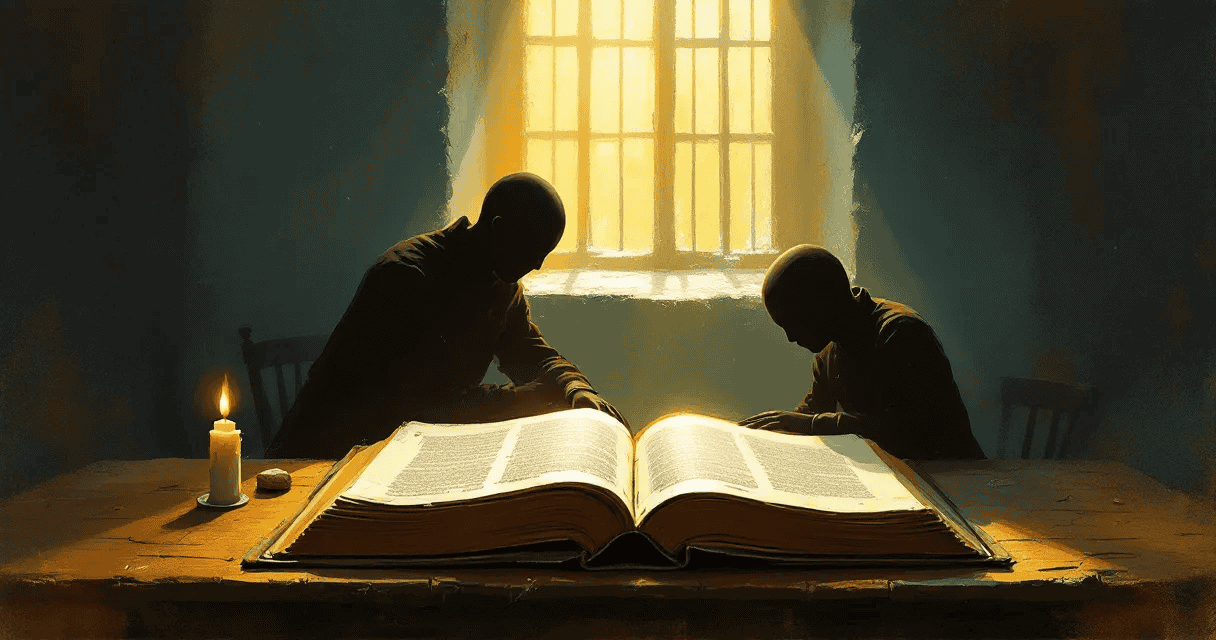
Why Listen to Dostoevsky?
Most of the writers we cover in this series wrote about hardship from a comfortable distance. Fyodor Dostoevsky did not.
In 1849, at twenty-eight, he was arrested for belonging to a group that read and discussed banned books. He was marched into a public square with his friends, dressed in a white burial shirt, and told he was about to be shot. The first three men were tied to posts. The rifles were raised. Then a messenger rode in with the Tsar’s commutation — the whole execution had been staged as a lesson. One of the men in that square went permanently insane.
Dostoevsky was sent to a Siberian prison camp for four years. He wore chains the entire time. He slept on bare boards in a rotting barracks with the worst men in Russia, was forbidden to write, and was allowed to keep exactly one book: a New Testament given to him by the wives of earlier political prisoners. He read it for four years because it was the only thing there was to read.
He came out of that camp a different man, and he spent the rest of his life writing about what he had learned there. The Brothers Karamazov, finished in 1880 a few months before he died, is the last and largest of those books. It is a story about a murder, a trial, a wrongful conviction, and four brothers arguing about whether a just God could possibly exist in a world like this one.
You do not need a literature class to get something out of it. You need to have been in a room where the truth did not matter as much as the story someone else was telling about you.
The Story in Brief
Old Fyodor Karamazov is a cruel, drunken landowner who abandoned all of his children. He has three legitimate sons and, almost certainly, one illegitimate one:
- Dmitri (Mitya) — the eldest. A former officer, hot-tempered, generous, reckless, deep in debt to his father and in love with the same woman his father wants.
- Ivan — the intellectual. Cold, brilliant, and tormented by the question of how a good God allows children to suffer.
- Alyosha — the youngest. A novice at the local monastery, student of the dying elder Zosima, and the moral center of the book.
- Smerdyakov — the servant, widely believed to be the old man’s illegitimate son. He listens to everything Ivan says and takes it further than Ivan ever meant.
The old man is murdered. Every piece of evidence points at Dmitri. Dmitri did not do it. What happens next is a trial, and the trial is the part of this book that Georgia readers will recognize in their bones.
1. We Are Responsible for Each Other
“Each of us is guilty before everyone, for everyone and for everything.”
This is the line the whole novel is built on. The elder Zosima learned it from his older brother Markel, who said it while dying at seventeen.
It sounds like nonsense at first. How can you be guilty of something a stranger did? But Dostoevsky is not talking about legal guilt. He is talking about the fact that no one arrives at the worst moment of their life alone. Somebody looked away. Somebody could have said something and stayed quiet. Somebody decided that a certain kind of person was not their problem.
This is the exact opposite of the logic that fills prisons — the idea that a person’s worst act is a complete account of who they are, and that once we have sorted them into a category we owe them nothing further. Zosima’s answer is that there is no such thing as somebody else’s problem.
Practical Tips:
- Notice the moments you have the option to look away from someone in your dorm and don’t take it. Those are the moments this line is about.
- If you are on the outside: the men and women inside are not a separate population. They are coming home. Almost all of them.
2. Above All, Do Not Lie to Yourself
“Above all, don’t lie to yourself.”
Zosima says this to old Fyodor Karamazov, who is performing a whole clownish routine to avoid ever telling the truth about himself for one second.
The reasoning is sharp: a man who lies to himself loses the ability to tell truth from falsehood in himself, and then in everyone else. Losing that, he stops respecting anyone. Stopping there, he stops loving. And a man who loves nothing has nothing to do but chase whatever amusement is in front of him.
That is a complete description of how a person hollows out, and it starts with small self-deceptions. The story you have told so many times that you have edited yourself out of it. The excuse you have polished until it shines.
Practical Tips:
- Write your own account of what brought you here — the honest one, for no one but you. Do not send it anywhere. Do not show it to anyone. Just get it down accurately once.
- Notice when you are rehearsing a version of events rather than remembering it.
3. Love in Action Is Harder Than Love in Dreams
“Love in action is a harsh and dreadful thing compared with love in dreams.”
A wealthy woman comes to Zosima and says she dreams of giving up everything to nurse the sick — but she is afraid she could not stand the ingratitude of the people she helped. Zosima tells her the truth: loving humanity in general is easy and costs nothing. Loving one specific irritating person in front of you is the hard version.
Everyone in here has met the man who talks constantly about what he is going to do for his family when he gets out. Talk is love in dreams. A letter written on a Tuesday when you are tired and have nothing interesting to report is love in action.
Practical Tips:
- Pick the smallest concrete thing you can do for someone this week and do it. One letter. One phone call you have been avoiding. One apology.
- Judge yourself by what you did, not by what you felt.
4. The Battlefield Is the Human Heart
“God and the devil are fighting there, and the battlefield is the heart of man.”
Dmitri says this about himself. He knows exactly what he is capable of in both directions. He is the man who will give away his last ruble and the man who will drag his father’s servant across a courtyard by the hair, and he refuses to pretend he is only one of them.
This is the most useful thing in the book for anyone who has been reduced to a case file. The system needs you to be one thing — a risk level, a classification, a number. Dostoevsky’s position is that no human being is one thing, ever, and the fight inside is not evidence that you are broken. It is evidence that you are alive and still in the fight.
Practical Tips:
- When you catch yourself doing something you are ashamed of, note it accurately and move on. Shame that loops does no work.
- Keep a short written record of the days you handled something well. You will need the evidence later, when someone tells you what you are.
5. You Are Allowed to Be Angry About Injustice
“It’s not God that I don’t accept. I merely most respectfully return Him the ticket.”
Ivan’s argument, in the chapter called “Rebellion,” is the most famous passage in the book and the hardest to answer. He collects true newspaper accounts of cruelty to children and lays them out one by one. Then he says: even if there is some final harmony where all of this makes sense, he refuses to buy a ticket to it. No future good is worth one child’s suffering.
Alyosha, the saint of the book, does not tell his brother he is wrong to be angry.
That matters. Dostoevsky was a devout man, and he gave the strongest argument in his novel to the man attacking his own faith — and he never lets anyone answer it with a slogan. If you are angry about what you have seen in a Georgia prison, about a death that got written up as “natural causes,” about a man who could not get his medication, that anger is not a spiritual failure. It is a form of moral seriousness. The book’s only warning is about where Ivan takes it next.
Practical Tips:
- Put the anger somewhere it does work: a grievance filed correctly, a documented account, a letter to a legislator, a report to an advocacy organization.
- Anger that stays inside curdles. Anger with a destination is fuel.
6. Watch Who Offers to Take Your Freedom for Your Own Good
In the novel’s centerpiece, “The Grand Inquisitor,” Ivan tells a story: Christ returns to earth during the Spanish Inquisition and is immediately arrested. The old Inquisitor visits his cell and explains that the Church has corrected his mistake. His mistake was leaving people free.
Freedom, the Inquisitor says, makes people miserable. What they actually want is bread, certainty, and someone to tell them what to do. So the Church took their freedom and gave them security, and the people were grateful.
Anyone who has watched a facility run knows this argument. It is the justification for every restriction sold as safety — every program cut, every lockdown, every rule that treats grown men as incapable of choosing. And it works partly because it is half true. Choice is exhausting. It is genuinely easier to let the days be decided for you.
The Inquisitor is not defeated by an argument in the story. Christ says nothing and kisses him. Dostoevsky’s point is that the only real answer to a system that takes your choices is to keep making them anyway.
Practical Tips:
- Find the decisions still yours and make them deliberately: what you read, when you sleep, who you talk to, what you do with an hour.
- Be suspicious of comfort that arrives in exchange for agency — inside and out.
7. A Courtroom Wants a Story, Not the Truth
Dmitri’s trial takes up the last section of the book, and it is a masterpiece of quiet fury. Everything the prosecutor says is reasonable. Dmitri threatened his father publicly. He was desperate for money. He was seen at the house that night with a weapon. He had blood on him. He suddenly had cash he could not explain.
Every fact is true. The conclusion is false.
The prosecutor builds a psychological portrait of Dmitri and the defense builds a different one, and the jury picks the more satisfying story. Nobody in that courtroom is chiefly interested in what happened. They are interested in a coherent narrative about a certain kind of man. The verdict is twenty years in the Siberian mines, and it lands on an innocent man.
Dostoevsky wrote this in 1880 and it needs no updating. The mechanics are the same in a Georgia courtroom in 2026: circumstantial evidence, a compelling narrative, a defendant whose past makes the story easy to believe, and an overworked system that needs the matter closed.
Practical Tips:
- If you are still fighting a case, understand that you are fighting a story as much as a set of facts. Documentation that breaks the story is worth more than a general protest of innocence.
- Keep every record. Dates, names, transfers, medical requests, grievances, responses. Paper outlives memory.
8. The New Man Can Rise Anywhere — Including in a Cell
“A new man has risen up in me.”
Dmitri says this after his conviction, and he means something specific. He did not kill his father. He does not accept the verdict as just. But he does look honestly at the man he had been — the drinking, the cruelty to Grushenka, the humiliation of Captain Snegiryov, the rage — and he decides that man is finished.
This distinction is worth reading twice, because the book is often summarized badly. Dostoevsky is not saying accept your sentence quietly. He is saying: do not let an unjust verdict decide who you become. When his brother later helps plan his escape to America, Alyosha — the holiest character in the novel — supports it. Nobody in the book thinks Dmitri owes the court his life.
What Dmitri owes is his own reckoning with his own conduct, and that is a separate ledger from the one the state keeps.
Practical Tips:
- Keep two ledgers separate. What the system did to you unjustly is one. What you actually did and want to change is the other. Confusing them keeps you stuck on both.
- Name one habit you are done with and mark the date. A change nobody witnesses still counts.
9. One Good Memory Can Save a Person
“There is nothing higher and stronger and more wholesome and good for life in the future than some good memory.”
At the end of the book, Alyosha stands at a boy’s funeral and speaks to a group of children by a stone. He tells them that if a person carries even one good memory from childhood, they may be saved by it in some later hour — that a single such memory kept in the heart can be the thing that stops a person from doing harm.
If you are a parent reading this from inside, this is the most important page in the novel for you. You may not be able to provide much right now. You can provide memory. A letter that gets read at the kitchen table. A birthday remembered. A drawing on the back of an envelope. Twelve minutes on the phone where you asked about them instead of talking about yourself.
Those are not consolation prizes. According to the man who wrote this book, they may be the load-bearing thing in a child’s whole life.
Practical Tips:
- Write to a child about something specific — a story from your own childhood, a question about their week, a thing you noticed. Specific beats sentimental every time.
- Families outside: keep the letters. Put them in a box. Read them again in ten years.
10. Give Away the Onion
There is a folk tale Grushenka tells about a cruel old woman who dies and goes to a lake of fire. Her guardian angel searches for one good thing she ever did and finds a single onion she once gave to a beggar. God says: hold out that onion, and if it can pull her out, let her go free. The angel holds it out and she begins to rise — but the other sinners grab hold of her legs to be pulled out too, and she kicks at them, shouting that it is her onion and not theirs. The onion breaks.
Grushenka tells this story about herself, and she means it as a warning she is giving herself out loud.
The lesson is small and hard: what you have is not diminished by sharing it, and the impulse to guard the little you have against everyone else is exactly what sinks you. In an environment engineered around scarcity, that impulse is constant and it feels like survival.
Practical Tips:
- Do the small unreciprocated thing. Explain the grievance process to the man who just got here. Share the commissary item. Teach somebody to read.
- Do not keep score. The scorekeeping is what breaks the onion.
Connecting with Families
The Brothers Karamazov is a genuinely long book — around eight hundred pages — and it works better as a shared project than a solo climb.
- Read it in parts. The novel is built in twelve books plus an epilogue. One “book” at a time is a reasonable pace for a letter cycle.
- Read the same section on both sides. A family member outside can read along and write about what they thought, which turns a visit or a phone call into a real conversation about something other than the case.
- Start with two chapters if the whole thing is too much. “Rebellion” and “The Grand Inquisitor” sit back-to-back in Book V and can be read on their own in an afternoon. They are the heart of the argument.
- Talk about the trial section with anyone still fighting a case. It is the most useful part of the book for understanding how a narrative gets built around a defendant.
How to Get the Book
The Brothers Karamazov is in the public domain. The Constance Garnett translation from 1912 is free to read, copy, and print, which makes this one of the easiest classics to get inside.
- Free full text: Project Gutenberg (gutenberg.org) has the complete Garnett translation. A family member can print sections and mail them where facility rules allow printed material.
- Cheap paperbacks: Used copies of the Garnett translation are widely available for a few dollars. The Pevear and Volokhonsky translation is generally considered the best modern one if the budget allows.
- Check the mail rules first. Most Georgia facilities require books to be shipped directly from an approved vendor or publisher, not from an individual. Confirm the current rule with the mailroom or the education coordinator before anyone spends money.
- Ask the library. Prison libraries frequently carry the major Russian novels. It costs nothing to submit a request.
Conclusion
Dostoevsky did not write this book from a study, looking down at suffering people and drawing conclusions. He wrote it as a man who had stood in front of a firing squad, worn chains for four years, and buried a three-year-old son named Alyosha two years before naming his hero after him.
What he concluded, after all of it, was not that the world is just. He gave the case against a just world to Ivan and made it unanswerable on purpose. What he concluded was that a person’s response to injustice is the only territory no one can take from them — and that the response that saves you is almost always smaller and more ordinary than you expect. A letter. An onion. One good memory in a child’s head.
The verdict in that courtroom was wrong. Dmitri’s answer was not to become the man the court described.
Stay tuned for more practical education guides each week here on Pathways to Success.
Further Reading
Other Pathways to Success articles in this series:
- 10 Stoic Lessons from Marcus Aurelius for Prisoners
- Escaping the Cave: Plato’s Lesson for Prisoners and Families
- Freedom of the Mind: Boethius, Philosophy, and Finding Peace Behind Bars
- 9 Life-Changing Lessons from Albert Einstein: Timeless Wisdom for Prisoners and Families
- Pathways to Success: Reading Your Way to Freedom
- Choosing Tenderness: The Strength in Softness
About Pathways to Success and Georgia Prisoners Speak (GPS)

At Georgia Prisoners Speak (GPS), we believe that education is one of the most powerful tools for breaking cycles of incarceration and building a better future. That’s why we created the Pathways to Success program—a dedicated initiative providing educational resources, skill-building guides, and financial literacy tools tailored specifically for prisoners and their families.
GPS is a prison reform advocacy platform focused on exposing systemic injustices, pushing for policy change, and empowering incarcerated individuals with the knowledge they need to successfully re-enter society. Our educational articles are part of this mission, ensuring that those impacted by incarceration have access to practical guidance that can help them build stability, opportunity, and financial independence.
To explore more resources, visit Pathways to Success.
You Have Options
Free tools to take action — the law is on your side.
Demand records from the prison system. Reach the officials who set policy. File a grievance or a complaint the right way. And for families who’ve lost someone in custody, get the records that tell the truth. Plain-language, step-by-step, and free.
Explore the GPS Toolkits →