Update, September 2, 2026: Georgia has now shown the contracts. Nine days after this article published, the Georgia State Financing and Investment Commission produced five fully executed Design-Build-Install agreements with ModCorr LLC in response to a GPS open records request. All five were signed on April 25, 2025. The four modular housing contracts, at Hays, Lee, Montgomery and Dodge, are $20,173,811 each, a base bid of $80,695,244 for two 63-bed units per site. The Johnson State Prison infirmary contract is $4,890,000. The total is $85,585,244 for the 524 beds. The commission also stated that it did not conduct the procurement behind the March 2025 request for information described below and holds no records of it, which leaves the solicitation question open and moves it to the Department of Corrections. GPS is reporting on the contracts separately.
When Georgia’s modular prison buildings were sold to the General Assembly, they were sold as “swing space.” Temporary. Somewhere to put people while the real buildings got repaired. The pitch was modest by design, and the modesty was the point: legislators were not asked to fund an expansion of Georgia’s prison capacity. They were asked to fund a maintenance workaround, and they appropriated the money on that understanding.
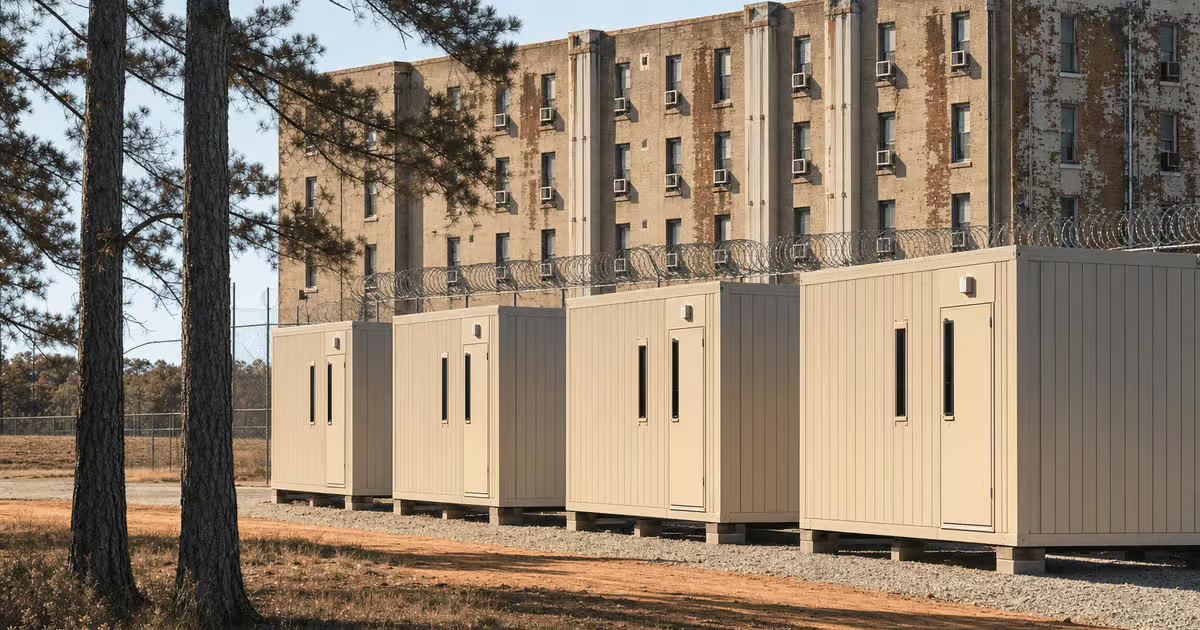
On July 22, 2026, GDC held a ribbon-cutting at Johnson State Prison and described the same project differently. The agency announced that modular housing units from a company called ModCorr had been installed at four prisons, that a modular Medical Intensive Infirmary had been added at a fifth, and that the project “adds 524 beds and strengthens GDC’s ability to manage Georgia’s offender population” 1.
Not swing space. Beds. Permanent capacity, counted and claimed, in the agency’s own announcement.
That shift is the story — and it is only the first of several things in this announcement that do not survive contact with the public record. The company that built the units is owned by the Galveston family behind one of the largest border-wall contractors in the country. Its stated founding date is a year off from its state registration. And while the General Assembly’s $86 million appropriation is documented down to the line item, Georgia’s procurement registry contains no contract, no award, and no named vendor — only an eight-day request for information from March 2025 with nothing attached to it.
What Changed Between the Two Announcements
The distinction between “swing space” and “beds” is not semantic. It is the difference between a temporary measure that ends and a permanent enlargement of Georgia’s carceral footprint that does not.
Swing space implies a return: people are moved out, walls are repaired, people are moved back, the pods come down. Bed count implies the opposite. Once a bed is counted, it is filled, and once it is filled the state has a new number to defend.
Thirteen months apart, GDC described the same steel boxes two different ways. In 2025 they were temporary space so repairs could proceed. In July 2026 the agency said they “add 524 beds.”
The July announcement closes the loop itself. Commissioner Tyrone Oliver used it to thank Governor Kemp and state legislators for the “critical funding and support” behind the project 2. The General Assembly appropriated for temporary maintenance space. What it bought, by GDC’s own accounting, is 524 permanent beds. No one appears to have gone back and told the legislature that the thing it funded became something else.
GDC’s announcement does not break the 524 figure into components. Georgia’s appropriations bills do. The amended fiscal 2025 budget funded “four 126-bed modular correctional units,” and the fiscal 2026 budget separately funded an acute-care unit at Johnson State Prison 3. Four units at 126 beds is 504. Add the 20-bed infirmary and the total is 524, exactly. What GPS previously reported as a plan is now a line item.
The Beds Went Where the Buildings Already Failed
The four prisons that received housing modules are Dodge, Lee, Montgomery, and Hays State Prisons. The infirmary went to Johnson State Prison.
GDC will tell you these facilities have room. It measures them against “rated capacity” — an operational number the department itself sets and revises upward by adding bunks, and the figure it publishes in its own facility directory 4. The measure used in Brown v. Plata is different: it is the capacity the physical plant was actually designed to hold. GDC does not publish that number. GPS compiled it facility by facility, and publishes both side by side 5. Measured against design, every one of these prisons was already past its limit before a single module arrived.
- Dodge State Prison — designed for 404. Rated for 1,236. Holding 1,322. That is 327 percent of design capacity 6 7.
- Hays State Prison — designed for 448. Rated for 1,101. Holding 1,103. That is 246 percent of design capacity 8 9.
- Lee State Prison — designed for 640. Rated for 762. Holding 860. That is 134 percent of design capacity 10 11.
- Montgomery State Prison — designed for 344. Rated for 900. Holding 415. That is 121 percent of design capacity 12 13.
Every rated-capacity figure above is GDC’s own published number, taken from the department’s facility pages. The design-capacity figures are what those same buildings were architecturally built to hold, compiled by GPS from construction and renovation records 14. The gap between the two columns is the whole argument.
Taken together, the four prisons receiving modules were built to hold 1,836 people. They are rated for 3,999. They hold roughly 3,700. Georgia has just added several hundred more beds to physical plants that were already carrying about twice the population they were engineered for — without expanding the plumbing, the kitchens, the medical units, or the officer posts that serve them.
This is the mechanism GPS has documented across the system: capacity is not created by construction, it is created by declaration. A bed is added, the rated number rises, and the overcrowding disappears on paper while every shared resource inside the fence gets thinner.
Montgomery Has 485 Empty Beds and a New Module Anyway
The most difficult number in the set belongs to Montgomery State Prison. It is rated for 900 people and holds 415 — roughly 46 percent of its rated capacity, with 485 beds already standing empty.
GDC installed a modular housing unit there.
There is no benign reading of that decision that GDC has offered. Either the department intends to raise Montgomery’s population substantially, in which case the “swing space” framing was never accurate and Georgia is planning an expansion it has not announced. Or the module is staged there for transfer elsewhere, in which case the 524-bed figure describes inventory rather than housing.
Montgomery is also the clearest illustration of the capacity gap. At 46 percent of its rated number, the prison sounds nearly empty. Measured against the 344 people it was actually designed to hold, it is already 21 percent over.
Twenty Beds at a Prison That Has Buried 88 People
The 20-bed Medical Intensive Infirmary went to Johnson State Prison, to be staffed by GDC’s healthcare contractor, Centurion.
Johnson is a medium-security prison in Wrightsville designed for 500 people. Its architects set 750 as the maximum overflow the building could absorb. GDC rates it for 1,612 and it holds 1,565 15 — more than three times what it was designed to hold, and more than double the ceiling its own architects called the outer limit. GPS has independently tracked 88 deaths there since 2020, twelve of them homicides, and the facility has produced $5.9 million in liability settlements 16 17.
Some of that death toll reflects Johnson’s role as a destination for medically fragile people, which is precisely why an infirmary there is defensible on its face. But the scale is the problem. GPS has tracked at least 1,863 deaths in GDC custody since 2020 — a floor, not a total, because GDC reports deaths roughly two months late and stopped publishing cause of death in March 2024 18 19. Against that record, Georgia’s answer is twenty beds.
The same week Georgia cut its ribbon in Wrightsville, the Florida Department of Corrections broke ground on a modular medical facility at Lowell Correctional Institution — same manufacturer, same healthcare contractor, same concept 20. ModCorr is selling a product line to Southern prison systems, and Georgia is one customer among several.
Who Is ModCorr?
GDC’s press release describes ModCorr in a single sentence: founded in 2023, specializing in rapidly deployable detention-grade modular construction. ModCorr’s own website says the same thing 21.
The corporate record says something more specific.
ModCorr LLC is a Texas domestic limited liability company, Secretary of State file number 0804727448. The governing persons the State of Texas lists for it are three people: John R. Sullivan, Todd P. Sullivan, and William W. Sullivan, each titled managing member, each at 6702 Broadway Street in Galveston 22.
That Galveston address is the thread. SLSCO Ltd. — Texas file number 0800787709, registered in 2007 — reports the same mailing address at 6702 Broadway and the same registered agent, InCorp Services of Austin. Its general partner is Sullivan Environmental Services, Inc., a Texas corporation registered on October 27, 1995, whose officers are Todd P. Sullivan as president, John R. Sullivan as vice president, and William W. Sullivan as secretary — again at 6702 Broadway 23.
Three entities. Three brothers. One street address, one registered agent, one family. ModCorr is not an independent startup that happened to win Georgia’s business. It is the corrections arm of a Galveston contracting enterprise.
GDC’s announcement identifies Budea “Buddy” Johns as ModCorr’s president, and quotes him. Johns does not appear in the company’s Texas governing-person record in any capacity. That is unremarkable in itself — hired executives are not owners — but it means the only ModCorr figure Georgia introduced to the public is the one person the state record does not connect to the company’s ownership.
SLSCO Ltd. is not an obscure entity. It is the Galveston, Texas contracting firm founded in 1995 by brothers John, Todd, and William Sullivan, and it is one of the principal builders of the United States–Mexico border wall. In 2019 the Department of Defense awarded SLSCO a $789 million contract for border wall replacement construction, on top of two Army Corps contracts then totaling $432 million 24.
The company’s record also includes contested allegations. A False Claims Act suit unsealed in a California federal court in 2020, filed by two whistleblowers who had worked as security contractors on a San Diego border wall project, named Sullivan Land Services Co. Ltd. — doing business as SLSCO — and alleged the use of unvetted workers and false documentation in claims submitted to the government. A company spokeswoman said at the time that the suit was based on inaccurate and untrue allegations 25. GPS labels these allegations ALLEGED. They are unresolved claims in litigation, not findings, and the company has denied them.
ModCorr’s product also has a documented relationship with the private prison industry. In reporting on a proposed jail in Adams County, Mississippi, Johns told a local newspaper that ModCorr supplied the modular cells used at the CoreCivic facility on U.S. 84 that now operates as an ICE detention center 26. CoreCivic is the second-largest recipient of GDC contractor payments in Georgia, at more than $861 million between fiscal years 2018 and 2025 27 28.
None of this is illegal. All of it is material. Georgia has quietly attached a piece of its prison infrastructure to a family enterprise built on federal detention and border enforcement contracting, and it disclosed exactly one fact about that enterprise: a founding year.
The Founding Year Doesn’t Match the Filing
GDC says ModCorr was founded in 2023. ModCorr says it was founded in 2023.
The State of Texas records ModCorr LLC’s effective registration date as September 13, 2022 22.
A one-year discrepancy in a marketing biography is trivial on its own. It is less trivial when the founding date is the only substantive fact a state agency published about a vendor it hired to build prison housing, and when neither the agency nor the vendor appears to have checked it against the filing. GPS labels the September 2022 registration date VERIFIED against the State of Texas. ModCorr has not been asked to explain the discrepancy, and is invited to.
A second registration question is unresolved. ModCorr registered as a foreign limited liability company in Florida in May 2023, ahead of its Florida work. GPS has not been able to confirm that a corresponding Georgia certificate of authority exists. Under O.C.G.A. § 14-11-702, a foreign LLC generally may not transact business in Georgia without one, though the statute exempts a list of activities and the burden of determining whether registration is required falls on the company. GPS is not asserting that ModCorr failed to register. GPS is reporting that it could not confirm the company did, and that GDC should be able to say — because verifying a vendor’s standing to do business in Georgia is a routine part of contracting with one.
That question is unresolved. The money question is not. Georgia’s own budget bills document this purchase down to the dollar.
The Appropriation Is Fully Documented. The Purchase Is Not.
In the amended fiscal 2025 budget, under the corrections section and the state prisons program, sits item 968: $80,220,240 (AFY2025 enacted, state funds) for “sitework and construction of four 126-bed modular correctional units to facilitate offender population movement necessary for capital and security improvements” 3.
Read that stated purpose again. Population movement, to enable capital and security improvements. That is the swing-space pitch written into law — the justification the General Assembly appropriated $80.2 million against.
The fiscal 2026 budget added $6,200,000 (FY2026 enacted) for design and construction of a long-term acute care unit at Johnson State Prison in Wrightsville. The House did not oppose the project — it wanted the unit financed through a twenty-year bond package rather than cash. The Senate and the conference committee rejected the bonds and paid for it outright 3.
Then the operating costs arrive, and they are the tell. For the amended fiscal 2026 year the Governor requested $880,104 to operate five modular correctional units and $182,375 to feed four of them; the conference committee cut those to $473,701 and $88,240 — roughly a quarter-year of operation. The fiscal 2027 budget then raises the operations line to $1,760,207, with $364,749 for food 3.
Nothing about a recurring, growing operations line is temporary. Georgia is not budgeting for storage pods it intends to remove. It is budgeting for prison housing it intends to staff and feed indefinitely.
The legislature also considered buying substantially more of it. The amended fiscal 2026 budget redirects $25 million from the earlier prison design appropriation and adds $125,000,000 to construct another modular unit and two transition centers — an item that appears in no version of the bill the Governor, House, or Senate produced. It was written in conference. Separately, the House proposed using $220 million in undesignated surplus for a 480-bed private prison; the Senate countered with $180 million in surplus for two additional modular units. The conference committee funded neither 3.
So the money is not hidden. Roughly $86.4 million in capital appropriations, plus operating costs that grow every year, all of it printed in Georgia’s budget bills where anyone can read it.
What is missing is everything between the appropriation and the ribbon-cutting.
The Procurement Record Is One Eight-Day RFI
Here is what Georgia’s own procurement system contains for a project that placed five buildings at five prisons.
A single event: number 46700-GDC0001150, titled “Modular Correctional Buildings.” It is classified as an RFI — a request for information, the stage at which an agency asks the market what exists, not the stage at which it buys anything. It opened March 4, 2025 and closed March 12, 2025, an eight-day window. Its status is “Completed.” No documents are attached to it 29.
GPS re-pulled that event live before publication. It is unchanged: still an RFI, still “Completed,” buyer Ross Barrineau, classified under infrastructure. No award. No named supplier. Its commodity codes include one for prefabricated medical structures. The only entry under Documents is a portal link that requires a supplier login — there is nothing a member of the public can open.
GPS then searched the entire Georgia Procurement Registry — every agency, not just corrections, across 2014 through 2026. The word “modular” returns 109 events. Exactly two of them touch corrections: the March 2025 RFI, and a cancelled GSFIC job to level a modular building at a Paulding County probation detention center. Searches for ModCorr, MaxMod, SLSCO, Sullivan, prefabricated, medical intensive, and housing unit return zero records each. Control searches on the same system return results normally, so the registry is answering — it simply has nothing.
GPS also searched Georgia’s own vendor payment disclosures under the Transparency in Government Act — statewide, every agency, every published year from fiscal 2015 through fiscal 2025. ModCorr, MaxMod, and SLSCO return nothing in any year. Sullivan Land Services appears nowhere. A control search returns GDC’s healthcare contractor with its payments intact, so the method works 28 27.
There are innocent explanations available, and GPS states them plainly rather than implying their absence. Fiscal 2026 vendor payments have not been published yet — the state’s disclosure site currently stops at fiscal 2025 — so payments made this year would not appear regardless. State capital construction in Georgia often flows through the Georgia State Financing and Investment Commission rather than the using agency, which would place the money outside GDC’s ledger entirely.
GPS followed that second lead. GSFIC’s five most recent published board meeting summaries, covering June 2025 through June 2026, contain no mention of modular units, ModCorr, SLSCO, or the Department of Corrections. The actual minutes — where a contract award and a dollar figure would appear — are not public. GSFIC’s own meeting repository lists every session back through 2025 with its minutes marked unpublished 30.
That is its own finding. The commission that may have handled an $86 million prison construction program does not publish the minutes in which it would have approved it.
But GDC did not say any of that. It announced a completed multi-site construction project, named the contractor, quoted the contractor’s president, thanked the Governor and the legislature for “critical funding” — and published no contract, no value, and no procurement pathway. The legislature’s side of this is fully documented down to the dollar. The purchasing side is a single eight-day market survey.
The Questions GDC Needs to Answer
GPS is publishing these as questions because that is what they are. The record supports asking them; it does not yet support answering them.
- What did the 524 beds actually cost, and who was paid? The General Assembly appropriated $80,220,240 for four modular units and $6,200,000 for the Johnson infirmary. GDC has published no contract, no award, and no vendor payment against either.
- What competitive solicitation followed the March 2025 RFI? An RFI is a market survey. If no RFP followed, what sole-source or emergency justification was used, and who signed it?
- Which state entity paid ModCorr? If the money moved through GSFIC, say so — and publish the board minutes in which it was approved.
- Is the “swing space” designation dead? The appropriation funded population movement to enable maintenance. The fiscal 2027 budget funds $1,760,207 a year to operate five modular units. GDC should say plainly which of those two things is true — and explain why the operations lines count five units when the food and construction lines count four.
- Why Montgomery? A prison at 46 percent of rated capacity received a housing module. What is the operational plan for those beds?
- Does ModCorr LLC hold a Georgia certificate of authority? And did GDC verify a vendor’s standing to do business in Georgia before contracting with it?
- Was GDC aware of ModCorr’s ownership? The State of Texas lists three Sullivan brothers as its managing members, at the same Galveston address and registered agent as SLSCO Ltd. Did that ownership factor into vendor review, and was any federal-contracting history assessed?
GPS has opened an open records request on the contract, the solicitation file, and the payment pathway. GDC, ModCorr, and SLSCO Ltd. are invited to respond to any of the above, and GPS will publish their responses in full.
What the Beds Do Not Fix
Georgia’s prison system holds 52,615 people across state prisons, private prisons, county facilities, transitional centers, and probation beds 31 32. GDC’s own press release describes the department as responsible for “approximately 49,000 state prisoners” — a subset presented as though it were the whole 1.
Five hundred twenty-four beds against that number is not a solution to overcrowding. It is roughly one percent.
And that figure does not include the people GDC has not taken yet. As of August 21, 2026, approximately 2,500 people convicted and sentenced to state prison were still sitting in Georgia county jails, waiting on a GDC bed to open 32. GDC publishes that number itself, every week, in a document it calls the backlog.
Those 2,500 people are the closest thing to a genuine bed-shortage argument Georgia has. They are also the measure of what 524 beds accomplishes. Fill every module the state just installed, twice over, and the backlog still would not clear — and Georgia would have spent $86 million to move people from one form of custody into another without releasing a single person, treating a single illness, or filling a single vacant officer post.
The backlog is not evidence that Georgia needs more prisons. It is evidence that the system is jammed at every valve at once — a parole board granting fewer releases, a classification system that pushes people up in security and holds them there, and a physical plant so degraded that people are being warehoused in county jails while the state buys steel boxes to warehouse them somewhere else.
And beds were never the finding. In October 2024, the Department of Justice concluded after a multi-year investigation that Georgia violates the Eighth Amendment, that the state is deliberately indifferent to unsafe conditions, and that the violations are driven by staffing collapse, failed classification, unmanaged gangs, uncontrolled contraband, and broken incident reporting 33. DOJ did not find that Georgia had too few beds. It found that Georgia could not safely operate the ones it had.
A steel box delivered on cribbing does not supervise a dorm. It does not fill a vacant officer post, examine a body, answer a call for help, or open a parole file. It holds people. That is the entire function, and Georgia has now purchased 524 more units of it from a company whose contract the state has not produced.
Call to Action: What You Can Do
If this was worth your time, share it with someone who should read it.
Spread the Word: It Takes One Click
Awareness without action changes nothing. Here’s how you can help push for accountability and real reform:
Join the GPS Advocacy Network — Sign up at https://gps.press/become-an-advocate/ and we’ll advocate on your behalf every week. GPS identifies your state legislators, crafts personalized letters on the most pressing prison issues, and sends them directly to the representatives who represent you. You receive a copy of every letter. It takes two minutes to sign up — we handle the rest.
Send a 60-Second Message — Pick an issue, get a ready-to-edit message with the verified facts already in it, and email your state House representative and senator directly from your own inbox at https://gps.press/send-a-message/. No signup, nothing stored — it takes about a minute.
Tell My Story — Are you or a loved one affected by Georgia’s prison system? GPS publishes first-person accounts from incarcerated people and their families. Submit your story at https://gps.press/tellmystory and help the world understand what’s really happening behind the walls.
Contact Your Representatives — Your state legislators control GDC’s budget, oversight, and the laws that created these failures. Find your Georgia legislators at https://gps.press/find-your-legislator/ or call Governor Kemp at (404) 656-1776 or the GDC Commissioner at (478) 992-5246.
Demand Media Coverage — Contact newsrooms at the AJC, local TV stations, and national criminal justice outlets. More coverage means more pressure.
Amplify on Social Media — Share this article and tag @GovKemp, @GDC_Georgia, and your local representatives. Use #GAPrisons, #PrisonReform, #GeorgiaPrisonerSpeak.
Message the Board of Corrections — The citizen board that oversees the GDC publishes no contact details for its members. GPS built the missing front door: pick a board member and a policy message and send it from your own email at https://gps.press/write-the-board/.
File Public Records Requests — Georgia’s Open Records Act gives every citizen the right to request incident reports, death records, staffing data, medical logs, and financial documents. Start with the GPS Action Toolkits at https://gps.press/toolkits/ — the Open Records Toolkit walks you through what to ask for, gives you ready-to-file request templates, and tells you what to do when the state says no. File directly with GDC at https://georgiadcor.govqa.us/WEBAPP/_rs/SupportHome.aspx.
Attend Public Meetings — The Georgia Board of Corrections and legislative committees hold public meetings. Your presence is noticed.
Contact the Department of Justice — File civil rights complaints at https://civilrights.justice.gov. Federal oversight has forced abusive systems to change before.
Support Organizations Doing This Work — Donate to or volunteer with Georgia-based prison reform groups fighting for change on the ground.
Vote — Research candidates’ positions on criminal justice. Primary elections often determine outcomes in Georgia.
Contact GPS — If you have information about conditions inside Georgia’s prisons, reach us securely at GPS.press.
Further Reading
Georgia’s “Hardened” Solution: Another Fortress Instead of Reform
GPS’s earlier reporting on the four-module plan, back when the state was still calling them temporary swing space.
Brown v. Plata: A Legal Roadmap for Georgia’s Prison Crisis
Why design capacity, not the operational number GDC sets for itself, is the benchmark that matters constitutionally.
Georgia Prison Population vs. Capacity: 2025 Data
The facility-by-facility gap between what Georgia’s prisons were built to hold and what they actually hold.
Mission Failure: Georgia Spends $1.8 Billion on Prisons and $52 Per Person on Rehabilitation
Where the money actually goes when Georgia says it is investing in corrections.
The Owl Sees All: Georgia’s $150M Prison Surveillance
Another large procurement sold as a safety upgrade, and what the contract documents did and did not show.
Decarceration Is Inevitable — Georgia Can Choose How, or Let the Courts Decide
The alternative to buying beds, and the deadline the state is running against.
GPS Intelligence System
The GPS Intelligence System maintains living research profiles that aggregate data, news, settlements, and analysis on Georgia’s prisons and the issues defining them. The profiles below provide deeper context for the issues raised in this article:
The facility that received Georgia’s new 20-bed infirmary, with its full mortality, settlement, and inspection record.
How Georgia’s corrections spending is structured, tracked, and disclosed — and where the gaps in disclosure appear.
Explore the Data
GPS makes GDC statistics accessible to the public through several resources:
- GPS Statistics Portal — Interactive dashboards translating complex GDC reports into accessible formats, updated within days of official releases.
- GPS Lighthouse AI — Ask questions about Georgia’s prison system and get answers drawn from GPS’s investigative archive and data analysis.
- GPS llms.txt — A single machine-readable index of every GPS data resource, published using the open llms.txt standard. Point any AI tool (ChatGPT, Claude, Gemini, Perplexity) at this URL and the model can navigate to facility profiles, intelligence briefs, mortality records, statistics, and the full investigative archive — no other configuration needed. It is the fastest way to ground an AI conversation in verified GPS data.
For a walkthrough of how to put these resources to work with AI, see How to Use GPS Data with AI Tools — a step-by-step guide for researchers, advocates, families, and journalists analyzing Georgia prison conditions, statistics, and policy with tools like ChatGPT, Claude, and Gemini.
Contact GPS at media@gps.press for access to underlying datasets used in this analysis.
About Georgia Prisoners’ Speak (GPS)
Georgia Prisoners’ Speak (GPS) is a nonprofit research organization built in partnership with incarcerated reporters, families, advocates, and data analysts. Operating independently from the Georgia Department of Corrections, GPS documents the truth the state refuses to acknowledge: extreme violence, fatal medical neglect, gang-controlled dorms, collapsed staffing, fraudulent reporting practices, and unconstitutional conditions across Georgia’s prisons.
Through confidential reporting channels, secure communication, evidence verification, public-records requests, legislative research, and professional investigative standards, GPS provides the transparency the system lacks. Our mission is to expose abuses, protect incarcerated people, support families, and push Georgia toward meaningful reform based on human rights, evidence, and public accountability.
Every article is part of a larger fight — to end the silence, reveal the truth, and demand justice.
The Architecture Is the Evidence
Across the 32 state prisons whose original design figures we hold, Georgia built for 15,737. They hold 33,805 — 215% of design capacity.
Dorms tripled. Cells double- and triple-bunked. Medical, kitchens, libraries — unchanged. Every facility, every design figure, every source.
See the receipts →- GDC press release, Georgia Department of Corrections Opens New Modular Housing Units, July 22 2026, https://gdc.georgia.gov/press-releases/2026-07-22/georgia-department-corrections-opens-new-modular-housing-units [↩][↩]
- GDC press release, Georgia Department of Corrections Opens New Modular Housing Units, July 22 2026, https://gdc.georgia.gov/press-releases/2026-07-22/georgia-department-corrections-opens-new-modular-housing-units [↩]
- Georgia appropriations bills, Office of Planning and Budget, https://opb.georgia.gov/budget-information/budget-documents/appropriations-bills [↩][↩][↩][↩][↩]
- Georgia Department of Corrections facility directory, https://gdc.georgia.gov/locations [↩]
- GPS Facilities Data, original design capacity vs. GDC inflated capacity, https://gps.press/facilities-data/ [↩]
- GPS Intelligence facility profile, Dodge State Prison, https://gps.press/intelligence/facility/dodge-state-prison/ [↩]
- GDC facility page, Dodge State Prison, constructed 1982, capacity 1,236, https://gdc.georgia.gov/locations/dodge-state-prison [↩]
- GPS Intelligence facility profile, Hays State Prison, https://gps.press/intelligence/facility/hays-state-prison/ [↩]
- GDC facility page, Hays State Prison, constructed 1989, capacity 1,101, https://gdc.georgia.gov/locations/hays-state-prison [↩]
- GPS Intelligence facility profile, Lee State Prison, https://gps.press/intelligence/facility/lee-state-prison/ [↩]
- GDC facility page, Lee State Prison, constructed 1978, capacity 762, https://gdc.georgia.gov/locations/lee-state-prison [↩]
- GPS Intelligence facility profile, Montgomery State Prison, https://gps.press/intelligence/facility/montgomery-state-prison/ [↩]
- GDC facility page, Montgomery State Prison, constructed 1972, capacity 900, https://gdc.georgia.gov/locations/montgomery-state-prison [↩]
- GPS Facilities Data, machine-readable, https://gps.press/facilities-data/ [↩]
- GDC facility page, Johnson State Prison, constructed 1991, capacity 1,612, https://gdc.georgia.gov/locations/johnson-state-prison [↩]
- GPS Intelligence facility profile, Johnson State Prison, https://gps.press/intelligence/facility/johnson-state-prison/ [↩]
- What Georgia Pays, settlement and claim payouts drawn from Georgia Department of Administrative Services Risk Management open records, https://gps.press/what-georgia-pays/ [↩]
- GPS Mortality Data, https://gps.press/mortality-data/ [↩]
- How GPS counts deaths in custody — methodology, records sources, and why the figure is a floor, https://gps.press/how-we-count/ [↩]
- Correctional News, Florida DOC modular medical groundbreaking, July 22 2026, https://correctionalnews.com/2026/07/22/florida-department-of-corrections-breaks-ground-on-modular-medical-facilities-to-expand-in-prison-surgical-care/ [↩]
- ModCorr company About page, https://modcorr.com/about [↩]
- Texas Comptroller Franchise Tax Account Status, ModCorr LLC, https://comptroller.texas.gov/taxes/franchise/account-status/search/32086308312 [↩][↩]
- Texas Comptroller Franchise Tax Account Status, SLSCO Ltd., https://comptroller.texas.gov/taxes/franchise/account-status/search/32035045593 [↩]
- Houston Chronicle, Galveston construction firm awarded defense contract to build border wall, https://www.chron.com/neighborhood/galveston/article/Galveston-construction-firm-awarded-defense-13757207.php [↩]
- Galveston County Daily News, lawsuit over border wall security contractors, https://www.galvnews.com/news/lawsuit-accuses-galveston-company-of-using-armed-illegals-to-guard-border-wall/article_4da61b92-aaed-542c-b92f-744e847f4163.html [↩]
- Natchez Democrat, proposed Adams County jail cost and site issues, https://www.natchezdemocrat.com/news/proposed-119-bed-jail-in-adams-county-faces-35-40-million-price-tag-site-selection-challenges-1db92376 [↩]
- GPS Follow the Money contractor payment data, https://gps.press/follow-the-money/data/ [↩][↩]
- Open Georgia, state vendor payment disclosures under the Transparency in Government Act, https://open.ga.gov [↩][↩]
- Georgia Procurement Registry event 46700-GDC0001150, https://ssl.doas.state.ga.us/gpr/eventDetails?eSourceNumber=46700-GDC0001150&sourceSystemType=ps [↩]
- GSFIC and GHEFA meeting repository, https://simbli.eboardsolutions.com/SB_Meetings/SB_MeetingListing.aspx?S=1001 [↩]
- GPS Statistics Data, https://gps.press/statistics-data/ [↩]
- GDC Friday Report, August 21 2026, https://gdc.georgia.gov/document/standing-statistical-reports/fridayreport20260821pdf/download [↩][↩]
- U.S. Department of Justice, Investigation of Georgia Prisons findings report, October 1 2024, https://www.justice.gov/d9/2024-09/findings_report_-_investigation_of_georgia_prisons.pdf [↩]
How about letting them out that didn’t kill and is nonviolent that only made a mistake and wish they hadn’t like car chases, shop lifters etc my son died by the hands of the blood gang and my son was nonviolent.