DODGE STATE PRISON
Facility Information
- Original Design Capacity
- 404 (at 323% capacity)
- Bed Capacity
- 1,236 beds
- Current Population
- 1,306
- Active Lifers
- 129 (9.9% of population) · Oct 2026 GDC report
What the courts held in Brown v. Plata, and how Georgia compares →
- Address
- 2971 Old Bethel Road, Chester, GA 31012
- Phone
- (478) 358-7201
- Fax
- (478) 358-7303
- Mailing Address
- P.O. Box 276, Chester, GA 31012
- County
- Dodge County
- Opened
- 1983
- Operator
- GDC (Georgia Dept. of Corrections)
Security Classification
Last updated: September 23, 2026
66 of the 1,302 people held here are classified Close security (5.1%), as of September 23, 2026.
| Security level | People | Share |
|---|---|---|
| Close | 66 | 5.1% |
| Medium | 1,093 | 83.9% |
| Minimum | 143 | 11.0% |
| Total | 1,302 |
Earlier count (undated table, produced October 22, 2025): 46 of 1,234 Close (3.7%).
Source: Georgia Department of Corrections records produced to GPS under the Open Records Act (R031471-090226, R024615-101925). A person's security level is GDC's classification of that person, which can differ from the prison's own designation.
Follow Dodge State Prison
Leadership & Accountability (as of 2026 records)
Officials currently holding positional authority at this facility, with deaths attributed to GPS-tracked records during their leadership tenure. Inclusion reflects role-based accountability, not legal findings of personal culpability. Death counts shown as facility / career.
| Role | Name | Since | Deaths this facility / career |
|---|---|---|---|
| Warden (facility lead) | Todd, Curtis J | 2026-01-16 | 1 / 1 |
| Deputy Warden of Care and Treatment (facility deputy) | Williams, Khalilah J | 2017-01-01 | 15 / 15 |
| Deputy Warden of Administration (facility deputy) | Ward, Alicia Necole | 2024-12-01 | 3 / 3 |
| Deputy Warden of Security (facility deputy) | Thomas, Karen | 2024-01-01 | 3 / 3 |
About
Last updated October 18, 2026.(DS)
Dodge State Prison: A 1980s Plant, a 105.7% Population, and a Death Record That Keeps Growing
Dodge State Prison sits in Chester, in Dodge County, on a campus first opened in 1983 and expanded in 1989. It is a medium-security men's prison that houses its general population in large dormitory-style units, with single-cell isolation reserved for segregation and disciplinary confinement. Its original design capacity was 404; its current rated capacity is 1,236; and its population, per GPS's facility records, stands at 1,306 — 105.7% of rated capacity. Curtis J. Todd has served as warden since January 16, 2026, working alongside Deputy Warden of Administration Alicia Necole Ward, Deputy Warden of Care and Treatment Khalilah J. Williams, and Deputy Warden of Security Karen Thomas.
The threads that run through this page are the ones the record makes unavoidable: a population that exceeds the prison's rated capacity, a death registry that has logged 16 deaths since 2020, a contraband problem that has repeatedly reached inside the fence through staff and outside it through drones, and a food-service inspection record that reads far better than the conditions GPS has documented across the system's kitchens.
Sixteen Deaths Since 2020, Two of Them Homicides
GPS's mortality registry records 16 deaths at Dodge State Prison since January 1, 2020 — a floor, not a final count, because GDC reports deaths roughly two months late. Eight are coded Natural/Medical, three Suicide, two Homicide, one Overdose, one Other, and one Unknown/Pending.
The two homicides are the cases with the most public documentation. The Atlanta Journal-Constitution reported that Hezekiah Sha'Nard Cuyler, 21, died on September 14, 2022, from blunt force trauma to the head. The same outlet reported that Douglas Anthony Forts, 57, died on June 2, 2022, from acute traumatic amputation of a finger sustained during a fight. Both deaths appear in GPS's registry with the same dates and homicide coding.
The three suicides span three years and three ages: Kenneth Brown died January 31, 2024, at 58; John August Comer died September 9, 2023, at 33; and Charles Dennis Casey died May 6, 2023, at 41. The natural/medical deaths include Sotero Uriquiza-Hernandez, who died May 20, 2025, at 51; Arnold Merle Mcdonald, who died December 22, 2022, at 63; Hoke Smith Tarpley, who died August 7, 2021, at 57; Kenneth Lockett, who died October 9, 2020, at 57; William D Hughes, who died October 8, 2020, at 61; Tadrick Terrian Osborne, who died September 29, 2020, at 40; Caesar Dupree, who died September 12, 2020, at 64; and Cantrell Lavar Edge, who died August 17, 2020, at 41.
The most recent entries are Warren Peacock, who died April 28, 2026, at 70, with GPS's registry listing the cause as Overdose; Joseph Chatfield, who died June 13, 2025, at 62, with the cause listed as Unknown/Pending — GPS does not yet know the cause and does not guess one; and Stewart Myles Mitchell, who died December 7, 2021, at 36, with the cause listed as Other.
Contraband: Drones, Meth, and the Staff Who Carry It In
GDC's own published contraband reports — arrests as reported, not convictions, and GDC publishes no dispositions — show a facility repeatedly targeted from outside and occasionally compromised from within. The reports GPS has collected for Dodge run from 2012 through 2026, and the pattern has shifted over time: in the early 2010s the arrests were mostly visitors and staff; by the mid-2020s they are overwhelmingly civilians intercepted near the perimeter, often with drones.
On September 1, 2025, GDC officers observed suspicious activity near the facility and recovered a package containing 810 grams of marijuana, 1,009 grams of methamphetamine, 3,894 grams of tobacco, 22 packs of rolling paper, two cellphones, a drone, a drone controller, six batteries, and four AirTags. The Dodge County Sheriff's Department arrested two civilians, identified in GDC's report as Marcus Will and Renoka Joff, pending charges. Four days later, on September 6, GDC OPS stopped a suspicious vehicle near the facility and found a drone, five drone batteries, a controller, an iPad, shrink wrap, vacuum-seal packaging, zip ties, and a knife; four civilians were arrested. On November 25, 2025, the GDC Canine Unit detained a civilian near the facility and recovered a DJI Matrice drone, 592 grams of marijuana, four vapes, 1,177 grams of tobacco, and two cellphones; Willie Stephens was arrested by the Dodge County Sheriff's Office.
The staff side of the record is smaller but persistent. GDC's reports show staff-class actors in incidents at Dodge across nearly every year from 2012 through 2026, with roles printed as "Officer" (nine actors), "Correctional Officer" (five), and "Contractor" (two). On May 4, 2025, following an investigation by the Office of Professional Standards, Officer Alisha Coleman was arrested by the Dodge County Sheriff's Office with pending charges. On April 30, 2026, during a routine search of vehicles, contraband consisting of a small bag of THC, a bag of a white crystal-like substance, and two cans of Michelob ULTRA was found in a vehicle belonging to Contractors David Tootle and Daniel Brown; both were arrested by the Dodge County Sheriff's Department and transported to the Dodge County jail pending charges.
Food-Service Scores That Don't Match the Kitchen
The Georgia Department of Public Health has inspected Dodge's food service repeatedly, and the scores are, on their face, strong: 100 (Grade A) on June 24, 2026; 90 (Grade A) and 84 (Grade B) on November 20, 2025; 94 (Grade A) and 84 (Grade B) on June 5, 2025; 100 (Grade A) and 87 (Grade B) on November 21, 2024; 91 (Grade A) and 89 (Grade B) on June 20, 2024; and 99 (Grade A) and 95 (Grade A) on December 29, 2023. The violations cited across those inspections are the ordinary vocabulary of commercial food service — date marking, wiping-cloth storage, cold and hot holding temperatures, backflow devices, ventilation.
GPS has documented a systemic pattern that complicates those numbers. Across GDC kitchens, GPS's reporting describes tray-sanitizing dishwashers broken for sustained periods, sustained roach and rodent infestation in kitchen and serving areas, and meals served on visibly contaminated trays — conditions GPS attributes to the fact that DPH inspections are scheduled walkthroughs that do not assess equipment under load. The Marshall Project's May 16, 2026 investigation of Georgia prison food, by Schwartzapfel, independently reported rats in kitchens, insects in food, moldy trays, and visible malnutrition across state facilities. GPS treats the coexistence of high DPH scores and sustained witness reports of equipment failure as the analytical center of its food-service investigation. The Dodge scores should be read in that light: they are a record of what a scheduled inspection saw, not a certification of what the kitchen does between inspections.
A 1980s Plant Inside a System Under Strain
Dodge's physical plant — dormitory housing, single-cell segregation, an expansion now nearly four decades old — is the same vintage as most of the GDC estate. GPS has documented that most GDC facilities are 30 to 40-plus years old, with deferred maintenance producing systemwide infrastructure failures: broken cell-door locks, inoperative surveillance and fire-alarm systems, mold and water failures, broken kitchen sanitization equipment, and pest infestations. The DOJ's October 2024 findings, the Guidehouse 2024 assessment, and Commissioner Oliver's public "end of life" statements all corroborate that pattern. GPS treats infrastructure collapse as a force multiplier for the violence, classification, and mortality crises it has documented facility by facility.
The staffing picture is part of the same story. GPS has documented officer vacancies running between 49.3% and 60% systemwide for multiple years against a national standard of no more than 10%, a hiring pipeline that cannot close the gap, and a state that ranks last of 50 for correctional-officer pay. The DOJ's October 2024 findings letter concluded that GDC leadership "has lost control of its facilities" and faulted the Department for placing "too much blame on gangs and insufficient emphasis on understaffing." GPS treats staffing collapse and gang assumption of facility control as the integrated structural finding behind the per-facility violence and mortality narratives — the frame in which Dodge's 16 deaths, its two homicides, and its three suicides belong.
A Settlement and a Record Still Being Written
The state's own risk-management ledger records a $16,000 liability payout tied to Dodge State Prison in 2025, in the matter of Kimyania Smith, per the Georgia Department of Administrative Services Risk Management settlement ledger obtained through open records. It is a small figure against the scale of the system, but it is the kind of entry that marks where the state has conceded, in dollars, that something went wrong.
What the public record does not contain is as telling as what it does. GPS's registry is a floor; GDC reports deaths late; and the causes coded "Unknown/Pending" and "Other" are placeholders, not answers. For a prison holding 1,306 people in a plant rated for 1,236, the analytical question is not whether the record will grow, but what the next entries will say.
Sources
This analysis draws on Georgia Department of Public Health food-safety inspection records for Dodge State Prison; GDC's own published contraband arrest reports; the Georgia Department of Administrative Services Risk Management settlement ledger obtained through open records; reporting by the Atlanta Journal-Constitution on the deaths of Hezekiah Sha'Nard Cuyler and Douglas Anthony Forts; The Marshall Project's May 16, 2026 investigation of Georgia prison food; the U.S. Department of Justice's October 2024 findings letter on Georgia prisons; the Guidehouse 2024 consultant assessment; and GPS's own mortality registry, facility records, and prior investigative reporting on infrastructure, staffing, and food service across the GDC system.
Mortality Statistics
16 deaths documented at this facility from 2020 to present.
Deaths by Year
- 2026: 1
- 2025: 2
- 2024: 1
- 2023: 2
- 2022: 3
- 2021: 2
- 2020: 5
County Public Health Department
Food service and sanitation at DODGE STATE PRISON fall under the jurisdiction of the Dodge County Environmental Health Department. Incarcerated people cannot choose where they eat — public health inspectors carry an elevated responsibility to hold this kitchen to the same standards applied to any restaurant.
Contact
- Title
- EH Specialist
- Name
- Jeremiah Arowolo
- Address
-
1121 Plaza Avenue
Eastman, GA 31023 - Phone
- (478) 374-5576
- dodge.eh@dph.ga.gov
- Website
- Visit department website →
Why this matters
GPS has documented black mold on chow-hall ceilings, cold and contaminated trays, spoiled milk, and pest contamination at Georgia prisons. The Department of Justice's 2024 report confirmed deaths from dehydration and untreated diabetes tied to food and water deprivation. Advance-notice inspections let facilities stage temporary fixes that disappear once inspectors leave.
Unannounced inspections by the county health department are one of the few outside checks on kitchen conditions behind the fence.
How you can help
Write to the county inspector and request an unannounced inspection of the kitchen and food service operation at this facility. A short, respectful letter citing Georgia food-safety regulations is more powerful than you think — inspectors respond to public concern.
Sample Letter
This is the letter Georgia Prisoners' Speak mailed to all county environmental health inspectors responsible for GDC facilities. Feel free to adapt it.
October 24, 2026
RE: Request for Unannounced Public Health Inspection of Food Service Operations at DODGE STATE PRISON
Dear Jeremiah Arowolo,
I am writing to respectfully request that your office conduct a thorough, unannounced inspection of food service and sanitation practices at DODGE STATE PRISON, located in Dodge County.
Documented concerns
Georgia Prisoners' Speak, a 501(c)(3) nonprofit investigative newsroom, has published extensive investigative reporting on food safety and nutrition failures across Georgia's prison system, including:
- Dangerous sanitation conditions — black mold on chow hall ceilings and air vents, contaminated food trays, and spoiled milk served to inmates.
- Severe nutritional deficiency — roughly 60 cents per meal; inmates receive only 40% of required protein and less than one serving of vegetables per day.
- Preventable deaths — the U.S. Department of Justice's 2024 report confirmed deaths from dehydration, renal failure, and untreated diabetes following food and water deprivation.
- Staged compliance — advance-notice inspections allow facilities to stage temporary improvements, then revert once inspectors leave.
Firsthand testimony
In Surviving on Scraps: Ten Years of Prison Food in Georgia, a person who has spent more than ten years in GDC custody describes no functional dishwashing sanitation, chronic mold on food trays, and roaches found on the undersides of trays at intake facilities. Full account: gps.press/surviving-on-scraps-ten-years-of-prison-food-in-georgia.
Specific requests
- Conduct an unannounced inspection of the kitchen and food service operations at this facility, with particular attention to dishwashing equipment, tray sanitation procedures, and food storage conditions.
- Evaluate compliance with applicable Georgia food safety regulations, including O.C.G.A. § 26-2-370 and the Georgia Food Service Rules and Regulations (Chapter 511-6-1).
- Verify permit status and confirm whether the facility is subject to the same inspection schedule as other institutional food service establishments in the county.
- Make inspection results available to the public, as permitted under Georgia's Open Records Act (O.C.G.A. § 50-18-70).
Incarcerated individuals cannot advocate for their own health and safety in the way a restaurant patron can — they cannot choose to eat elsewhere. This places an elevated responsibility on public health officials to ensure these facilities meet the same sanitation standards applied to any food service establishment.
Thank you for your attention to this important public health matter.
Sincerely,
[Your name]
Food Safety Inspections
Georgia Department of Public Health
What the score doesn't measure. DPH grades kitchen compliance on inspection day — food storage, temperatures, pest control. It does not grade whether today's trays are clean. GPS reporting has found broken dishwashers at most Georgia state prisons we've documented; trays go out wet, stacked, and visibly moldy — including at facilities with recent scores near 100.
Who inspects. Most Georgia state prisons sit in rural counties — often with fewer than 20,000 people, several with fewer than 10,000. The environmental health inspector lives in that community and often knows the kitchen staff personally. Rural inspection regimes don't have the structural independence you'd expect in a city-sized health department. Read the scores accordingly.
Read the investigation: “Dunked, Stacked and Served: Why Georgia Prison Trays Are Making People Sick”
Recent inspections
| Date | Score | Purpose | |
|---|---|---|---|
| Jun 24, 2026 | 100 | Routine | |
| Nov 20, 2025 | 84 | Routine | |
| Jun 5, 2025 | 94 | Routine | |
| Nov 21, 2024 | 87 | Routine | |
| Jun 20, 2024 | 89 | Routine | |
| Dec 29, 2023 | 95 | Routine |
June 24, 2026 — Score 100
Routine · Inspector: Jeremiah Arowolo
No violations recorded for this inspection.
November 20, 2025 — Score 84
Routine · Inspector: Jaime Williams
| Code | Violation | Pts | Inspector notes |
|---|---|---|---|
| 2B |
food-contact surfaces: cleaned & sanitized 511-6-1.05(7)(b) - food contact surfaces and utensils - cleaning frequency (p, c) | 4 | Bulk ice machine was observed with mold build up on interior unit needs to be cleaned more frequently to avoid accumulation. Needs to be cleaned within 72 Hours |
| 1A |
proper cold holding temperatures 511-6-1.04(6)(f) - time/temperature control for safety; cold holding (p) Corrected | 9 | Cold hold equipment on the serving line is not working. Cole slaw temped at 74 degrees and it was sitting on ice. COS staff discarded the food product and brought out a new pan of prepped cole slaw and demonstrated the proper techniques of submerging metal down into ice where ice is on bottom and on sides of container in line with depth of food in container. |
| 1B | proper hot holding temperatures Corrected | 9 | Hot hold violation fish sticks not maintaining proper hot hot temps at 135 degree minimum or above. temps were reading 120, 124, and staff corrected on site and reheated till they reached 167 degrees |
| 12B |
personal cleanliness 511-6-1.03(5)(g) - jewelry (c) | 3 | Staff observed swearing rings and bracelets while working in the kitchen with food equipment etc. |
June 5, 2025 — Score 94
Routine · Inspector: Jaime Williams
| Code | Violation | Pts | Inspector notes |
|---|---|---|---|
| 15A |
food and nonfood-contact surfaces cleanable, properly designed, constructed, and used 511-6-1.05(6)(q)1&3 - good repair & calibration (c) | 1 | Observed St Up CH Unit Behind Gate where Large Boil pots are stored still not in operation. Unit either needs to be fixed and in working order with proper out of order signage on equipment |
| 16B |
plumbing installed; proper backflow devices 511-6-1.06(2)(r) - system maintained in good repair (p, c) Repeat | 2 | Plumbing leaks at faucet, pipes, spray nozzle, and line equipment not sealed sink to counter in the warewash room all leaks in equipment need to be fixed accordingly. |
| 17C |
physical facilities installed, maintained, and clean 511-6-1.07(5)(a),(b) - good repair, physical facilities maintained; cleaning, frequency & restrictions, cleaned often enough to keep them clean (c) Repeat | 1 | Floor tile missing in facility. Floors need to be fixed against broken tile and needs to be sealed. Also tiles in entrance of kitchen where Chemicals and Vomit kit are stored and in room adjacent have heavy mold build up on ceiling tiles. These need to be replaced with smooth water resistant easily cleanable tiles. |
November 21, 2024 — Score 87
Routine · Inspector: Jaime Williams
| Code | Violation | Pts | Inspector notes |
|---|---|---|---|
| 1B |
proper hot holding temperatures 511-6-1.04(6)(f) - time/temperature control for safety; hot holding (p) | 9 | Hot holding violation observed chicken diced at serving line temping at 125, went to hot hold box they temped at 111 and 102. While other hheld items near the stoves were at 156, fish sticks and 152 respectively 2 hot hold wells not observed turned on which the chicken was sitting in. Staff immediately pulled all chicken to started reheating process. |
| 16B |
plumbing installed; proper backflow devices 511-6-1.06(2)(r) - system maintained in good repair (p, c) Repeat | 2 | Plumbing leaks at faucet, pipes, spray nozzle, and linc equipment not sealed sink to counter all leaks need to be fixed accordingly. |
| 17C |
physical facilities installed, maintained, and clean 511-6-1.07(5)(a),(b) - good repair, physical facilities maintained; cleaning, frequency & restrictions, cleaned often enough to keep them clean (c) | 1 | Floor tile missing in warewash facilities. Floors need to be fixed against broken tile and needs to be sealed. |
| 17D |
adequate ventilation and lighting; designated areas used 511-6-1.07(3)(f) - lighting intensity, adequate in food prep, storage & service areas (c) | 1 | Lights multiple above stoves out need to be replaced as needed. |
June 20, 2024 — Score 89
Routine · Inspector: Jaime Williams
| Code | Violation | Pts | Inspector notes |
|---|---|---|---|
| 2B |
food-contact surfaces: cleaned & sanitized 511-6-1.05(7)(b) - food contact surfaces and utensils - cleaning frequency (p, c) Repeat | 4 | Bulk ice machine was observed with mold build up on interior unit needs to be cleaned more frequently to avoid accumulation. |
| 16A |
hot and cold water available; adequate pressure 511-6-1.06(1)(i) - system, approved, installed (pf) | 2 | Warewash Machine is not currently working using alternative method to wash trays until unit is fixed. Also plumbing fixtures need to be fixed at hand wash sink. you have to push and hold top fixtures--- they need to be properly time calibrated to shut off on a timer or they need to be floor pedals |
| 16B |
plumbing installed; proper backflow devices 511-6-1.06(2)(r) - system maintained in good repair (p, c) | 2 | Warewash Machine is not currently working using alternative method to wash trays until unit is fixed. Also plumbing fixtures need to be fixed at hand wash sink. you have to push and hold top fixtures--- they need to be properly time calibrated to shut off on a timer or they need to be floor pedals |
| 18 |
insects, rodents, and animals not present 511-6-1.07(5)(k) - controlling pests (pf, c) | 3 | Saw numerous roaches throughout the facility kitchen, Practices need to be put into place and pest control measures need to be taken to control pests. |
December 29, 2023 — Score 95
Routine · Inspector: Jaime Williams
| Code | Violation | Pts | Inspector notes |
|---|---|---|---|
| 2B |
food-contact surfaces: cleaned & sanitized 511-6-1.05(7)(b) - food contact surfaces and utensils - cleaning frequency (p, c) | 4 | Bulk ice machine was observed with mold build up on interior unit needs to be cleaned more frequently to avoid accumulation. |
| 17D |
adequate ventilation and lighting; designated areas used 511-6-1.07(3)(f) - lighting intensity, adequate in food prep, storage & service areas (c) | 1 | Light bulbs need to be replaced as needed. Noted as not working above stoves. |
Timeline (3)
Source Articles (9)
Former leadership
Officials who previously held leadership roles at this facility.
| Role | Name | Tenure | Deaths this facility / career |
|---|---|---|---|
| Warden (facility lead) | Thomas, Micheal | 2024-03-01 → 2025-07-15 | 2 / 12 |
| Warden (facility lead) | COX, Eric | 2025-07-16 → 2026-01-15 | — / 51 |
| Warden 1 (facility lead) | Bowen, Tommy M | 2023-11-22 → 2023-11-22 | — / — |
| DEPUTY WARDEN (facility deputy) | Jackson, Kendric | 2022-01-01 → 2022-12-31 | 3 / 23 |
| DEPUTY WARDEN (facility deputy) | Blair, Sherryl F | 2019-01-01 → 2019-12-31 | — / 1 |
| Chaplain (specialty lead) | Averett, Sterling | 2023-11-22 → 2026-08-27 | — / — |
Location
Aerial View
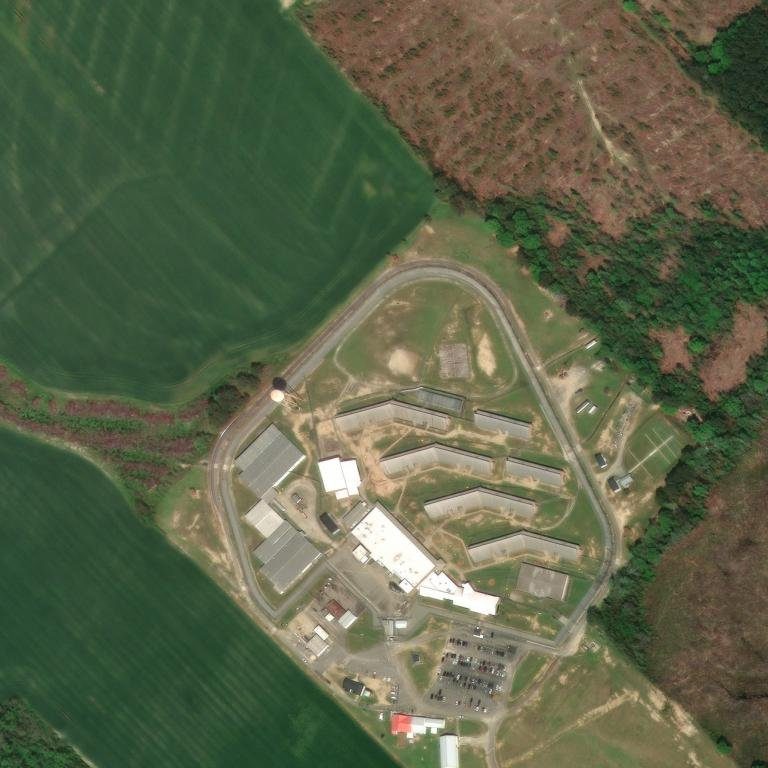
Satellite image: Esri World Imagery. Architecture documents what the building was designed to hold. See the system-wide receipts at gps.press/warehouse.
Then and now


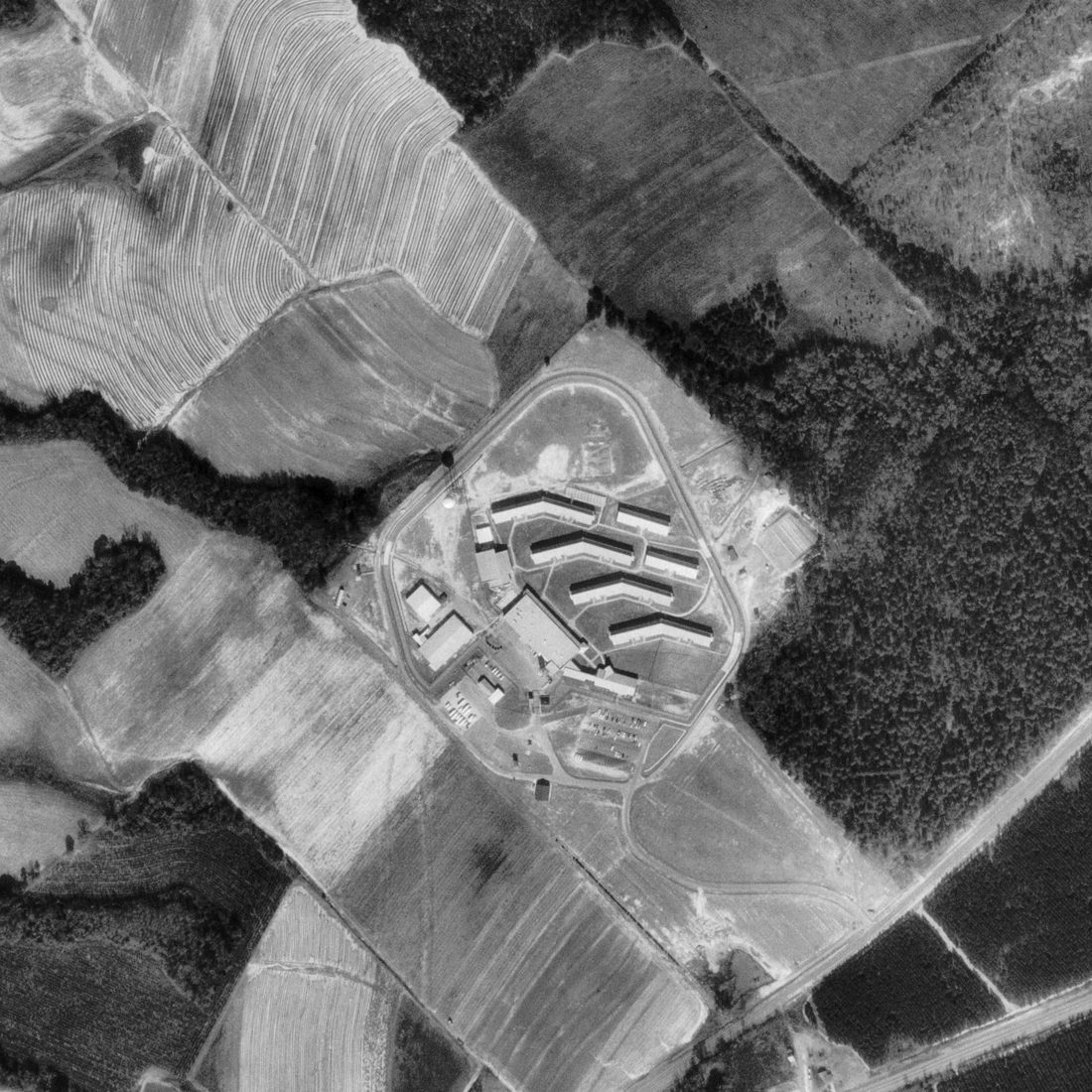
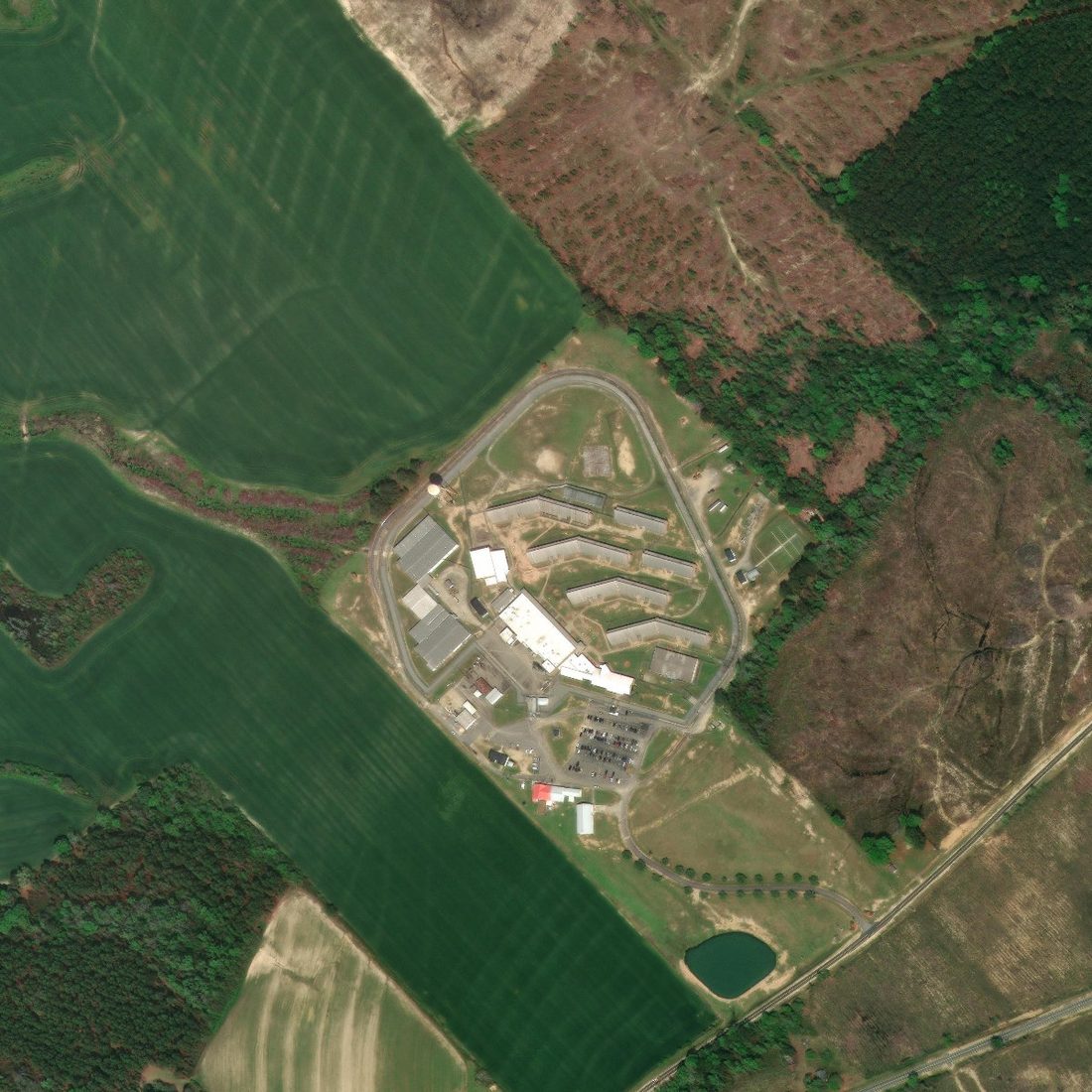
Each photo shows the same 1.2 km square, north up, so buildings line up from one year to the next. The older photos are U.S. Geological Survey aerial photographs. The photos from 1988 and earlier were taken on film and lined up with the later ones by their roads, so their positions are approximate. The early-1980s photos were taken from very high up and are less sharp. Select a photo to see it full size.