
Estimated reading time: 14 minutes
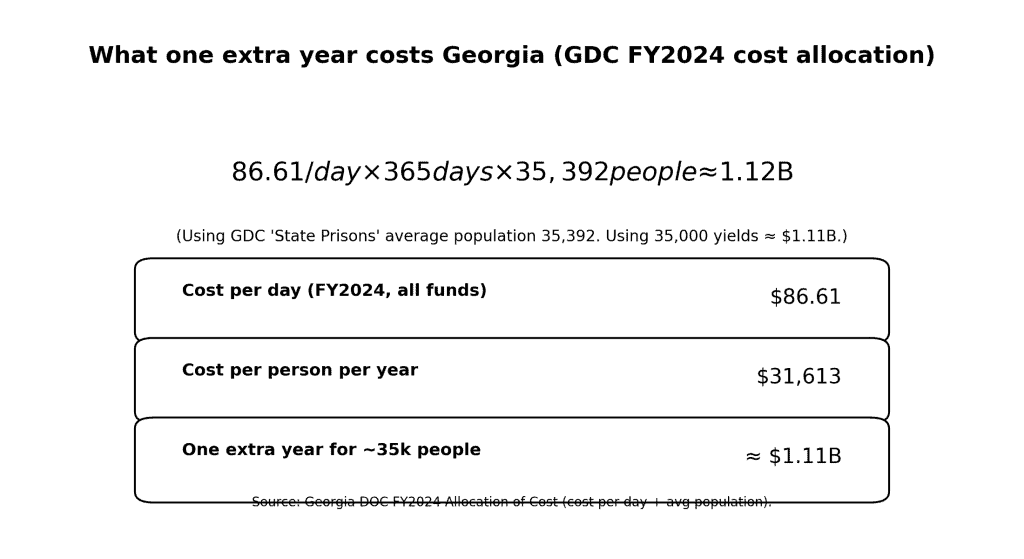
It costs Georgia taxpayers $86.61 to house one person in a state prison for one day. That figure comes directly from the Georgia Department of Corrections’ FY2024 cost allocation report—an internal accounting document that breaks down exactly where the money goes.
But the daily rate only tells part of the story. This investigation examines Georgia’s shadow sentencing system—the largely unseen parole practices that quietly determine how long people actually remain incarcerated, often years beyond what past parole practices would have required—and what that hidden system is costing taxpayers.
By itself, that number tells you something. Multiply it by 365 days, and you get $31,614 per year, per person. Multiply that by the 35,392 people GDC counts in its state prisons — the population the daily rate is calculated against — and you arrive at an annual operating cost of about $1.12 billion, which is what GDC reports.
But the daily rate only tells part of the story. The real question is: how many days? And that’s where a second GDC report becomes essential. The department’s own Length of Stay data—tracking how long people actually serve before release—reveals a pattern that should concern every Georgia taxpayer, every family with a loved one inside, and every legislator who claims to care about public safety or fiscal responsibility.
People are serving dramatically longer sentences than they did a decade ago. Not because courts ordered it. Not because the law changed. But because the Georgia State Board of Pardons and Paroles quietly stopped doing its job.
The Numbers Don’t Lie
The GDC’s Length of Stay report tracks the average time served by people released each calendar year, broken down by original sentence length. The trend over the past decade is unmistakable.
In 2014, the average Georgia prisoner served 3.94 years before release. By 2023, that number had climbed to 5.00 years—a 27% increase in actual time served.
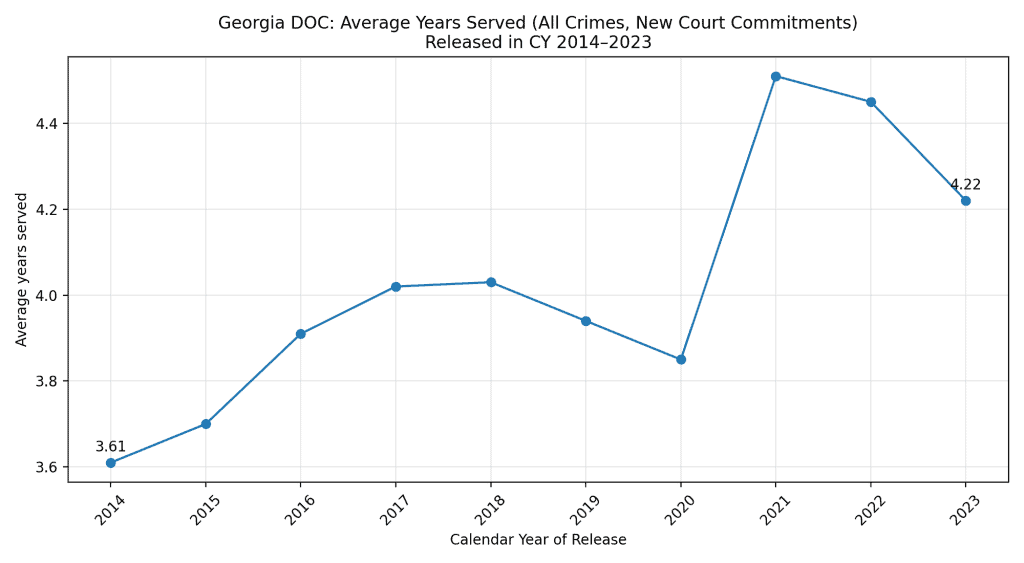
The jump during COVID was particularly sharp. Average time served shot from 4.45 years in 2019 to 5.55 years in 2021—when parole hearings froze, courts closed, and processing ground to a halt. But here’s what’s telling: even after the pandemic emergency ended, time served never returned to pre-COVID levels. The system found a new, longer baseline and stayed there.
The increases are even more dramatic when you look at specific sentence categories. People with sentences of 10-15 years went from serving an average of 4.67 years in 2014 to 6.77 years in 2023. That’s a 45% increase in actual time served—for identical sentence lengths.
What changed wasn’t the law. What changed was policy—unwritten, unlegislated, and unaccountable.
The Parole Board’s Tightening Grip
The Georgia Parole Board’s own annual reports quantify the shift. In FY 2019, the Board granted parole to 38% of people considered — releasing 9,455 individuals. By FY 2024, that grant rate had collapsed to just 28% — a record low. Only 5,443 people were paroled.
Notably, grant rates actually increased during the pandemic years (48% in 2020, 53% in 2021)—but the Board quickly reversed course, dropping to record lows by 2024. This wasn’t a return to normal. It was an overcorrection.
That’s a 42% drop in actual releases over five years, even as Georgia’s prison population grew.
The trend is even starker for people serving life sentences. In FY 2024, the Board considered 2,046 life sentence cases and granted parole to just 93 — a 4.5% approval rate. For those convicted of “serious violent felonies,” only 67 were released. The average time served before release: 29.2 years. In 1973, that figure was under nine years.
When the Board denies parole to someone serving life, it can wait up to eight years before reconsidering — one of the longest setback periods in the nation. And it never has to explain why.
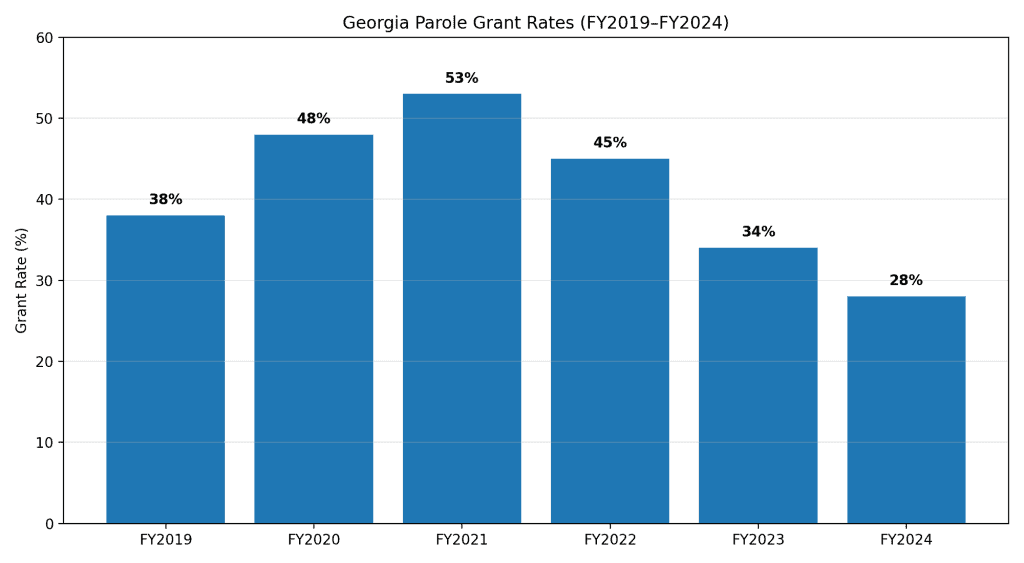
| Fiscal Year | Cases Considered | Granted | Rate |
|---|---|---|---|
| 2019 | 24,738 | 9,455 | 38% |
| 2020 | 21,790 | 10,429 | 48% |
| 2021 | 16,255 | 8,634 | 53% |
| 2022 | 13,967 | 6,245 | 45% |
| 2023 | 17,151 | 5,863 | 34% |
| 2024 | 19,328 | 5,443 | 28% |
Source: Georgia State Board of Pardons and Paroles Annual Reports
This table reveals the COVID-era spike (2020-2021 saw higher grant rates) followed by a sharp overcorrection—the Board became more restrictive than pre-pandemic, not just returning to baseline.
Do the Math
The arithmetic is brutal. Start with the length of stay increase: One additional year served across 35,000 state prisoners costs $1.1 billion annually at $86.61 per day.
Now add the parole effect: The 42% decline in parole releases since 2019 means roughly 4,000 additional people remain incarcerated each year who would have been released under the Board’s prior practices—at $86.61 per day, that’s approximately $126 million annually in additional incarceration costs attributable solely to the shift in parole policy.
These costs compound. Georgia isn’t just paying more per person—it’s paying for more people, for longer.
Georgia is spending over a billion dollars annually to keep people incarcerated longer than it did ten years ago—with nothing to show for it but more violence, more deaths, and a federal finding of unconstitutional conditions.
Over a decade, the cumulative fiscal impact approaches the $40 billion figure GPS has documented in previous reporting 1. This isn’t abstract. It’s money that could fund schools, roads, hospitals, or—if we’re serious about public safety—actual rehabilitation programs that reduce recidivism.
Instead, it’s being spent to warehouse people longer, in facilities the U.S. Department of Justice has declared unconstitutionally violent and dangerous 2.
How Did This Happen?
Georgia never passed a comprehensive “truth in sentencing” law like the federal system or many other states. But it didn’t need to. The same outcome was achieved through a combination of targeted legislation and administrative discretion.
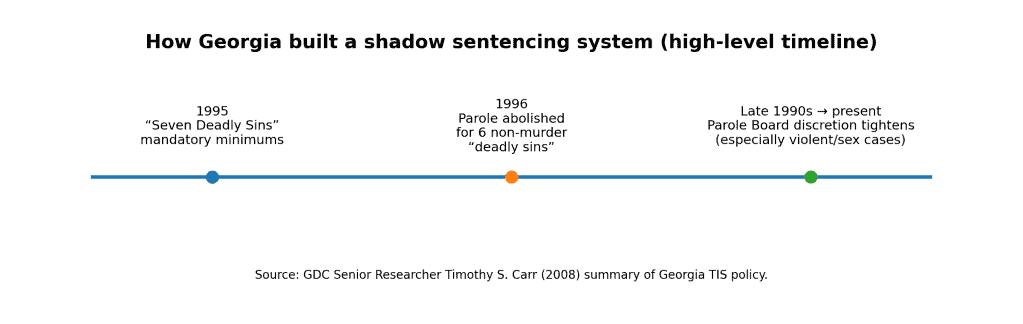
In 1995, Georgia passed the “Seven Deadly Sins” law, mandating minimum sentences of at least ten years—without parole—for kidnapping, armed robbery, rape, aggravated sodomy, aggravated sexual battery, and aggravated child molestation. Murder required life with no parole eligibility for 25 years. A second offense for any of these crimes meant life without parole.
In 1996, parole was formally abolished for those six non-murder offenses. Anyone convicted must serve 100% of their sentence.
These changes were significant—and Georgia collected $82 million in federal funds between 1996 and 2001 specifically for adopting them 3. But they only applied to a subset of offenses.
What happened next was quieter and broader. As GDC’s own senior researcher Timothy Carr documented in a 2008 internal report:
“Starting in the late 1990’s, on its own volition, the Georgia Parole Board has sharply curtailed its use of clemency, especially for violent and sex crimes.”
On its own volition. Not by statute. Not by court order. Not after public debate. The Parole Board simply decided to grant fewer releases—and the average length of stay climbed year after year.
The Population Explosion
The consequences are visible in GDC’s own historical population data. In 1989, Georgia’s prison system held 20,825 people. By 1995—the year the Seven Deadly Sins law passed—that number had grown to 34,044. By 2007, it peaked at 54,463.
The population has since declined slightly—partly due to sentencing reforms, partly due to COVID releases—but as of 2025, Georgia still holds over 53,000 people in its prison system. That’s more than double the 1989 level, in a state whose general population grew by only about 60% over the same period.
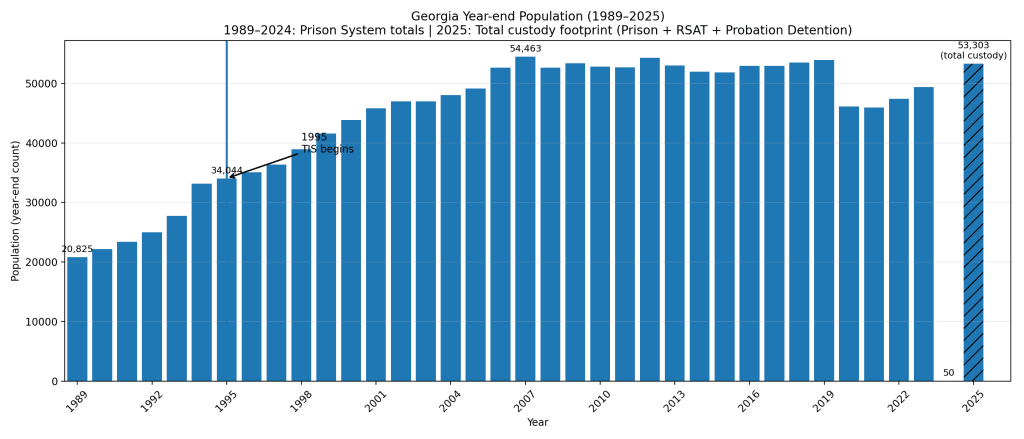
The prison population didn’t explode because Georgians suddenly became more criminal. It exploded because the state started holding people longer—first by law for the most serious offenses, then by policy for everyone else.
What Are We Getting for $1.5 Billion a Year?
If longer incarceration produced safer prisons or lower recidivism, there might be a policy argument for the expense. But the evidence points the opposite direction.
In October 2024, the U.S. Department of Justice released its findings from a multi-year investigation into Georgia’s prison system. The conclusions were damning:
- Georgia prisons violate the Eighth Amendment’s prohibition on cruel and unusual punishment
- Inmates face “substantial risk of serious harm” from violence
- The state has failed to protect people in its custody from assault, rape, and murder
- Understaffing has reached crisis levels—some facilities operated with fewer than half the officers needed
- Gangs effectively control housing units because there aren’t enough guards to maintain order
This is what $86.61 per day is buying. Not rehabilitation. Not public safety. Not even basic humane custody. Just longer warehousing in facilities the federal government has declared unconstitutionally dangerous.
If longer incarceration produced better outcomes, Georgia’s recidivism rate should have plummeted. It hasn’t. According to the Georgia Council on Criminal Justice Reform, the state’s three-year reconviction rate remained stuck at approximately 30 percent for over a decade—even as corrections spending doubled and average time served increased by 27 percent. GDC’s own data shows that vocational program completers have a recidivism rate of roughly 13%—half the general population rate. Yet programming continues to be slashed as facilities remain dangerously understaffed.
The Accountability Vacuum
The Georgia State Board of Pardons and Paroles operates with almost no public oversight. Its five members are appointed by the Governor for staggered seven-year terms—longer than any elected official’s tenure. They don’t answer to voters. They don’t have to explain their decisions. When they deny parole, they aren’t required to say why.
The Board’s own annual report confirms that “parole hearings are not held.” Decisions are made through administrative review of case files — no testimony, no opportunity for the incarcerated person to speak, no public record of deliberation. The Board ballot showing how individual members voted is explicitly protected from public disclosure. In FY 2024, this opaque process resulted in 72% of parole-eligible people being denied release, with zero written explanations provided.
This lack of transparency creates a shadow sentencing system. A judge imposes a sentence in open court, with a public record. The Parole Board then effectively re-sentences that person behind closed doors—often adding years to their incarceration—with no hearing, no written findings, and no appeal.
Consider what that means in practice. A person sentenced to 15 years might have been released after 7 or 8 years under the parole practices of the 1990s. Today, that same person might serve 11 or 12 years. The difference isn’t because of anything they did or didn’t do. It’s because the Parole Board’s unwritten policies shifted.
That’s not justice. It’s administrative caprice with life-altering consequences—paid for by Georgia taxpayers at $86.61 per day.
A Path Forward: Senate Bill 25
There is legislation pending that would begin to address this accountability vacuum. Senate Bill 25, currently in the Senate Public Safety Committee, would require the Parole Board to:
- Provide video conference hearings before a tentative parole date
- Allow incarcerated people to actually speak to the board about their case
- Issue written findings when parole is denied or delayed
- Notify all five board members when three vote to deny release
These are modest reforms. SB25 doesn’t mandate release for anyone. It doesn’t change sentencing laws. It simply requires that when the Parole Board keeps someone incarcerated beyond their tentative parole date, they have to explain why—in writing, on the record.
The bill died in committee during the 2025 legislative session 4. It will be back for consideration when the legislature reconvenes in January 2026. Advocates are pushing for it to pass before Crossover Day—the deadline for bills to move between chambers—or it will likely be dead until 2027.
Some reform advocates argue SB25 doesn’t go far enough. They want presumptive parole—a system where release is the default for people who’ve served their minimum time and met program requirements, with the burden on the state to justify continued incarceration 5. They want expedited review for elderly and terminally ill prisoners who pose no public safety risk. They want real oversight of a board that currently answers to no one.
These broader reforms make sense. But SB25 is the bill that’s actually on the table. Passing it would be a first step toward restoring transparency to a system that has operated in darkness for too long.
The Bottom Line
Georgia is spending more than ever to incarcerate people longer than ever, in facilities that are more dangerous than ever. The state’s own data proves it. The federal government has confirmed it. And the Parole Board—the agency most responsible for determining how long people actually serve—operates without transparency, without hearings, and without accountability.
This isn’t a partisan issue. Fiscal conservatives should be appalled at the waste. Criminal justice reformers should be outraged at the human cost. Families should be demanding answers about why their loved ones are serving years longer than people with identical sentences served a generation ago.
The numbers are in GDC’s own reports. The constitutional violations are in the DOJ’s findings. The only thing missing is the political will to change it.
At $86.61 per day, Georgia can’t afford to wait.
Call to Action: What You Can Do
Georgia is spending over $1 billion annually to warehouse people 27% longer in prisons the DOJ calls unconstitutionally violent. The Parole Board operates in complete secrecy while families wait years for answers that never come. If this doesn't make you angry enough to share, you're choosing to let it continue.
Spread the Word: It Takes One Click
Awareness without action changes nothing. Here are the most effective ways you can help push for accountability and real reform:
Use Impact Justice AI
Our free tool at https://impactjustice.ai helps you instantly draft and send personalized emails to lawmakers, journalists, and agencies. No expertise required—just your voice and your concern.

Contact Your Representatives
Your state legislators control GDC’s budget, oversight, and the laws that created these failures. Demand accountability and transparency.
- Find your Georgia legislators: https://openstates.org/findyourlegislator
- Governor Brian Kemp: (404) 656-1776
- Georgia Department of Corrections Commissioner: (478) 992-5246
Demand Media Coverage
Journalists need to know these stories matter. Contact newsrooms at the Atlanta Journal-Constitution, local TV stations, and national outlets covering criminal justice. More coverage means more pressure for reform.
Amplify on Social Media
Share this article and call out the people in power.
Tag: @GovKemp, @GDC_Georgia, your local representatives
Use hashtags such as #GAPrisons, #PrisonReform, #GeorgiaPrisonerSpeak
Public pressure works—especially when it’s loud.
File Public Records Requests
Georgia’s Open Records Act gives every citizen the right to access government documents. Request:
- Incident reports
- Death records
- Staffing data
- Medical logs
- Financial and contract documents
Transparency reveals truth.
Attend Public Meetings
The Georgia Board of Corrections holds public meetings. Legislative committees review corrections issues during session. Your presence is noticed.
Contact the Department of Justice
For civil rights violations in Georgia prisons, file a complaint with the DOJ Civil Rights Division:
https://civilrights.justice.gov
Federal oversight has forced abusive systems to change before.
Support Organizations Doing This Work
Donate to or volunteer with Georgia-based prison reform groups fighting for change on the ground.
Vote
Research candidates’ positions on criminal justice. Primary elections often determine outcomes in Georgia. Your vote shapes who controls these systems.
Contact GPS
Georgia Prisoners’ Speak exists because incarcerated people and their families deserve to be heard. If you have information about conditions inside Georgia’s prisons, contact us securely at GPS.press.
About Georgia Prisoners’ Speak (GPS)
Georgia Prisoners’ Speak (GPS) is a nonprofit research organization built in partnership with incarcerated reporters, families, advocates, and data analysts. Operating independently from the Georgia Department of Corrections, GPS documents the truth the state refuses to acknowledge: extreme violence, fatal medical neglect, gang-controlled dorms, collapsed staffing, fraudulent reporting practices, and unconstitutional conditions across Georgia’s prisons.
Through confidential reporting channels, secure communication, evidence verification, public-records requests, legislative research, and professional investigative standards, GPS provides the transparency the system lacks. Our mission is to expose abuses, protect incarcerated people, support families, and push Georgia toward meaningful reform based on human rights, evidence, and public accountability.
Every article is part of a larger fight — to end the silence, reveal the truth, and demand justice.
Further Reading
- Georgia’s $40 Billion Mistake: How Bad Science and Federal Bribes Created a Constitutional Crisis A comprehensive investigation into how truth-in-sentencing policies drained Georgia’s budget while failing to improve public safety.
- Truth in Sentencing Broke Parole. Georgia Is Paying the Price. How federal incentives and state policy choices dismantled Georgia’s parole system and created today’s crisis.
- Senate Bill 25: A Way Out The parole transparency bill that could restore accountability to Georgia’s secretive release process.
- A Second Chance for Georgia: Fixing Parole With the Reform It Desperately Needs The case for presumptive parole and the Second Chance Parole Reform Act of 2026.
- Georgia’s 2026 Legislative Session: A Second Chance for Real Parole Reform What’s at stake when the legislature reconvenes and how advocates can push for meaningful change.
Source Documents:
GDC FY2024 Cost Per Day Consolidated Summary
GDC Length of Stay by Calendar Year Report
GDC Year-End Population Counts, 1925-Present
GDC Internal Document: “Truth in Sentencing” in Georgia (Timothy S. Carr, PhD, 2008)
U.S. Department of Justice, Investigation of Georgia’s State Prisons (October 2024)
Georgia State Board of Pardons and Paroles, Annual Report FY 2024
Prison Policy Initiative, “Parole in Perspective: Discretionary Parole Grant Rates by State, 2019-2024”
The Architecture Is the Evidence
Across the 32 state prisons whose original design figures we hold, Georgia built for 15,737. They hold 33,805 — 215% of design capacity.
Dorms tripled. Cells double- and triple-bunked. Medical, kitchens, libraries — unchanged. Every facility, every design figure, every source.
See the receipts →- GPS $40 Billion Mistake, https://gps.press/georgia-truth-in-sentencing-40-billion-failure[↩]
- DOJ Investigation of Georgia Prisons October 2024, https://www.justice.gov/usao-ndga/pr/justice-department-finds-conditions-georgia-prisons-violate-constitution[↩]
- Bureau of Justice Assistance VOITIS Report, https://bja.ojp.gov/sites/g/files/xyckuh186/files/media/document/voitis-final-report.pdf[↩]
- GPS SB25 Coverage, https://gps.press/senate-bill-25-a-way-out-for-many/[↩]
- GPS Second Chance Act, https://gps.press/second-chance-act/[↩]
You Have Options
Free tools to take action — the law is on your side.
Demand records from the prison system. Reach the officials who set policy. File a grievance or a complaint the right way. And for families who’ve lost someone in custody, get the records that tell the truth. Plain-language, step-by-step, and free.
Explore the GPS Toolkits →
Yes We Must Do Something To Get Things Changed And Done. My Son Is In Prison In South Georgia. Jackson Was The Worst, Watching People Die In Front Of You. My Son Was Jumped And Beat Up Pretty Bad. He Couldn’t Wait To Get Out Of Jackson. Now Where He Is At They Barely Feed Them! Everyone Wants A Piece Of The Pie When It Comes To People Who Are Incarcerated! You Put Money On There Books And Depending On How Much The Fee Starts At $7.95 And Goes Up. And Then They Send Your Loved One Hours Away From Where You Live! I Drive 5.5-6 Hours One Way To Visit For 2 Hours!