CALHOUN STATE PRISON
Facility Information
- Original Design Capacity
- 500 (at 308% capacity)
- Bed Capacity
- 1,677 beds
- Current Population
- 1,540
- Active Lifers
- 552 (35.8% of population) · Oct 2026 GDC report
- Life Without Parole
- 1 (0.1%)
What the courts held in Brown v. Plata, and how Georgia compares →
- Address
- 27823 Main Street, Morgan, GA 39866
- Phone
- (229) 849-5000
- Fax
- (229) 849-5017
- Mailing Address
- P.O. Box 249, Morgan, GA 39866
- County
- Calhoun County
- Opened
- 1994
- Operator
- GDC (Georgia Dept. of Corrections)
Security Classification
Last updated: September 23, 2026
619 of the 1,516 people held here are classified Close security (40.8%), as of September 23, 2026.
| Security level | People | Share |
|---|---|---|
| Close | 619 | 40.8% |
| Medium | 871 | 57.5% |
| Minimum | 26 | 1.7% |
| Total | 1,516 |
Earlier count (undated table, produced October 22, 2025): 487 of 1,657 Close (29.4%).
Source: Georgia Department of Corrections records produced to GPS under the Open Records Act (R031471-090226, R024615-101925). A person's security level is GDC's classification of that person, which can differ from the prison's own designation.
Follow Calhoun State Prison
Leadership & Accountability (as of 2026 records)
Officials currently holding positional authority at this facility, with deaths attributed to GPS-tracked records during their leadership tenure. Inclusion reflects role-based accountability, not legal findings of personal culpability. Death counts shown as facility / career.
| Role | Name | Since | Deaths this facility / career |
|---|---|---|---|
| Warden (facility lead) | Hudson, Charles Leonard | 2026-06-01 | 1 / 15 |
| Deputy Warden of Care and Treatment (facility deputy) | Scott, Tracey | 2020-01-01 | 28 / 28 |
| Deputy Warden of Security (facility deputy) | Spencer, Gwendolyn A | 2023-11-22 | 14 / 14 |
| Deputy Warden of Security (facility deputy) | Johnson, Curtis Tyrone | 2025-05-16 | 6 / 6 |
| Deputy Warden of Administration (facility deputy) | Owens, Sawanda | 2026-08-01 | 1 / 1 |
About
Last updated October 18, 2026.(DS)
Calhoun State Prison sits in Morgan, in Calhoun County, a medium-security institution for adult male felons that opened in 1994 on a design built for 500 people. It was renovated in 1999 and 2008, and its housing today consists mainly of double-bunked cells and dormitory units with a segregation and disciplinary area. It supports standard work details and limited programming. Its current rated capacity is 1,677, and GPS's facility records put the population at roughly 1,540 — about 92 percent of rated capacity, but more than three times what the plant was designed to hold.
That gap between design and use is the thread that runs through nearly everything GPS has documented about Calhoun: a federal civil-rights investigation that found staff there failed to follow classification procedures and that an incarcerated man died of dehydration after his water was shut off; a homicide record that includes a 21-year-old stabbed to death by a cellmate after staff moved his assailant through housing without following procedure; a documented wave of 87 men serving life sentences transferred out to close-security prisons in under three months; and a contraband economy that has run through the facility's own staff and, in one federal case, out of a contraband cellphone to victims in six states.
A Medium-Security Prison Housing a Close-Security Population
The most consequential fact about Calhoun is one its security designation obscures. As of October 2025, the facility held 487 close-security inmates — 29.4 percent of its total population — inside a prison the Georgia Department of Corrections classifies as medium-security. That figure is drawn from GDC's own numbers.
GPS's analysis has described this as classification drift: medium-security prisons operating as de facto close-security facilities without the staffing or infrastructure that close security requires. In a published analysis, GPS reported that four medium-security prisons — Dooly, Wilcox, Calhoun, and Washington State Prisons — now house close-security populations in the 28 to 30 percent range, and that those facilities show homicide rates four to five times higher than properly classified prisons. The analysis counted 33 deaths across the four in 2024 alone, more than half of them under age 50. The U.S. Department of Justice found all four in violation of the Eighth Amendment.
The mismatch is not abstract at Calhoun. It is the mechanism the DOJ identified in the 2022 death of DaQuavious Cachone Lackey, 21, who died on May 16, 2022, from a stab wound to the neck and multiple blunt-force injuries. The Atlanta Journal-Constitution reported that the DOJ found staff failed to follow procedures when moving Lackey's assailant between segregation and general population, leading to Lackey being housed with the man who killed him — beaten with a fan motor in a net bag. A separate news account of the same homicide described staff moving an assailant through segregation and general population without following classification procedures.
The Federal Findings: Dehydration, Delayed EMS, and a Grievance That Went Nowhere
The DOJ's October 2024 findings letter, as reported by WALB, documented conditions at Calhoun that go well beyond classification. Federal investigators found that an incarcerated person at the facility died of dehydration after staff shut off his water, closed the door flap, and did not deliver meals for two days. The Atlanta Journal-Constitution reported that the man was 24 years old and that he died of dehydration with renal failure after staff cut off his food and water following an incident in which he threw water through his cell door flap. In a separate account, the AJC reported that in February 2023 an incarcerated person was found dead in his restrictive-housing cell, that the coroner believed he had been dead seven to eight hours before being found, and that the cause was dehydration with renal failure.
The DOJ also found that a grievance filed by an incarcerated person at Calhoun alleging extortion and gang violence was rejected as untimely with no follow-up. More broadly, federal investigators found that less than 10 percent of prison fights, less than 23 percent of inmate-on-inmate assaults, and less than 6 percent of incidents involving weapons were forwarded for investigation. WALB reported that the DOJ concluded Georgia's prison system fails to provide incarcerated persons with the constitutionally required minimum of reasonable physical safety, that EMS teams are delayed an average of 30 minutes during emergency responses to GDC prisons due to understaffing, and that incarcerated people were cleaning and dressing their own wounds with toothpaste, coffee grounds, dirt, and makeshift bandages because medical help was delayed or unavailable.
The DOJ further found that Georgia deliberately underreports prison homicides, listing deaths clearly identified as homicides in internal reports as "unknown" in official mortality data. WALB reported the state recorded only 6 homicides in the first five months of 2024 while internal GDC incident reports documented at least 18 deaths as homicides in the same period.
Thirty Deaths Since 2020
GPS's mortality registry records 30 deaths at Calhoun State Prison since January 1, 2020 — a floor, since GDC reports deaths roughly two months late. Of those, 14 are coded Unknown/Pending, 7 Homicide, 7 Natural/Medical, 1 Suicide, and 1 Deliberate Indifference. The full list is maintained at GPS's facility death registry.
The most recent deaths GPS has recorded include Randy Walton, who died August 21, 2026, at Calhoun State Prison; the registry lists the cause as Unknown/Pending and his age as 67. Freddie Lee Patterson died May 13, 2026, at Calhoun State Prison, cause Unknown/Pending, age 51. Jimmy McMullen died January 28, 2026, at Calhoun State Prison; the registry lists the cause as Natural/Medical, age 67. Matthew Len Nutt died December 21, 2025, at Calhoun State Prison; the registry lists the cause as Homicide, age 37. Thomas Haugabook died September 25, 2025, at Calhoun State Prison, Natural/Medical, age 67. Tyler Jackson died June 28, 2025, at Calhoun State Prison, Unknown/Pending, age 30. Gary Bernard Duncan died May 4, 2025, at Calhoun State Prison, Unknown/Pending, age 67. Theodore Roundtree died January 19, 2025, at Calhoun State Prison; the registry lists the cause as Homicide. Charles Owens died January 6, 2025, at Calhoun State Prison, Unknown/Pending. Kent Tyrik Robinson died November 5, 2024, at Calhoun State Prison, Unknown/Pending, age 26. Willie Andrew Willis died October 21, 2024, at Calhoun State Prison; the registry lists the cause as Homicide, age 27. William Dutton Maddox died August 1, 2024, at Calhoun State Prison, Unknown/Pending, age 62. Terry Paul Smith died July 20, 2024, at Calhoun State Prison, Unknown/Pending, age 62. Gonzalo Colmenero-Ayala died July 17, 2024, at Calhoun State Prison; the registry lists the cause as Homicide, age 54. Tyler Jackson Blackwell died July 13, 2024, at Calhoun State Prison, Unknown/Pending, age 31. Kenneth Scott Piper died May 4, 2024, at Calhoun State Prison; the registry lists the cause as Homicide, age 37. Martel Orlando Dorsey died November 24, 2023, at Calhoun State Prison; the registry lists the cause as Homicide, age 32. Randy Dixon died November 23, 2023, at Calhoun State Prison, Unknown/Pending, age 63. Paul Russell Gordon died November 13, 2023, at Calhoun State Prison, Unknown/Pending, age 63. Sergio Andres Lopez-Herrera died July 15, 2023, at Calhoun State Prison, Natural/Medical, age 41. Reginald Jerome Jacobs Jr. died February 6, 2023, at Calhoun State Prison; the registry lists the cause as Deliberate Indifference, age 24. Timothy Edwin Bryant died October 11, 2022, at Calhoun State Prison, Natural/Medical, age 64. James Thomas Ennis died September 30, 2022, at Calhoun State Prison, Unknown/Pending, age 63. Daquavious Lackey died May 16, 2022, at Calhoun State Prison; the registry lists the cause as Homicide, age 21. Christopher Edward Oliva died April 9, 2022, at Calhoun State Prison; the registry lists the cause as Suicide, age 43.
Several of these deaths carry public reporting. The AJC reported that Kenneth Piper, 37, was killed in an inmate-to-inmate assault on May 4, 2024, per incident report data. The AJC reported that Gonzalo Colmenero, 54, died July 17, 2024, following an inmate-to-inmate assault. The AJC reported that Martel Dorsey, 34, was stabbed by other prisoners on October 4, 2023, and that GDC told a television station several witnesses saw Dorsey run out of a dorm as he was chased by other prisoners. WALB reported that Willie Andrew Willis Jr. suffered catastrophic injuries from a fall at Calhoun State Prison and later died, with medical records listing sepsis as the cause of death; his family alleges he was thrown from a balcony by other inmates and that nearly an hour passed before he was airlifted for treatment. The family also alleges nurses gave a conflicting account, claiming he came to get Tylenol and returned to his dorm before collapsing, while the family states he was paralyzed from the waist down and on a ventilator.
The Quiet Purge: 87 Lifers Shipped to Close Security
In less than three months, Warden Kendric Jackson transferred 87 men serving life sentences out of Calhoun State Prison, 79 percent of them to close-security facilities, according to GPS's own investigative reporting. GPS's analysis, published under the title "The Quiet Purge: Calhoun Edition," described a systematic population swap: stable, long-term residents shipped to Level 5 prisons while younger short-termers arrived from those same facilities. GPS reported that no other medium-security prison in Georgia was doing anything close to this. The reporting documented a concentrated wave of 36 lifer transfers in the final week of March 2026, and profiled John Morgan Coleman, an 82-year-old lifer transferred from Calhoun to Hancock State Prison, a close-security Level 5 facility.
GPS staff analysis identified Calhoun as a significant statistical outlier in transfer rates for life-sentenced incarcerated persons compared with other facilities, and observed that a large majority of the lifers transferred were Black, that a significant portion were 60 or older, and that a large majority had been convicted of murder. GPS's internal analysis further found that a majority of outgoing transfers were short-term inmates — roughly two-thirds — while a large majority of incoming transfers from Level 5 facilities were non-lifers being reclassified to lower security. GPS flagged for verification a pattern in which incoming close-security disciplinary transfers may be replacing outgoing stable long-term residents.
The leadership context matters here. GPS's canonical personnel records list Charles Leonard Hudson as warden since June 1, 2026. The transfer wave GPS documented is attributed in its reporting to Warden Kendric Jackson, who is not listed in GPS's current leadership record for the facility. The deputies currently on record are Sawanda Owens (Deputy Warden of Administration, since August 2026), Tracey Scott (Deputy Warden of Care and Treatment), Curtis Tyrone Johnson (Deputy Warden of Security, since May 2025), and Gwendolyn A. Spencer (Deputy Warden of Security).
Contraband, Staff, and a Scam Network That Reached Six States
Calhoun's contraband problem is not only an inmate problem. GPS's analysis of GDC's own contraband reports found that Calhoun ranked second among state facilities for incidents naming a staff-class person — 28 staff-class people across 159 incidents, behind only Dooly State Prison. GDC publishes arrests as reported, not convictions, and publishes no dispositions.
The AJC's June 2025 investigation into the collapse of drug prosecutions tied to Calhoun laid out how thoroughly the enforcement chain failed. Correctional officers Corlethia Lattimore and Imani Ferguson were arrested in February 2020 after arriving for their shifts with Hot Pockets packages — Lattimore's allegedly containing 112 grams of methamphetamine, four times the amount for a trafficking charge, and Ferguson's containing tobacco. Both were immediately fired. Their charges were dismissed in July 2023 because there was no crime lab report or law enforcement report to support them; the drug evidence had never been submitted for testing, and the four-year statute of limitations had run. GDC investigator Ruby Long took out the arrest warrants but failed to submit the drug evidence to the crime lab. In all, nearly two dozen cases leading to 33 arrests between 2018 and 2021 were dismissed by District Attorney Joe Mulholland because drug evidence was never submitted to the GBI crime lab — and five prison employees and dozens of other suspected smugglers walked free. The Calhoun County Sheriff's Department separately failed to submit drug evidence in 12 dismissed cases. The AJC reported that GDC's public statement about the number of dismissed cases conflicted with what the newspaper found in court files. On June 2, 2025, a grand jury heard 35 Calhoun-related cases; more than 300 remained pending afterward, according to the Superior Court clerk.
The AJC also documented the money flowing the other direction: in the first three months of 2025, GDC paid nearly $127,000 to Calhoun County Sheriff Josh Hilton and eight of his deputies for off-duty perimeter patrol at $45 per hour.
Contraband cellphones at Calhoun have powered crimes far beyond the fence. FOX 5 Atlanta reported that inmates used Voice Over Internet Protocol to spoof police department numbers and pose as officers, telling victims they had arrest warrants for missing jury duty and demanding bond payments; some victims were instructed to undress in a Target restroom and film a self-conducted cavity search, then received lewd messages and violent threats. A federal jury convicted Lance Riddle and Joey Amour Jackson of conspiracy to commit wire fraud and conspiracy to commit money laundering after a five-day trial; Riddle was sentenced to 200 months and Jackson to 120 months, consecutive to any state sentences. A Florida sheriff, Volusia County's Mike Chitwood, has said a "huge scam" operation is being run out of Calhoun State Prison and Wheeler Correctional Institution, and the AJC reported that Annie Ashley of Atlanta was charged with grand theft in connection with the network — one of roughly two dozen people arrested in the past year by Volusia County.
Other Calhoun prisoners ran their own operations. The AJC reported that Jonathan Alvin Pope led a drug ring operating in at least seven Georgia counties as far back as 2018, with 13 others indicted, seven of them also incarcerated; Pope was sentenced to 20 years in federal prison. Edwin Murillo brokered major meth sales in several northeast Georgia counties and was sentenced to 300 months in federal prison in April 2019; he was later sentenced to life for directing a 2021 torture and murder. Irvin Falcon, 23, used a contraband cellphone to direct meth deliveries in the Fitzgerald area. And in 2019, Calhoun officer Temperess Johnson was caught attempting to smuggle eight cellphones and 2.6 pounds of meth in a GDC van; she was sentenced to five years in federal prison.
Settlements, Sanitation, and the Record of What the State Has Paid For
The state's own risk-management ledger records what Calhoun has cost. In 2023, the state paid $3,250,000 to Reginald Jacobs Sr., for the Estate of Reginald Jacobs Jr., tied to Calhoun and linked to a documented death record — the same Reginald Jerome Jacobs Jr. whose February 6, 2023 death GPS's registry codes as Deliberate Indifference. Earlier payouts include $998,715 to Angel M. Ortiz (2019 incident), $10,000 to Asmar Rasheed (2018), and $1,400 to Lasharon Brantley (2020), per the Georgia DOAS Risk Management settlement ledger obtained through open records.
On food safety, the Georgia Department of Public Health's routine inspections of Calhoun's kitchen have scored consistently high — 100, 99, 98, and 96 across inspections in 2023, 2024, 2025, and 2026, all Grade A, with violations typically limited to handwashing facilities and physical-facility cleanliness. GPS has documented a systemic pattern in which DPH scores fail to capture food-service sanitation failure, because inspections are scheduled walkthroughs that do not assess equipment under load. That finding is systemwide; GPS's records do not establish a specific Calhoun kitchen failure beyond the inspection record itself.
What GPS's Records Show at Scale
GPS's intelligence system records, over the past twelve months, 26 sources reporting alleged inmate-on-inmate assaults at Calhoun across eight cases and six months, with severity ranging from moderate to critical and at least one external complaint filed to the DOJ Civil Rights Division. GPS records 11 sources reporting unnamed staff misconduct and 10 reporting named staff misconduct; 10 sources expressing family fear for an incarcerated person's life; nine family safety concerns; eight reports of a death in custody; eight alleging medical neglect; seven alleging due-process violations; five alleging assault by staff and five alleging excessive force; five alleging grievance obstruction; four reporting staffing shortages; three food-quality complaints; and three alleging racial discrimination. Nine external complaints were filed to oversight bodies in the period, including the DOJ Civil Rights Division.
GPS has also received recurring accounts from inside Calhoun describing force used for talking, meals withheld as punishment, group punishment of entire housing units, and food distribution controlled by gang affiliation. These are accounts GPS has collected; they are not independently corroborated findings, and GPS treats them as reports awaiting corroboration.
Sources
This analysis draws on the U.S. Department of Justice's October 2024 findings letter on Georgia prisons as reported by WALB and the Atlanta Journal-Constitution; reporting by the Atlanta Journal-Constitution, FOX 5 Atlanta, and the AJC's homicide and prosecution tracking; the Georgia Department of Public Health's routine food-safety inspection records; the Georgia Department of Public Health and Georgia DOAS Risk Management settlement ledger obtained through open records; GDC's own published contraband reports; GPS's mortality registry and personnel records; GPS's published investigations "The Quiet Purge: Calhoun Edition" and "The Classification Crisis: How Four Medium Security Prisons Are Killing People"; and inmate, family, and staff accounts collected by GPS.
Mortality Statistics
32 deaths documented at this facility from 2020 to present.
Deaths by Year
- 2026: 4
- 2025: 7
- 2024: 7
- 2023: 5
- 2022: 5
- 2021: 1
- 2020: 3
County Public Health Department
Food service and sanitation at CALHOUN STATE PRISON fall under the jurisdiction of the Calhoun County Environmental Health Department. Incarcerated people cannot choose where they eat — public health inspectors carry an elevated responsibility to hold this kitchen to the same standards applied to any restaurant.
Contact
- Title
- Environmental Health Director
- Address
-
P.O. Box 56
Morgan, GA 31766 - Phone
- (229) 849-2515
- calhoun.eh@dph.ga.gov
- Website
- Visit department website →
Why this matters
GPS has documented black mold on chow-hall ceilings, cold and contaminated trays, spoiled milk, and pest contamination at Georgia prisons. The Department of Justice's 2024 report confirmed deaths from dehydration and untreated diabetes tied to food and water deprivation. Advance-notice inspections let facilities stage temporary fixes that disappear once inspectors leave.
Unannounced inspections by the county health department are one of the few outside checks on kitchen conditions behind the fence.
How you can help
Write to the county inspector and request an unannounced inspection of the kitchen and food service operation at this facility. A short, respectful letter citing Georgia food-safety regulations is more powerful than you think — inspectors respond to public concern.
Sample Letter
This is the letter Georgia Prisoners' Speak mailed to all county environmental health inspectors responsible for GDC facilities. Feel free to adapt it.
October 18, 2026
RE: Request for Unannounced Public Health Inspection of Food Service Operations at CALHOUN STATE PRISON
Dear County Environmental Health Director,
I am writing to respectfully request that your office conduct a thorough, unannounced inspection of food service and sanitation practices at CALHOUN STATE PRISON, located in Calhoun County.
Documented concerns
Georgia Prisoners' Speak, a 501(c)(3) nonprofit investigative newsroom, has published extensive investigative reporting on food safety and nutrition failures across Georgia's prison system, including:
- Dangerous sanitation conditions — black mold on chow hall ceilings and air vents, contaminated food trays, and spoiled milk served to inmates.
- Severe nutritional deficiency — roughly 60 cents per meal; inmates receive only 40% of required protein and less than one serving of vegetables per day.
- Preventable deaths — the U.S. Department of Justice's 2024 report confirmed deaths from dehydration, renal failure, and untreated diabetes following food and water deprivation.
- Staged compliance — advance-notice inspections allow facilities to stage temporary improvements, then revert once inspectors leave.
Firsthand testimony
In Surviving on Scraps: Ten Years of Prison Food in Georgia, a person who has spent more than ten years in GDC custody describes no functional dishwashing sanitation, chronic mold on food trays, and roaches found on the undersides of trays at intake facilities. Full account: gps.press/surviving-on-scraps-ten-years-of-prison-food-in-georgia.
Specific requests
- Conduct an unannounced inspection of the kitchen and food service operations at this facility, with particular attention to dishwashing equipment, tray sanitation procedures, and food storage conditions.
- Evaluate compliance with applicable Georgia food safety regulations, including O.C.G.A. § 26-2-370 and the Georgia Food Service Rules and Regulations (Chapter 511-6-1).
- Verify permit status and confirm whether the facility is subject to the same inspection schedule as other institutional food service establishments in the county.
- Make inspection results available to the public, as permitted under Georgia's Open Records Act (O.C.G.A. § 50-18-70).
Incarcerated individuals cannot advocate for their own health and safety in the way a restaurant patron can — they cannot choose to eat elsewhere. This places an elevated responsibility on public health officials to ensure these facilities meet the same sanitation standards applied to any food service establishment.
Thank you for your attention to this important public health matter.
Sincerely,
[Your name]
Food Safety Inspections
Georgia Department of Public Health
What the score doesn't measure. DPH grades kitchen compliance on inspection day — food storage, temperatures, pest control. It does not grade whether today's trays are clean. GPS reporting has found broken dishwashers at most Georgia state prisons we've documented; trays go out wet, stacked, and visibly moldy — including at facilities with recent scores near 100.
Who inspects. Most Georgia state prisons sit in rural counties — often with fewer than 20,000 people, several with fewer than 10,000. The environmental health inspector lives in that community and often knows the kitchen staff personally. Rural inspection regimes don't have the structural independence you'd expect in a city-sized health department. Read the scores accordingly.
Read the investigation: “Dunked, Stacked and Served: Why Georgia Prison Trays Are Making People Sick”
Recent inspections
| Date | Score | Purpose | |
|---|---|---|---|
| Jul 14, 2026 | 96 | Routine | |
| Jan 7, 2026 | 98 | Routine | |
| Jul 23, 2025 | 99 | Routine | |
| Jan 8, 2025 | 98 | Routine | |
| Jul 25, 2024 | 99 | Routine | |
| Jan 10, 2024 | 98 | Routine | |
| Jul 19, 2023 | 97 | Routine |
July 14, 2026 — Score 96
Routine · Inspector: Ken Collins
| Code | Violation | Pts | Inspector notes |
|---|---|---|---|
| 11D |
thermometers provided and accurate 511-6-1.05(2)(x) - tmd, located in refrigerators/ hot holding (pf, c) | 3 | No thermometer provided in walk-in refrigerators B172 B174 |
| 17C |
physical facilities installed, maintained, and clean 511-6-1.07(5)(a),(b) - good repair, physical facilities maintained; cleaning, frequency & restrictions, cleaned often enough to keep them clean (c) | 1 | Observed damaged floors throughout food prep areas. |
January 7, 2026 — Score 98
Routine · Inspector: Ken Collins
| Code | Violation | Pts | Inspector notes |
|---|---|---|---|
| 17C |
physical facilities installed, maintained, and clean 511-6-1.07(5)(a),(b) - good repair, physical facilities maintained; cleaning, frequency & restrictions, cleaned often enough to keep them clean (c) Repeat | 1 | Oberved worn and damaged floors throughout food prep areas. |
July 23, 2025 — Score 99
Routine · Inspector: Ken Collins
| Code | Violation | Pts | Inspector notes |
|---|---|---|---|
| 17C |
physical facilities installed, maintained, and clean 511-6-1.07(5)(a),(b) - good repair, physical facilities maintained; cleaning, frequency & restrictions, cleaned often enough to keep them clean (c) | 1 | Observed damaged floors in need of repair. |
January 8, 2025 — Score 98
Routine · Inspector: Ken Collins
| Code | Violation | Pts | Inspector notes |
|---|---|---|---|
| 17C |
physical facilities installed, maintained, and clean 511-6-1.07(5)(a),(b) - good repair, physical facilities maintained; cleaning, frequency & restrictions, cleaned often enough to keep them clean (c) Repeat | 1 | Observed damaged floors in need of repair throughout food preparation and dish washing areas. |
July 25, 2024 — Score 99
Routine · Inspector: Ken Collins
| Code | Violation | Pts | Inspector notes |
|---|---|---|---|
| 17C |
physical facilities installed, maintained, and clean 511-6-1.07(5)(a),(b) - good repair, physical facilities maintained; cleaning, frequency & restrictions, cleaned often enough to keep them clean (c) | 1 | Observed damaged floors in need of repair throughout food preparation areas. |
January 10, 2024 — Score 98
Routine · Inspector: Ken Collins
| Code | Violation | Pts | Inspector notes |
|---|---|---|---|
| 13A |
posted: permit/inspection/choking poster/handwashing 511-6-1.02(1)(d) - displaying of the inspection report (c) | 1 | Manager could not locate last inspection report during this inspection. |
| 17C |
physical facilities installed, maintained, and clean 511-6-1.07(5)(a),(b) - good repair, physical facilities maintained; cleaning, frequency & restrictions, cleaned often enough to keep them clean (c) | 1 | Observed damaged ceiling over prep tables in food prep rooms. |
July 19, 2023 — Score 97
Routine · Inspector: Ken Collins
| Code | Violation | Pts | Inspector notes |
|---|---|---|---|
| 18 |
insects, rodents, and animals not present 511-6-1.07(5)(k) - controlling pests (pf, c) | 3 | Observed roaches in warehouse and kitchen. |
Recent reports (33)
Source-attributed observations and allegations from news coverage and reports submitted to GPS. Each entry credits its source.
- ALLEGATION According to FOX 5 Atlanta Published: Oct 17, 2026Inmates used Voice Over Internet Protocol to spoof police department numbers and posed as officers to tell victims they had arrest warrants for missing jury duty, demanding payment of a bond.
"Inmates at Calhoun State Prison used advanced electronic techniques, including Voice Over Internet Protocol, to make phone calls appear as though they were coming from local police departments. Posing as police officers, the inmates told victims they had arrest warrants for missing jury duty."
Read source → - ALLEGATION According to FOX 5 Atlanta Published: Oct 17, 2026Some victims were instructed to undress in a Target restroom and film a self-conducted cavity search, and subsequently received lewd messages and violent threats.
"Some victims were instructed to go to a local Target store, enter a restroom, undress, and film themselves performing a self-conducted cavity search before verifying their signature, subsequently receiving lewd messages and violent threats."
Read source → - ALLEGATION According to FOX 5 Atlanta Published: Oct 17, 2026Contraband cellphones were present at Calhoun State Prison, though how they were smuggled in has not been confirmed.
"Authorities have not yet confirmed how the contraband cellphones were smuggled into Calhoun State Prison."
Read source → - ALLEGATION According to Atlanta Journal-Constitution Published: Sep 28, 2026A Florida sheriff says a 'huge scam' operation is being run out of Calhoun State Prison and Wheeler Correctional Institution.
"She is one of roughly two dozen people arrested in the past year by Volusia County in the “huge scam” the Florida sheriff says is being run out of two Georgia prisons: Calhoun State Prison and Wheeler Correctional Institution."
Read source → - ALLEGATION According to Atlanta Journal-Constitution Published: Sep 28, 2026Annie Ashley is accused of participating in a scam network through Georgia prisons that took $15,000 from a woman near Daytona Beach, Florida.
"Volusia County Sheriff Mike Chitwood, in a video posted to social media, said investigators there linked an Atlanta woman and three others to $15,000 taken from a woman near Daytona Beach, Florida."
Read source →
Timeline (73)
Source Articles (25)
Former leadership
Officials who previously held leadership roles at this facility.
| Role | Name | Tenure | Deaths this facility / career |
|---|---|---|---|
| Warden (facility lead) | Bobbitt, Trevonza L | 2023-01-01 → 2024-12-15 | 12 / 12 |
| WARDEN 1 (facility lead) | Jackson, Kendric | 2024-12-16 → 2025-12-31 | 8 / 23 |
| Warden (facility lead) | Steedley, William J | 2020-10-01 → 2022-12-31 | 6 / 6 |
| WARDEN 1 (facility lead) | Smith, Tarmarshe A | 2018-01-01 → 2019-12-31 | — / 36 |
| WARDEN 1 (facility lead) | Ford, Benjamin | 2016-01-01 → 2017-12-31 | — / 34 |
| DEPUTY WARDEN (facility deputy) | Peoples, Delvin Rasaunn | 2019-01-01 → 2024-08-31 | 19 / 48 |
| Deputy Warden (facility deputy) | Craft, Jennifer L | 2023-11-22 → 2023-11-22 | — / — |
| Chaplain (specialty lead) | Alexander, Darrell | 2026-08-27 → 2026-08-27 | — / — |
| Chaplain (specialty lead) | Jordan, Alexander | 2023-11-22 → 2023-11-22 | — / — |
| Chief Counselor (specialty lead) | Spann, James Clarence | 2009-01-01 → 2009-12-31 | — / 43 |
Location
Aerial View
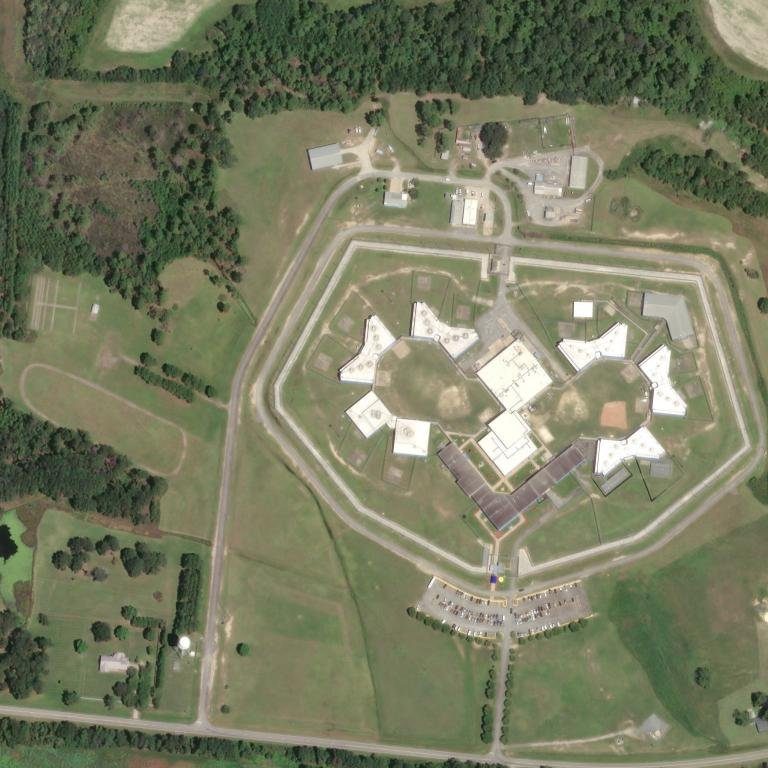
Architecture documents what the building was designed to hold. See the system-wide receipts at gps.press/warehouse.