VALDOSTA STATE PRISON
Facility Information
- Original Design Capacity
- 500 (at 198% capacity)
- Bed Capacity
- 1,312 beds
- Current Population
- 990
- Active Lifers
- 267 (27.0% of population) · Oct 2026 GDC report
- Life Without Parole
- 174 (17.6%)
What the courts held in Brown v. Plata, and how Georgia compares →
- Address
- 3259 Val Tech Road, Valdosta, GA 31603
- Phone
- (229) 333-7900
- Fax
- (229) 333-5387
- Mailing Address
- P.O. Box 5368, Valdosta, GA 31603
- County
- Lowndes County
- Opened
- 1989
- Operator
- GDC (Georgia Dept. of Corrections)
Security Classification
Last updated: October 2, 2026
811 of the 1,098 people held here are classified Close security (73.9%), as of September 23, 2026.
| Security level | People | Share |
|---|---|---|
| Close | 811 | 73.9% |
| Medium | 156 | 14.2% |
| Minimum | 13 | 1.2% |
| High | 16 | 1.5% |
| Standard | 78 | 7.1% |
| Warrant | 1 | 0.1% |
| Not recorded | 23 | 2.1% |
| Total | 1,098 |
Earlier count (undated table, produced October 22, 2025): 866 of 1,137 Close (76.2%).
Restrictive housing beds
| Program | Beds | Occupied |
|---|---|---|
| Tier II | 129 | 80 |
Source: Georgia Department of Corrections records produced to GPS under the Open Records Act (R031471-090226, R024615-101925, R031710-091426). A person's security level is GDC's classification of that person, which can differ from the prison's own designation.
Following Valdosta State Prison?
Leadership & Accountability (as of 2026 records)
Officials currently holding positional authority at this facility, with deaths attributed to GPS-tracked records during their leadership tenure. Inclusion reflects role-based accountability, not legal findings of personal culpability. Death counts shown as facility / career.
| Role | Name | Since | Deaths this facility / career |
|---|---|---|---|
| Warden (facility lead) | Jackson, Kendric | 2026-06-01 | 4 / 23 |
| Deputy Warden of Administration (facility deputy) | Gibson, LEN Thomas | 2016-01-01 | 70 / 70 |
| Deputy Warden of Care and Treatment (facility deputy) | Davis, Heather Alice | 2022-01-01 | 58 / 58 |
| Deputy Warden of Security (facility deputy) | Marcus, Charlie J | 2023-11-22 | 42 / 42 |
| Deputy Warden of Security (facility deputy) | Bryant, Delisha L | 2025-03-16 | 22 / 22 |
About
Last updated October 4, 2026.(DS)
Valdosta State Prison: Seventy Deaths, an 80% Vacancy Rate, and a Federal Court Finding of Bad Faith
Valdosta State Prison sits on the outskirts of Valdosta in Lowndes County, a close-security men's facility with an attached annex. GPS's standing record describes a main plant of 10 general-population units, multiple mental-health units, isolation and acute-care beds, and a Crisis Stabilization Unit, with the annex adding several open dorms including a residential substance-abuse unit. The facility opened in 1989 and holds a current rated capacity of 1,312 against a population of roughly 1,004 — about 76.5% of rated capacity. Kendric Jackson became warden on June 1, 2026, taking responsibility for approximately 1,151 male offenders, according to reporting on his promotion.
What follows is the record GPS has assembled on how that facility has functioned over the past several years: a mortality count that has climbed sharply since 2020, a staffing collapse that at one point left four out of five officer posts unfilled, a contraband economy that ran through the staff ranks, and a federal court that found the Department destroyed evidence and an officer lied under oath.
Seventy Deaths Since 2020, Seventeen Ruled Homicides
GPS's mortality registry records 70 deaths at Valdosta State Prison since January 1, 2020. That figure is a floor, not a ceiling — GDC reports deaths roughly two months late, so the count lags the true total. Of those 70, 17 are classified as homicides, 42 remain Unknown/Pending, six are suicides, and five are Natural/Medical. The yearly distribution shows the escalation: eight deaths in 2020, four in 2021, seven in 2022, nine in 2023, then 17 in 2024, 14 in 2025, and 11 already in 2026.
The 25 most recent entries in that registry, as GPS holds them:
- James Loreno died August 13, 2026, at Valdosta State Prison; GPS's registry lists the cause as Unknown/Pending.
- Ramon Daniel Ortiz, 33, died July 4, 2026, at Valdosta State Prison; cause Unknown/Pending.
- Steven Bryant, 49, died June 23, 2026, at Valdosta State Prison; cause Unknown/Pending.
- Antavious Bailey, 40, died June 21, 2026, at Valdosta State Prison; cause Unknown/Pending.
- Kevin James Flamer, 26, died May 28, 2026, at Valdosta State Prison; cause Unknown/Pending.
- Jeremiah Alan Brown, 40, died May 26, 2026, at Valdosta State Prison; cause Unknown/Pending.
- Dontarious Lamonta Burke, 23, died April 19, 2026, at Valdosta State Prison; cause Unknown/Pending.
- Robert Jordan Watkins, 38, died March 18, 2026, at Valdosta State Prison; cause Unknown/Pending.
- Robert Louis Johnson, 60, died March 8, 2026, at Valdosta State Prison; cause Unknown/Pending.
- Sergio Hernandez, 39, died February 26, 2026, at Valdosta State Prison; GPS's registry lists the cause as Homicide.
- Ronnie Jackson, 62, died February 15, 2026, at Valdosta State Prison; cause Natural/Medical.
- Dequontist Marquez Lucas, 41, died December 25, 2025, at Valdosta State Prison; cause Unknown/Pending.
- Jevion Andrez Benham, 21, died December 24, 2025, at Valdosta State Prison; cause Homicide.
- Jessie James Kilgore, 56, died December 23, 2025, at Valdosta State Prison; cause Unknown/Pending.
- Arthur Nekita Burks, 61, died November 28, 2025, at Valdosta State Prison; cause Unknown/Pending.
- Paul Hampton, 66, died October 12, 2025, at Valdosta State Prison; cause Unknown/Pending.
- Garrett Paul Schmidt, 40, died September 21, 2025, at Valdosta State Prison; cause Unknown/Pending.
- William Stacey Springer, 36, died September 16, 2025, at Valdosta State Prison; cause Homicide.
- Jason Frank Jordan, 45, died June 1, 2025, at Valdosta State Prison; cause Unknown/Pending.
- Anthony Vashern Prothro, 34, died April 7, 2025, at Valdosta State Prison; cause Suicide.
- Brandon Dominique Mcgee, 33, died April 2, 2025, at Valdosta State Prison; cause Homicide.
- Chet Elliott Kent, 45, died March 16, 2025, at Valdosta State Prison; cause Unknown/Pending.
- Ryan Cornelius Rumph, 34, died March 11, 2025, at Valdosta State Prison; cause Homicide.
- Eric Lee Schermerhorn, 40, died March 4, 2025, at Valdosta State Prison; cause Unknown/Pending.
- Sinjuan Harmon died January 12, 2025, at Valdosta State Prison; cause Homicide.
The full registry for this facility is published at https://gps.press/georgia-prison-deaths/facility/valdosta-state-prison/.
The Unknown/Pending share — 42 of 70, or 60% — is itself a finding. It means that for most of the people who have died at Valdosta since 2020, GPS does not yet know the cause. It does not mean the cause is unrecorded by the state; it means the record has not reached GPS.
The Deaths That Drew Federal Attention
Several of those deaths generated litigation, criminal charges, and in one case a federal sanctions order.
Hakeem Olajuwon Williams, 27, was stabbed to death in February 2022 by his cellmate Jonathan Bivens using a 9-inch makeshift metal knife, according to the Atlanta Journal-Constitution. Officer Angela Butler had locked a handcuffed Williams in the cell with an unrestrained and unsearched Bivens. A claim filed against the state alleged that an officer placed Williams in a cell while handcuffed and he was attacked by a cellmate. Haley Mackrell, the mother of Williams' only child, sued Butler in January 2024, claiming Butler acted with deliberate indifference to Williams' constitutional right to be free from cruel and unusual punishment. Mackrell alleged Butler ignored Williams' cries for help and did nothing to stop his death. Bivens is serving a life sentence without parole for murder and aggravated assault, according to court records.
The litigation then turned on the evidence. The AJC reported that GDC failed to preserve video footage of the stabbing after being notified nine days after Williams' death that it needed to be preserved; by November 2024, counsel confirmed the footage had rolled over and was lost. Chief U.S. District Judge Leslie Gardner sanctioned the Georgia Department of Corrections for destroying video evidence in bad faith and sanctioned Angela Butler for lying under oath, ruling the jury will be informed of both acts and that GDC will be on the hook for any verdict against Butler. The AJC further reported that Butler and her state lawyers are alleged to have failed to correct Butler's false statements in a timely manner, for which the judge may impose further sanctions. The court found Butler intentionally lied under oath by testifying she had handcuffed Bivens, when in fact she had not, and later admitted her actions violated department policy and led to Williams' death. She also failed to restrain or search Bivens before locking a handcuffed Williams in the cell with him, stripping Williams of virtually every means of self-protection.
Shane Griffith, 32, died on May 30, 2024, from blunt force trauma to the head, torso, and extremities. Warrants showed he was attacked by 11 other prisoners who beat him with fists and a pole, kicked him, stood on his chest, and placed a burning object on his body. The AJC reported that on the night of May 29, 2024, Griffith was beaten for potentially six or more hours in a barracks-style dorm. All 11 alleged attackers have been charged with murder. His mother alleged her son, who sought protective custody, was placed in a maximum-security prison general population despite safety concerns, where he was killed the day after his transfer. The AJC reported that Griffith was allegedly beaten for up to six hours in a barracks-style dorm with no intervention, raising questions about whether surveillance footage was monitored in real time. His family filed a notice of intent to sue the state, alleging he was beaten, burned, dragged by a rope, and killed while staff failed to intervene, with staff only discovering his death during breakfast rounds at 6:30 a.m.
Melvin Towns, 37, died on April 21, 2024. GDC incident records show a homicide during a disruptive event with six inmates disciplined, and warrants show he was stabbed with homemade knives. The AJC reported that Towns, serving a six-month probation violation sentence and due for release in 12 days, was stabbed to death with a homemade weapon. The same outlet reported that Towns, who by court order could have served his probation violation sentence in a county jail, was instead sent to the GDC's most understaffed and potentially most dangerous prison, where he was killed.
Ricky Bernard Harris, 39, died on February 20, 2024, from sharp force face and neck trauma. The AJC reported he was stabbed at least 30 times in the neck and face with ink pens. Rufus Shawn Lane, 55, was found dead in his cell on January 13, 2024, from ligature strangulation; GDC incident data shows a gang member was involved. Dexter Jarrod Burnett, 35, died on September 16, 2022, from a stab wound to the torso; in February 2024, a prisoner was indicted on a charge of killing Burnett with a homemade knife.
More recently, Je'Vion Benham, 21, was found dead in his cell on December 24, 2025. The coroner ruled the cause of death as strangulation and the manner as homicide, estimating he died on December 22 and that his body went undiscovered for approximately two days. Coroner Austin Fiveash criticized the two-day delay in discovering Benham's body as a major security concern, WTOC reported. William Springer was stabbed multiple times in his face and head while incarcerated at Valdosta State Prison; doctors told his family he was brain-dead upon arrival at the hospital. His family donated his organs, and an honor walk was held at a hospital in Macon before his body was sent to Atlanta. The family alleges GDC failed to contact them after their loved one was attacked in prison, and inmates allegedly reported that jailers did not respond to the stabbing for several hours, WALB reported.
In June 2026, GDC's Office of Professional Standards opened investigations into the deaths of Antavious Bailey and Steven Bryant as standard procedure; official causes of death were undetermined and autopsies were to be performed by the GBI crime lab. Bailey died June 21 while serving a 15-year sentence for kidnapping, armed robbery, and home invasion. Bryant died June 23 while serving a life sentence without parole for aggravated sexual battery.
An 80% Vacancy Rate and a Contraband Economy Run Through Staff
The AJC reported that as of April 2024, 80% of correctional officer positions at Valdosta State Prison were vacant, making it virtually impossible to supervise the inmate population. That figure sits at the extreme end of a systemwide problem: GPS has documented officer vacancies across Georgia's prisons running between 49.3% and 60% for multiple years, against a national standard of no more than 10%. The October 2024 DOJ findings letter concluded that "the leadership of the Georgia Department of Corrections has lost control of its facilities" and faulted GDC for placing "too much blame on gangs and insufficient emphasis on understaffing."
The staffing vacuum at Valdosta coincided with a contraband operation that ran through the staff ranks. In what became known as Operation Skyhawk — announced by Governor Brian Kemp on March 28, 2024, a two-year investigation targeting drone contraband drops into Georgia prisons — seven officers, including six GDC correctional officers and one Grady County jailer, were arrested for allegedly participating in a contraband scheme run by Valdosta State Prison inmate Kydetrius Thomas. Five Valdosta State Prison employees were accused of helping an inmate move drugs and money as part of a massive contraband scheme involving drone deliveries. At least six correctional officers aided Thomas in smuggling drug-soaked paper, pills and tobacco, the AJC reported.
The specifics of the alleged scheme are detailed in the AJC's coverage. Officer Walker allegedly conspired with Thomas to introduce contraband and traded information with him regarding law enforcement investigations and prison security. Officer Peak allegedly conspired with Thomas to obtain money to bond out another officer and attended the bond hearing, reporting findings to Thomas via cellphone. Officer Mannings allegedly procured pills for Thomas, had over 400 phone conversations with him, and allegedly had sex with him. Correctional officer Alexandria Shadae Walker was arrested twice — first on December 1 on charges of improper dealings with an inmate and serving as a lookout for a drone drop, then again in February for allegedly conspiring with Thomas to introduce contraband and trading law enforcement information.
The operation also reached the private sector. Robert Schwartz, 65-year-old owner of Thunderdrones in Gwinnett County, was arrested on March 28, 2024, and charged with violating the state's RICO Act for alleged dealings with Valdosta State Prison inmate Joseph Broxton. Schwartz allegedly communicated with Broxton about the sale and repair of a drone altered to carry packages and programmed to mitigate no-fly zone software. Nelda Leora Alber, an employee of Schwartz's drone business, was arrested the same day and faces charges related to providing items to inmates; she was held without bond in Lowndes County jail. Wire taps used in Operation Skyhawk allowed officers to foil a murder-for-hire plot arranged by a prisoner, according to GDC Commissioner Tyrone Oliver, and the probe's phone taps allowed local authorities to stop more than 170 drone drops between November 2023 and March 2024.
Separately, Lieutenant Lyric Oliver resigned in March 2024 and was arrested in June 2024 after an investigation found she had improper dealings with inmate Alfred Jones, allegedly receiving $1,880 in payments and sending him sexually explicit videos of herself. Warden Ralph Shropshire was fired in July 2024; his personnel file states he was terminated due to "misconduct," though the GDC declined to elaborate citing an open investigation.
In May 2026, seven people were indicted in a drug trafficking operation directed from inside the prison. Luis Ramirez, an inmate at Valdosta State Prison, and six others were arrested and indicted for conspiracy to distribute methamphetamine and fentanyl. Law enforcement seized 35 kilograms of suspected crystal methamphetamine, three and a half kilograms of suspected fentanyl, and $145,000. Task forces began investigating Ramirez in July 2025 as a prominent suspect trafficking large amounts of fentanyl and crystal methamphetamine using contraband cellphones while incarcerated. Monique Burton, Jacquez Franks, Bergin Flores, Alejandro Blanco, Misael Bustos, and Ramiro Chaves were each charged with conspiracy to possess with intent to distribute and to distribute controlled substances; Flores, Blanco, Bustos, and Chaves had previously been deported and illegally reentered the country, according to Yahoo.com. The federal indictment paperwork was filed on May 13.
Gang Violence, Classification Drift, and the Question of Who Controls the Housing Units
The contraband prosecutions are one expression of a broader problem GPS has documented systemwide: gangs effectively running multiple GDC facilities, controlling access to phones, showers, food, and bed assignments. DOJ and the Guidehouse 2024 consultant assessment independently concluded as much. Approximately 31% of the system's ~49,000 incarcerated population are validated members of 315 different security threat groups — more than double the national average.
At Valdosta specifically, gang-related fights at Smith, Wilcox, Hays, and Valdosta State Prisons sent five inmates to the hospital with non-life-threatening injuries on April 2, 2026, according to GDC. GPS has received recurring accounts describing gang violence at the facility, including accounts of Bloods and GD violence that sources say spilled over to other prisons.
The classification picture at Valdosta is complicated by the facility's own profile. GPS's standing record describes it as a close-security men's prison, and its rated capacity of 1,312 is more than two and a half times its original design capacity of 500. GPS has documented a systemwide pattern of classification drift — medium-security facilities housing high numbers of close-security inmates without adequate staffing and infrastructure — and has separately published an analysis of GDC's own security-level numbers showing medium-security prisons functioning like high-security facilities. GPS has also documented a small group of incarcerated people serving life sentences transferred to Valdosta State Prison in 2025.
Food Scores, Standing Water, and the Gap Between Inspection and Condition
DPH food-safety inspections at Valdosta State Prison have produced consistently high scores across both the primary kitchen and the annex, most recently a 96 (Grade A) for the primary and a 91 (Grade A) for the annex on May 1, 2026. The record going back to 2020 shows the primary kitchen scoring between 91 and 100 on every inspection, and the annex ranging from 85 to 100. The lowest annex score in the series was an 85 (Grade B) on May 21, 2024; the lowest primary score was a 91 (Grade A) on March 30, 2021.
Those scores sit uneasily alongside what GPS has documented about food service across the system. GPS has documented a systemic pattern of food-service sanitation failure in GDC kitchens that DPH inspection scores systematically fail to capture: tray-sanitizing dishwashers broken for sustained periods, sustained roach and rodent infestation in kitchen and serving areas, and meals served on visibly contaminated trays. The pattern is hidden from DPH scores, per GPS's analysis, because inspections are scheduled walkthroughs that do not assess equipment under load, and because GPS has documented professional overlap between inspectors and facility staff in small-county settings. The Marshall Project independently corroborated the broader pattern on May 16, 2026, reporting rats in kitchens, insects in food, moldy trays, and visible malnutrition across Georgia facilities.
GPS has separately documented that GDC spends approximately $1.69 per person per day on food (2024) and has proposed $1.60 per day in FY27 — under 60 cents per meal — against the FDA Thrifty Food Plan estimate of roughly $10 per day for an adult man's nutritionally adequate diet.
On the physical plant, GPS records show recurring reports of standing water and flooding in housing units at Valdosta, with video footage described as showing ankle-deep water inside a housing area and a housing area without electricity. In July 2026, a viral TikTok video showing a flooded cell at Valdosta State Prison circulated; the Georgia Department of Corrections stated the video was staged by an inmate, who they said flooded his own cell after being placed in lockdown for possessing contraband cell phones. WRDW reported an inmate's claim of poor living conditions and GDC's staging allegation. GPS has received multiple accounts describing standing water conditions at the facility persisting over extended periods.
Settlements, Sanitation, and the Paper Trail of Liability
Georgia's DOAS Risk Management settlement ledger records a long series of liability payouts tied to Valdosta State Prison, spanning more than a decade. The largest is $998,485 to Caleb Mitchell (2017), followed by $736,748 to Jimmy Tucker (2014) and $362,500 on an unnamed claim (#111, 2016). Terry Berrian received $60,000 (2021); Rodney Manyon Lane $21,012 (2012); Corey King $15,000 (2019); Earnest Clayton $15,000 (2014); an unnamed claimant $15,000 (#102, 2015); Marquise Robbins $10,500 (2015); Micki Brown $10,000 (2018); Taurus Bernard Dickerson $10,000 (2017); Melvin Cooper $10,000 (2016); Otis Redmon $6,500 (2019); Kendrick Martin $5,000 (2019); Arnold Jerome Johnson $5,000 (2009); Reginald E. Grimes $3,500 and $1,550 (2019); Christopher D. Beal $3,400 (2019); Olajuwon Williams $3,500 (2017); Kenneth Greene Jr. $2,000 (2025); Brandon Edward Herndon $1,500 (2019); Mwamaratunga Pipore $750 (2017); an unnamed claimant $750 (#88, 2015); Paul Keith $600 (2018); Dale Davies $350 (2015); Earl McClendon $70 (2022); and Jordan Hunter $1 (2022).
The ledger is a record of what the state paid, not of what happened. It does not establish liability in any individual case, and the small sums are as likely to reflect nuisance settlement as anything else. But the pattern — payouts in nearly every year from 2009 through 2025, with two exceeding $700,000 — is a documented financial trace of harm at a single facility.
What GPS Records Show
Beyond the published record, GPS's intelligence system holds aggregated signals from the past 12 months at Valdosta State Prison. GPS records eight sources reporting death in custody across four months between December 2025 and June 2026, at critical and high severity. Five sources report assault by another incarcerated person across three months in the same window. Five report staffing shortage across four months from December 2025 to July 2026. Six report sanitation failure concentrated in July 2026. Four report equipment failure or installation across three months. Four report named staff misconduct across March and July 2026, at critical and high severity. Three external complaints were filed to oversight bodies — the Lowndes County Coroner's Office, the Georgia Bureau of Investigation, and the Georgia Department of Corrections — across four months. Six sources attempted media outreach, with WALB and WSB-TV named as external contacts.
GPS has additionally received accounts of an in-custody death at Valdosta State Prison, and accounts of a sexual assault at the facility. GPS has received reports that Tier II segregation is used at Valdosta as retaliation against incarcerated people who file grievances or lawsuits, rather than for legitimate security purposes, and that a witness held there was placed in Tier II segregation following the filing of a civil rights lawsuit against GDC. A family member has alleged that housing-unit check logs were falsified in connection with a death in custody that went undiscovered for approximately two days.
Sources
This analysis draws on GPS's mortality registry and settlement-ledger records; Georgia Department of Public Health food-safety inspection reports; Georgia Department of Corrections statements and incident records; reporting by the Atlanta Journal-Constitution, WTOC, WALB, WRDW, and Yahoo.com; federal court filings in the Williams matter; the U.S. Department of Justice's October 2024 findings letter on Georgia prisons; and inmate, family, and staff accounts collected by GPS.
Mortality Statistics
80 deaths documented at this facility from 2020 to present.
Deaths by Year
- 2026: 20
- 2025: 15
- 2024: 17
- 2023: 9
- 2022: 7
- 2021: 4
- 2020: 8
County Public Health Department
Food service and sanitation at VALDOSTA STATE PRISON fall under the jurisdiction of the Lowndes County Environmental Health Department. Incarcerated people cannot choose where they eat — public health inspectors carry an elevated responsibility to hold this kitchen to the same standards applied to any restaurant.
Contact
- Title
- EH County Manager
- Name
- Kyle Coppage, MPH
- Address
-
P.O. Box 5619
Valdosta, GA 31603 - Phone
- (229) 245-2314
- Kyle.Coppage@dph.ga.gov
- Website
- Visit department website →
Why this matters
GPS has documented black mold on chow-hall ceilings, cold and contaminated trays, spoiled milk, and pest contamination at Georgia prisons. The Department of Justice's 2024 report confirmed deaths from dehydration and untreated diabetes tied to food and water deprivation. Advance-notice inspections let facilities stage temporary fixes that disappear once inspectors leave.
Unannounced inspections by the county health department are one of the few outside checks on kitchen conditions behind the fence.
How you can help
Write to the county inspector and request an unannounced inspection of the kitchen and food service operation at this facility. A short, respectful letter citing Georgia food-safety regulations is more powerful than you think — inspectors respond to public concern.
Sample Letter
This is the letter Georgia Prisoners' Speak mailed to all county environmental health inspectors responsible for GDC facilities. Feel free to adapt it.
October 9, 2026
RE: Request for Unannounced Public Health Inspection of Food Service Operations at VALDOSTA STATE PRISON
Dear Kyle Coppage, MPH,
I am writing to respectfully request that your office conduct a thorough, unannounced inspection of food service and sanitation practices at VALDOSTA STATE PRISON, located in Lowndes County.
Documented concerns
Georgia Prisoners' Speak, a 501(c)(3) nonprofit investigative newsroom, has published extensive investigative reporting on food safety and nutrition failures across Georgia's prison system, including:
- Dangerous sanitation conditions — black mold on chow hall ceilings and air vents, contaminated food trays, and spoiled milk served to inmates.
- Severe nutritional deficiency — roughly 60 cents per meal; inmates receive only 40% of required protein and less than one serving of vegetables per day.
- Preventable deaths — the U.S. Department of Justice's 2024 report confirmed deaths from dehydration, renal failure, and untreated diabetes following food and water deprivation.
- Staged compliance — advance-notice inspections allow facilities to stage temporary improvements, then revert once inspectors leave.
Firsthand testimony
In Surviving on Scraps: Ten Years of Prison Food in Georgia, a person who has spent more than ten years in GDC custody describes no functional dishwashing sanitation, chronic mold on food trays, and roaches found on the undersides of trays at intake facilities. Full account: gps.press/surviving-on-scraps-ten-years-of-prison-food-in-georgia.
Specific requests
- Conduct an unannounced inspection of the kitchen and food service operations at this facility, with particular attention to dishwashing equipment, tray sanitation procedures, and food storage conditions.
- Evaluate compliance with applicable Georgia food safety regulations, including O.C.G.A. § 26-2-370 and the Georgia Food Service Rules and Regulations (Chapter 511-6-1).
- Verify permit status and confirm whether the facility is subject to the same inspection schedule as other institutional food service establishments in the county.
- Make inspection results available to the public, as permitted under Georgia's Open Records Act (O.C.G.A. § 50-18-70).
Incarcerated individuals cannot advocate for their own health and safety in the way a restaurant patron can — they cannot choose to eat elsewhere. This places an elevated responsibility on public health officials to ensure these facilities meet the same sanitation standards applied to any food service establishment.
Thank you for your attention to this important public health matter.
Sincerely,
[Your name]
Food Safety Inspections
No inspection records are on file with the Georgia Department of Public Health for this facility. GPS has filed an open records request asking where these records are maintained.
What the score doesn't measure. DPH grades kitchen compliance on inspection day — food storage, temperatures, pest control. It does not grade whether today's trays are clean. GPS reporting has found broken dishwashers at most Georgia state prisons we've documented; trays go out wet, stacked, and visibly moldy — including at facilities with recent scores near 100.
Who inspects. Most Georgia state prisons sit in rural counties — often with fewer than 20,000 people, several with fewer than 10,000. The environmental health inspector lives in that community and often knows the kitchen staff personally. Rural inspection regimes don't have the structural independence you'd expect in a city-sized health department. Read the scores accordingly.
Read the investigation: “Dunked, Stacked and Served: Why Georgia Prison Trays Are Making People Sick”
Recent reports (41)
Source-attributed observations and allegations from news coverage and reports submitted to GPS. Each entry credits its source.
- ALLEGATION According to WRDW Published: Jul 23, 2026The Georgia Department of Corrections alleges an inmate staged a flooded cell video.
"The Georgia Department of Corrections stated that a viral TikTok video showing a flooded cell at Valdosta State Prison was staged by an inmate, who they said flooded his own cell after being placed in lockdown for possessing contraband cell phones."
Read source → - ALLEGATION According to WRDW Published: Jul 23, 2026Inmate claims poor living conditions.
"The department denied the inmate’s claims of poor living conditions."
Read source → - ALLEGATION According to WTOC Published: Dec 26, 2025Coroner Austin Fiveash criticized the two-day delay in discovering Benham's body as a major security concern.
"Coroner Austin Fiveash publicly criticized the delay, calling it a major security concern and stating that Valdosta State Prison needs assistance."
Read source → - ALLEGATION According to Yahoo.com Published: May 27, 2026Luis Ramirez directed a drug trafficking network tied to Mexican cartels using contraband cellphones while incarcerated at Valdosta State Prison.
"They said Luis Ramirez, 40, who has the nicknames "Poncho" and "OG Ponch," was charged as the "director" of the trafficking network. ... task forces began investigating in July 2025 into Ramirez, a prominent suspect of someone trafficking large amounts of fentanyl and crystal methamphetamine using contraband cellphones while locked up at Valdosta State Prison."
Read source → - ALLEGATION According to Yahoo.com Published: May 27, 2026Ramiro Chaves, previously deported, illegally reentered the country and conspired to possess and distribute controlled substances.
"Ramiro Chaves, 39, ... all reentered the country illegally. They were also charged with a count of conspiracy to possess with intent to distribute and to distribute controlled substances."
Read source →
Timeline (118)
Source Articles (25)
Former leadership
Officials who previously held leadership roles at this facility.
| Role | Name | Tenure | Deaths this facility / career |
|---|---|---|---|
| Warden (facility lead) | Shropshire, Ralph W | 2023-03-01 → 2024-10-15 | 21 / 21 |
| Warden (facility lead) | Emmons, Shawn F | 2018-07-01 → 2022-02-28 | 15 / 62 |
| Warden (facility lead) | Carter, Curtis | 2025-07-16 → 2026-05-31 | 14 / 17 |
| Warden (facility lead) | Odum, ROY Matthew | 2024-10-16 → 2025-07-15 | 10 / 68 |
| DEPUTY WARDEN (facility deputy) | Pineiro, Aaron Thomas | 2019-01-01 → 2021-12-31 | 12 / 85 |
| DEPUTY WARDEN (facility deputy) | Mims, Charles Michael | 2020-01-01 → 2020-12-31 | 8 / 46 |
| DEPUTY WARDEN (facility deputy) | Beasley, Jacob | 2022-01-01 → 2022-12-31 | 7 / 42 |
| Deputy Warden (facility deputy) | Foulks, Rodney | 2026-08-27 → 2026-08-27 | — / 7 |
| Chaplain (specialty lead) | Miller, James Patrick | 2023-11-22 → 2026-08-27 | — / — |
Location
Aerial View
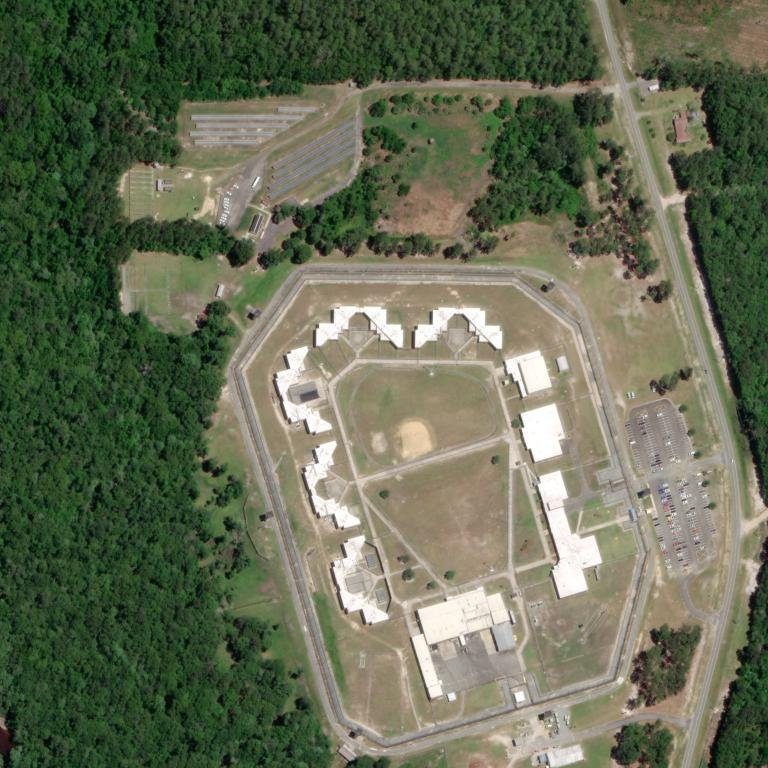
Architecture documents what the building was designed to hold. See the system-wide receipts at gps.press/warehouse.