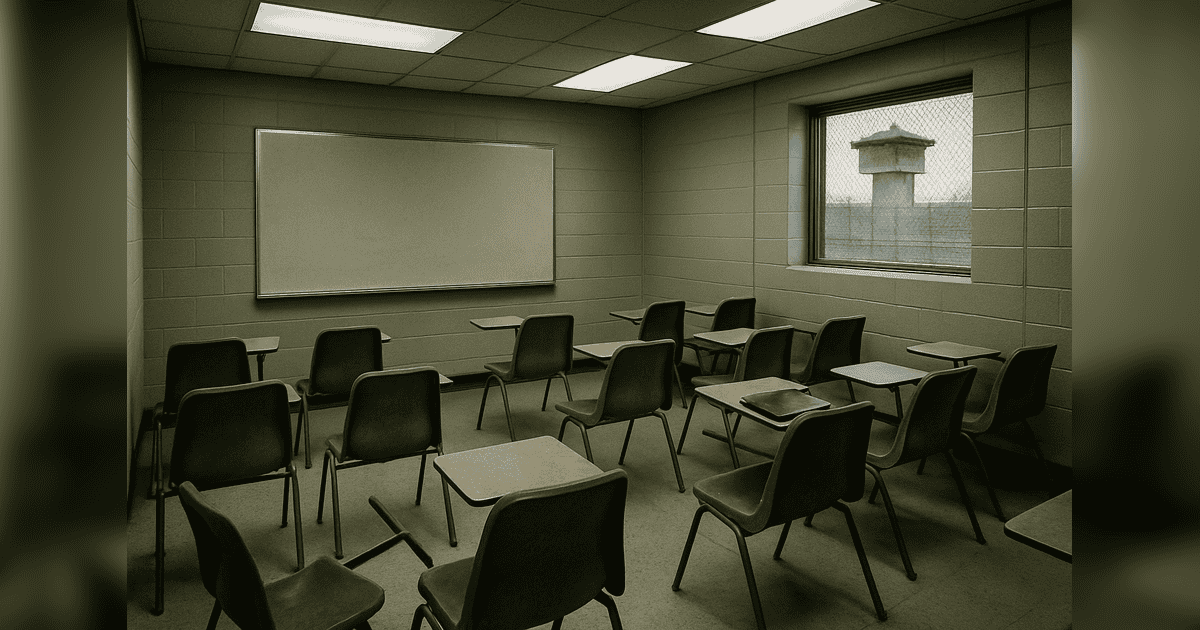
On the homepage of gdc.georgia.gov, the Georgia Department of Corrections makes a promise to every citizen in this state:
“To protect Georgians by operating secure facilities and providing opportunities for offender rehabilitation.”
Two obligations. Secure facilities. Rehabilitation. That is the mission statement of the agency that controls $1.8 billion in taxpayer money and the lives of more than 50,000 human beings. 1
In October 2024, the U.S. Department of Justice told Georgia the first obligation — secure facilities — was a failure. Federal investigators found reasonable cause that Georgia’s prisons violate the Eighth Amendment’s prohibition against cruel and unusual punishment. They documented 142 homicides between 2018 and 2023. They found over 1,400 reported violence incidents in just sixteen months, with nearly half resulting in serious injury. They found gangs controlling housing units, broken fire alarms, padlocked cell doors, and one officer watching nearly 400 beds. 2
But this article is about the second obligation — the one that nobody is holding GDC accountable for. The one the DOJ barely mentioned. The one the Georgia Senate Study Committee voted to ignore. The one the Governor’s budget treats as an afterthought.
Rehabilitation.
Georgia invested approximately $2.6 million in rehabilitation and education programming across two budget years. In the same period, it invested over $120 million in surveillance and technology. That is a ratio of 46 to 1 — forty-six dollars watching people for every one dollar helping them. 3 4
Divide that $2.6 million by the 50,000 people incarcerated in Georgia, and you get $52 per person per year. Fourteen cents a day. Less than the profit the GDC makes off of a single ramen packet from the prison commissary. GDC profits more from one person’s weekly commissary purchase than it invests in that person’s rehabilitation for the entire year.
This is not a policy failure. This is a public safety crisis manufactured by the agency responsible for preventing it.
The Word Itself
The word penitentiary comes from the Latin poenitentia — penitence. The prison was invented as a place of rehabilitation. Not punishment. Not warehousing. Reform.
In 1787, Benjamin Franklin and fellow Quakers formed the Philadelphia Society for Alleviating the Miseries of Public Prisons. In 1790, their advocacy created America’s first penitentiary — the Walnut Street Jail in Philadelphia — built on the explicit premise that people could be reformed. Eastern State Penitentiary, opened in 1829, was the most expensive public building in the United States at its completion. The founders of this country believed rehabilitation was worth that investment.
The entire American corrections system was founded on this principle. It is literally in the name. And the U.S. Supreme Court has repeatedly affirmed it. In Graham v. Florida (2010), Justice Kennedy wrote that a sentence that “forswears altogether the rehabilitative ideal” violates the Constitution. The Court identified rehabilitation as one of the four legitimate goals of the penal system — alongside retribution, deterrence, and incapacitation — and held that states must provide “some meaningful opportunity to obtain release based on demonstrated maturity and rehabilitation.” 5
In Holt v. Sarver (1970), the federal court went further: “The absence of an affirmative program of training and rehabilitation may have constitutional significance where conditions and practices exist which actually militate against reform and rehabilitation.” 6
Georgia meets that test. The DOJ found constitutional violations on safety. Violence is pervasive. The DOJ itself found programming had been “slashed rather than expanded” and that conditions made “meaningful programming participation effectively impossible.” The totality of conditions — violence, no programming, survival mode, cognitive decline — is exactly the pattern courts have identified as unconstitutional.
GDC’s own mission statement promises rehabilitation. The Constitution requires it. The word “penitentiary” means it. And Georgia spends $52 a year per person on it.
“Prisons Are for Punishment and Rehabilitation — Not TikTok”
Those are the words of Senator Blake Tillery, Chairman of the Senate Appropriations Committee — the man who controls GDC’s budget. He said them while supporting tens of millions in surveillance technology spending: managed access cell phone blocking, thermal cameras, drone detection, the OWL surveillance unit. 7
Senator Tillery is right. Prisons are for punishment and rehabilitation. So where is the rehabilitation money?
Here is where the $634 million in new corrections spending — the largest single corrections funding increase in Georgia history — actually went:
Surveillance and technology: $84.7 million for thermal cameras, CCTVs, and perimeter security. $35 million or more for managed access cell phone blocking. $7.2 million for body cameras and tasers. $6.8 million for the OWL surveillance unit. $4.1 million for digital forensics. $2.5 million for officer tablets. Nearly $1 million for off-site mail screening.
Rehabilitation and education — all of it: $336,851 for “additional programming through offender reentry services and a high school diploma program” (AFY2026). $992,819 for the same (FY2027). $150,000 for a pilot peer-led program at one prison. $93,179 for additional programming at one reentry facility.
The total new rehabilitation investment across two budget years: approximately $2.6 million. The surveillance investment in the same period: over $120 million. 3
Senator Tillery said prisons are for rehabilitation. Then he funded $120 million in cameras and $2.6 million in programming. That is his definition of rehabilitation: forty-six surveillance dollars for every programming dollar. The senator’s own words condemn his own budget.
And it gets worse. Education is not even a standalone line item in GDC’s budget. It is buried inside the $901-to-$938 million “State Prisons” appropriation with no dedicated allocation. There is no way to determine from the budget how much GDC spends on education in total. The only visible numbers are incremental changes: $1.2 million (AFY2025) and $805,000 (FY2026) for “technical and vocational education programs and related equipment.” The vocational education budget for the entire state prison system in FY2025 was $172,000 — $3.44 per incarcerated person per year. 4
For context: GDC’s total budget exceeds $1.8 billion. Education spending represents 0.11% of that. The surveillance technology budget alone is sixty times larger than the education budget.
A War Zone Is Not a Classroom
Senator Tillery’s budget might matter less if GDC were actually providing rehabilitation within those numbers. But it is not — because the conditions inside Georgia’s prisons make rehabilitation biologically impossible.
This is what “secure facilities” look like from inside.
“I’ve been down 17 years now. Seventeen years of living in what I can only describe as a war zone. Literally war. Gang violence and extreme officer shortage to control it. There’s no relief in here. No yard call. No groups or classes. Nothing to help ease your mind.”
— KingdomMan32, “Better Chances” (gps.press) 8
“I’ve had to sleep with a knife in my hand at my side in case they came in while I was sleeping. I have to use the bathroom with a weapon in my hand because I witnessed an associate get murdered while sitting on the toilet. I’ve had to sleep with magazines wrapped around my chest to keep from getting stabbed in my sleep.”
— Mikemike, “Magazines Wrapped Around My Chest” (gps.press) 9
“I have been threatened, had weapons pulled on me, had someone five feet away from me stabbed, seen others who have been beaten or stabbed, been fed rancid and moldy food, had roaches and rats everywhere I’ve turned, drank water I’ve been told is toxic, seen people sleeping on bare concrete or in showers because they couldn’t afford to pay ‘rent’ on their cell, heard people beaten and raped, been threatened with physical violence by staff… We live in conditions that would be illegal for animals at a shelter.”
— Bandit, “We Are People, Not Statistics” (gps.press) 10
The DOJ confirmed all of this. Federal investigators found 27,425 weapons recovered from Georgia prisons in less than two years. They found 315 gangs controlling housing units. They found that incarcerated people simply stopped reporting violence because they expected no response. They found hundreds of GDC officers arrested on criminal charges in the past six years. 2
When 50,000 people live in facilities where gangs control the housing, weapons are everywhere, one guard watches 400 beds, and fire alarms do not work, they are not in a position to pursue rehabilitation. They are in survival mode. And survival mode is not a state of mind. It is a neurological condition.
Your Brain Cannot Learn When It Is Fighting to Survive
This is not a matter of willpower. This is not about motivation or personal responsibility. The human brain physically cannot learn under chronic threat. The science is unambiguous.
The prefrontal cortex — the brain region responsible for learning, working memory, attention, problem-solving, and cognitive flexibility — shuts down under stress. Research from Yale University found that “even quite mild acute uncontrollable stress can cause a rapid and dramatic loss of prefrontal cognitive abilities.” Chronic stress causes structural damage: dendrites in the prefrontal cortex begin to physically change after just one week of sustained stress exposure. 11
The hippocampus — the brain structure essential for forming new memories — physically shrinks under chronic cortisol exposure. People with PTSD, a condition directly relevant to those living under constant threat of violence, show smaller hippocampal volume correlated with deficits in verbal memory. 12
When the amygdala activates the fight-or-flight response, the prefrontal cortex cannot be simultaneously engaged. Blood drains from the reasoning centers of the brain. In a chronically dangerous environment, this is not a temporary reaction. It is the permanent baseline. It becomes, as researchers describe it, “virtually impossible to learn new things, focus on small tasks, or engage with other people.” 13
A 2018 controlled study at Rikers Island directly measured this. Among 197 incarcerated men, cognitive control declined significantly over just four months. Emotion regulation declined significantly. Emotion recognition declined across all groups — even those receiving cognitive-behavioral intervention could not prevent it. Incarceration itself causes measurable cognitive decline. 14
This is what Senator Tillery’s budget produces. Georgia spends $120 million creating the exact surveillance environment that keeps people in a state of hypervigilance, then allocates $2.6 million for programming that their brains physically cannot access. The state creates the neurological conditions under which education and rehabilitation are biologically impossible — then claims to provide “opportunities for rehabilitation.”
Here is how the people inside experience this reality:
“I’m a lifer so they don’t like to give us education. They’ll put short timers ahead of us on the list for education. They don’t try to rehabilitate you. I honestly believe they don’t ever intend on letting me out so there’s no reason for me to have an education other than what they need me for — sweeping and mopping floors or pushing food trays. It seems easier to control a dumb person.”
— Mikemike, “Magazines Wrapped Around My Chest” (gps.press) 9
“I finished my entire case plan within two years. I’ve worked many jobs including law library, education, vocation. I have graduated two different faith and character programs. Nothing helps to reduce my time. I’ve become a better person, but no one in the GDC cares.”
— Wynter, “No Matter How Good I Am” (gps.press) 15
Thirty-Three People a Day
This is where the argument shifts from prisoners’ rights to your safety.
Every year, approximately 12,000 people walk out of Georgia’s prisons and back into Georgia’s communities. That is roughly 1,000 per month. Thirty-three per day. Every single day. 16
According to the Bureau of Justice Statistics, at least 95% of all state prisoners will eventually be released. This is not a question of whether they come back to your community. They are coming back. The question is what condition they are in when they arrive.
These are people returning to neighborhoods in Atlanta, Savannah, Macon, Augusta, Columbus, Albany, and rural communities across every corner of the state. They will be your neighbors. They will work at your local Walmart, your gas station, your restaurant. They will sit in the pew next to you at church. Their children will attend school with your children.
If GDC had rehabilitated them — if they left prison with education, vocational skills, treated mental health conditions, cognitive-behavioral tools, and a functioning prefrontal cortex — they would protect Georgians by becoming productive, taxpaying members of your community.
But that is not what GDC produces.
What GDC produces, after years of survival mode, chronic violence, zero programming, and measurable cognitive decline, is a person who is more traumatized than when they entered. A person with untreated PTSD. A person whose brain has been structurally damaged by years of chronic stress. A person with no education, no skills, no savings, and no support.
“We were sent here to learn a lesson from our mistakes and come out a better person. In most cases, that is the opposite of what happens due to the accepted culture of the prison system itself.”
— NeverGiveUp, “Let Me Go or Just Execute Me” (gps.press) 17
“You lose your sense of humanity. You stop seeing others as people; they’re either threats or victims. It takes away your empathy, your dignity, your ability to even think clearly.”
— Former inmate, “Invisible Scars” (gps.press) 18
$25 and a Bus Ticket
When a person walks out of a Georgia prison after years or decades inside, this is what GDC provides:
- A $25 prepaid Visa card
- Whatever money was left in their inmate trust account, deposited by loved ones
- A shirt, pants, and a cheap pair of shoes
- A bus ticket — if no one is there to pick them up
That is it. No housing referral. No job placement. No identification assistance. No phone. No transitional support. After years of measurable cognitive decline, chronic PTSD from violence, zero job skills, and $0 in wages — because Georgia is one of the states that pays incarcerated workers nothing — GDC hands someone $25 and puts them on a Greyhound.
Research published in the New England Journal of Medicine found that formerly incarcerated people face dramatically elevated death risk in the first two weeks after release — from overdose, suicide, homicide, and cardiovascular events. The transition from total institutional control to zero support is itself a cause of death. 19
“I went in at 19 and came out at 36. My twenties and thirties, gone. The world moved on without me. And even now, fifteen years later, I’m still fighting.”
— Forever19, “Seventy Dollars” (gps.press) 20
GDC’s mission says “protect Georgians.” Every year, 12,000 people leave Georgia’s prisons. If GDC does not rehabilitate them, it is not protecting Georgians. It is manufacturing the next generation of crime victims.
The 45,000-Certificate Lie
GDC is aware of this criticism. Its defense is a single number.
Commissioner Tyrone Oliver told the 2024 Senate Study Committee that “in FY2024, the department helped individuals achieve about 45,000 career, technical, and educational certificates.” 7
That number deserves scrutiny.
GDC bundles micro-credentials — CPR certification, food handler cards, “Business Etiquette” completion, “Workplace Diversity” short courses — with actual vocational certifications like welding and cosmetology. One person can generate multiple “certificates.” The number counts credentials, not people.
The jump from 29,091 certificates in FY2022 to 45,000 in FY2024 occurred while the DOJ was simultaneously documenting 50% staff vacancies and chronic facility-wide lockdowns that made programming “effectively impossible.” Georgia’s prisons average an estimated 60 days per year on lockdown. Evening programming, suspended during COVID in March 2020, has never been restored at most facilities — six years later.
Meanwhile, the vocational education budget for the entire state was $172,000. You do not produce 45,000 meaningful credentials on $172,000.
The DOJ itself noted that understaffing directly kills programming: “The prisons do not have enough staff to prevent or, often, even respond to the most blatant gang activities and violence, let alone provide programs such as exercise, rehabilitation, or gang intervention.” 2
And here is the number GDC will never volunteer: where programs actually exist and people can access them, the results are remarkable. GDC’s own data shows that vocational program completers recidivate at just 13.64% — roughly half the general population rate. 21
The programs work. GDC knows they work. It simply chooses not to fund them.
Senator Tillery’s response? His committee voted for the status quo. On December 13, 2024, the Senate Study Committee on DOC Facilities shot down proposals to create an oversight body, provide de-escalation training, and strengthen reintegration programming. Overcrowding, lack of programming, and a broken parole system were dismissed.
Senator Tillery said prisons are for rehabilitation. His committee rejected every rehabilitation proposal put before it.
Dead Last: How Every Southern State Outperforms Georgia
If Georgia’s approach were simply a regional norm — if every Southern state underfunded rehabilitation — it might be defensible as a political reality. It is not. Georgia ranks dead last among Southern states in per-inmate education spending.
Florida spends approximately $91 million on prison education — roughly $1,028 per inmate per year. Its recidivism rate is 21%. Florida increased its prison education spending by 119% in three years.
Texas spends $66 to $76 million through the Windham School District, a dedicated educational agency within the prison system with its own superintendent and more than 1,000 staff. Per-inmate spending is approximately $508 to $585 per year. Texas’s recidivism rate is 15%.
Alabama — currently under federal oversight for unconstitutional prison conditions — spends approximately $19.3 million on prison education, roughly $742 per inmate. Even Alabama, under federal court supervision, outspends Georgia nineteen to one.
Mississippi — the poorest state in the nation — enrolls 80% of its incarcerated population in programming.
South Carolina has the lowest recidivism rate in the entire country at 17.1%, with a dedicated prison school district and nearly 8,300 credentials awarded annually.
Georgia spends approximately $2 million on prison education for 51,000 inmates. That is $39 per person per year. Dead last. Below every peer. Below states with smaller budgets, smaller economies, and fewer resources.
If Georgia matched just 2% of its corrections budget for education — what Texas and Florida approximate — that would mean roughly $30 million per year. Still less than what GDC spends on private prison contracts. But it would be a fifteen-fold increase from current levels, enough to fund real programming at scale. 22
The Math of Public Safety
Georgia’s official three-year reconviction rate is 25 to 27%. That means approximately 3,000 to 3,200 people from each annual release cohort will be reconvicted within three years. Each reconviction represents a new crime, a new victim, a new prosecution, and a new incarceration at approximately $34,000 per year.
And those official numbers are almost certainly understated. Georgia measures only reconvictions, not rearrests. It uses only a three-year window. It excludes deaths from the dataset. National Bureau of Justice Statistics data from 30 states, including Georgia, shows a three-year rearrest rate of 68%, a six-year rate of 79%, and a nine-year rate of 83%. The GPS Research Library estimates Georgia’s actual return-to-incarceration rate is closer to 50% — roughly double the official figure. Only nine states report all three recidivism measures; Georgia is not among them. 23
Now consider what rehabilitation could change. The RAND Corporation’s landmark meta-analysis found that inmates who participate in educational programs are 43% less likely to recidivate. Employment outcomes are 13 percentage points higher. Every dollar invested in prison education returns four to five dollars in reduced reincarceration costs. Vocational training produces a 205% return on investment. 24
The Bard Prison Initiative achieves under 4% recidivism among its participants. Thinking for a Change, a cognitive-behavioral program, produces 23% recidivism compared to 36% in control groups. Moral Reconation Therapy shows sustained lower recidivism for up to 20 years.
Reducing Georgia’s recidivism by just 10 percentage points — achievable with evidence-based programming — would mean approximately 1,200 fewer crimes per year. 1,200 fewer victims. And roughly $40 million in avoided incarceration costs — more than fifteen times what GDC currently spends on rehabilitation.
Rehabilitation is not soft on crime. It is the single most effective crime prevention tool that exists. Every dollar spent on evidence-based programming inside prison is a dollar invested in the safety of the Georgia community that person will return to.
Walker State Prison: The Proof GDC Ignores
The most damning evidence against GDC comes from GDC itself.
The DOJ singled out Walker State Prison as a “notable exception.” Walker has more staff positions filled than other Georgia prisons. It has more programming. Fewer incarcerated people report fearing for their lives. And Walker has had zero homicides in years. 2
Walker is proof that the formula works: adequate staffing plus programming equals safety. It is GDC’s own evidence that investment in people produces results.
The DOJ told Georgia this. The data confirms it. GDC’s own programming completers recidivate at half the general rate. And yet the state chooses not to replicate Walker’s model system-wide. It chooses to spend $84.7 million on thermal cameras and $172,000 on vocational education. It chooses to watch people instead of helping them.
“Every day felt like survival mode. If you heard footsteps behind you, your heart raced. You never knew when the next attack was coming. Even when you’re safe, you’re not really safe. The anxiety stays with you.”
— Alexander Stetz, “Invisible Scars” (gps.press) 18
“I watched in horror as I saw a man I knew to be a good guy, a friend, get stabbed through the chest. He stumbled down the stairs trying to yell for help, the only thing coming out of his mouth was blood and gurgling. For 30 agonizing minutes, we watched helplessly as this man grasped for air until it was obvious he had died. Officers finally arrived, but their only response was to lock down the dorm.”
— Anonymous prisoner, “Invisible Scars” (gps.press)
Nobody Is Watching
Perhaps the most disturbing finding in this investigation is that nobody holds GDC accountable for its rehabilitation mandate.
The DOJ’s report contained 82 recommended remedial measures. Only three — numbers 63, 64(a), and 64(e) — address programming in any form, and those only narrowly: substance abuse treatment, graduated housing incentives, and generalized “programs designed to promote social values.” There is not a single mandate for educational programming, vocational training, cognitive-behavioral therapy, GED access, or college education. 2
The Senate Study Committee voted down rehabilitation proposals. The Governor’s budget allocates $325 million for the new DREAMS scholarship for free citizens while providing $2 million for prison education — a 162-to-1 ratio from the same governor in the same budget cycle. The legislature appropriated $805,000 for vocational education statewide. The Commissioner responds to criticism by calling news coverage “propaganda.” The AJC has found that GDC officials “repeatedly presented false or misleading information to federal investigators, state lawmakers, and even a federal judge.”
No one is holding the line on rehabilitation. Not the federal government. Not the state legislature. Not the Governor. Not the Commissioner. The entire oversight ecosystem ignores the second half of GDC’s own mission statement.
And meanwhile, 33 people a day walk out of Georgia’s prisons and into your community with $25 in their pocket, structural brain damage from years of chronic stress, untreated PTSD, no job skills, and no support.
Senator Tillery said prisons are for rehabilitation. Commissioner Oliver claims 45,000 certificates. Governor Kemp signs $325 million in education scholarships for everyone except the 50,000 people his corrections department is mission-bound to rehabilitate.
“I’m 69 years old. I pee through a tube because of prostate cancer. I am a man who, at this moment, has no purpose to his existence on this earth. If I lay down tonight and meet death before I rise in the morning I will know I have fully wasted this time in this human body. I served no purpose. Let me go or just execute me.”
— NeverGiveUp, “Let Me Go or Just Execute Me” (gps.press) 17
“That’s what mandatory minimum sentencing does. It removes all hope of a person doing the right thing. No matter how good I am, no matter how much I change, it doesn’t help me to go home.”
— Wynter, “No Matter How Good I Am” (gps.press) 15
The Mission
GDC’s mission says “protect Georgians by operating secure facilities and providing opportunities for offender rehabilitation.”
The facilities are not secure. The DOJ proved it. One hundred homicides in a single year proved it.
The rehabilitation does not exist. The budget proves it. Fifty-two dollars per person per year proves it. A 46-to-1 surveillance-to-programming ratio proves it. The neuroscience proves it. The voices of the people trapped inside these walls prove it.
And every day, 33 people walk out of those walls and into your neighborhood. Twelve thousand a year. Ninety-five percent of everyone who goes in will eventually come out. The only question is whether they come out rehabilitated or destroyed.
Right now, Georgia is choosing destroyed. At a cost of $1.8 billion per year.
Winston Churchill called the treatment of prisoners “one of the most unfailing tests of the civilisation of any country.” Nelson Mandela wrote that “a nation should not be judged by how it treats its highest citizens, but its lowest ones.”
Georgia is failing that test. And every Georgian is paying the price — not just in tax dollars, but in the safety of their communities, the victims of preventable crimes, and the human wreckage of a system that abandoned its mission while spending $1.8 billion pretending it hadn’t.
The question for Senator Tillery, for Governor Kemp, and for every member of the Georgia General Assembly is simple: Do you mean it? Do prisons exist for rehabilitation? Because if they do, the budget must reflect it. The programs must exist. The staffing must support it. And the people coming home must arrive as better neighbors — not broken ones.
If they don’t mean it, then they should change the mission statement. Because right now, it is a lie published on a government website, paid for by the citizens it claims to protect.
Call to Action: What You Can Do
Thirty-three people walk out of Georgia prisons every day with $25 and zero rehabilitation after the state spent 46 times more on watching them than helping them. Your silence allows this $1.8 billion public safety failure to continue while your neighbors pay the price.
Spread the Word — It Takes 15 Seconds
Awareness without action changes nothing. Here’s how you can help push for accountability and real reform:
Join the GPS Advocacy Network — Sign up at https://gps.press/become-an-advocate/ and we’ll advocate on your behalf every week. GPS identifies your state legislators, crafts personalized letters on the most pressing prison issues, and sends them directly to the representatives who represent you. You receive a copy of every letter. It takes two minutes to sign up — we handle the rest.
Tell My Story — Are you or a loved one affected by Georgia’s prison system? GPS publishes first-person accounts from incarcerated people and their families. Submit your story at https://gps.press/category/tellmystory/ and help the world understand what’s really happening behind the walls.
Contact Your Representatives — Your state legislators control GDC’s budget, oversight, and the laws that created these failures. Find your Georgia legislators at https://gps.press/find-your-legislator/ or call Governor Kemp at (404) 656-1776 or the GDC Commissioner at (478) 992-5246.
Demand Media Coverage — Contact newsrooms at the AJC, local TV stations, and national criminal justice outlets. More coverage means more pressure.
Amplify on Social Media — Share this article and tag @GovKemp, @GDC_Georgia, and your local representatives. Use #GAPrisons, #PrisonReform, #GeorgiaPrisonerSpeak.
File Public Records Requests — Georgia’s Open Records Act gives every citizen the right to request incident reports, death records, staffing data, medical logs, and financial documents at https://georgiadcor.govqa.us/WEBAPP/_rs/SupportHome.aspx.
Attend Public Meetings — The Georgia Board of Corrections and legislative committees hold public meetings. Your presence is noticed.
Contact the Department of Justice — File civil rights complaints at https://civilrights.justice.gov. Federal oversight has forced abusive systems to change before.
Support Organizations Doing This Work — Donate to or volunteer with Georgia-based prison reform groups fighting for change on the ground.
Vote — Research candidates’ positions on criminal justice. Primary elections often determine outcomes in Georgia.
Contact GPS — If you have information about conditions inside Georgia’s prisons, reach us securely at GPS.press.
Further Reading
The OWL Sees All: Georgia’s $150M Prison Surveillance
How Georgia built a massive surveillance apparatus while neglecting rehabilitation — a deep look at where the money actually goes.
$700 Million More — And Nothing to Show for It
GPS’s investigation into the largest corrections funding increase in Georgia history and the absence of measurable improvement in safety or outcomes.
Forced Criminality: Inside Georgia’s Prison Violence Factory
How Georgia’s prisons create the conditions that produce more crime — not less — and why the system itself generates recidivism.
Invisible Scars: A Path to Healing and Reform in Georgia’s Prisons
First-person accounts of trauma, violence, and the psychological wreckage Georgia’s prisons inflict on the people who will return to our communities.
The Deterrence Myth: Georgia’s Harsh Sentencing Backfired
The evidence that Georgia’s punitive approach to corrections does not reduce crime — and the data showing what actually does.
Normalization: The Principle That Changes Everything
What prison could look like if Georgia followed the evidence: the Scandinavian model that achieves the lowest recidivism rates in the world.
Research Explainers
GPS Research Explainers distill complex data and legal research into accessible briefings. These explainers are directly relevant to the issues covered in this article:
Georgia Spends $1.8 Billion on Prisons — and Just $52 Per Person on Rehab
A comprehensive breakdown of how Georgia’s corrections budget prioritizes surveillance over rehabilitation at a ratio of 46:1 — and what the neuroscience says about learning under chronic threat.
What the Research Says: Programs That Actually Work in Prisons
An evidence-based review of the rehabilitation programs proven to reduce recidivism by up to 43% — and why Georgia refuses to fund them at scale.
Explore the Data
GPS makes GDC statistics accessible to the public through several resources:
- GPS Statistics Portal — Interactive dashboards translating complex GDC reports into accessible formats, updated within days of official releases.
- GPS Lighthouse AI — Ask questions about Georgia’s prison system and get answers drawn from GPS’s investigative archive and data analysis.
- Machine-Readable Pages for Researchers — GPS maintains AI-optimized pages for data analysis:
- AI Content Index — https://gps.press/ai-index/
The AI Content Index has links to numerous machine readable pages, but this is all that is needed by an AI to fully understand all the data. You can learn more about using GPS Data with AI in our article on the topic:
How to Use GPS Data with AI Tools (https://gps.press/how-to-use-gps-data-with-ai-tools/)
A step-by-step guide showing researchers, advocates, families, and journalists how to use GPS’s machine-readable data pages with AI tools like ChatGPT, Claude, and Gemini to analyze Georgia prison conditions, statistics, and policy.
Contact GPS at media@gps.press for access to underlying datasets used in this analysis.
About Georgia Prisoners’ Speak (GPS)
Georgia Prisoners’ Speak (GPS) is a nonprofit investigative newsroom built in partnership with incarcerated reporters, families, advocates, and data analysts. Operating independently from the Georgia Department of Corrections, GPS documents the truth the state refuses to acknowledge: extreme violence, fatal medical neglect, gang-controlled dorms, collapsed staffing, fraudulent reporting practices, and unconstitutional conditions across Georgia’s prisons.
Through confidential reporting channels, secure communication, evidence verification, public-records requests, legislative research, and professional investigative standards, GPS provides the transparency the system lacks. Our mission is to expose abuses, protect incarcerated people, support families, and push Georgia toward meaningful reform based on human rights, evidence, and public accountability.
Every article is part of a larger fight — to end the silence, reveal the truth, and demand justice.
Footnotes
- GDC Official Mission Statement, https://gdc.georgia.gov [↩]
- DOJ Investigation of Georgia’s Prison System (October 2024), https://www.justice.gov/opa/pr/justice-department-finds-conditions-georgia-state-prisons-violate-eighth-amendment [↩][↩][↩][↩][↩]
- Governor’s Budget Report AFY2026/FY2027, https://opb.georgia.gov/budget-information/budget-documents [↩][↩]
- Georgia Budget and Policy Institute FY2025-FY2027 Criminal Legal System Budget Analysis, https://gbpi.org [↩][↩]
- Graham v. Florida, 560 U.S. 48 (2010), https://supreme.justia.com/cases/federal/us/560/48/ [↩]
- Holt v. Sarver, 300 F. Supp. 825 (E.D. Ark. 1970), https://law.justia.com/cases/federal/district-courts/FSupp/300/825/1668498/ [↩]
- 2024 Georgia Senate Study Committee Report on Prison Conditions [↩][↩]
- Tell My Story: “Better Chances,” GPS, https://gps.press/better-chances/ [↩]
- Tell My Story: “Magazines Wrapped Around My Chest,” GPS, https://gps.press/magazines-wrapped-around-my-chest/ [↩][↩]
- Tell My Story: “We Are People, Not Statistics,” GPS, https://gps.press/we-are-people-not-statistics/ [↩]
- Arnsten AF, “Stress signalling pathways that impair prefrontal cortex structure and function,” Nature Reviews Neuroscience (2009), https://pmc.ncbi.nlm.nih.gov/articles/PMC2907136/ [↩]
- Kim EJ et al., “Stress effects on the hippocampus: a critical review,” Learning and Memory (2015), https://pmc.ncbi.nlm.nih.gov/articles/PMC4561403/ [↩]
- Calma-Birling D and Gurung RAR, Psychology Learning and Teaching (2017), https://pmc.ncbi.nlm.nih.gov/articles/PMC5756532/ [↩]
- Noorbakhsh S et al., “Cognitive Decline as a Result of Incarceration,” American Journal of Community Psychology (2018), https://pmc.ncbi.nlm.nih.gov/articles/PMC5961486/ [↩]
- Tell My Story: “No Matter How Good I Am,” GPS, https://gps.press/no-matter-how-good-i-am/ [↩][↩]
- Bureau of Justice Statistics, Prisoners in 2023, Table 9, https://bjs.ojp.gov/library/publications/prisoners-2023 [↩]
- Tell My Story: “Let Me Go or Just Execute Me,” GPS, https://gps.press/let-me-go-or-just-execute-me/ [↩][↩]
- Invisible Scars: A Path to Healing and Reform, GPS, https://gps.press/invisible-scars-a-path-to-healing-and-reform-in-georgias-prisons/ [↩][↩]
- Binswanger et al., “Release from Prison — A High Risk of Death for Former Inmates,” New England Journal of Medicine (2007), https://www.nejm.org/doi/full/10.1056/nejmsa064115 [↩]
- Tell My Story: “Seventy Dollars,” GPS, https://gps.press/seventy-dollars/ [↩]
- GDC Reentry and Cognitive Programming Fact Sheet, https://gdc.georgia.gov/document/fact-sheets/reentry-and-cognitive-programming-fact-sheet/download [↩]
- GPS Research Library Collection #86: GDC Mission vs. Reality, https://gps.press/research/ [↩]
- Bureau of Justice Statistics, 2018 Update on Prisoner Recidivism, https://bjs.ojp.gov/library/publications/2018-update-prisoner-recidivism-9-year-follow-period-2005-2014 [↩]
- RAND Corporation, Evaluating the Effectiveness of Correctional Education (2013), https://www.rand.org/pubs/research_reports/RR266.html [↩]