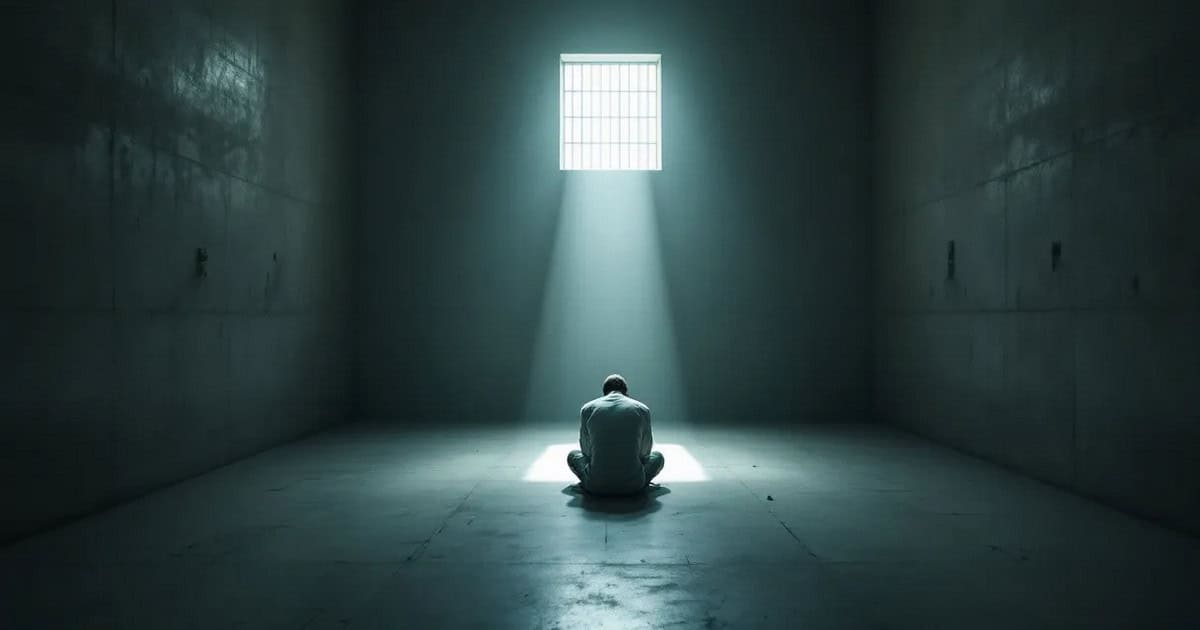
“I am a man who, at this moment, has no purpose to his existence on this earth.” A man in a Georgia prison wrote that sentence about himself, and added that if he died in his sleep he would know he had “fully wasted this time in this human body.” 1 Down the row, another man — eight years deep in heroin before prison, and high again inside to survive the gang that forced him into a phone-scam operation — gave his answer to the same emptiness in five words: “I got high to numb the pain.” 2
These are not complaints about comfort. They are reports from inside a specific kind of injury — the one that comes not from losing your freedom, but from losing every reason to want the next day. To understand what Georgia’s prisons are doing to the tens of thousands of people inside them, it helps to start not with a statute or a budget, but with a psychiatrist who studied this exact wound in the worst laboratory the twentieth century produced.
The will to meaning
Viktor Frankl survived Auschwitz. He went in a doctor and came out with a theory, forged from watching who lived and who did not. The prisoners who died first, he observed, were often not the weakest in body but the ones who had lost their sense of a future — who could no longer answer the question of what they were living for. Strip a person of meaning, and the body soon follows.
From that, Frankl built an argument that cut against the psychology of his day. The deepest human drive, he held, is not Freud’s pleasure or Adler’s power. It is the search for meaning — what he called the will to meaning. A person can endure almost unimaginable suffering if it is suffering for something. He kept close a line from Nietzsche that became the spine of his thinking:
He who has a why to live can bear almost any how.
That sentence is usually read as inspiration. Read it instead as a warning, because it runs in both directions. Take away the why, and the how — the daily grind of a cage — becomes unbearable. Meaning is not a luxury layered on top of survival. It is load-bearing.
The vacuum, engineered
Frankl had a name for a life emptied of meaning. He called it the existential vacuum, and he warned that it announces itself first as boredom and then as apathy — the sense that nothing one does matters, because there is nothing to do that could. He was describing a psychological condition. Georgia has turned it into an architecture.
We have documented the machinery elsewhere: the dormitory with a single television for fifty people, the three work assignments per hundred, the classrooms that reach a few dozen out of sixteen hundred, the yard that opens once a fortnight. 3 That is not incidental deprivation. It is the existential vacuum built to spec, and then filled with bodies. When researchers have actually measured it — administering standardized tests of purpose in life to incarcerated people — they have found them scoring strikingly low, exactly as the theory predicts. 4 And the programs Georgia stripped away were never idle enrichment: correctional education is tied to roughly 43 percent lower odds of returning to prison, and cognitive-behavioral programming cuts reoffending by about a quarter. 5 The emptiness is not a metaphor. It is measurable, and it was manufactured.
The triad
Frankl’s grim insight was that the vacuum does not stay empty. The human psyche abhors it, and rushes to fill it with whatever is at hand. Left untreated, Frankl warned in his later work, it curdles into what he named the mass neurotic triad: depression, aggression, and addiction. 6
Read that list again, because it is not a theory about Georgia’s prisons. It is a description of them. The depression is in the testimony — the man with “no purpose,” the despair that erodes the will to go on. The aggression is in the stabbings over drug debts and the gang that runs the dorm. 7 The addiction is everywhere — the K2 strips, the meth, the “soup” traded for two hours of oblivion (the drug economy we document in Zombie Dorms) — and it is the most literal proof of all, because the people inside name the mechanism precisely: they get high to numb the pain. 2 A century before Georgia built these dorms, a Viennese psychiatrist predicted exactly what would grow in them.
The two ways a person breaks
If Frankl explains what fills the vacuum, Nietzsche explains how it destroys. Nietzsche spent his life on a single dangerous question: what happens to people when the structures that gave their lives meaning fall away? His answer was nihilism — the condition of a life that no longer believes anything is worth anything. And he saw that it breaks in two directions.
The first is passive. The person collapses inward: apathy, resignation, the slow surrender of someone who has decided it does not matter whether he lives. You hear it when a prisoner says, in effect, that he could do all the drugs he could handle and no one would care — a sentence in which the speaker has already half-disappeared. 8 Sociologists have a phrase for this state — social death — the condition of being alive but counted by no one.
The second is active. The drive that should have gone into building a life, denied every legitimate outlet, turns outward as destruction. This is the violence — the predation, the gang economy, the casual brutality that the warehouse breeds and then points to as proof that the people inside are beasts who need caging. Nietzsche’s warning was that if you stare long enough into an abyss, it begins to stare back; Georgia has built abysses by the dozen and is shocked by what looks out. The full accounting of that violence — the homicides, the gang control, the staffing collapse the U.S. Department of Justice documented — is the subject of our companion investigation, The Only Family Left. 9 For now it is enough to name it as the second face of the same emptiness.
Three doors
Here the essay could turn comforting, and it is important that it does not. Because Frankl, having named the disease, also named the cure — and the cure contains a trap.
Meaning, Frankl taught, is found through three doors. The first is work — creating something, accomplishing a task, doing a deed that matters. The second is love — encountering another person, being known, belonging to someone. The third, and the hardest, is the stance a person takes toward unavoidable suffering: the freedom, when everything else has been stripped away, to choose one’s own attitude — what Frankl called the last of the human freedoms.
And here is the part that honors the people inside rather than pitying them: no one can walk through those doors for them. Meaning cannot be injected or assigned. It has to be found, by the person, through his own act. The man in “The Flame” did exactly that. At his lowest — his hope for the future, in his words, gone to nothing — he turned to faith, to the daughter he was trying to reach, to a book he began to write, and he climbed. 2 That is real, and it is his. The work was his to do, and he did it.
Georgia bolted two of the doors shut
But look again at which door he went through.
He did not find meaning in work, because Georgia has bolted that door: there are almost no jobs, the vocational programs are “mostly gone,” and the education that a few seize, they seize against the institution, not because of it. 10 11 One mother watched her son complete every class the system offered and earn a welding diploma and two years of college — and then watched it change nothing about how he was treated. 12 Another man works through college courses he had to fight to access at all. 13
He did not find it through love and connection, because Georgia has bolted that door too: the isolation, the severed and surveilled family contact, the destruction of the community that lets a person be known. The faith that finally reached him, he reached largely alone, by mail and by will. 14
So he went through the only door left open — the third, the hardest, the one that asks a person to wring meaning out of suffering itself, usually through faith, usually in solitude. That door cannot be locked, because it lives inside the person. But it was never meant to be the only door. Frankl offered three because most people, most of the time, need the easier two. A system that bolts the first two shut and leaves only the third has not preserved the path to meaning. It has narrowed it to a needle’s eye and dared people to thread it.
And this is the quiet violence beneath the loud kind. When a man like the one in “The Flame” makes it through, Georgia does not learn the lesson; it claims the survivor as proof that the doors were never needed — and treats everyone who could not thread the needle as having simply failed. “I’ve become a better person,” one man wrote, “but no one in the GDC cares.” 8 His resilience is real. It is also rare, and it is no alibi for the state that removed every other way. The handful who climb out the hardest door do not exonerate the warehouse. They indict it, because they show what the people inside are still capable of — and what is being wasted on an industrial scale.
Reopen the doors
Frankl is right that the state cannot hand a person his purpose; that much the man in the cell must do himself. But that truth is constantly abused to excuse the thing the state can do, and refuses to: stop bolting the doors.
Reopening them is not mysterious. It is the work — real jobs, real education, real training, the chance to make and build and be useful. It is connection — visits, contact, the family ties the system severs and the human community it forbids. It is treatment for the addiction the vacuum breeds, paired with a reason to stay sober once the craving is met. None of it manufactures meaning. All of it restores the conditions under which a human being can find his own.
A prison can be a place that deepens the vacuum until despair, violence, and addiction are the only things left to fill it. Or it can be a place that opens the doors and gets out of the way. Georgia has spent two decades choosing the first. The people inside keep proving they would walk through the second — if anyone would unlock it.
Call to Action: What You Can Do
You just read about people dying in state custody. The least you can do is make sure other people read it too. Share this story.
Spread the Word — It Takes One Click
Awareness without action changes nothing. Here’s how you can help push for accountability and real reform:
Join the GPS Advocacy Network — Sign up at https://gps.press/become-an-advocate/ and we’ll advocate on your behalf every week. GPS identifies your state legislators, crafts personalized letters on the most pressing prison issues, and sends them directly to the representatives who represent you. You receive a copy of every letter. It takes two minutes to sign up — we handle the rest.
Tell My Story — Are you or a loved one affected by Georgia’s prison system? GPS publishes first-person accounts from incarcerated people and their families. Submit your story at https://gps.press/category/tellmystory/ and help the world understand what’s really happening behind the walls.
Contact Your Representatives — Your state legislators control GDC’s budget, oversight, and the laws that created these failures. Find your Georgia legislators at https://gps.press/find-your-legislator/ or call Governor Kemp at (404) 656-1776 or the GDC Commissioner at (478) 992-5246.
Demand Media Coverage — Contact newsrooms at the AJC, local TV stations, and national criminal justice outlets. More coverage means more pressure.
Amplify on Social Media — Share this article and tag @GovKemp, @GDC_Georgia, and your local representatives. Use #GAPrisons, #PrisonReform, #GeorgiaPrisonerSpeak.
File Public Records Requests — Georgia’s Open Records Act gives every citizen the right to request incident reports, death records, staffing data, medical logs, and financial documents at https://georgiadcor.govqa.us/WEBAPP/_rs/SupportHome.aspx.
Attend Public Meetings — The Georgia Board of Corrections and legislative committees hold public meetings. Your presence is noticed.
Contact the Department of Justice — File civil rights complaints at https://civilrights.justice.gov. Federal oversight has forced abusive systems to change before.
Support Organizations Doing This Work — Donate to or volunteer with Georgia-based prison reform groups fighting for change on the ground.
Vote — Research candidates’ positions on criminal justice. Primary elections often determine outcomes in Georgia.
Contact GPS — If you have information about conditions inside Georgia’s prisons, reach us securely at GPS.press.
Part of Something Bigger
This article is part of the GPS Reform Agenda — two active campaigns to transform Georgia’s criminal justice system.
End the Warehouse THIS SERIES
Transform Georgia’s prisons from punishment to rehabilitation. Two tracks: litigation to reduce overcrowding + evidence-based programs that work.
Four model bills for the 2027 Georgia legislature. The legislature doesn’t need new laws — it needs to enforce two dormant statutes it already passed.
Read the full GPS Reform Agenda →
Further Reading
The companion investigation: how Georgia stripped work, school, and programs from its prisons and left tens of thousands with nothing to do.
The passive face of the vacuum: the people who answer the same emptiness by going silent and giving up — and the despair the state manufactures, refuses to treat, and declines to count.
The violence companion: how Georgia hollowed out its prisons and left the gang as the only institution offering purpose, kinship, and something to do — the active face of the vacuum.
Mission Failure: Georgia Spends $1.8 Billion on Prisons and $52 Per Person on Rehabilitation
The budget math behind the warehouse, and how little of it reaches the programs that give a person something to live for.
The Reform That Worked — and the Governor Who Killed It
Georgia once led on evidence-based reform; the story of how that momentum was abandoned.
Breaking Free with MOOCs: Education Empowers Prisoners and Families
What opens when the education door does — and why Georgia keeps it mostly shut.
10 Stoic Lessons from Marcus Aurelius for Prisoners
On the one door the state cannot lock: the stance a person takes toward what he cannot change.
GPS Intelligence System
The GPS Intelligence System maintains living research profiles that aggregate data, news, settlements, and analysis on Georgia’s prisons and the issues defining them. The profiles below provide deeper context for the issues raised in this article:
The living profile tracking Georgia’s shift from rehabilitation to warehousing, and the campaign to reverse it.
Aggregated reporting on day-to-day conditions inside Georgia’s prisons, including the idleness at the root of the vacuum.
Explore the Data
GPS makes GDC statistics accessible to the public through several resources:
- GPS Statistics Portal — Interactive dashboards translating complex GDC reports into accessible formats, updated within days of official releases.
- GPS Lighthouse AI — Ask questions about Georgia’s prison system and get answers drawn from GPS’s investigative archive and data analysis.
- GPS llms.txt — A single machine-readable index of every GPS data resource, published using the open llms.txt standard. Point any AI tool (ChatGPT, Claude, Gemini, Perplexity) at this URL and the model can navigate to facility profiles, intelligence briefs, mortality records, statistics, and the full investigative archive — no other configuration needed. It is the fastest way to ground an AI conversation in verified GPS data.
For a walkthrough of how to put these resources to work with AI, see How to Use GPS Data with AI Tools — a step-by-step guide for researchers, advocates, families, and journalists analyzing Georgia prison conditions, statistics, and policy with tools like ChatGPT, Claude, and Gemini.
Contact GPS at media@gps.press for access to underlying datasets used in this analysis.
About Georgia Prisoners’ Speak (GPS)
Georgia Prisoners’ Speak (GPS) is a nonprofit research organization built in partnership with incarcerated reporters, families, advocates, and data analysts. Operating independently from the Georgia Department of Corrections, GPS documents the truth the state refuses to acknowledge: extreme violence, fatal medical neglect, gang-controlled dorms, collapsed staffing, fraudulent reporting practices, and unconstitutional conditions across Georgia’s prisons.
Through confidential reporting channels, secure communication, evidence verification, public-records requests, legislative research, and professional investigative standards, GPS provides the transparency the system lacks. Our mission is to expose abuses, protect incarcerated people, support families, and push Georgia toward meaningful reform based on human rights, evidence, and public accountability.
Every article is part of a larger fight — to end the silence, reveal the truth, and demand justice.
The Architecture Is the Evidence
Across the 32 state prisons whose original design figures we hold, Georgia built for 15,737. They hold 34,019 — 216% of design capacity.
Dorms tripled. Cells double- and triple-bunked. Medical, kitchens, libraries — unchanged. Every facility, every design figure, every source.
See the receipts →- Let Me Go or Just Execute Me — Georgia Prisoners Speak, https://gps.press/let-me-go-or-just-execute-me/ [↩]
- The Flame — Georgia Prisoners Speak, https://gps.press/the-flame/ [↩][↩][↩]
- Nothing to Do — Georgia Prisoners Speak, https://gps.press/nothing-to-do/ [↩]
- Purpose in Life test scores among incarcerated populations, National Library of Medicine, https://pubmed.ncbi.nlm.nih.gov/893692/ [↩]
- A Sense of Purpose as a Driver of Rehabilitation in Incarcerated People: An Evidence Brief, https://gps.press/research-library/a-sense-of-purpose-as-a-driver-of-rehabilitation-in-incarcerated-people-an-evidence-brief/ [↩]
- Viktor E. Frankl, The Unheard Cry for Meaning, Simon & Schuster, 1978, https://www.simonandschuster.com/books/The-Unheard-Cry-for-Meaning/Viktor-E-Frankl/9780671247362 [↩]
- The Fire Alarm Kept Ringing and No One Came — Georgia Prisoners Speak, https://gps.press/the-fire-alarm-kept-ringing-and-no-one-came/ [↩]
- No Matter How Good I Am — Georgia Prisoners Speak, https://gps.press/no-matter-how-good-i-am/ [↩][↩]
- U.S. Department of Justice — Investigation of Georgia Prisons Findings Report, https://www.justice.gov/d9/2024-09/findings_report_-_investigation_of_georgia_prisons.pdf [↩]
- They Have Hope, So I Play My Part — Georgia Prisoners Speak, https://gps.press/they-have-hope-so-i-play-my-part/ [↩]
- Nature of Crime — Georgia Prisoners Speak, https://gps.press/nature-of-crimelet-the-truth-shine-even-in-dark-times/ [↩]
- How Much Time Is Enough? — Georgia Prisoners Speak, https://gps.press/how-much-time-is-enough/ [↩]
- Magazines Wrapped Around My Chest — Georgia Prisoners Speak, https://gps.press/magazines-wrapped-around-my-chest/ [↩]
- Time Is the Most Valuable Thing You Have — Georgia Prisoners Speak, https://gps.press/time-is-the-most-valuable-thing-you-have/ [↩]
You Have Options
Free tools to take action — the law is on your side.
Demand records from the prison system. Reach the officials who set policy. File a grievance or a complaint the right way. And for families who’ve lost someone in custody, get the records that tell the truth. Plain-language, step-by-step, and free.
Explore the GPS Toolkits →
GDC and Parole are completely aware of the status of Georgia’s prison facilities. They are aware of all of the drugs, gangs, violence, homicides, suicides, dirty officers, lack of programs, and everything else that’s wrong. They are complacent. Many inherited the problems and have no desire or ability to change it. Laws have to be changed. Too many people are incarcerated in GA. A person on probation shouldn’t be sent back to prison on nonviolent charges. Diversion programs have to be put in place to lower the prison population. The entire system needs to be restructured.