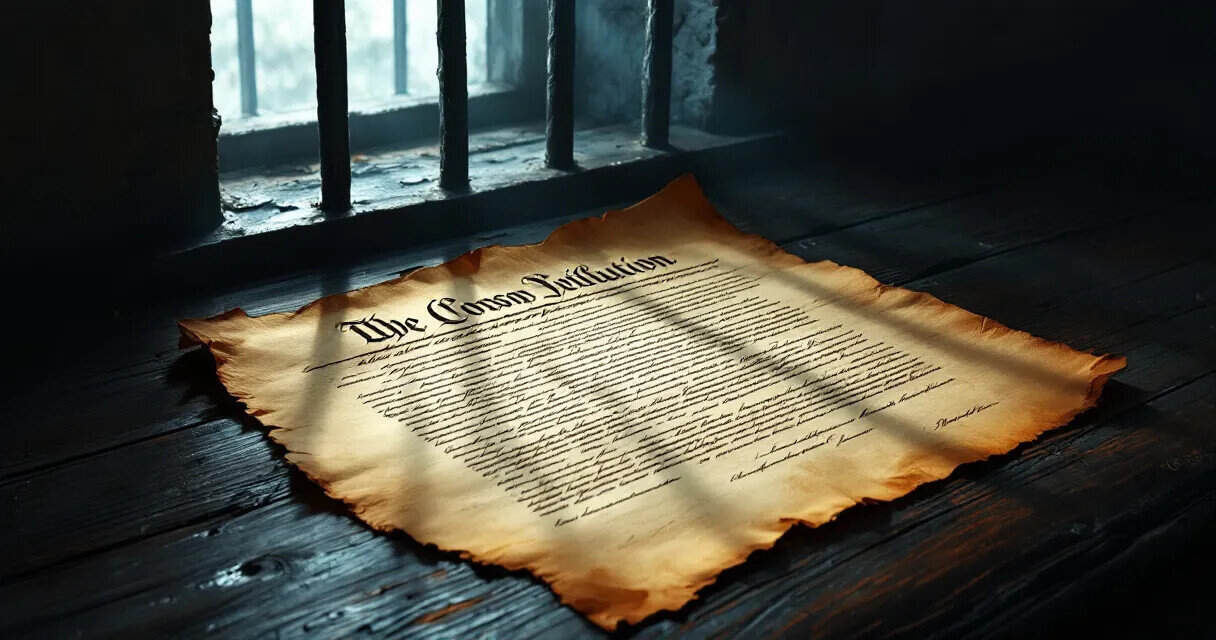
When the U.S. Department of Justice concluded in October 2024 that conditions in Georgia’s prisons violate the Eighth Amendment, it relied on the federal Constitution’s familiar ban on cruel and unusual punishment 1. What almost no one mentioned — not the state, not the coverage, not the litigation that has followed — is that Georgia’s own constitution goes further than the federal one. Much further.
Buried in Article I of the Georgia Constitution, at the end of the same paragraph that bans cruel and unusual punishment, sit words that appear in no other state constitution in America. They have been there since 1868. They have been cited by Georgia courts roughly ten times in 158 years. And a new law review article argues they may be one of the most powerful untested tools for challenging mass incarceration in the state 2.
The clause is called the Abuse Provision. This is what it says, what it was written to do, and why it matters now.
Nine Words No Other State Has
Georgia’s constitutional paragraph on punishment begins exactly like the federal Eighth Amendment — and then keeps going:
Excessive bail shall not be required, nor excessive fines imposed, nor cruel and unusual punishments inflicted; nor shall any person be abused in being arrested, while under arrest, or in prison.
That final clause is unique. Legal scholars who have catalogued every state constitution’s punishment provisions have found nothing like it anywhere else in the country. Every other state stops at some variation of “cruel and unusual.” Georgia — alone — added an affirmative ban on abuse, and extended it across the entire span of a person’s contact with the criminal legal system: the moment of arrest, the time in custody, and imprisonment itself.
The distinction matters. The federal Eighth Amendment protects against cruel and unusual punishment — which courts have interpreted to require proving that officials acted with deliberate indifference, and which applies awkwardly or not at all to people who haven’t been convicted of anything. The Abuse Provision has no such limits on its face. It doesn’t ask whether mistreatment was part of a punishment. It asks whether a person was abused.
Georgia’s Supreme Court has repeatedly held that every part of the state constitution must be given independent meaning — drafters are not presumed to write words that do nothing. Read that way, the Abuse Provision cannot simply repeat the cruel-and-unusual ban that precedes it in the same sentence. It has to add something. The question courts have never answered is: what?
Born From Reconstruction
The Abuse Provision was not an accident of drafting. It was proposed at Georgia’s 1868 Constitutional Convention by Richard Whiteley — an Irish immigrant, former Confederate major turned Radical Republican, and one of the only lawyers in southwest Georgia who would represent Black clients after the Civil War 3.
The context was brutal and specific. In 1868 alone, Georgia recorded 260 incidents of Black residents being whipped over alleged theft. The state legislature had moved quickly after the war to criminalize the ways newly freed people survived — new vagrancy laws, new capital offenses, hunting bans in majority-Black counties — and law enforcement applied facially neutral laws almost exclusively against Black Georgians. The numbers tell the story: in 1866, Black people were 300 of the 325 people held in Georgia’s prisons. By 1878, the Black prison population had grown to 1,122, against 117 white prisoners.
The delegates who backed Whiteley’s amendment understood exactly what they were writing against. G.W. Ashburn, a Radical Republican who championed the provision on the convention floor, was murdered by the Ku Klux Klan within months. Aaron A. Bradley, the most outspoken Black delegate, endorsed it by pointing directly at police treatment of Black residents in Savannah — and, according to contemporaneous newspaper coverage, declared that every Black delegate would support it.
The convention even had a narrower option on the table. Delegate J.R. Parrott proposed simply extending the cruel-and-unusual clause to apply “either before or after conviction.” The delegates rejected the narrow version and adopted Whiteley’s sweeping one. Georgia has rewritten its constitution four times since. The Abuse Provision survived every rewrite, with a single change: “whilst” became “while.”
Ten Citations in 158 Years
For a constitutional guarantee, the Abuse Provision has lived a remarkably quiet life. A comprehensive search finds its language cited only about ten times by Georgia courts — and only twice with any substance.
- Loeb v. Jennings (1910). The Georgia Supreme Court upheld a sentence of a fine plus street labor, but went out of its way to warn — citing the Abuse Provision — that the law does not tolerate brutality by the state or a municipality. The implication: even a punishment a statute allows must still comply with the Abuse Provision.
- Long v. Jones (1993). A pretrial detainee was kept continuously in leg irons, waist chains, and handcuffs for twenty-two days in a jail cell. The Georgia Court of Appeals reversed summary judgment for the State, holding that the Abuse Provision supplies an independent state-law ground for his claim — separate from any federal claim — and protects pretrial detainees at least as strongly as federal due process.
That is essentially the entire body of law. Long v. Jones explicitly left open the biggest question: whether the Abuse Provision protects more than the federal floor. Federal courts asked to decide the question have declined, saying it belongs to Georgia’s courts. Georgia’s courts have never taken it up. Even sitting Georgia jurists have said so in print. Nels S.D. Peterson — then a justice, now Chief Justice of the Georgia Supreme Court — wrote in the Mercer Law Review that independent interpretation of the Georgia Constitution “is often easier to talk about than to do,” and pointed to the Abuse Provision as a paragraph whose meaning remains unsettled 4.
The result is a constitutional provision that is simultaneously 158 years old and almost entirely unexplored — expansive language with no limiting precedent attached to it.
What It Could Mean Now
The Abuse Provision names three settings: being arrested, being under arrest, and being in prison. Georgia currently supplies documented crises in all three.
In prison. The DOJ’s 93-page findings report describes a system in which violence is systemic and near-constant, thousands of people face substantial ongoing risk of serious harm, more than 1,400 violent incidents were reported in a fifteen-month span, and 2,629 sexual abuse allegations were logged from 2019 through 2022, per DOJ figures compiled in the Georgia Criminal Law Review analysis 5. The Atlanta Journal-Constitution, which has tracked every death in GDC custody since 2020, counted a record 44 homicides by mid-October 2024 6. GPS’s own mortality database, built from official records and family reports, documents the same trajectory in granular detail.
Under arrest. The DOJ’s separate investigation of the Fulton County Jail found officers routinely using force against people offering no resistance, deploying tasers on people in mental health crisis, and detaining people amid flooding, pest infestations, exposed wiring, and malnutrition. Everyone held there is presumed innocent — which is precisely why the federal cruel-and-unusual framework fits so poorly, and why a provision written for people “under arrest” fits so well.
Being arrested. Incomplete data — only 45 of Georgia’s 768 law enforcement agencies report use-of-force numbers — still shows 15,386 reported uses of force between 2017 and 2022 and 533 people killed by Georgia police since 2013, with Black Georgians twice as likely to be killed as white Georgians 7. Whiteley’s decision to include the words “in being arrested” was deliberate: the provision reaches the street, not just the cell.
The racial pattern the 1868 delegates wrote against has not disappeared either. Black Georgians are 31 percent of the state’s population and a majority of both its prison and jail populations, incarcerated in prison at more than two and a half times the rate of white Georgians 8.
The Honest Caveats
The Abuse Provision is not a magic key, and the scholarship is candid about what remains unresolved. Georgia’s official and sovereign immunity doctrines — themselves embedded in the state constitution — may sharply limit who can be sued and for what. At least one federal court has treated Georgia’s use-of-force statute as qualifying the provision’s reach. And no court has ever defined the remedy for a violation, especially a systemic one.
Those are real obstacles. But they are obstacles of the same kind every neglected constitutional provision faces before someone litigates it seriously. The provision’s text is broad. Its history points one direction. The two substantive precedents that exist both point the same way. What has been missing for a century and a half is not legal material — it is attention.
Why This Belongs in the Fight
GPS’s End the Warehouse campaign runs on two tracks: litigation to reduce the harm Georgia’s prisons inflict, and evidence-based rehabilitation to replace warehousing. The Abuse Provision speaks directly to the first track. It is a state-law theory, litigated in state courts, grounded in Georgia’s own founding documents — immune to the federal-courthouse bottlenecks that have slowed Eighth Amendment enforcement, and rooted in a history that is impossible to dismiss as imported or novel.
It also reframes the political conversation. Georgia’s leaders are not being asked to adopt some new standard of decency. They are being asked to honor a promise their own constitution has made, in plain language, since 1868: no person in this state shall be abused in being arrested, while under arrest, or in prison.
The words are already there. Someone has to make them mean something.
Call to Action: What You Can Do
Georgia's own constitution bans abuse in prison—and has for 158 years. Yet 44 people were killed in GDC custody by mid-October 2024. Sharing this story is the least anyone can do to force the question: why have these nine words never been enforced.
Spread the Word — It Takes One Click
Awareness without action changes nothing. Here’s how you can help push for accountability and real reform:
Join the GPS Advocacy Network — Sign up at https://gps.press/become-an-advocate/ and we’ll advocate on your behalf every week. GPS identifies your state legislators, crafts personalized letters on the most pressing prison issues, and sends them directly to the representatives who represent you. You receive a copy of every letter. It takes two minutes to sign up — we handle the rest.
Send a 60-Second Message — Pick an issue, get a ready-to-edit message with the verified facts already in it, and email your state House representative and senator directly from your own inbox at https://gps.press/send-a-message/. No signup, nothing stored — it takes about a minute.
Tell My Story — Are you or a loved one affected by Georgia’s prison system? GPS publishes first-person accounts from incarcerated people and their families. Submit your story at https://gps.press/category/tellmystory/ and help the world understand what’s really happening behind the walls.
Contact Your Representatives — Your state legislators control GDC’s budget, oversight, and the laws that created these failures. Find your Georgia legislators at https://gps.press/find-your-legislator/ or call Governor Kemp at (404) 656-1776 or the GDC Commissioner at (478) 992-5246.
Demand Media Coverage — Contact newsrooms at the AJC, local TV stations, and national criminal justice outlets. More coverage means more pressure.
Amplify on Social Media — Share this article and tag @GovKemp, @GDC_Georgia, and your local representatives. Use #GAPrisons, #PrisonReform, #GeorgiaPrisonerSpeak.
File Public Records Requests — Georgia’s Open Records Act gives every citizen the right to request incident reports, death records, staffing data, medical logs, and financial documents at https://georgiadcor.govqa.us/WEBAPP/_rs/SupportHome.aspx.
Attend Public Meetings — The Georgia Board of Corrections and legislative committees hold public meetings. Your presence is noticed.
Contact the Department of Justice — File civil rights complaints at https://civilrights.justice.gov. Federal oversight has forced abusive systems to change before.
Support Organizations Doing This Work — Donate to or volunteer with Georgia-based prison reform groups fighting for change on the ground.
Vote — Research candidates’ positions on criminal justice. Primary elections often determine outcomes in Georgia.
Contact GPS — If you have information about conditions inside Georgia’s prisons, reach us securely at GPS.press.
Part of Something Bigger
This article is part of the GPS Reform Agenda — two active campaigns to transform Georgia’s criminal justice system.
End the Warehouse THIS SERIES
Transform Georgia’s prisons from punishment to rehabilitation. Two tracks: litigation to reduce overcrowding + evidence-based programs that work.
Four model bills for the 2027 Georgia legislature. The legislature doesn’t need new laws — it needs to enforce two dormant statutes it already passed.
Read the full GPS Reform Agenda →
Further Reading
The Crisis Georgia’s Prison Leaders Call ‘Propaganda’
How GDC leadership dismisses documented findings of violence and death as a public relations problem.
At Least Nineteen: The Murders the State Didn’t Prosecute
GPS’s investigation into homicides in GDC custody that never resulted in criminal charges.
Buried Alive: The Four-Year Deadline That Killed Habeas Corpus in Georgia
Why Georgia’s procedural barriers have shut most incarcerated people out of the courts — and why new legal theories matter.
The Georgia Prison Commander Who Warned the State
An insider’s warnings about the system’s collapse, ignored by the officials who could have acted.
GPS Intelligence System
The GPS Intelligence System maintains living research profiles that aggregate data, news, settlements, and analysis on Georgia’s prisons and the issues defining them. The profiles below provide deeper context for the issues raised in this article:
The living research profile for GPS’s campaign to replace warehousing with rehabilitation — including the litigation track this constitutional theory could serve.
GPS’s ongoing documentation of every death in GDC custody — the factual record any Abuse Provision litigation would draw on.
Explore the Data
GPS makes GDC statistics accessible to the public through several resources:
- GPS Statistics Portal — Interactive dashboards translating complex GDC reports into accessible formats, updated within days of official releases.
- GPS Lighthouse AI — Ask questions about Georgia’s prison system and get answers drawn from GPS’s investigative archive and data analysis.
- GPS llms.txt — A single machine-readable index of every GPS data resource, published using the open llms.txt standard. Point any AI tool (ChatGPT, Claude, Gemini, Perplexity) at this URL and the model can navigate to facility profiles, intelligence briefs, mortality records, statistics, and the full investigative archive — no other configuration needed. It is the fastest way to ground an AI conversation in verified GPS data.
For a walkthrough of how to put these resources to work with AI, see How to Use GPS Data with AI Tools — a step-by-step guide for researchers, advocates, families, and journalists analyzing Georgia prison conditions, statistics, and policy with tools like ChatGPT, Claude, and Gemini.
Contact GPS at media@gps.press for access to underlying datasets used in this analysis.
About Georgia Prisoners’ Speak (GPS)
Georgia Prisoners’ Speak (GPS) is a nonprofit investigative newsroom built in partnership with incarcerated reporters, families, advocates, and data analysts. Operating independently from the Georgia Department of Corrections, GPS documents the truth the state refuses to acknowledge: extreme violence, fatal medical neglect, gang-controlled dorms, collapsed staffing, fraudulent reporting practices, and unconstitutional conditions across Georgia’s prisons.
Through confidential reporting channels, secure communication, evidence verification, public-records requests, legislative research, and professional investigative standards, GPS provides the transparency the system lacks. Our mission is to expose abuses, protect incarcerated people, support families, and push Georgia toward meaningful reform based on human rights, evidence, and public accountability.
Every article is part of a larger fight — to end the silence, reveal the truth, and demand justice.
The Architecture Is the Evidence
Across the 32 state prisons whose original design figures we hold, Georgia built for 15,737. They hold 34,019 — 216% of design capacity.
Dorms tripled. Cells double- and triple-bunked. Medical, kitchens, libraries — unchanged. Every facility, every design figure, every source.
See the receipts →- DOJ press release, Oct. 1, 2024, https://www.justice.gov/archives/opa/pr/justice-department-finds-unconstitutional-conditions-georgia-prisons [↩]
- Max Tinter, (Re)constructing the Abuse Provision, Georgia Criminal Law Review, Vol. 4, No. 1, https://digitalcommons.law.uga.edu/gclr/vol4/iss1/3 [↩]
- Journal of the 1868 Georgia Constitutional Convention, https://digitalcommons.law.uga.edu/ga_constitutions/80 [↩]
- Nels S.D. Peterson, Principles of Georgia Constitutional Interpretation, 75 Mercer L. Rev. 1, https://digitalcommons.law.mercer.edu/jour_mlr/vol75/iss1/4/ [↩]
- DOJ Findings Report, Investigation of Georgia Prisons, https://www.justice.gov/d9/2024-09/findings_report_-_investigation_of_georgia_prisons.pdf [↩]
- AJC homicide tracking project, https://www.ajc.com/news/investigations/ga-prison-homicides-a-list-of-those-killed-in-georgias-prison-system/FLCH6BL3ZZDLPKRBHBKTEPOVFU/ [↩]
- Mapping Police Violence, Georgia use of force data, https://policedata.org/report/ga/statewide/uof [↩]
- Prison Policy Initiative, Georgia profile, https://www.prisonpolicy.org/profiles/GA.html [↩]