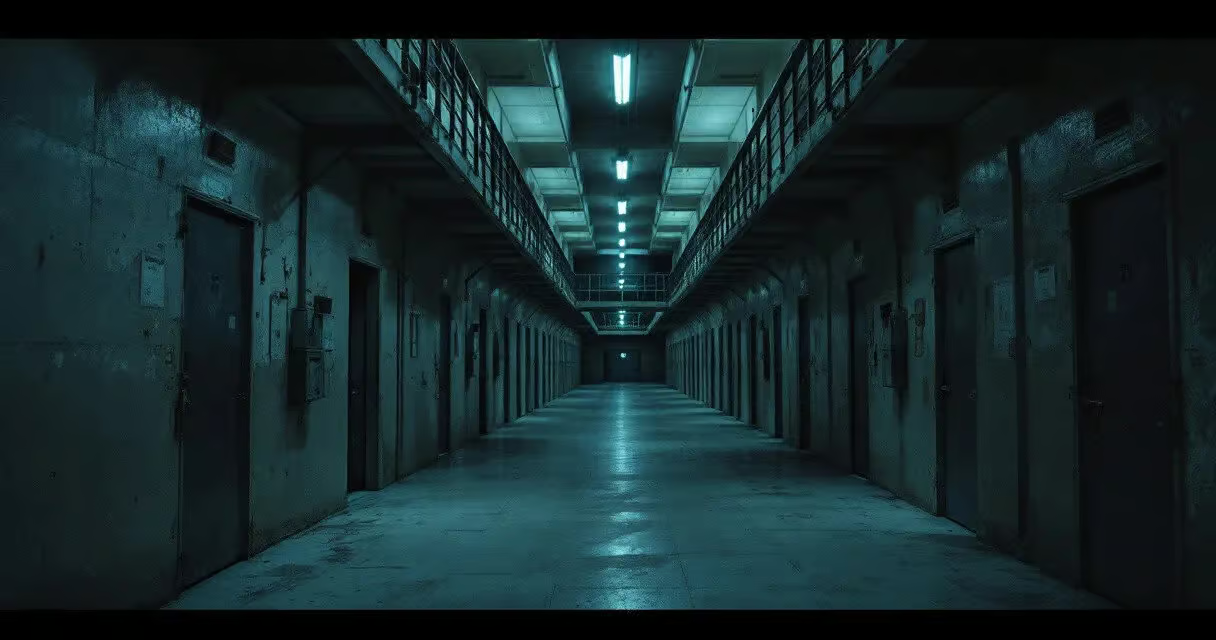
Between 2020 and today, at least nineteen men were killed by other prisoners inside Ware State Prison — stabbed, beaten, and strangled in a single close-security facility outside Waycross. Georgia’s own coroner and state crime-lab records, obtained by Georgia Prisoners’ Speak through an open-records request, name a suspected attacker in eleven of those deaths. In not one of them could GPS find any public record that the accused was ever charged, indicted, or tried.
That absence is the story. The State of Georgia examined these bodies, photographed the wounds, and wrote the manner of death as homicide in its own files. Then, as far as any public record shows, it did nothing.
The documents — 231 death-investigation reports, GBI autopsies, and toxicology findings covering 84 Ware deaths since 2020 — describe a prison where men are killed by the people locked in with them, where the paperwork proving how they died sits in a county coroner’s office, and where the machinery of accountability simply stops. GPS holds copies of these records but is not republishing them, at the coroner’s request.
A body count at one prison
Ware State Prison opened in 1990 as a close-security men’s prison designed to hold roughly 500 people. Today it holds about 1,447 — nearly three times its original design capacity. It is one of some three dozen prisons Georgia operates, and it has long been a focal point of reporting on riots, staff brutality, and extreme violence.
In under six years, the coroner records GPS obtained document at least 19 homicides there, alongside twelve suicides — many of men held in segregation — and eight fatal overdoses from methamphetamine and synthetic cannabinoids smuggled inside. Georgia publishes no official prison-homicide count. This figure is a floor, drawn only from the coroner records GPS has so far obtained, and it will rise as more arrive.
These are not quiet deaths. The autopsies record men with more than two dozen stab wounds. One victim, Squaier Jiles, bled to death from sharp-force injuries in 2024. Another, Christopher Gresham, was stabbed by at least three other prisoners in 2021. The weapons were homemade; the killings, overwhelmingly, happened between cellmates and dorm-mates in a prison too short-staffed to watch them.
Named in the autopsies, charged with nothing
In eleven of the nineteen homicides, the state’s own death investigations name at least one accused attacker in the “Subject” field of the autopsy or in the coroner’s narrative. GPS searched Georgia news outlets, the Waycross Judicial Circuit district attorney’s releases, GBI and GDC announcements, federal court dockets, and Georgia offender records for each name. We found no public record of a single charge, indictment, plea, or conviction tied to any of these killings.
The records name the accused as follows:
- Robert Darius Scott (2021, strangled) — Henry Lee Stubbs
- Christopher Eli Gresham (2021, stabbed) — Breon Quinarius Heard, Issac Hikeen Jenkins, and Tyreek Isaiah Bowers-Rivera
- Kyle Anthony Strother (2022, stabbed) — Devon Malik Brown
- Alfonso Marquez Moore (2023, beaten by his cellmate) — Lashon Boddie
- Thomas Jerome McCoy (2023, stabbed) — Kareem Felder and Reco Echols
- Christopher Michael Taylor (2024, stabbed) — Johannes Lopez
- Christopher Allen Barrett (2025, sharp- and blunt-force; the cellmate admitted the assault) — Andrew Shadrix
- Christopher Shane Henry (2026, beaten and strangled) — Jonathan Hardman-Simmons, who told staff he had killed his roommate and then died in custody himself weeks later
- Anthony Terrell Grover (2026, stabbed) — a roommate the records identify as Donovan McCray
- Justin Dean Pulley (2026, beaten and strangled) — Javon Deontay Rice
- Kojack Thomas Jr (2026, bludgeoned) — Demetric Joseph
The other eight killings — Robert Lee Wilson, Christopher Rawls, Vadarian Carr, Leonardo Anderson, Samuel Ellis, Squaier Jiles, Scott Hullander, and David Renfro — name no attacker at all. The autopsies say only that the men were killed by “other inmates.”
Georgia does prosecute prison homicides when it chooses to; it has publicly indicted killings at other state prisons. The total silence around Ware is itself the anomaly. Offender records hint that a few of the accused later received longer sentences — one is now serving life without parole for murder — but no court record or news account GPS could find ties those outcomes to the Ware killings rather than to earlier crimes, and Ware County Superior Court’s criminal dockets are not searchable online. One accused man, Reco Echols, was simply released from prison on August 29, 2024, less than a year after the killing he is named in.
This is the absence of a public record — which is exactly the question GPS is now putting to the district attorney and the county court clerk: nineteen people killed at one prison, eleven cases with a suspect named in the state’s own autopsies, and no evidence anyone was prosecuted. Why?
“Please Help Me!!!”
The same records show a prison that failed the men who died in it — before, during, and after their deaths.
In one cell, a prisoner left a written plea to staff: “my cellmate has killed himself… Please Help Me!!!” On the cell-check logs meant to catch exactly these emergencies, a unit manager admitted that officers “check and forget to sign” — the falsified safety rounds that turn a required head count into a signature on an empty form.
The forms said the checks happened. The bodies said they didn’t.
The neglect ran through the medical deaths too. In one case a prison doctor declined the hospice care a hospital had recommended for a dying man. Others were shackled to their beds as they died. One man was found dead weighing roughly 100 pounds. In several cases the coroner noted that bodies had been moved or scenes cleaned before investigators arrived; in another, the response to a death was delayed by about two hours. These are the conditions in which a homicide becomes indistinguishable from a natural death — and in which the ninety-plus records marked “unknown” or “pending” should be read with suspicion. Some of them may be homicides the system never worked to solve.
A prison with no one watching
None of this happened in a vacuum. Georgia’s own 2024 Senate study committee on the Department of Corrections heard that the agency was running at roughly a 47 percent correctional-officer vacancy rate across its 7,500 funded security posts. 1 The Governor’s own consultants at Guidehouse assessed the prison system and concluded it was operating in “emergency mode,” with no quick fix possible. 2
A prison that cannot be staffed cannot watch the cells, cannot run the checks, and cannot investigate what happens when the lights go down. Overcrowded to nearly triple its design, staffed at half strength, and armed with homemade knives moved by the gangs that fill the vacuum, Ware is what the warehouse looks like counted in bodies.
What Georgia won’t say
According to testimony before Georgia’s 2024 Senate study committee, the Department of Corrections stopped issuing press releases when a prisoner dies. And, according to testimony before that same Senate committee, it removed the manner of death from the mortality reports it releases under the Open Records Act — the single field that tells the public whether a death was a homicide. 3
The result is a closed loop: the agency that runs the prison decides what the public is allowed to know about the people who die in it. GPS sought comment from the Department of Corrections for this article and will update it with any response. As of publication, the department had not replied — consistent with its practice of declining to answer questions about deaths in its custody.
Nineteen men. Eleven named suspects. Zero prosecutions we can find. The State of Georgia wrote all of it down. It just never acted on any of it.
Call to Action: What You Can Do
Eleven men were named as killers in state autopsy reports. Not one was prosecuted. You just read the evidence Georgia wrote down and ignored. Share this story so the nineteen dead are not also invisible. Silence is how the system keeps counting bodies without consequence.
Spread the Word: It Takes One Click
Awareness without action changes nothing. Here’s how you can help push for accountability and real reform:
Join the GPS Advocacy Network — Sign up at https://gps.press/become-an-advocate/ and we’ll advocate on your behalf every week. GPS identifies your state legislators, crafts personalized letters on the most pressing prison issues, and sends them directly to the representatives who represent you. You receive a copy of every letter. It takes two minutes to sign up — we handle the rest.
Send a 60-Second Message — Pick an issue, get a ready-to-edit message with the verified facts already in it, and email your state House representative and senator directly from your own inbox at gps.press/send-a-message. No signup, nothing stored — it takes about a minute.
Tell My Story — Are you or a loved one affected by Georgia’s prison system? GPS publishes first-person accounts from incarcerated people and their families. Submit your story at https://gps.press/tellmystory and help the world understand what’s really happening behind the walls.
Contact Your Representatives — Your state legislators control GDC’s budget, oversight, and the laws that created these failures. Find your Georgia legislators at https://gps.press/find-your-legislator/ or call Governor Kemp at (404) 656-1776 or the GDC Commissioner at (478) 992-5246.
Demand Media Coverage — Contact newsrooms at the AJC, local TV stations, and national criminal justice outlets. More coverage means more pressure.
Amplify on Social Media — Share this article and tag @GovKemp, @GDC_Georgia, and your local representatives. Use #GAPrisons, #PrisonReform, #GeorgiaPrisonerSpeak.
File Public Records Requests — Georgia’s Open Records Act gives every citizen the right to request incident reports, death records, staffing data, medical logs, and financial documents at https://georgiadcor.govqa.us/WEBAPP/_rs/SupportHome.aspx.
Attend Public Meetings — The Georgia Board of Corrections and legislative committees hold public meetings. Your presence is noticed.
Contact the Department of Justice — File civil rights complaints at https://civilrights.justice.gov. Federal oversight has forced abusive systems to change before.
Support Organizations Doing This Work — Donate to or volunteer with Georgia-based prison reform groups fighting for change on the ground.
Vote — Research candidates’ positions on criminal justice. Primary elections often determine outcomes in Georgia.
Contact GPS — If you have information about conditions inside Georgia’s prisons, reach us securely at GPS.press.
Part of Something Bigger
This article is part of the GPS Reform Agenda — two active campaigns to transform Georgia’s criminal justice system.
End the Warehouse THIS SERIES
Transform Georgia’s prisons from punishment to rehabilitation. Two tracks: litigation to reduce overcrowding + evidence-based programs that work.
Four model bills for the 2027 Georgia legislature. The legislature doesn’t need new laws — it needs to enforce two dormant statutes it already passed.
Read the full GPS Reform Agenda →
Further Reading
The Six Who Disappeared: Georgia’s Prison Death Cover-Up
How Georgia’s prison system erases the people who die in its custody — and the paper trail that exposes it.
Blood on Blood: Georgia Statewide Prison Lockdown
Inside the violence that forced a statewide lockdown, and the staffing collapse driving it.
Separate the Gangs. It Costs Nothing. Georgia Keeps Choosing the Bodies.
A no-cost violence-reduction strategy other states use — and why Georgia won’t.
The Quiet Purge: Calhoun Edition
What happens to the record when the state would rather you not count the dead.
Georgia’s “Hardened” Solution: Another Fortress Instead of Reform
The state’s answer to prison violence is more concrete — not more people to run the prisons.
Starved and Silenced: The Hidden Crisis Inside Georgia Prisons
Neglect, hunger, and silence as policy across Georgia’s prison system.
GPS Intelligence System
The GPS Intelligence System maintains living research profiles that aggregate data, news, settlements, and analysis on Georgia’s prisons and the issues defining them. The profiles below provide deeper context for the issues raised in this article:
Ware State Prison — Facility Intelligence Profile
Living data on deaths, violence, staffing, and conditions at Ware State Prison.
Violence — Issue Intelligence Profile
How prison violence in Georgia is tracked, undercounted, and left uninvestigated.
Explore the Data
GPS makes GDC statistics accessible to the public through several resources:
- GPS Statistics Portal — Interactive dashboards translating complex GDC reports into accessible formats, updated within days of official releases.
- GPS Lighthouse AI — Ask questions about Georgia’s prison system and get answers drawn from GPS’s investigative archive and data analysis.
- GPS llms.txt — A single machine-readable index of every GPS data resource, published using the open llms.txt standard. Point any AI tool (ChatGPT, Claude, Gemini, Perplexity) at this URL and the model can navigate to facility profiles, intelligence briefs, mortality records, statistics, and the full investigative archive — no other configuration needed. It is the fastest way to ground an AI conversation in verified GPS data.
For a walkthrough of how to put these resources to work with AI, see How to Use GPS Data with AI Tools — a step-by-step guide for researchers, advocates, families, and journalists analyzing Georgia prison conditions, statistics, and policy with tools like ChatGPT, Claude, and Gemini.
Contact GPS at media@gps.press for access to underlying datasets used in this analysis.
About Georgia Prisoners’ Speak (GPS)
Georgia Prisoners’ Speak (GPS) is a nonprofit research organization built in partnership with incarcerated reporters, families, advocates, and data analysts. Operating independently from the Georgia Department of Corrections, GPS documents the truth the state refuses to acknowledge: extreme violence, fatal medical neglect, gang-controlled dorms, collapsed staffing, fraudulent reporting practices, and unconstitutional conditions across Georgia’s prisons.
Through confidential reporting channels, secure communication, evidence verification, public-records requests, legislative research, and professional investigative standards, GPS provides the transparency the system lacks. Our mission is to expose abuses, protect incarcerated people, support families, and push Georgia toward meaningful reform based on human rights, evidence, and public accountability.
Every article is part of a larger fight — to end the silence, reveal the truth, and demand justice.
Correction (August 11, 2026): An earlier version of this article misstated how two of the nineteen men died and misidentified one of the eight victims whose records name no attacker. Justin Dean Pulley was not stabbed; the coroner and GBI medical examiner records state that he died of multiple blunt force injuries to the head with ligature compression of the neck, ruled a homicide. Christopher Shane Henry was not stabbed; his autopsy states that he died of blunt force injuries including strangulation, ruled a homicide. The earlier version also listed Marty Wright among the men killed by other prisoners; the coroner record states that Mr. Wright’s death was self-inflicted and ruled a suicide. The nineteenth homicide victim is David Renfro, who died in October 2024 of multiple blunt and sharp force injuries with ligature strangulation, ruled a homicide following an altercation with his cellmate; his records, like those of the other seven, name no attacker. The article’s count of nineteen homicides and eleven named suspects is unchanged.
The Architecture Is the Evidence
Across the 32 state prisons whose original design figures we hold, Georgia built for 15,737. They hold 33,805 — 215% of design capacity.
Dorms tripled. Cells double- and triple-bunked. Medical, kitchens, libraries — unchanged. Every facility, every design figure, every source.
See the receipts →- Final Report of the 2024 Senate Study Committee on the Department of Corrections, https://www.senate.ga.gov/committees/Documents/2024SenateStudyCommDOCFinalReport.pdf [↩]
- Guidehouse System-Wide Assessment of the Georgia Department of Corrections, https://www.documentcloud.org/documents/25485954-guidehouse-report-on-georgia-prisons/ [↩]
- The Georgia Virtue on GDC silence and violence at Ware State Prison, https://www.thegeorgiavirtue.com/georgia-news/gdc-is-silent-once-again-on-ware-state-prison-violence-stabbings/ [↩]
You Have Options
Free tools to take action — the law is on your side.
Demand records from the prison system. Reach the officials who set policy. File a grievance or a complaint the right way. And for families who’ve lost someone in custody, get the records that tell the truth. Plain-language, step-by-step, and free.
Explore the GPS Toolkits →
Outrageous this is happening. My son is fixing to go into the system and I am so scared he won’t make it back home.
We’re very sorry to hear that. Your fears are grounded in reality, but there are things your son can do to stay safe.
Stay to himself
Never borrow ANYTHING
Don’t join a gang, the protection they entice young men with may seem like safety, but the reality is that he will now have to fight when gang leaders say to, and refusal will have severe consequences.