WARE STATE PRISON
Facility Information
- Original Design Capacity
- 500 (at 287% capacity)
- Bed Capacity
- 1,546 beds
- Current Population
- 1,436
- Active Lifers
- 398 (27.7% of population) · Oct 2026 GDC report
- Life Without Parole
- 240 (16.7%)
What the courts held in Brown v. Plata, and how Georgia compares →
- Address
- 3620 North Harris Road, Waycross, GA 31503
- Phone
- (912) 285-6400
- Fax
- (912) 285-6415
- County
- Ware County
- Opened
- 1990
- Operator
- GDC (Georgia Dept. of Corrections)
Security Classification
Last updated: October 2, 2026
1,019 of the 1,415 people held here are classified Close security (72.0%), as of September 23, 2026.
| Security level | People | Share |
|---|---|---|
| Close | 1,019 | 72.0% |
| Medium | 372 | 26.3% |
| Minimum | 24 | 1.7% |
| Total | 1,415 |
Earlier count (undated table, produced October 22, 2025): 1,035 of 1,452 Close (71.3%).
Restrictive housing beds
| Program | Beds | Occupied |
|---|---|---|
| Tier II | 138 | 138 |
Source: Georgia Department of Corrections records produced to GPS under the Open Records Act (R031471-090226, R024615-101925, R031710-091426). A person's security level is GDC's classification of that person, which can differ from the prison's own designation.
Follow Ware State Prison
Leadership & Accountability (as of 2026 records)
Officials currently holding positional authority at this facility, with deaths attributed to GPS-tracked records during their leadership tenure. Inclusion reflects role-based accountability, not legal findings of personal culpability. Death counts shown as facility / career.
| Role | Name | Since | Deaths this facility / career |
|---|---|---|---|
| WARDEN 3 (facility lead) | Spann, James Clarence | 2024-10-16 | 32 / 43 |
| Deputy Warden of Care and Treatment (facility deputy) | Jones, Lutria Jamil | 2022-01-01 | 61 / 61 |
| Deputy Warden of Security (facility deputy) | Walker, Martella L | 2025-09-16 | 17 / 17 |
| Deputy Warden of Administration (facility deputy) | Johnson, Aiyesha | 2026-01-16 | 13 / 13 |
About
Last updated October 18, 2026.(DS)
Ware State Prison: Ninety Deaths, Locked Fire Exits, and a Custody Breakdown the State Keeps Finding
Ware State Prison sits on the edge of Waycross in Ware County, a close-security men's facility that opened around 1990 with an original design capacity of 500 and a current rated capacity of 1,546. It houses men in a mix of dormitory housing and high-security cellblocks, including Tier II special-management units, and maintains a CERT team and other tactical resources. GPS's own records put the current population at 1,436 — roughly 92.9 percent of rated capacity — under Warden James Clarence Spann, who has led the facility since October 2024, with Deputy Wardens Lutria Jamil Jones (Care and Treatment), Martella L. Walker (Security), and Aiyesha Johnson (Administration) rounding out the leadership table.
What follows is not a story about a single bad year. It is a story about a facility where the state's own inspectors, the state's own settlement ledger, the federal government's civil-rights division, and the people held inside keep arriving at the same conclusion from different directions: the custody model at Ware has failed, and the failures compound.
Ninety Deaths Since 2020, Twenty-One of Them Homicides
GPS's mortality registry records 90 deaths at Ware State Prison since January 1, 2020 — a figure that is a floor, not a ceiling, because GDC reports deaths roughly two months late. Of those, 21 are classified as homicides, 37 as natural or medical, 13 as suicides, eight as overdoses, two as accidents, eight as unknown or pending, and one as other. The yearly counts climb from eight in 2020 to 16 in 2023, then hold at 15 in both 2024 and 2025, with 13 already recorded in 2026.
The most recent deaths GPS has recorded at Ware include David Williams, who died September 13, 2026, with the registry listing the cause as suicide. David Allan Dowling died August 9, 2026, at age 69; Percy Lee Burdine died August 6, 2026, at 44; David Miller Newman died July 15, 2026, at 60; Reberto Baez died July 9, 2026, at 69; and David Randolph Newcomer died June 30, 2026, at 85 — all six with causes listed as unknown or pending, meaning GPS does not yet know how they died.
The spring of 2026 was especially deadly. Kojack Junior Thomas died May 31, 2026, at 27, a homicide. Justin Dean Pulley died May 20, 2026, at 48, a homicide; Johnathan Cleo Hardman-Simmons died the same day, at 36, a suicide. Anthony Terrell Grover died May 11, 2026, at 25, a homicide. Earlier in the year, Christopher Henry died February 12, 2026, at 48, a homicide; Cody Humphrey died February 21, 2026, at 72, of natural or medical causes; and Carlton Atkins Jones died January 24, 2026, at 55, also natural or medical.
The 2025 record is equally grim. Christopher Allen Barrett died December 1, 2025, at 46, a homicide. Vernon Edward Kennedy died December 12, 2025, at 70, an accident. Marty Shawn Wright died November 13, 2025, at 49, a suicide. Michael Cohen died October 13, 2025, at 68, natural or medical. Jose Hervert Vazquez died September 9, 2025, at 53, and Matias Elijaone Evans died August 15, 2025, at 28, both with causes unknown or pending. Dakota Lee Duffin died July 19, 2025, at 29, a suicide. David Michael Dixon died July 14, 2025, at 76, natural or medical. Barry Lynn Rutherford died May 25, 2025, at 36, of an overdose. Henry A. Hamilton died May 9, 2025, at 79, natural or medical. Charles Johnny Rice died April 27, 2025, at 62, a homicide. And Lon Taylor Willbanks died April 19, 2025, at 31, of an overdose.
The full registry, including the 65 earlier deaths at Ware not named here, is published at gps.press/georgia-prison-deaths/facility/ware-state-prison. Systemwide, GPS has independently tracked 1,913 deaths in GDC custody since 2020.
The Stabbings the Atlanta Journal-Constitution Counted
The Atlanta Journal-Constitution has documented the homicide pattern at Ware in detail, drawing on GDC incident reports. The paper reported that ten inmates were killed at Ware between July 2020 and August 2024, with multiple inmates involved in several of the homicides. Its case-by-case reporting names the dead and the mechanism: Robert Lee Wilson III, 31, died July 17, 2020, from multiple stab wounds, with an incident report showing 16 other inmates involved, seven of whom were injured. Christopher Arnett Rawls, 32, died September 5, 2020, by strangulation. Christopher Eli Gresham, 39, died September 30, 2021, from stab wounds to the back and lower extremities, with three other inmates involved. Kyle Anthony Strother, 31, died June 5, 2022, from a stab wound to the chest. Va'Darian LaVianta Carr, 26, died September 18, 2022, from stab wounds to the chest and back. Alfonso Marquez Moore, 30, died June 19, 2023, from blunt impact injuries to the head. Thomas Jerome McCoy, 38, died October 7, 2023, from a stab wound to the chest, with three other prisoners involved. Leonardo Lamonte Anderson, 49, died April 20, 2024, from multiple stab wounds. Christopher Michael Drake Taylor, 33, died May 28, 2024, from a stab wound to the torso. And Samuel Keith Ellis, 31, died August 1, 2024, from multiple sharp force injuries, with three inmates involved.
The AJC also reported the death of Kojack Thomas Jr., 27, pronounced dead May 31 at Ware, with the Georgia Department of Corrections investigating the death as a potential homicide. GDC's Office of Professional Standards was leading that investigation, and his body was sent to the GBI crime lab.
The pattern did not stop at the AJC's 2024 cutoff. GPS's registry records homicides at Ware in 2025 and 2026 — Barrett, Rice, Henry, Grover, Pulley, and Thomas among them — and GPS's own investigative reporting has described at least nineteen men killed by other prisoners inside Ware since 2020, with Georgia's autopsies naming a suspect in eleven of the deaths and no public record that anyone was ever prosecuted. That reporting carries a clean GPS fact-check tag; the underlying claim is that the absence of prosecution records is itself the finding.
August 1, 2020: The Night the Doors Opened
The AJC's account of August 1, 2020, is the clearest single illustration of what happens at Ware when infrastructure and staffing fail at the same moment. Malfunctioning doors allowed inmates to walk out of their rooms; those prisoners took two guards hostage, beating and stabbing one, and ultimately hundreds of inmates ransacked the prison. GDC records cited by the paper show 33 homemade weapons were used, 55 security staff were directly involved, and a mass employee exodus followed.
GDC publicly described the incident as merely a "disturbance," according to the AJC, while internal records describe hostage-taking, escape attempts, assaults, and use of force. That gap between the public label and the internal record is the same gap that runs through nearly every other category of evidence on this page.
Fire Exits Bolted Shut, and Inspectors Who Found Them Still Bolted
In June 2026, state fire inspectors found barrel bolts on every fire exit at Ware State Prison and told GDC to remove them. In August they came back and found the bolts still there — plus new ones on the dorm doors, empty control rooms, and escorting staff who lacked keys to unlock the gates. GPS's reporting describes the second inspection, on August 24, 2026, when two inspectors from the Georgia State Fire Marshal's Office entered Ware for the second time in two months after a second anonymous complaint about steel bars blocking exit doors; Warden Spann walked the buildings with them, and they found what the complaint described.
That reporting carries a not-yet-checked fact-check tag, so it should be read as GPS's account pending verification rather than as settled fact. But the underlying pattern is corroborated elsewhere: GPS records show six external complaints filed to oversight bodies in the past year, including to the Fire Marshal, GASFMO, GBI, GDC Ombudsman, and State Fire Marshal. GPS has received recurring reports that exit points at Ware are blocked by steel rods locked from outside or from control booths, that the blockage violates fire and building codes, and that officials have refused to comply with removal orders. Multiple sources at Ware report that locking latches on cell doors prevent people from opening them from the inside — hardware that fire-safety guidance reserves for extreme emergencies.
The stakes are not abstract. GPS's systemic finding on infrastructure collapse documents broken cell-door locks, inoperative surveillance and fire-alarm systems, mold and water failures, and pest infestations across GDC, corroborated by the DOJ's October 2024 findings, the Guidehouse 2024 assessment, and Commissioner Oliver's public "end of life" statements. GPS treats infrastructure collapse as a force multiplier for the violence, classification, gang-control, and mortality crises documented at the facility level — and Ware is where the multiplier is most visible.
What the Federal Government Found Inside Ware
The U.S. Department of Justice's Civil Rights Division, together with the U.S. Attorney's Offices for the Northern, Middle, and Southern Districts of Georgia, released a 94-page findings report on October 1, 2024, documenting conditions across Georgia's prisons. Among its specific findings: at Ware State Prison, a stabbing victim waited half an hour while other prisoners banged on a window for help. The report also documented prisoners dressing their own wounds and relatives calling facilities to report emergencies inside.
The DOJ's broader conclusions frame everything else on this page. The findings letter concluded that "the leadership of the Georgia Department of Corrections has lost control of its facilities" and faulted GDC for placing "too much blame on gangs and insufficient emphasis on understaffing." It found sexual assault "rampant" and concluded GDC does not reasonably protect incarcerated people, including LGBTI individuals, from sexual harm. Of 456 sexual-abuse allegations recorded in 2022, only 35 were substantiated — 7.7 percent. GDC's own consultants, PREA Auditors of America, reviewed 388 PREA investigation files in May 2022 and found that not one met the law's standards. Georgia has never submitted a PREA certification of full compliance in the law's two-decade history.
The staffing numbers behind that finding are stark: officer vacancies in Georgia's prisons have run between 49.3 and 60 percent systemwide for multiple years, against a national standard of no more than 10 percent. The hiring pipeline cannot close the gap — acceptance rate under 15 percent, 82.7 percent of new hires leaving in their first year — and Georgia ranks last of 50 states for correctional-officer pay. Approximately 31 percent of the system's roughly 49,000 incarcerated population are validated members of 315 different security threat groups, more than double the national average. DOJ and the Guidehouse 2024 consultant assessment independently concluded that gangs effectively run multiple facilities, controlling access to phones, showers, food, and bed assignments.
Gang Control, Overcrowding, and the Housing Units
GPS records show 31 distinct sources reporting alleged inmate-on-inmate assaults at Ware in the past 12 months, concentrated heavily in May 2026 (17 sources) and August 2026 (three). GPS has received recurring reports of gang-related violence at Ware, including multiple stabbing incidents in 2026, at least one guard stabbed, and multiple people transported to outside hospitals. Multiple sources describe gang-affiliated individuals occupying single-occupancy cells and restricting other incarcerated people's access to housing areas, with non-affiliated people sleeping on dayroom floors and multiple people confined to individual small cells.
GPS records show three sources reporting overcrowding at Ware in May 2026, and five sources reporting staffing shortages across four months of the past year. Multiple sources at Ware report that violent incidents are more frequent during periods of reduced staffing, and that administrative staff are not available or operational on weekends. GPS's internal analysis has identified a disproportionate share of recorded incidents occurring on weekends relative to their share of the week — a pattern consistent with a supervision gap rather than a coincidence.
The facility's own profile notes chronic understaffing and overcrowding cited in both media reporting and federal civil-rights findings. At 1,436 people against a rated capacity of 1,546, Ware is not the most overcrowded facility in the system — but the population figure says nothing about how those people are distributed across housing units, and the accounts GPS has collected describe a housing map in which gang affiliation determines who gets a cell and who gets a dayroom floor.
Food, Inspections, and the Gap Between the Score and the Tray
The Georgia Department of Public Health has inspected Ware's food service nine times since April 2023, and the scores are mostly high: 95 in April 2023, 95 in November 2023, 94 in May 2024, 94 in November 2024, 98 in March 2025, 97 in August 2025, 98 in March 2026, 90 in July 2026, and 86 in July 2026 — the last a Grade B, with three violations including proper cold holding temperatures, date marking and disposition, and physical facilities installed, maintained, and clean. Inspector Stephen Johnson conducted seven of the nine; Bradley Hood conducted the July 1, 2026 inspection.
Those scores sit uneasily alongside what GPS has collected. GPS has documented a systemic pattern of food-service sanitation failure across GDC kitchens that DPH inspection scores systematically fail to capture — tray-sanitizing dishwashers broken for sustained periods, sustained roach and rodent infestation, and meals served on visibly contaminated trays, corroborated by The Marshall Project's May 16, 2026 investigation of Georgia prison food. The pattern is hidden from DPH scores because inspections are scheduled walkthroughs that do not assess equipment under load. GPS treats the contradiction between high scores and sustained witness reports as the analytical center of its investigation "Dunked, Stacked, and Served."
GPS has received recurring reports from family members that people at Ware are routinely served undercooked or raw food and that portions fall short of state guidelines. In 2026, family members filed a formal complaint about food safety and meal portions at Ware, directed to the GDC Ombudsman and Georgia Department of Corrections Administration, and requested an immediate health inspection of the kitchen facilities.
Heat, Showers, and the Public Record of a Lockdown
Justin Martin, writing in the Ga. Prisons Exposed Facebook group on October 16, 2026, described conditions at Ware as people were "forced to endure on lockdown with temperatures rising to 108°F" and said the facility "refuse[s] you showers." A week earlier, on October 9, 2026, he wrote that he was "still talking about Ware State Prison denying me my shower for over a month." Those are his accounts as posted publicly, not GPS findings — but they align with what GPS has received. GPS records show 14 distinct sources reporting family safety concerns at Ware across four months of the past year, and multiple sources describe punitive lockdowns lasting weeks or months without infractions.
GPS has received accounts of an in-custody death at Ware attributed to circumstances a family disputes, and family members have alleged that a death at the facility was wrongly classified as a suicide. GPS has received accounts of staff retaliation at Ware, including allegations that release from segregation was conditioned on a family member ceasing contact with staff. GPS records show seven distinct sources reporting unnamed staff misconduct in the past year, and four sources reporting alleged due-process violations.
The facility's segregation units are part of the same story. GPS has received recurring reports that people at Ware were held in segregation for extended periods, that one person was advanced to a higher segregation tier without a documented infraction, and that a written notice indicated release from segregation required authorization from a specific individual — a gatekeeping arrangement that concentrates discretion in one person.
Settlements: What the State Has Paid
Georgia's Department of Administrative Services Risk Management settlement ledger, obtained through open records, records five payouts tied to Ware State Prison. Christopher Stewart received $50,578 for an incident in 2016. Jimmy Mack Rice received $20,000 for an incident in 2023. Denard Brown received $10,000 for an incident in 2019, linked to a documented death record. Bennie James Johnson received $2,500 for an incident in 2021. David Michael Slaughter received $2,500 for an incident in 2015.
These are liability payouts, not admissions, and the ledger does not describe what happened in each case. But they establish that the state has, on at least five occasions, concluded that something at Ware was worth paying for rather than defending.
A Facility That Keeps Being Found
Ware State Prison is not a facility where the record is thin or contested. It is a facility where the record is thick and consistent: 90 deaths since 2020, 21 of them homicides; a 2020 riot that GDC called a disturbance and its own records describe as a hostage-taking; a federal findings report that documented a stabbing victim waiting half an hour while other prisoners beat on a window; fire exits found bolted in June and still bolted in August; and a settlement ledger that records the price of five incidents the state chose not to litigate.
The people held at Ware live inside all of it at once. GPS will keep recording what happens there, and the registry will keep growing, because the deaths at Ware are not anomalies in an otherwise functioning system. They are what the system produces when custody, infrastructure, and staffing fail together — and at Ware, they have been failing together for years.
Sources
This analysis draws on the Georgia Department of Public Health's food-service inspection records for Ware State Prison; the Georgia Department of Administrative Services Risk Management settlement ledger obtained through open records; the U.S. Department of Justice Civil Rights Division and U.S. Attorney's Offices for the Northern, Middle, and Southern Districts of Georgia's October 1, 2024 findings report on Georgia prisons; reporting by the Atlanta Journal-Constitution and Georgia Public Broadcasting; The Marshall Project's May 16, 2026 investigation of Georgia prison food; GPS's own mortality registry and intelligence records; GPS investigative reporting on deaths at Ware and on fire-exit violations; public Facebook posts by Justin Martin in the Ga. Prisons Exposed group; and first-person accounts published in Georgia Prisoners' Speak — Tell My Story, including "They Have Hope, So I Play My Part," whose author describes arriving at Ware in January 1997 and finding a facility markedly different from the Lee Arrendale he had left.
Mortality Statistics
99 deaths documented at this facility from 2020 to present.
Deaths by Year
- 2026: 21
- 2025: 16
- 2024: 15
- 2023: 16
- 2022: 12
- 2021: 11
- 2020: 8
County Public Health Department
Food service and sanitation at WARE STATE PRISON fall under the jurisdiction of the Ware County Environmental Health Department. Incarcerated people cannot choose where they eat — public health inspectors carry an elevated responsibility to hold this kitchen to the same standards applied to any restaurant.
Contact
- Title
- EH Specialist
- Name
- Chelsea Cravey
- Address
-
604 Riverside Drive
Waycross, GA 31501 - Phone
- (855) 473-4374
- Chelsea.Cravey@dph.ga.gov
- Website
- Visit department website →
Why this matters
GPS has documented black mold on chow-hall ceilings, cold and contaminated trays, spoiled milk, and pest contamination at Georgia prisons. The Department of Justice's 2024 report confirmed deaths from dehydration and untreated diabetes tied to food and water deprivation. Advance-notice inspections let facilities stage temporary fixes that disappear once inspectors leave.
Unannounced inspections by the county health department are one of the few outside checks on kitchen conditions behind the fence.
How you can help
Write to the county inspector and request an unannounced inspection of the kitchen and food service operation at this facility. A short, respectful letter citing Georgia food-safety regulations is more powerful than you think — inspectors respond to public concern.
Sample Letter
This is the letter Georgia Prisoners' Speak mailed to all county environmental health inspectors responsible for GDC facilities. Feel free to adapt it.
October 18, 2026
RE: Request for Unannounced Public Health Inspection of Food Service Operations at WARE STATE PRISON
Dear Chelsea Cravey,
I am writing to respectfully request that your office conduct a thorough, unannounced inspection of food service and sanitation practices at WARE STATE PRISON, located in Ware County.
Documented concerns
Georgia Prisoners' Speak, a 501(c)(3) nonprofit investigative newsroom, has published extensive investigative reporting on food safety and nutrition failures across Georgia's prison system, including:
- Dangerous sanitation conditions — black mold on chow hall ceilings and air vents, contaminated food trays, and spoiled milk served to inmates.
- Severe nutritional deficiency — roughly 60 cents per meal; inmates receive only 40% of required protein and less than one serving of vegetables per day.
- Preventable deaths — the U.S. Department of Justice's 2024 report confirmed deaths from dehydration, renal failure, and untreated diabetes following food and water deprivation.
- Staged compliance — advance-notice inspections allow facilities to stage temporary improvements, then revert once inspectors leave.
Firsthand testimony
In Surviving on Scraps: Ten Years of Prison Food in Georgia, a person who has spent more than ten years in GDC custody describes no functional dishwashing sanitation, chronic mold on food trays, and roaches found on the undersides of trays at intake facilities. Full account: gps.press/surviving-on-scraps-ten-years-of-prison-food-in-georgia.
Specific requests
- Conduct an unannounced inspection of the kitchen and food service operations at this facility, with particular attention to dishwashing equipment, tray sanitation procedures, and food storage conditions.
- Evaluate compliance with applicable Georgia food safety regulations, including O.C.G.A. § 26-2-370 and the Georgia Food Service Rules and Regulations (Chapter 511-6-1).
- Verify permit status and confirm whether the facility is subject to the same inspection schedule as other institutional food service establishments in the county.
- Make inspection results available to the public, as permitted under Georgia's Open Records Act (O.C.G.A. § 50-18-70).
Incarcerated individuals cannot advocate for their own health and safety in the way a restaurant patron can — they cannot choose to eat elsewhere. This places an elevated responsibility on public health officials to ensure these facilities meet the same sanitation standards applied to any food service establishment.
Thank you for your attention to this important public health matter.
Sincerely,
[Your name]
Food Safety Inspections
Georgia Department of Public Health
What the score doesn't measure. DPH grades kitchen compliance on inspection day — food storage, temperatures, pest control. It does not grade whether today's trays are clean. GPS reporting has found broken dishwashers at most Georgia state prisons we've documented; trays go out wet, stacked, and visibly moldy — including at facilities with recent scores near 100.
Who inspects. Most Georgia state prisons sit in rural counties — often with fewer than 20,000 people, several with fewer than 10,000. The environmental health inspector lives in that community and often knows the kitchen staff personally. Rural inspection regimes don't have the structural independence you'd expect in a city-sized health department. Read the scores accordingly.
Read the investigation: “Dunked, Stacked and Served: Why Georgia Prison Trays Are Making People Sick”
Recent inspections
| Date | Score | Purpose | |
|---|---|---|---|
| Jul 6, 2026 | 86 | Routine | |
| Jul 1, 2026 | 90 | Routine | |
| Mar 23, 2026 | 98 | Routine | |
| Aug 18, 2025 | 97 | Routine | |
| Mar 17, 2025 | 98 | Routine | |
| Nov 6, 2024 | 94 | Routine | |
| May 14, 2024 | 94 | Routine | |
| Nov 1, 2023 | 95 | Routine | |
| Apr 25, 2023 | 95 | Routine |
July 6, 2026 — Score 86
Routine · Inspector: Stephen Johnson
| Code | Violation | Pts | Inspector notes |
|---|---|---|---|
| 1A | proper cold holding temperatures | 9 | Observed milk in walk-in cooler out of temperature. CA: Dispose of all milk that's out of temp. and repair coolers to maintain temperature. |
| 2 | proper date marking and disposition | 4 | Cooked chili and rice in WIC were not date marked. CA: Date mark all prepared foods in WIC for the date it was made. |
| 17C | physical facilities installed, maintained, and clean | 1 | Busted floor tiles in milk cooler. |
July 1, 2026 — Score 90
Routine · Inspector: Bradley Hood
| Code | Violation | Pts | Inspector notes |
|---|---|---|---|
| 1A | proper cold holding temperatures | 9 | Observed milk in walk-in cooler not cold holding foods at 41F or colder. Food not in temperature of 41F or colder is to be discarded. |
| 15C | nonfood-contact surfaces clean | 1 | Seal floors in kitchen. *Concrete is not sealed. Repair/replace broken tile in walk-in coolers. |
March 23, 2026 — Score 98
Routine · Inspector: Stephen Johnson
| Code | Violation | Pts | Inspector notes |
|---|---|---|---|
| 17C | physical facilities installed, maintained, and clean | 1 | Bottom walls of meat prep area rusted through at floor. Debris on floor of WIC. |
| 17D | adequate ventilation and lighting; designated areas used Repeat | 1 | Light shielding missing in thorough out kitchen. |
August 18, 2025 — Score 97
Routine · Inspector: Stephen Johnson
| Code | Violation | Pts | Inspector notes |
|---|---|---|---|
| 13A | posted: permit/inspection/choking poster/handwashing | 1 | Last inspection was not posted in office. |
| 17C | physical facilities installed, maintained, and clean Repeat | 1 | Ceiling in main kitchen was water damage and floor tiles in WIC next to kitchen was still missing. |
March 17, 2025 — Score 98
Routine · Inspector: Stephen Johnson
| Code | Violation | Pts | Inspector notes |
|---|---|---|---|
| 17C | physical facilities installed, maintained, and clean Repeat | 1 | Missing floor tiles in WIC. |
November 6, 2024 — Score 94
Routine · Inspector: Stephen Johnson
| Code | Violation | Pts | Inspector notes |
|---|---|---|---|
| 2B | certified food protection manager | 4 | No CFSM on site. |
| 15A | food and nonfood-contact surfaces cleanable, properly designed, constructed, and used | 1 | Repair or remove the non-working ovens in kitchen, approx. 12 ovens that do not work. |
| 17C | physical facilities installed, maintained, and clean | 1 | Ceiling in kitchen over cookline has water damage. |
May 14, 2024 — Score 94
Routine · Inspector: Stephen Johnson
| Code | Violation | Pts | Inspector notes |
|---|---|---|---|
| 17C | physical facilities installed, maintained, and clean Repeat | 1 | Ceiling leaking in kitchen/ cookline. |
| 18 | insects, rodents, and animals not present Repeat | 3 | Bags of beans and oats in WIC with indications of rodent infestation. |
November 1, 2023 — Score 95
Routine · Inspector: Stephen Johnson
| Code | Violation | Pts | Inspector notes |
|---|---|---|---|
| 17C | physical facilities installed, maintained, and clean | 1 | WIC in main kitchen area with broke up floor tiles. |
| 18 | insects, rodents, and animals not present Repeat | 3 | Large WIC in back storing rice, beans and meal has rat droppings on floor and on bags of food. Saw live rats running around bags of beans. |
April 25, 2023 — Score 95
Routine · Inspector: Stephen Johnson
| Code | Violation | Pts | Inspector notes |
|---|---|---|---|
| 17C | physical facilities installed, maintained, and clean | 1 | Ceiling in main kitchen falling in due to water damage. |
| 17D | adequate ventilation and lighting; designated areas used Repeat | 1 | Light shielding missing in kitchen. |
| 18 | insects, rodents, and animals not present | 3 | Dry storage room , grits/corn meal on floor with mice/rat droppings. |
Recent reports (13)
Source-attributed observations and allegations from news coverage and reports submitted to GPS. Each entry credits its source.
- ALLEGATION According to Atlanta Journal-Constitution Published: Jan 21, 2025Ten inmates were killed at Ware State Prison between July 2020 and August 2024, with multiple inmates involved in several of the homicides according to GDC incident reports.
"Ware State Prison: 10 homicides"
Read source → - ALLEGATION According to Atlanta Journal-Constitution Published: Jan 28, 2026The GDC publicly described the August 1, 2020, Ware State Prison incident as merely a 'disturbance,' while internal records describe it as involving hostage-taking, escape attempts, assaults, and use of force.
"While the GDC posted a news release describing the incident as a disturbance, GDC records obtained by the AJC paint a different picture. An incident report spreadsheet describes what happened as 'inmate to staff assault; injury; taking hostage; escape attempt; disruptive behavior; contraband-hard; disruptive event; shakedown; inmate special transport; fire incident; keys/tools; maintenance incident; property; and use of force.'"
Read source → - ALLEGATION According to Georgia Public Broadcasting Published: Oct 1, 2024Narissa Wright alleges that no counts or welfare checks were conducted at Ware State Prison, allowing her son's body to go undiscovered for days.
""If he's laying there a couple of days, that means no one fed him," Wright said in 2021. "How did he eat? Who did counts? Who came around to check on them?""
Read source → - ALLEGATION Submitted via GPS public submission form Recorded by GPS: Apr 27, 2026A stabbing…Read source →
- ALLEGATION Submitted via GPS public submission form Incident: Apr 20, 2026INCIDENT — WARE STATE PRISON: A stabbing occurred at Ware State Prison. The exact date is unclear (described as…Read source →
Timeline (37)
Source Articles (24)
Associated Facilities
The following facilities are located on these grounds:
- APPLING INTEGRATED TREATMENT FACILITY (Integrated Treatment Facility)
- BACON TRANSITIONAL CENTER (Transitional Center)
Former leadership
Officials who previously held leadership roles at this facility.
| Role | Name | Tenure | Deaths this facility / career |
|---|---|---|---|
| Warden (facility lead) | Odum, ROY Matthew | 2019-01-01 → 2024-10-15 | 58 / 68 |
| DEPUTY WARDEN (facility deputy) | COX, Eric | 2022-01-01 → 2024-12-31 | 43 / 51 |
| DEPUTY WARDEN (facility deputy) | Johnson, Edwina L | 2011-01-01 → 2020-12-31 | 8 / 8 |
| Deputy Warden (facility deputy) | Crawford, Juanda Yvette | 2023-11-22 → 2023-11-22 | — / — |
| Chaplain (specialty lead) | Flynn, Michael H | 2023-11-22 → 2026-08-27 | — / — |
Location
Aerial View
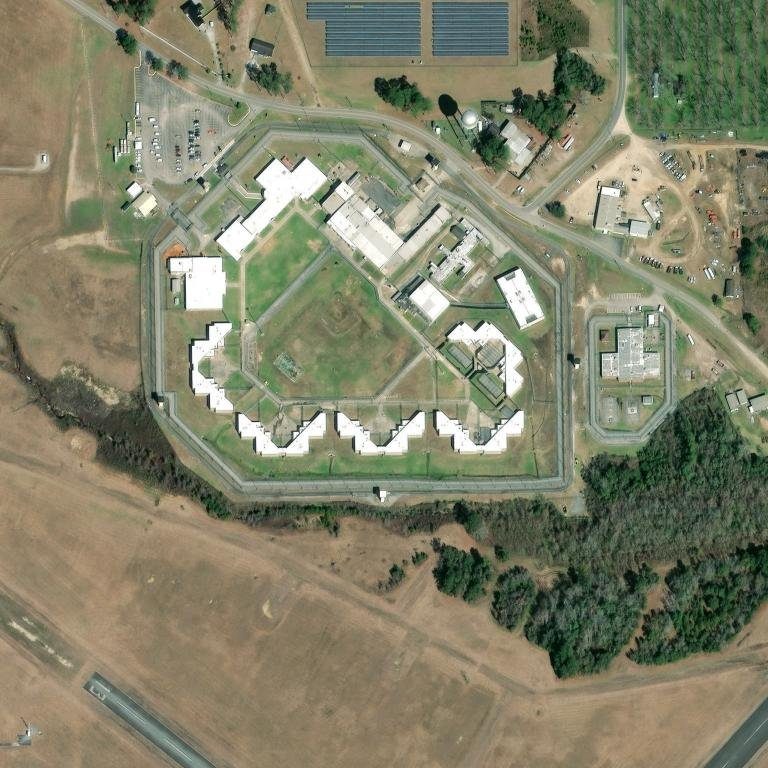
Architecture documents what the building was designed to hold. See the system-wide receipts at gps.press/warehouse.