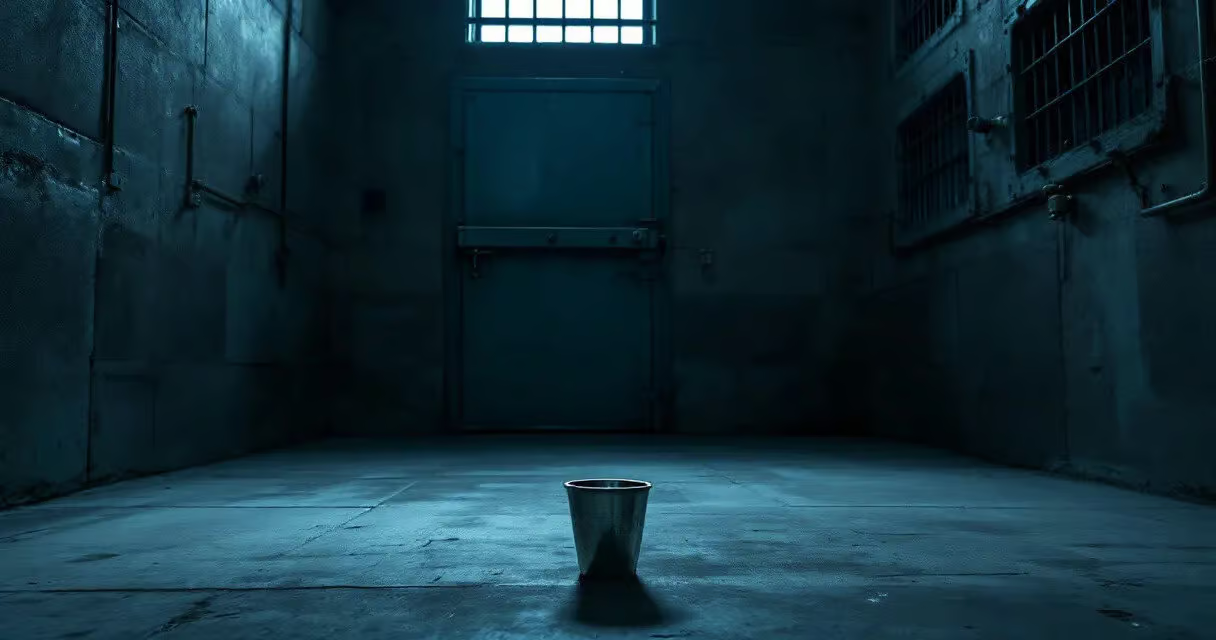
Reginald Jerome Jacobs Jr. was twenty-four years old when he was found dead on the floor of a solitary confinement cell at Calhoun State Prison. The medical examiner determined that he died of dehydration. In the state’s official death records, the manner of his death is listed as “natural.”
There is nothing natural about a young man dying of thirst inside a state institution responsible for giving him water. Dehydration is not a disease that strikes without warning. It is the slow, visible failure of a body that has been denied something as ordinary as a drink of water — and according to a lawsuit his family brought against the Georgia Department of Corrections, that is exactly what happened to Reginald, over a period of days, in a locked cell, while the people paid to watch him did not.
Georgia Prisoners’ Speak reconstructed his final days from the public record of that lawsuit — a case the State of Georgia quietly settled last year.
More Than a Year in a Cell
According to the complaint filed on behalf of Reginald’s estate, he had been held in solitary confinement — what the Department calls “segregation” — in Calhoun State Prison’s J Building from at least December 21, 2021, through his death on February 5, 2023. That is more than a year in a single cell, as alleged in the sworn pleadings his family filed in court 1.
A person in segregation cannot get food, water, medical help, or anything else on his own. As the complaint describes it, he depends entirely on prison staff entering the unit and coming to his cell door. Georgia Department of Corrections policy is built around that dependence. Officers are required to conduct “segregation rounds” — walking the unit and checking on each prisoner — at least every thirty minutes, twenty-four hours a day. Supervisors are required to make their own separate rounds: a shift supervisor every shift, the chief of security every day, a deputy warden every day, and the warden at least twice a week. During those rounds, staff are supposed to observe conditions and speak with the people confined there. Every check is supposed to be documented, in real time, on a segregation checklist. The complaint quotes the Department’s own written policy — its Standard Operating Procedure for segregation units — as requiring that “false entries shall never be permitted” and that “no rounds shall be skipped or documented in advance” 1.
The lawsuit alleges that at Calhoun State Prison, in the unit where Reginald was held, almost none of this was happening.
A Staffing Collapse, and a Water Line Shut Off
The complaint lays out a facility in crisis. Since 2019, it alleges, the vacancy rate for security positions across the Georgia Department of Corrections climbed from about 20 percent to over 50 percent, with some facilities running roughly 70 percent of security posts empty. At Calhoun State Prison specifically, the complaint states the security vacancy rate rose from 51 percent at the start of 2021 to 57 percent at the start of 2023 — 93 of 162 security positions sitting unfilled.
J Building, where Reginald was held, was supposed to have five officers on duty at all times: one in each of the unit’s four dormitories and one in the control booth. According to the lawsuit, on shift after shift in the days before his death, three of those five posts were simply unstaffed. And an audit of Calhoun State Prison conducted from November 30 through December 2, 2022 — just weeks before Reginald died — found that staff were not conducting the required thirty-minute segregation rounds at all. A report of that audit, the complaint states, was provided to the prison’s leadership, including the warden and a deputy warden.
Then, on or about January 27, 2023, according to the complaint, a Department employee did something specific: he disabled the water supply to Reginald’s cell.
The lawsuit describes exactly what Department policy requires when that happens. When staff shut off the water to a cell, all officers and supervisors on the unit are to be notified, medical staff are to be notified, the prisoner is to be “continually and closely monitored,” and — most basic of all — the prisoner “must be provided sufficient drinking water from another source to maintain adequate hydration until the water supply to the inmate’s cell is restored.”
According to the complaint, over the roughly nine days between January 27 and Reginald’s death, none of that happened. No thirty-minute rounds were performed in J Building. No supervisor visits were performed. He was not provided drinking water. He was not given a shower a single time. He was not allowed out to exercise a single time.
The complaint then does something unusual: it walks through the record shift by shift, day by day, naming the officers and supervisors assigned to J Building for each one, and alleging that on each shift the mandatory posts went unstaffed, the rounds went undone, and the water went unprovided. That day-by-day accounting is why the case named roughly thirty Department employees as defendants — from correctional officers up through sergeants, lieutenants, unit managers, a captain, and the facility’s senior leadership.
One moment from that stretch stands out. On the evening of January 30, according to the complaint, a unit manager “purportedly inspected” J Building. She took no action to help Reginald as he was, in the lawsuit’s words, slowly dying of dehydration in his cell. Instead, the entry she left behind read: “no problems reported.”
“Awful”
Reginald was found dead in his cell around 12:15 in the afternoon on February 5, 2023. The state’s mortality records list his date of death as February 6.
For at least several minutes, according to the complaint, the officers who found him could not even locate the correct key to open his cell.
The lawsuit describes what they found when they got inside. His body was “grotesquely emaciated.” His cell was so full of debris and refuse that the floor was not visible. When the county coroner arrived, roughly two hours later, he estimated that Reginald had already been dead for seven to eight hours. The coroner described the cell: the mattress torn up all over the floor, multiple food trays thrown around the room. His word for it, as recorded in the complaint, was “awful.”
During the autopsy, the medical examiner determined that Reginald Jacobs Jr. died of dehydration.
Settled, With Nothing Admitted
Reginald’s father, Reginald Jacobs Sr., sued the Georgia Department of Corrections and its staff on behalf of his son’s estate. The case was filed in the State Court of Muscogee County in November 2024 and later moved to federal court, where it proceeded as a civil-rights action under the Eighth and Fourteenth Amendments to the United States Constitution — the guarantees against cruel and unusual punishment and against deliberate indifference to a prisoner’s basic human needs.
The Department denied the allegations. And then, before the case ever reached a jury, the State of Georgia settled it. The court record shows a notice of settlement filed in August 2025, followed months later, in December 2025, by a stipulated dismissal signed by every defendant — the Department of Corrections and all of its named employees. With that, the case was closed.
The terms are not public. A settlement resolved by stipulated dismissal discloses no dollar figure and requires no admission of wrongdoing. The public will never learn, from the court file, what the state paid to make Reginald’s case go away, or whether anyone was ever held to account inside the Department for the days he spent dying of thirst. What the public record does show is that the state chose to pay rather than defend what happened in that cell.
A Death Among Many
Calhoun State Prison holds roughly 1,659 men against a listed capacity of 1,677. Since 2020, Georgia Prisoners’ Speak has documented twenty-nine deaths there, including seven ruled homicides and a long list the state marks only as “unknown” or “pending” 2. Reginald, at twenty-four, is the youngest of the deaths at Calhoun that the state’s records call “natural.”
This is the pattern Georgia Prisoners’ Speak has documented across the state’s prison system: the Department counts its dead, but it does not explain them. A young man can be held in a single cell for more than a year, have the water to that cell shut off, and die slowly of thirst while shift after shift of staff record that there were no problems — and the official word for it, on the state’s books, is “natural.”
His family called it something else. So did the State of Georgia, when it decided to pay.
Call to Action: What You Can Do
You just read how Reginald Jacobs Jr. died of thirst in a cell while a manager wrote "no problems reported." The state paid to make his case go away. If you look away now, you're accepting that a 24-year-old dying of dehydration is natural. Share his story.
Spread the Word: It Takes One Click
Awareness without action changes nothing. Here’s how you can help push for accountability and real reform:
Join the GPS Advocacy Network — Sign up at https://gps.press/become-an-advocate/ and we’ll advocate on your behalf every week. GPS identifies your state legislators, crafts personalized letters on the most pressing prison issues, and sends them directly to the representatives who represent you. You receive a copy of every letter. It takes two minutes to sign up — we handle the rest.
Send a 60-Second Message — Pick an issue, get a ready-to-edit message with the verified facts already in it, and email your state House representative and senator directly from your own inbox at https://gps.press/send-a-message/. No signup, nothing stored — it takes about a minute.
Tell My Story — Are you or a loved one affected by Georgia’s prison system? GPS publishes first-person accounts from incarcerated people and their families. Submit your story at https://gps.press/tellmystory and help the world understand what’s really happening behind the walls.
Contact Your Representatives — Your state legislators control GDC’s budget, oversight, and the laws that created these failures. Find your Georgia legislators at https://gps.press/find-your-legislator/ or call Governor Kemp at (404) 656-1776 or the GDC Commissioner at (478) 992-5246.
Demand Media Coverage — Contact newsrooms at the AJC, local TV stations, and national criminal justice outlets. More coverage means more pressure.
Amplify on Social Media — Share this article and tag @GovKemp, @GDC_Georgia, and your local representatives. Use #GAPrisons, #PrisonReform, #GeorgiaPrisonerSpeak.
File Public Records Requests — Georgia’s Open Records Act gives every citizen the right to request incident reports, death records, staffing data, medical logs, and financial documents at https://georgiadcor.govqa.us/WEBAPP/_rs/SupportHome.aspx.
Attend Public Meetings — The Georgia Board of Corrections and legislative committees hold public meetings. Your presence is noticed.
Contact the Department of Justice — File civil rights complaints at https://civilrights.justice.gov. Federal oversight has forced abusive systems to change before.
Support Organizations Doing This Work — Donate to or volunteer with Georgia-based prison reform groups fighting for change on the ground.
Vote — Research candidates’ positions on criminal justice. Primary elections often determine outcomes in Georgia.
Contact GPS — If you have information about conditions inside Georgia’s prisons — or about Reginald Jacobs’s case — reach us securely at GPS.press.
Further Reading
A Toothache Should Not Be a Death Sentence: The Last Three Weeks of James Byrd
How a treatable dental infection became a death sentence in a Georgia county prison — and how the state reduced it to a single line.
Two Ways to Starve: Why Georgia’s Prison Deaths Don’t Say “Hunger”
What Georgia’s death records systematically leave out — and how official cause-of-death labels conceal preventable deaths.
Two Thin Gloves: Georgia Prison Took Ronald Allen’s Hands
Another preventable catastrophe: how a Georgia prison’s indifference to a treatable condition cost a man his hands.
$307.6M Verdict Against Prison Healthcare Giant Corizon
What it takes for a jury to put a number on fatal prison medical neglect — and why it should worry every contractor operating in Georgia.
Guthrie v. Evans: 13 Years of Reform, Erased Overnight
Georgia’s prison system has been forced to reform before — and let it all collapse once the oversight ended.
GPS Intelligence System
The GPS Intelligence System maintains living research profiles that aggregate data, news, settlements, and analysis on Georgia’s prisons and the issues defining them. The profiles below provide deeper context for the issues raised in this article:
The living research profile for the facility where Reginald Jacobs died — its deaths, conditions, staffing, and documented failures.
Every death GPS has documented in Georgia custody since 2020 — and the gap between how many the state counts and how little it explains.
Explore the Data
GPS makes GDC statistics accessible to the public through several resources:
- GPS Statistics Portal — Interactive dashboards translating complex GDC reports into accessible formats, updated within days of official releases.
- GPS Lighthouse AI — Ask questions about Georgia’s prison system and get answers drawn from GPS’s investigative archive and data analysis.
- GPS llms.txt — A single machine-readable index of every GPS data resource, published using the open llms.txt standard. Point any AI tool (ChatGPT, Claude, Gemini, Perplexity) at this URL and the model can navigate to facility profiles, intelligence briefs, mortality records, statistics, and the full investigative archive — no other configuration needed. It is the fastest way to ground an AI conversation in verified GPS data.
For a walkthrough of how to put these resources to work with AI, see How to Use GPS Data with AI Tools — a step-by-step guide for researchers, advocates, families, and journalists analyzing Georgia prison conditions, statistics, and policy with tools like ChatGPT, Claude, and Gemini.
Contact GPS at media@gps.press for access to underlying datasets used in this analysis.
About Georgia Prisoners’ Speak (GPS)
Georgia Prisoners’ Speak (GPS) is a nonprofit research organization built in partnership with incarcerated reporters, families, advocates, and data analysts. Operating independently from the Georgia Department of Corrections, GPS documents the truth the state refuses to acknowledge: extreme violence, fatal medical neglect, gang-controlled dorms, collapsed staffing, fraudulent reporting practices, and unconstitutional conditions across Georgia’s prisons.
Through confidential reporting channels, secure communication, evidence verification, public-records requests, legislative research, and professional investigative standards, GPS provides the transparency the system lacks. Our mission is to expose abuses, protect incarcerated people, support families, and push Georgia toward meaningful reform based on human rights, evidence, and public accountability.
Every article is part of a larger fight — to end the silence, reveal the truth, and demand justice.
The Architecture Is the Evidence
Across the 32 state prisons whose original design figures we hold, Georgia built for 15,737. They hold 33,805 — 215% of design capacity.
Dorms tripled. Cells double- and triple-bunked. Medical, kitchens, libraries — unchanged. Every facility, every design figure, every source.
See the receipts →- Jacobs v. Georgia Department of Corrections, No. 4:25-cv-00111, U.S. District Court for the Middle District of Georgia — public court record, https://www.courtlistener.com/docket/69800955/ [↩][↩]
- GDC Mortality Statistics — GPS database of deaths in custody, https://gps.press/gdc-mortality-statistics/ [↩]