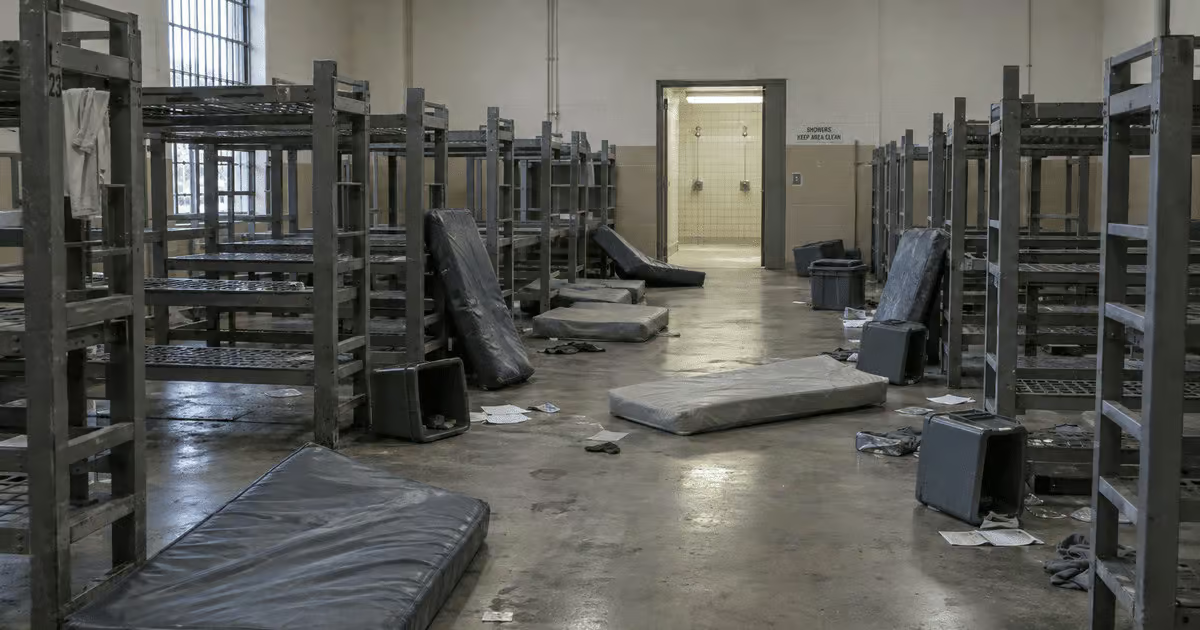
At about seven o’clock on the morning of Thursday, September 3, a tactical squad walked into F2 dorm at Wilcox State Prison in Abbeville and began turning it out. They stayed roughly five hours. When they left, around noon, the men who’d been searched were let out to shower. That’s when the attack began. By about two o’clock the Wilcox County coroner’s phone was ringing.1
The man who died was Maurice Antonio Brown. He was pronounced dead where he fell. The Department of Corrections named him the next afternoon: serving twenty-five years for kidnapping out of Fulton County, in custody since December 2009, maximum release date 2034.2 His body went to the GBI Crime Lab. The cause of death is still pending there.
The sequence above, squad in at seven, out at noon, showers, attack, comes from three separate accounts sent to GPS from inside Wilcox on the day of the killing and the day after. They agree on the times, the dorm, and the order of events. None of it appears in anything the Department has said. Its statement doesn’t mention a squad, a search, or the hour of noon.
What the Department did say was three things. Each is worth reading slowly.
The Three Phrases
The Department’s statement calls the killing an “altercation.” An altercation is a word for an argument. GDC used it for an event that put two men on a helicopter with life-threatening injuries, five more in ambulances, and one in the morgue.3
The statement says the fight is “believed to have been gang-related.” That is a sentence about what the Department knows. A department that believes a fight was gang-related is a department that knows which men in F2 belonged to which set. It houses those men. It decided who sleeps in that dorm.
And the statement says the violence was “contained to one dorm.” That phrase is offered as reassurance. It is the opposite. The violence was contained to one dorm because that is where the Department had put everyone involved, and where it left them, together, at noon, with the squad gone.
By its own statement, the Department knew the affiliations. It put those men in one room. Then it sent a squad through the room for five hours and walked away.
What the Policy Says a Squad Is For
Georgia’s operating procedure for its tactical squads runs four pages.4 It defines the squad as correctional officers “with additional duties at their assigned facility to assist with shakedowns, special details, and other emergency situations.” It says a squad “shall be activated during emergencies and for other purposes.”
Nearly all of the four pages are about the officers’ bodies. To serve on a facility squad, a member must do thirty sit-ups in a minute and twenty-one military push-ups in a minute, run four hundred meters in a hundred and twenty seconds, and drag a hundred-and-fifty-pound dummy fifteen meters. The regional interdiction teams must do twenty-five push-ups and run it in ninety. A member must score eighty percent with the shotgun and eighty percent with the rifle, and requalify every year. Eight hours of training a month.
That is the whole policy. It specifies how fast a squad member must run. It doesn’t contain a sentence about the dorm after the squad leaves it.
It says nothing about who is responsible for several hundred men who have just had their beds stripped and their property seized. Nothing about whether they are let out together or kept in. Nothing about what is supposed to happen at noon.
The Department has a four-page rule for who may carry the shotgun into F2. It has no rule for the hour after the shotgun leaves.
Two Days Before
One account, written from inside F2 and sent to GPS the night after the killing, describes the two days before it. GPS hasn’t been able to confirm its details independently, and the Department hasn’t addressed them. It’s set out here because it’s specific, because parts of it are corroborated by the other two accounts, and because nobody in authority has said it’s wrong.
According to that account, on the morning of Tuesday, September 1, a deputy warden came into F2 during inspection and gave a speech. A video shot in the dorm had gone viral on Facebook. He said he had already “made a call to the folks,” meaning the squad was coming. Before he left, the account says, he told the dorm: “give me two phones and I might let y’all keep y’all shit.”
Two phones were turned in. The men then went looking for the video themselves and found it. The person in it, and the person who recorded it, were both members of the same set: Piru, one of the sets that goes under the name Bloods. Their own set dealt with them that day, the account says, in the way sets do.
Wednesday night the dorm was locked down, which the account says almost never happens. The doors on F2 ordinarily stay open around the clock.
Thursday morning the squad came. The account puts the number at fifteen. They searched room to room asking to see faces, and they had a photograph of the man who’d recorded the video. Some rooms they went through hard. Others they skipped. When they found him they moved him out of his three-man cell and out of the dorm. Another account sent to GPS says the squad carried “two net bags of shanks” out of F2 that morning.
Then they left. And the men who had been searched were let out to shower.
The squad came for one man and took him. It took the phones and the knives it found. It left everything else exactly as it found it, minus the phones and the knives and one man, and with a dorm full of people who had spent five hours being turned out and now knew who had been taken and why.
Bloods Is Not a Gang
The Department’s statement stops at “gang-related.” That’s where the useful part begins.
Bloods is not one gang. It’s a name shared by many sets with their own leadership and their own quarrels, and a set is as likely to be at war with another Bloods set as with anyone else. Piru is one such set. The account from inside F2 describes the set enforcing its own rules on its own members two days before the killing.
So when the Department says it believes the fight was gang-related, the question it hasn’t answered is which affiliations it knew, and whether it treats “Bloods” as one thing when it decides who shares a dorm. A classification that lumps the sets together does not separate enemies. It concentrates them.
The Department hasn’t said how the men in F2 were housed relative to what it knew about them. Its statement runs to the word “gang-related” and stops.
None of this is a conclusion GPS reached on September 3. GPS published the argument on May 22 in Separate the Gangs. It Costs Nothing., and had by then been asking the Department in writing for fifteen months, since A Simple Message for the GDC in February 2025. The first of the nine reforms in that piece was one sentence: separate rival gangs from each other, and don’t house civilians where gangs can extort, assault or recruit them.
The reason that ask has never had a price attached is that it doesn’t have one. Moving rival sets into different dorms inside the same prison is a housing assignment. It is names on a roster, made by classification officers the State already employs and already pays. It isn’t construction and it isn’t hiring.
The Department has had that in writing for nineteen months. On September 3 the men in F2 were in one dorm.
The Count
The Department said nine men were hurt: two flown out with life-threatening injuries, five taken by ambulance, two treated at the prison. No staff.2
Four days later, an official told WALB that three inmates remained in hospital and eleven had been returned to the prison.5 That’s fourteen. The addition is GPS’s, done on the Department’s own two sets of numbers. Between Friday and Tuesday the injured grew by five, and nobody announced the revision.
On the staff, people inside agree with the Department. An early rumor that an officer had been stabbed was disputed the same day by a witness who told our source the officer had been having a panic attack, not bleeding.
Who Was Told
The family of one of the injured men spoke to WALB this week. His mother, Tihirah Johnson, and his sister, Rachelle Hale, say he was stabbed more than thirty times.5 They found out the day after, from a stranger on the phone. Then from more strangers, by text and by social media, none of whom would give a name. The prison told them it would call. It never did.
“The hospital wouldn’t give us information. The jail wouldn’t give us information. It was inmates who were empathetic enough to reach out for him, who were concerned enough, who found the human decency to reach out for him and risk their freedom.”
That’s the mother, to WALB. The people who told her that her son was alive were breaking a prison rule to do it.
The Department has a policy on this. It’s the media relations procedure, and it’s seventeen pages long.6 It lists what may not be released to a reporter, and item f on that list is the “identity of any critically injured or deceased person prior to notification of next of kin.” For a death, the same document says the name is “withheld until next of kin notified.”
Read what that policy governs. It governs what the Department tells reporters. It makes the family’s notification the gate on a press release. It doesn’t, anywhere in seventeen pages, require the Department to notify the family.
So the policy worked exactly as written. The Department never released the injured man’s name, which is consistent with never having told his mother. The name was withheld pending a notification that didn’t happen, and the rule was satisfied by the silence.
Maurice Brown’s name was released on Friday. By the Department’s own rule, that means his family had been told by then. His was the one death, and it got the one notification.
The Building
Wilcox State Prison was designed for five hundred men. The figure is the State’s own: the FY1989 budget authorized the Department to “design and construct a 500-cell correctional facility (maximum operating capacity 750 inmates).”7 That’s the same prototype as Dooly, Hancock, Macon, Calhoun, Autry, Johnson, Smith and Washington, nine buildings off one drawing.
The State’s September 2026 roster counts 1,831 people at Wilcox. That’s 366 percent of the number it was built to hold, and above even the 750 the planners called the maximum. It has 1,827 beds, so it’s also four people past its own bed count. Four hundred and ninety of the men there are serving life sentences, better than one in four.
A three-man cell is a room of about 97 square feet with the bunks stacked three high. GPS has scanned one in a Georgia prison, and you can look around inside it.
The Department didn’t fill a building for 500 with 1,831 men on its own. The General Assembly writes the sentences and the Parole Board decides who leaves, and GPS has shown how rarely it now says yes to the men serving life. What the Department owns is what happens to those men once they’re inside.
As of September 8, GPS has recorded 48 deaths at Wilcox since the start of 2020. The registry is a floor: it holds what GPS has been able to confirm, and it only ever goes up. Eight of the 48 were homicides. Thirteen men died there in 2025 alone. Brown is the sixth death recorded in 2026 and the second homicide.
Those are the numbers for the building the Department chose to put a tactical squad through for five hours and then leave.
What a Sweep Leaves
Here is what the squad took out of F2 on September 3: two phones, some knives, and one man.
Here is what it left: 1,831 people in a prison built for 500, in a dorm where the beds had just been stripped and the property gone through, where everyone now knew who had been taken and what for, with the doors about to open for showers, and nobody with a shotgun anywhere in the building.
The Department’s policy defines what a squad is for. Shakedowns, special details, emergencies. It doesn’t define what the Department owes the dorm when the squad is done, because the policy has no such section. There’s no counselor in it. No program. No officer assigned to the hour after.
GPS has documented this pattern before, at Pulaski, at Smith, at Baldwin. A squad arrives, seizes, humiliates, and departs, and the anger it stirs has nowhere to go but sideways, into the men left standing in the same room. The Department calls the result an altercation.
A four-page rule for the shotgun. No rule for noon.
The Department hasn’t said who decided to let F2 out to shower at midday on September 3, or what the squad had been sent to find, or how the men in that dorm were housed relative to what it says it knew about them. Its Office of Professional Standards is investigating. It’s been investigating homicides at Wilcox since 2022, and there have been eight.
Call to Action: What You Can Do
You just read that a squad left F2 at noon and the coroner was called at two. Maurice Brown's family got the one notification. The mother of a man stabbed 30 times learned from strangers on the phone. If you don't share this, the silence you just read about wins. Send it to one person who needs to see it.
Spread the Word: It Takes One Click
Awareness without action changes nothing. Here’s how you can help push for accountability and real reform:
Join the GPS Advocacy Network: Sign up at https://gps.press/become-an-advocate/ and we’ll advocate on your behalf every week. GPS identifies your state legislators, crafts personalized letters on the most pressing prison issues, and sends them directly to the representatives who represent you. You receive a copy of every letter. It takes two minutes to sign up, and we handle the rest.
Send a 60-Second Message: Pick an issue, get a ready-to-edit message with the verified facts already in it, and email your state House representative and senator directly from your own inbox at https://gps.press/send-a-message/. No signup, nothing stored. It takes about a minute.
Tell My Story: Are you or a loved one affected by Georgia’s prison system? GPS publishes first-person accounts from incarcerated people and their families. Submit your story at https://gps.press/tellmystory and help the world understand what’s really happening behind the walls.
Contact Your Representatives: Your state legislators control GDC’s budget, oversight, and the laws that created these failures. Find your Georgia legislators at https://gps.press/find-your-legislator/ or call Governor Kemp at (404) 656-1776 or the GDC Commissioner at (478) 992-5246.
Demand Media Coverage: Contact newsrooms at the AJC, local TV stations, and national criminal justice outlets. More coverage means more pressure.
Amplify on Social Media: Share this article and tag @GovKemp, @GDC_Georgia, and your local representatives. Use #GAPrisons, #PrisonReform, #GeorgiaPrisonerSpeak.
Message the Board of Corrections: The citizen board that oversees the GDC publishes no contact details for its members. GPS built the missing front door: pick a board member and a policy message and send it from your own email at https://gps.press/write-the-board/.
File Public Records Requests: Georgia’s Open Records Act gives every citizen the right to request incident reports, death records, staffing data, medical logs, and financial documents. Start with the GPS Action Toolkits at https://gps.press/toolkits/. The Open Records Toolkit walks you through what to ask for, gives you ready-to-file request templates, and tells you what to do when the state says no. File directly with GDC at https://georgiadcor.govqa.us/WEBAPP/_rs/SupportHome.aspx.
Attend Public Meetings: The Georgia Board of Corrections and legislative committees hold public meetings. Your presence is noticed.
Contact the Department of Justice: File civil rights complaints at https://civilrights.justice.gov. Federal oversight has forced abusive systems to change before.
Support Organizations Doing This Work: Donate to or volunteer with Georgia-based prison reform groups fighting for change on the ground.
Vote: Research candidates’ positions on criminal justice. Primary elections often determine outcomes in Georgia.
Contact GPS: If you have family at Wilcox and have heard from them since September 3, or if you have information about conditions inside Georgia’s prisons, reach us securely at https://gps.press/submit-a-report/.
Part of Something Bigger
This article is part of the GPS Reform Agenda, two active campaigns to transform Georgia’s criminal justice system.
End the Warehouse THIS SERIES
Transform Georgia’s prisons from punishment to rehabilitation. Two tracks: litigation to reduce overcrowding + evidence-based programs that work.
Three model bills for the 2027 Georgia legislature. The legislature doesn’t need new laws. It needs to enforce two dormant statutes it already passed.
Read the full GPS Reform Agenda →
Further Reading
A killing the officers were told was coming, and the federal complaint that followed.
The State’s own death investigation into a man locked in a shower at Washington State Prison, read in its own words.
Pulaski State Prison Crisis: Untested Warden, Deadly History
How the same Dooly-prototype building at Pulaski became one of the deadliest in the system.
Invisible Scars: Cycle of Retaliation and Abuse in Georgia Prisons
What a tactical squad sweep does to a dorm, and what follows it, from the people who live through them.
When the state stops telling families anything, the men inside become the only ones who will.
The Board That Stopped Saying Yes: Georgia’s Lifer Parole Collapse, in Its Own Numbers
Why one in four men at Wilcox is serving life, in the Parole Board’s own figures.
Separate the Gangs. It Costs Nothing. Georgia Keeps Choosing the Bodies.
The reform GPS has asked for in writing since February 2025, and what it would cost the State to do it.
GPS Intelligence System
The GPS Intelligence System maintains living research profiles that aggregate data, news, settlements, and analysis on Georgia’s prisons and the issues defining them. The profiles below provide deeper context for the issues raised in this article:
Wilcox State Prison Intelligence Profile
Every death, incident, lawsuit and inspection GPS has recorded at Wilcox, in one living record.
The system-wide record of homicide and assault in GDC custody, and what the Department has said about each.
Explore the Data
GPS makes GDC statistics accessible to the public through several resources:
- GPS Statistics Portal: Interactive dashboards translating complex GDC reports into accessible formats, updated within days of official releases.
- GPS Lighthouse AI: Ask questions about Georgia’s prison system and get answers drawn from GPS’s investigative archive and data analysis.
- GPS llms.txt: A single machine-readable index of every GPS data resource, published using the open llms.txt standard. Point any AI tool (ChatGPT, Claude, Gemini, Perplexity) at this URL and the model can navigate to facility profiles, intelligence briefs, mortality records, statistics, and the full investigative archive, with no other configuration needed. It is the fastest way to ground an AI conversation in verified GPS data.
- GPS Public MCP Server: For AI tools that support the Model Context Protocol (Claude, ChatGPT, and others), connect directly to GPS’s data: read-only tools covering population, facilities, mortality, parole, the Georgia Code, settlements, and more. Every answer arrives with its source link and citation built in.
For a walkthrough of how to put these resources to work with AI, see How to Use GPS Data with AI Tools: a step-by-step guide for researchers, advocates, families, and journalists analyzing Georgia prison conditions, statistics, and policy with tools like ChatGPT, Claude, and Gemini.
Contact GPS at media@gps.press for access to underlying datasets used in this analysis.
About Georgia Prisoners’ Speak (GPS)
Georgia Prisoners’ Speak (GPS) is a nonprofit research organization built in partnership with incarcerated reporters, families, advocates, and data analysts. Operating independently from the Georgia Department of Corrections, GPS documents the truth the state refuses to acknowledge: extreme violence, fatal medical neglect, gang-controlled dorms, collapsed staffing, fraudulent reporting practices, and unconstitutional conditions across Georgia’s prisons.
Through confidential reporting channels, secure communication, evidence verification, public-records requests, legislative research, and professional investigative standards, GPS provides the transparency the system lacks. Our mission is to expose abuses, protect incarcerated people, support families, and push Georgia toward meaningful reform based on human rights, evidence, and public accountability.
Every article is part of a larger fight: to end the silence, reveal the truth, and demand justice.
The Architecture Is the Evidence
Across the 32 state prisons whose original design figures we hold, Georgia built for 15,737. They hold 33,805 — 215% of design capacity.
Dorms tripled. Cells double- and triple-bunked. Medical, kitchens, libraries — unchanged. Every facility, every design figure, every source.
See the receipts →- WGXA, Inmate dead and several others injured during altercation at Wilcox State Prison, September 3 2026, https://wgxa.tv/news/local/inmate-dead-several-others-injured-during-altercation-at-all-male-wilcox-state-prison-per-wilcox-county-coroner-janice-brown-abbeville-male-inmate-killed-dies-in-physical-altercation-gdc-investigation-gbi-crime-lab-georgia-prison-deaths [↩]
- 13WMAZ, GDC identifies dead inmate after gang-related fight at Wilcox State Prison and nine other inmates injured, September 4 2026, https://www.13wmaz.com/article/news/local/inmate-identified-fatal-fight-at-wilcox-state-prison-nine-other-inmates-injured-gdc-says/93-a8a2cf6a-dc1e-457c-a377-dac6fb112166 [↩][↩]
- 41NBC, Inmate dies after gang-related altercation at Wilcox State Prison, September 4 2026, https://www.41nbc.com/wilcox-state-prison-inmate-death-gang-related-altercation/ [↩]
- GDC SOP 205.13 Tactical Squad Standards and Selection, effective April 22 2025, https://public.powerdms.com/GADOC/documents/106048 [↩]
- WALB, Georgia family left in the dark after loved one allegedly stabbed over 30 times in Wilcox State Prison fight, September 8 2026, https://www.walb.com/2026/09/08/georgia-family-left-dark-after-loved-one-allegedly-stabbed-over-30-times-wilcox-state-prison-fight/ [↩][↩]
- GDC SOP 102.01 Media Relations, effective July 14 2022, https://public.powerdms.com/GADOC/documents/105670 [↩]
- State of Georgia Budget Report Fiscal Year 1989 and Capital Budget, Office of Planning and Budget, held by the Digital Library of Georgia, https://dlg.usg.edu/record/dlg_ggpd_y-ga-bg620-b-ps1-bb8-b1989-bfolio [↩]