WILCOX STATE PRISON
Facility Information
- Original Design Capacity
- 500 (at 368% capacity)
- Bed Capacity
- 1,827 beds
- Current Population
- 1,841
- Active Lifers
- 494 (26.8% of population) · Oct 2026 GDC report
What the courts held in Brown v. Plata, and how Georgia compares →
- Address
- 470 South Broad Street, Abbeville, GA 31001
- Phone
- (229) 467-3000
- Fax
- (229) 467-2380
- Mailing Address
- P.O. Box 397, Abbeville, GA 31001
- County
- Wilcox County
- Opened
- 1993
- Operator
- GDC (Georgia Dept. of Corrections)
Security Classification
Last updated: September 23, 2026
694 of the 1,824 people held here are classified Close security (38.0%), as of September 23, 2026.
| Security level | People | Share |
|---|---|---|
| Close | 694 | 38.0% |
| Medium | 1,090 | 59.8% |
| Minimum | 40 | 2.2% |
| Total | 1,824 |
Earlier count (undated table, produced October 22, 2025): 545 of 1,835 Close (29.7%).
Source: Georgia Department of Corrections records produced to GPS under the Open Records Act (R031471-090226, R024615-101925). A person's security level is GDC's classification of that person, which can differ from the prison's own designation.
Follow Wilcox State Prison
Leadership & Accountability (as of 2026 records)
Officials currently holding positional authority at this facility, with deaths attributed to GPS-tracked records during their leadership tenure. Inclusion reflects role-based accountability, not legal findings of personal culpability. Death counts shown as facility / career.
| Role | Name | Since | Deaths this facility / career |
|---|---|---|---|
| Warden (facility lead) | Thomas, Micheal | 2025-07-16 | 9 / 12 |
| Deputy Warden of Administration (facility deputy) | Jones, Latorsha T | 2020-01-01 | 43 / 43 |
| Deputy Warden of Security (facility deputy) | Bryant, Talithia N | 2023-11-22 | 23 / 23 |
| Deputy Warden of Care and Treatment (facility deputy) | Jackson, Tracey Catina | 2026-03-16 | 3 / 3 |
| Deputy Warden of Security (facility deputy) | Kellom, Jimmy J | 2026-05-01 | 2 / 2 |
About
Last updated October 25, 2026.(DS)
Wilcox State Prison: A Medium-Security Prison Run Like Something Else
Wilcox State Prison sits on the edge of Abbeville in Wilcox County, a medium-security facility for adult men that opened in 1993 and was built to hold 500 people. It now holds 1,841 against a rated capacity of 1,827 — 100.8 percent of rated capacity, and more than three and a half times its original design. Housing consists of multiple dormitory and cell units, along with segregation for disciplinary and protective custody cases. Wilcox serves as a major general-population hub for medium-custody prisoners, providing work details, basic education, and limited vocational programs. Micheal Thomas has served as warden since July 2025.
What follows is an attempt to read the facility's public record as a single story: the deaths GPS has recorded there, the gang violence that has repeatedly produced them, the contraband economy that runs through the prison, the classification drift that GPS's own reporting has documented at Wilcox and three other medium-security prisons, and the infrastructure and sanitation failures that compound all of it. The through-line is not any one incident. It is the gap between what the facility is rated to be and what the record shows it has become.
Forty-Eight Deaths, and the Nine That Were Homicides
GPS's mortality registry records 48 deaths at Wilcox State Prison since January 1, 2020 — a figure that is a floor, not a ceiling, because GDC reports deaths roughly two months late. The full list is maintained at GPS's facility death registry. The distribution by year tells its own story: six deaths in 2020, five in 2021, four in 2022, five in 2023, then nine in 2024, thirteen in 2025, and six in the first nine months of 2026.
By cause, the registry records 20 deaths as Natural/Medical, nine as Overdose, nine as Homicide, four as Suicide, four as Unknown/Pending, one as Accident, and one as Medical Neglect. The nine homicides are the analytical center of any account of this prison.
The most recent 25 people on that registry, as GPS holds them:
- Maurice Antonio Brown died September 3, 2026, at Wilcox State Prison; GPS's registry lists the cause as Homicide.
- Gary Dwayne Felver died June 15, 2026, at Wilcox State Prison, age 65; the cause is listed as Unknown/Pending.
- Earnest Sims died March 16, 2026, at Wilcox State Prison, age 44; the cause is listed as Unknown/Pending.
- Jeremy Cole Watson died March 9, 2026, at Wilcox State Prison, age 37; the cause is listed as Unknown/Pending.
- Deon Khalil Vanzyre died January 16, 2026, at Wilcox State Prison, age 28; the cause is listed as Suicide.
- Marcus Walker died January 10, 2026, at Wilcox State Prison, age 20; the cause is listed as Homicide.
- Willie Thomas Mosley died December 1, 2025, at Wilcox State Prison, age 63; the cause is listed as Natural/Medical.
- Stacy Ray Bullard died November 8, 2025, at Wilcox State Prison, age 54; the cause is listed as Overdose.
- Collis Jr Welch died November 7, 2025, at Wilcox State Prison, age 55; the cause is listed as Overdose.
- Harold Stanley Hester died July 10, 2025, at Wilcox State Prison, age 78; the cause is listed as Natural/Medical.
- Ian Rashod Henry died June 22, 2025, at Wilcox State Prison, age 29; the cause is listed as Homicide.
- Dominique Cornelius Cole died June 8, 2025, at Wilcox State Prison, age 37; the cause is listed as Homicide.
- Terry Alan Roper died June 6, 2025, at Wilcox State Prison, age 70; the cause is listed as Natural/Medical.
- Roy Lee Gates died May 16, 2025, at Wilcox State Prison, age 39; the cause is listed as Natural/Medical.
- Thomas Leonardo Schwartz died May 14, 2025, at Wilcox State Prison, age 59; the cause is listed as Natural/Medical.
- Darrius Jerrod Zanders died May 5, 2025, at Wilcox State Prison, age 33; the cause is listed as Suicide.
- Daylyne Collins died April 20, 2025, at Wilcox State Prison, age 30; the cause is listed as Homicide.
- Raymond Trey Moody died March 11, 2025, at Wilcox State Prison, age 37; the cause is listed as Unknown/Pending.
- Keith Wingo died January 16, 2025, at Wilcox State Prison; the cause is listed as Natural/Medical.
- James Edward Hogan died December 10, 2024, at Wilcox State Prison, age 32; the cause is listed as Overdose.
- Rodney Hurley died November 9, 2024, at Wilcox State Prison, age 56; the cause is listed as Natural/Medical.
- George Luis Morales died October 28, 2024, at Wilcox State Prison, age 75; the cause is listed as Natural/Medical.
- Alexander S Grimes died October 9, 2024, at Wilcox State Prison, age 44; the cause is listed as Overdose.
- Rodney Whatley died October 5, 2024, at Wilcox State Prison, age 54; the cause is listed as Homicide.
- Mariol Juante Rawls died August 27, 2024, at Wilcox State Prison, age 41; the cause is listed as Homicide.
Where the registry shows Unknown/Pending, GPS does not yet know the cause, and this page does not guess at one.
The Stabbing of Mariol Rawls and the Shape of a Gang Killing
The Atlanta Journal-Constitution's homicide tracking gives the Rawls case its detail: Mariol Rawls, 41, was stabbed repeatedly with a 12-inch blade by at least eight men described as validated gang members at Wilcox State Prison in late August 2024, and at least eight men have been charged with murder. The AJC's incident-report data shows nine offenders involved and a homemade weapon.
The same outlet documented a second Wilcox homicide in the same summer: Arthur Williams, 55, died July 18, 2024, in a killing the incident data records as involving two inmates. GPS's registry lists Arthur Jerome Williams, age 55, died July 19, 2024, at Wilcox State Prison, cause Homicide.
These are not isolated. The AJC reported that in just the first six months of 2025, the Georgia Department of Corrections was investigating 42 deaths as possible homicides — nearly two-thirds of the 66 suspected prison homicides investigated in all of 2024. Wilcox's own 2025 homicide count in GPS's registry is three: Daylyne Collins in April, Dominique Cole in June, and Ian Henry in June.
Dominique Cole, Two Months From Release
Dominique Cole was killed by another prisoner at Wilcox State Prison two months before his release date, the Atlanta Journal-Constitution reported. He had been serving time for more than two years for a probation violation. GPS's registry records Dominique Cornelius Cole, age 37, died June 8, 2025, at Wilcox State Prison, cause Homicide.
The AJC's reporting on Cole's death describes what happened to his family afterward: the warden promised Cole's family a follow-up call with details about his death that never came, and the prison failed to return Cole's belongings, including his wallet and Social Security card. Cole, according to the same reporting, had allegedly told his family that guards at Wilcox State Prison were tied to gangs, with gang members even signing off on actions for the guards. That is the family's account as the AJC reported it, not a finding of this page.
September 3, 2026: The F2 Dorm Shakedown and the Death of Maurice Brown
The most recent homicide in GPS's registry is Maurice Antonio Brown, who died September 3, 2026, at Wilcox State Prison. GDC's account, as carried in news reporting, is that an inmate died and several others were injured following an altercation involving multiple inmates at the facility that day — a fight GDC described as gang-related. Seven inmates were taken to hospitals, including two who were airlifted, while two others with minor injuries were treated on-site. No staff were injured. Brown's body was sent to the Georgia Bureau of Investigation Crime Lab to determine official cause of death, and GDC's Office of Professional Standards opened an investigation.
GPS's own reporting on the sequence describes a tactical squad entering F2 dormitory around seven in the morning on Thursday, September 3, and searching it for roughly five hours. When the squad left around noon, the men who had been searched were let out to shower. It was then, per that account, that the attack began; by two in the afternoon the Wilcox County coroner's phone was ringing. GPS's reporting notes that GDC's own policies run four pages on the tactical squad and have no page for the hour after it leaves.
The facility was placed on lockdown until further notice, according to GDC officials. A former GDC officer, Tyler Ryals, wrote on Facebook on September 3, 2026, that he was re-sharing his earlier commentary "in light of what's happening at Wilcox State Prison today (major stabbing with life flights and possible fatalities)." In the days that followed, family members posted publicly under coverage of the death: Jeffrey Bo Scott wrote on September 6 that the inmate murdered "is my nephew MAURICE"; Christina Marie Mendez Paulette asked on September 4 for the name of the person killed because her son was in the prison; Kelci Stanley wrote that she had just gotten off the phone with her brother, who said they were on lockdown. Mike Bunn, writing on September 4, recalled being there in 2007 "when they put 3 men in a 1 men in a cell built for 1 man. Absolute chaos." Judy Chamlee wrote that her son had been in GDC five years with "no detail no classes rarely a yard call it's taking a toll on his health mental and physical." These are public posts by named individuals — their accounts, not findings of this page.
GPS records show that in September 2026 alone, eight distinct sources reported assault by another incarcerated person at this facility, and eight reported a death in custody — the month in which the Brown death and its aftermath sit.
Nine Hospitalized, and a Pattern of Gang Fights
The September 2026 killing was not the first mass-casualty fight at Wilcox. The Atlanta Journal-Constitution reported that nine inmates were sent to the hospital with stab wounds after a gang fight at Wilcox State Prison in early 2025. Separately, the AJC reported that two weeks before a major incident at Telfair State Prison, a gang-related fight at Wilcox State Prison killed one inmate and injured nine others.
GPS's own coverage carried the headline "Nine people hospitalized after gang fight at Wilcox State Prison." The recurring shape — a gang-aligned fight, multiple stabbings, several hospitalizations, occasionally a death — is the facility's dominant violence signature in the public record.
Classification Drift: A Medium-Security Prison Holding Close-Security Men
GPS's reporting has documented that Georgia has packed four medium-security prisons — Dooly, Wilcox, Calhoun, and Washington State Prisons — with close-security inmates at rates up to 10 times higher than other facilities, producing homicide rates four to five times higher than properly classified prisons. GPS obtained data showing those four facilities housing 28–30 percent close-security populations. The U.S. Department of Justice found all four facilities in violation of the Eighth Amendment. GDC's response, per that reporting, was to stop reporting causes of death.
The arithmetic at Wilcox is stark on its face: a prison built for 500, rated for 1,827, and holding 1,841. GPS's reporting has described GDC packing close-security men into single-man cells that hold three at these four prisons. A separate GPS analysis of GDC's own October 27, 2025 security-level data described medium-security prisons functioning like high-security facilities — systemic classification drift that GPS treats as a driver of the state's prison homicide rate.
Contraband, and the Staff Named in It
GPS's analysis of contraband incidents found that Wilcox State Prison ranks third among GDC facilities for incidents in which a staff-class person is named — 26 staff-class people across 131 incidents, behind Dooly State Prison (29 staff-class people in 77 incidents) and Calhoun State Prison (28 in 159 incidents), and ahead of Valdosta, Telfair, and Smith.
That finding sits against a broader record. The Atlanta Journal-Constitution reported that hundreds of GDC employees have been arrested and fired for smuggling drugs and other contraband into prisons. And the AJC reported that the U.S. Department of Justice found Georgia's gang-run prisons riddled with regular violence and sexual assault — a findings letter, issued in October 2024, that concluded GDC's leadership had "lost control of its facilities."
GPS's systemic reporting treats staffing collapse and gang assumption of facility control as the integrated structural finding behind per-facility violence. Officer vacancies in Georgia's prisons have run between 49.3 and 60 percent systemwide for multiple years against a national standard of no more than 10 percent; the hiring pipeline cannot close the gap, with an acceptance rate under 15 percent and 82.7 percent of new hires leaving in their first year; and Georgia ranks last of 50 states for correctional-officer pay. Approximately 31 percent of the system's roughly 49,000 incarcerated people are validated members of 315 different security threat groups — more than double the national average.
Heat, Water, Mold, and the Infrastructure Underneath
GPS has received recurring reports from inside Wilcox about heat in the dormitories, with inside temperatures described as routinely in the 90s, no cold water available, and staff stating that the ice machine is broken. GPS has also received accounts describing black mold in the facility's showers that was painted over rather than remediated, and reports that staff prepare for inspections by cleaning and painting over problem areas. GPS has received accounts of concern about the facility's water supply, and of outside utility crews digging at multiple locations on the grounds. These are accounts GPS has received; they are not findings of this page.
What GPS has documented systemwide is the infrastructure picture they fit into: most GDC facilities are 30 to 40-plus years old, with documented patterns of deferred maintenance producing broken cell-door locks, inoperative surveillance and fire-alarm systems, mold and water failures, broken kitchen sanitization equipment, and pest infestations. The DOJ's October 2024 findings, the Guidehouse 2024 assessment, and Commissioner Oliver's public "end of life" statements all corroborate that pattern. GPS treats infrastructure collapse as a force multiplier for the violence, classification, and mortality crises documented at the facility level.
On food, GPS has documented that GDC spends approximately $1.69 per person per day (2024) and has proposed $1.60 per day in FY27 — under 60 cents per meal — against the FDA Thrifty Food Plan estimate of roughly $10 per day for an adult man's nutritionally adequate diet. The Marshall Project independently reported on May 16, 2026, on rats in kitchens, insects in food, moldy trays, and visible malnutrition across Georgia facilities.
Settlements: What the State Has Paid
Georgia's own risk-management settlement ledger, obtained through open records, records six liability payouts tied to Wilcox State Prison:
- James Wheeler — $750,000, incident dated October 29, 2017.
- Jimmy Lucero — $550,000, incident dated June 29, 2016.
- Toddrick Hunter — $50,000, incident dated August 31, 2013.
- Ricky Johnson — $48,242, incident dated October 12, 2016.
- Barrington Morrison — $13,000, incident dated July 3, 2023.
- Jeffrey Ray — $2,000, incident dated October 31, 2016.
The Wheeler settlement is the largest and the one with the most public documentation. The Atlanta Journal-Constitution reported that officials failed to recognize James Wheeler's mental health disease despite his history of self-harm and placed him in solitary confinement, where he was found hanging. GPS's registry separately records four suicides at Wilcox since 2020: Darrius Jerrod Zanders (May 5, 2025, age 33) and Deon Khalil Vanzyre (January 16, 2026, age 28) among the recent 25, with two earlier in the registry period.
What Families Report, and Where It Goes
GPS records show a sustained volume of family-safety-concern signals at this facility over the past twelve months — seven distinct sources across four months, at critical and moderate severity — alongside five sources reporting family fear for life, and five external complaints filed to bodies including the GDC Ombudsman, the Georgia Bureau of Investigation, the Southern Center for Human Rights, the Federal Defender Program, the Georgia State Senate, and the U.S. Department of Justice.
GPS records also show six sources reporting grievance obstruction at Wilcox over three months, and seven reporting due-process violations across four months. These are patterns, not individual cases: GPS receives reports and waits for corroborating evidence to surface.
The public record of family experience at Wilcox includes the AJC's account of the warden's unfulfilled promise to Cole's family. It also includes the public Facebook posts from September 2026 — a mother asking which man had been killed because her son was inside, a sister relaying a lockdown from a phone call, a former resident recalling triple-celling in 2007. None of these is a finding. Together they describe what it is like to be on the outside of a prison that has recorded 48 deaths in six and a half years.
A Note on the Wider System
Wilcox does not sit alone in this record. GPS has independently tracked 1,918 deaths in GDC custody systemwide since 2020 — a floor, since GDC reports deaths roughly two months late. The Georgia Legislature approved $434 million in new funding for the Georgia Department of Corrections for the current fiscal year, and around $200 million in new spending for Fiscal Year 2026, to address staffing vacancies and facility operations, the Atlanta Journal-Constitution reported.
Whether that money reaches the conditions described on this page is the open question. What the record shows at Wilcox is a prison rated for 1,827 and holding 1,841, built for 500, with nine homicides in its registry since 2020, a contraband problem in which staff are repeatedly named, a classification profile GPS's reporting places among the four most drifted medium-security prisons in the state, and a family-information pipeline that, by the AJC's account of one death, simply stopped answering.
Sources
This analysis draws on the Atlanta Journal-Constitution's homicide tracking and investigative reporting on Georgia prisons; GDC statements carried in news coverage of the September 3, 2026 incident at Wilcox; Georgia Department of Public Health and DOAS Risk Management settlement records obtained through open records; the U.S. Department of Justice's October 2024 findings letter on Georgia prisons; GPS's mortality registry and intelligence records; GPS's own investigative reporting on classification drift, contraband and staff involvement, infrastructure, and food service; Georgia Prisoners' Speak — Tell My Story; and public Facebook posts by named individuals, cited as their accounts.
Mortality Statistics
52 deaths documented at this facility from 2020 to present.
Deaths by Year
- 2026: 10
- 2025: 13
- 2024: 9
- 2023: 5
- 2022: 4
- 2021: 5
- 2020: 6
County Public Health Department
Food service and sanitation at WILCOX STATE PRISON fall under the jurisdiction of the Wilcox County Environmental Health Department. Incarcerated people cannot choose where they eat — public health inspectors carry an elevated responsibility to hold this kitchen to the same standards applied to any restaurant.
Contact
- Title
- Environmental Health Director
- Address
-
1001 Second Avenue
Rochelle, GA 31079 - Phone
- (229) 365-2310
- wilcox.eh@dph.ga.gov
- Website
- Visit department website →
Why this matters
GPS has documented black mold on chow-hall ceilings, cold and contaminated trays, spoiled milk, and pest contamination at Georgia prisons. The Department of Justice's 2024 report confirmed deaths from dehydration and untreated diabetes tied to food and water deprivation. Advance-notice inspections let facilities stage temporary fixes that disappear once inspectors leave.
Unannounced inspections by the county health department are one of the few outside checks on kitchen conditions behind the fence.
How you can help
Write to the county inspector and request an unannounced inspection of the kitchen and food service operation at this facility. A short, respectful letter citing Georgia food-safety regulations is more powerful than you think — inspectors respond to public concern.
Sample Letter
This is the letter Georgia Prisoners' Speak mailed to all county environmental health inspectors responsible for GDC facilities. Feel free to adapt it.
October 26, 2026
RE: Request for Unannounced Public Health Inspection of Food Service Operations at WILCOX STATE PRISON
Dear County Environmental Health Director,
I am writing to respectfully request that your office conduct a thorough, unannounced inspection of food service and sanitation practices at WILCOX STATE PRISON, located in Wilcox County.
Documented concerns
Georgia Prisoners' Speak, a 501(c)(3) nonprofit investigative newsroom, has published extensive investigative reporting on food safety and nutrition failures across Georgia's prison system, including:
- Dangerous sanitation conditions — black mold on chow hall ceilings and air vents, contaminated food trays, and spoiled milk served to inmates.
- Severe nutritional deficiency — roughly 60 cents per meal; inmates receive only 40% of required protein and less than one serving of vegetables per day.
- Preventable deaths — the U.S. Department of Justice's 2024 report confirmed deaths from dehydration, renal failure, and untreated diabetes following food and water deprivation.
- Staged compliance — advance-notice inspections allow facilities to stage temporary improvements, then revert once inspectors leave.
Firsthand testimony
In Surviving on Scraps: Ten Years of Prison Food in Georgia, a person who has spent more than ten years in GDC custody describes no functional dishwashing sanitation, chronic mold on food trays, and roaches found on the undersides of trays at intake facilities. Full account: gps.press/surviving-on-scraps-ten-years-of-prison-food-in-georgia.
Specific requests
- Conduct an unannounced inspection of the kitchen and food service operations at this facility, with particular attention to dishwashing equipment, tray sanitation procedures, and food storage conditions.
- Evaluate compliance with applicable Georgia food safety regulations, including O.C.G.A. § 26-2-370 and the Georgia Food Service Rules and Regulations (Chapter 511-6-1).
- Verify permit status and confirm whether the facility is subject to the same inspection schedule as other institutional food service establishments in the county.
- Make inspection results available to the public, as permitted under Georgia's Open Records Act (O.C.G.A. § 50-18-70).
Incarcerated individuals cannot advocate for their own health and safety in the way a restaurant patron can — they cannot choose to eat elsewhere. This places an elevated responsibility on public health officials to ensure these facilities meet the same sanitation standards applied to any food service establishment.
Thank you for your attention to this important public health matter.
Sincerely,
[Your name]
Food Safety Inspections
No inspection records are on file with the Georgia Department of Public Health for this facility. GPS has filed an open records request asking where these records are maintained.
What the score doesn't measure. DPH grades kitchen compliance on inspection day — food storage, temperatures, pest control. It does not grade whether today's trays are clean. GPS reporting has found broken dishwashers at most Georgia state prisons we've documented; trays go out wet, stacked, and visibly moldy — including at facilities with recent scores near 100.
Who inspects. Most Georgia state prisons sit in rural counties — often with fewer than 20,000 people, several with fewer than 10,000. The environmental health inspector lives in that community and often knows the kitchen staff personally. Rural inspection regimes don't have the structural independence you'd expect in a city-sized health department. Read the scores accordingly.
Read the investigation: “Dunked, Stacked and Served: Why Georgia Prison Trays Are Making People Sick”
Recent reports (14)
Source-attributed observations and allegations from news coverage and reports submitted to GPS. Each entry credits its source.
- ALLEGATION According to Facebook (public post) Recorded by GPS: May 12, 2026Public Facebook post (author unknown) alleges that Wilcox State Prison under Warden Micheal Thomas locks down inmate movement when senior staff (Warden, DW, DWA, DWCT, counselors) hold on-clock gatherings on state property, described as the 6th such event this year including Mother's Day and staff-appreciation gatherings. The poster further alleges that basic inmate-supply issuance (toothbrushes, undergarments, socks, towels, facecloths, sheets, blankets) has lapsed for roughly a year despite annual issuance being budgeted, while inmates were recently issued new uniforms instead. Includes a speculative concern that staff gatherings may be funded out of the inmate benefit fund.
"Well I need to vent .... Warden Thomas at Wilcox does it again Another day of no movement with one Officer running the whole camp while Thomas and staff , counselors, DW ,DWA, DWCT, all grilling ,partying for mothers day , staff appreciation day ,this is about the 6th party they had this year, who pays for it?inmate benefit funds? I'd like to see Mrs Jones receipts she is in charge of the credit card., But inmates can't have any movement when they do this and inmates can't get new boxers, t-shirts,socks ,towels, facecloths, sheets, blankets, hell they haven't given tooth brushes out in a year.. Where is the money that is budgeted for those items, suppose to get one set of everything at least once a year.. Now they did give everyone new uniforms but inmates didn't need uniforms as much as under garments.., smh this guy doesnt give a shit about anything but his ego.. Worst warden ever I post this because these parties are personal parties on the clock on state property during business hours, they do this alot, retirement , birthday doiesnt matter, no oversight on the warden , God forbid they give an incentive meal to inmates omg that's just crazy right .lol"
- ALLEGATION According to Atlanta Journal-Constitution Published: Jan 21, 2025Officials failed to recognize James Wheeler's mental health disease despite his history of self-harm and placed him in solitary confinement, where he was found hanging.
"Despite his previous history of self-harm, a claim alleged that officials at Wilcox State Prison failed to recognize James Wheeler's mental health disease and placed him in solitary confinement."
Read source → - ALLEGATION According to Atlanta Journal-Constitution Published: Sep 16, 2025Cole allegedly told his family that guards at Wilcox State Prison were tied to gangs, with gang members even signing off on actions for the guards.
"Cole had called his family to tell them about the conditions at Wilcox State Prison, saying guards were tied to gangs with gang members even signing off on actions for the guards."
Read source → - ALLEGATION According to Atlanta Journal-Constitution Published: Sep 16, 2025The warden promised Cole's family a follow-up call with details about his death that never came, and the prison failed to return Cole's belongings including his wallet and Social Security card.
"Someone would call her with more details, the warden promised. The call never came."
Read source → - ALLEGATION According to Atlanta Journal-Constitution Published: Sep 16, 2025Hundreds of GDC employees were arrested and fired for smuggling drugs and other contraband into prisons.
"The stories also exposed widespread corruption in the system, with hundreds of GDC employees arrested and fired for smuggling in drugs and other forms of contraband."
Read source →
Timeline (38)
Source Articles (22)
Associated Facilities
The following facilities are located on these grounds:
- TURNER RESIDENTIAL SUBSTANCE ABUSE TREATMENT CENTER (RSAT Center)
Former leadership
Officials who previously held leadership roles at this facility.
| Role | Name | Tenure | Deaths this facility / career |
|---|---|---|---|
| Warden (facility lead) | Mims, Charles Michael | 2022-01-01 → 2025-07-15 | 28 / 46 |
| Warden (facility lead) | Whittington, Lawrence R | 2020-12-01 → 2023-01-14 | 10 / 10 |
| Warden 1 (facility lead) | Mims II, Charles Michael | 2023-11-22 → 2023-11-22 | — / — |
| WARDEN 1 (facility lead) | Emmons, Shawn F | 2017-01-01 → 2017-12-31 | — / 62 |
| WARDEN 1 (facility lead) | Caldwell, Antoine Galen | 2013-01-01 → 2016-12-31 | — / 61 |
| DEPUTY WARDEN (facility deputy) | Wilson, Jennifer | 2023-11-22 → 2025-12-31 | 22 / 22 |
| DEPUTY WARDEN (facility deputy) | Spann, James Clarence | 2016-01-01 → 2019-12-31 | — / 43 |
| Chaplain (specialty lead) | Sisson III, John William | 2023-11-22 → 2023-11-22 | — / — |
| Chief Counselor (specialty lead) | Thompson, Lisa H | 2009-01-01 → 2009-12-31 | — / 1 |
Location
Aerial View
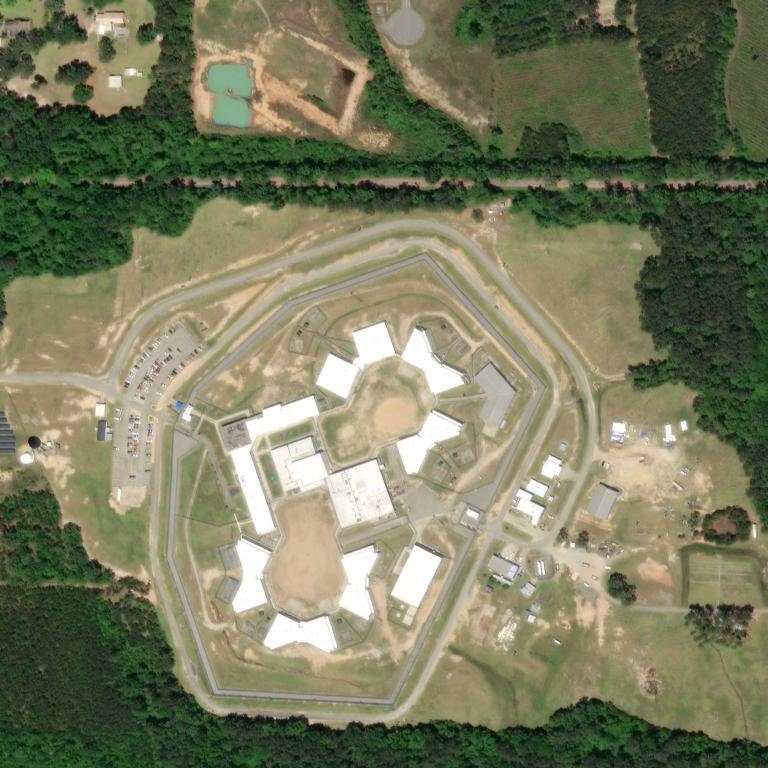
Satellite image: Esri World Imagery. Architecture documents what the building was designed to hold. See the system-wide receipts at gps.press/warehouse.
Then and now
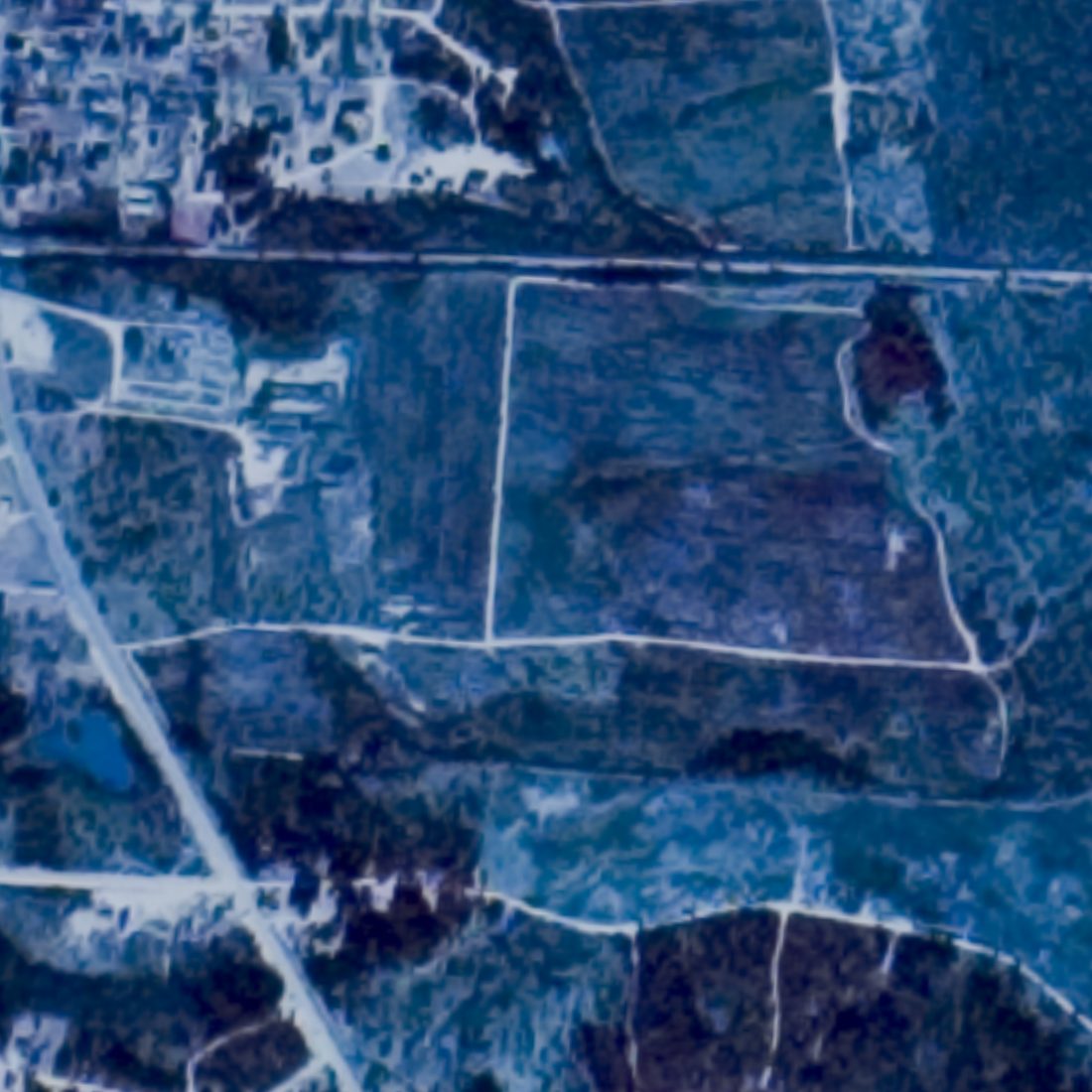
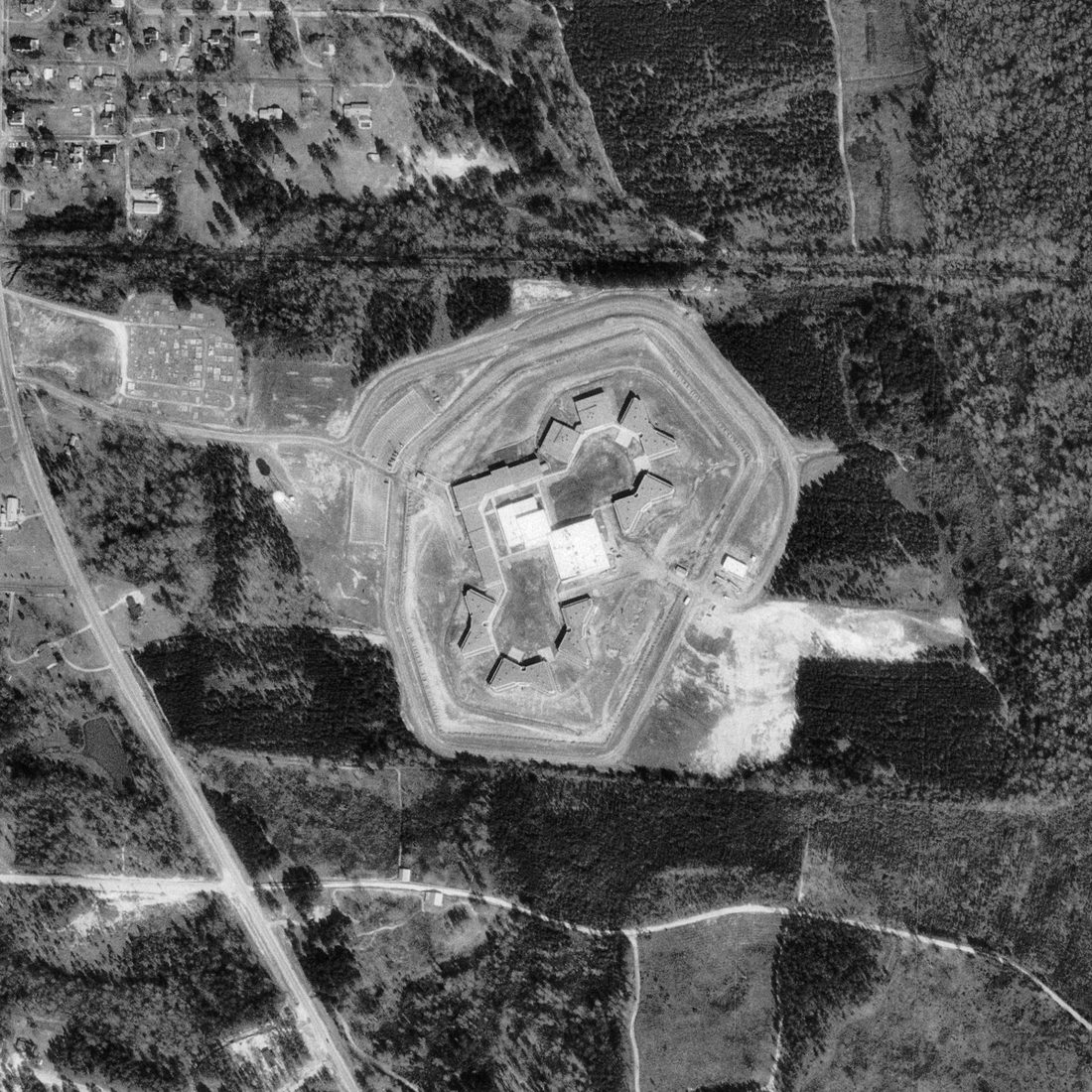
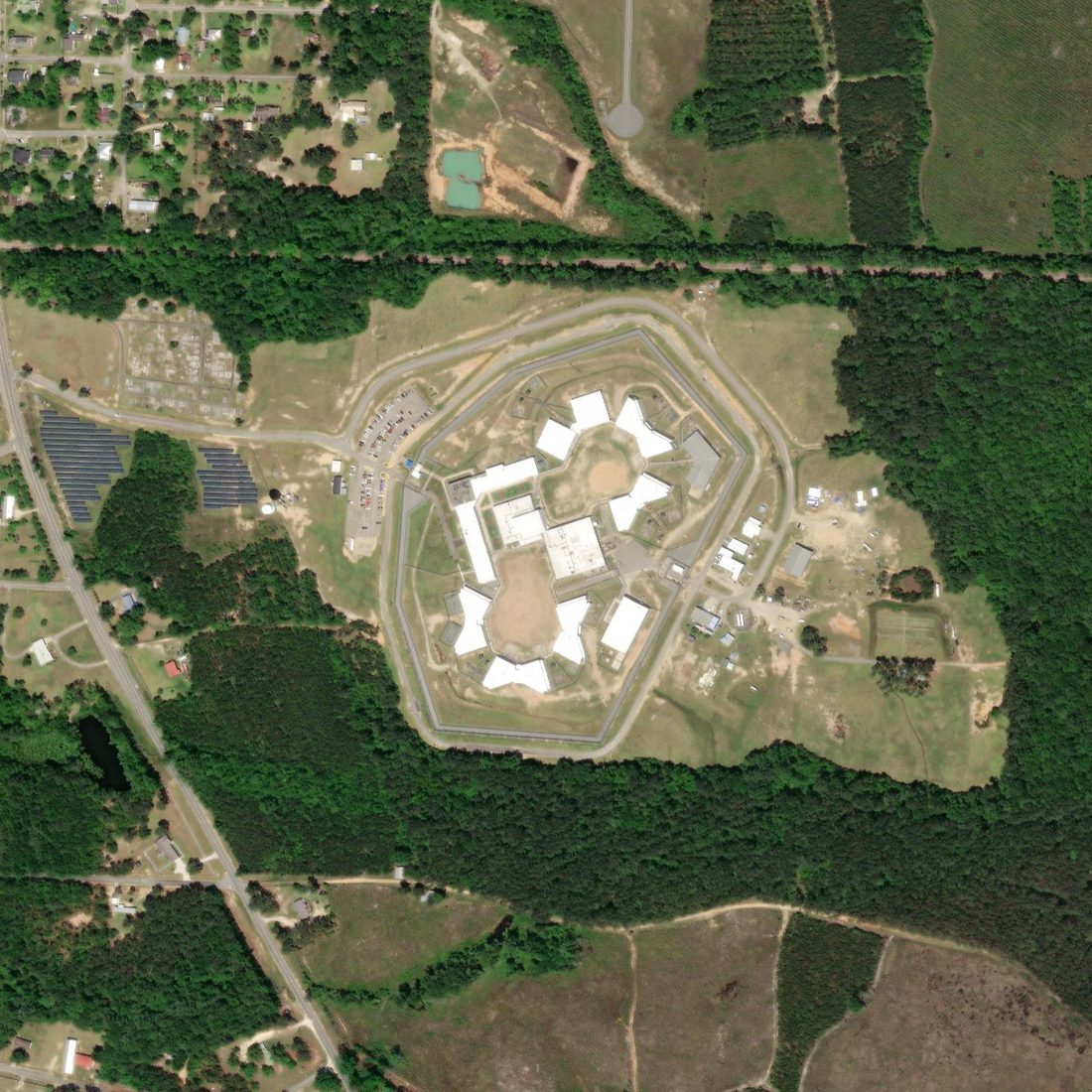
Each photo shows the same 1.2 km square, north up, so buildings line up from one year to the next. The older photos are U.S. Geological Survey aerial photographs. The photos from 1988 and earlier were taken on film and lined up with the later ones by their roads, so their positions are approximate. The early-1980s photos were taken from very high up and are less sharp. Select a photo to see it full size.