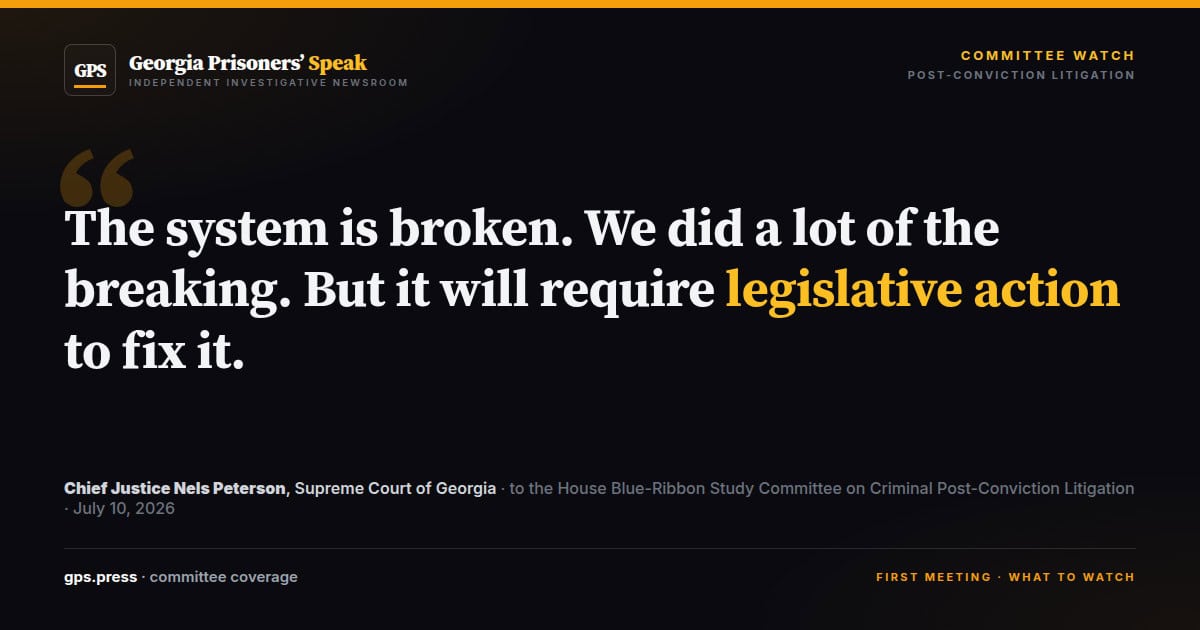
On a Friday afternoon in July, the Chief Justice of Georgia sat before a panel of state lawmakers in the Nathan Deal Judicial Center — the building that houses his own court — and told them that the system Georgia uses to review criminal convictions after appeal is broken, that the courts themselves broke much of it, and that judges cannot fix it.
“In short, the system is broken,” Chief Justice Nels Peterson told the committee. “We did a lot of the breaking. But it will require legislative action to fix it.” 1
The panel he was addressing is the House Blue-Ribbon Study Committee on Criminal Post-Conviction Litigation — one of seven blue-ribbon study committees Speaker Jon Burns announced in April, charged with examining “Georgia’s post-conviction legal framework to protect constitutional rights, reduce delays, and improve the efficiency of the state’s justice system.” 2
Its first meeting, on July 10, drew less public attention than almost anything else happening under the Gold Dome this summer. It may end up mattering more. What this committee recommends will shape what the 2027 General Assembly does about a question most Georgians never have to think about: what happens when someone says their conviction was wrong — after the ordinary appeal is over.
Where the committee came from
The committee’s origin is unusual: it began with the state’s highest court publicly criticizing itself.
In March, Chief Justice Peterson wrote a concurrence in a case called Sanders v. State describing Georgia’s post-conviction machinery as a system “no rational person would have chosen” — and inviting the legislature to rebuild it. 1
Thirteen days after that opinion, Rep. Stan Gunter — a Blairsville Republican, former district attorney, and chairman of the House Judiciary Committee — filed House Resolution 1703 to create a study committee on exactly that subject. 3 The resolution died when the session ended without a vote. The Speaker then carried the idea forward anyway, creating the committee by appointment as one of his seven blue-ribbon panels. Gunter presided over the July 10 session.
That sequence — a judicial invitation, a resolution, and a leadership decision to proceed regardless — is worth noticing. Study committees are common under the Gold Dome. Study committees requested by the Chief Justice of the state Supreme Court are not.
What the Chief Justice asked for
Peterson’s testimony sketched the mechanics of the problem. In Georgia, a person who says their trial lawyer failed them — the most common claim in the post-conviction world — generally must raise that claim through a process bound up with the motion for new trial and direct appeal, argued by a new lawyer, on a clock. The result, he told the panel, is a system that is slow for everyone: defendants with real claims wait years, and the state spends years defending convictions through layers of overlapping review.
Among the ideas he put before the committee: separating — “decoupling” — ineffective-assistance claims from the direct appeal so each process can move on its own track, rethinking where post-conviction cases are heard, and confronting what he described as the hardest question in the field: how a court identifies the meritorious petition filed by a prisoner with no lawyer.
Rep. Scott Holcomb, an Atlanta Democrat and attorney who sits on the committee, walked through why the current structure forces delay: a trial lawyer cannot be expected to argue their own ineffectiveness. “That person is not going to say ‘I didn’t do my job and I was ineffective,'” Holcomb said. “So you have to bring in different lawyers to do that, which then slows down the system because that person has to get completely up to speed.” He acknowledged the tradeoff, too: separating the processes “is going to be a little bit more complicated, and there will be some potential costs to the state.” 1
Who else was in the room
GPS reviewed the full hearing video. Beyond the Chief Justice, the committee heard from a cross-section of the institutions that live inside this system every day:
- The Georgia Association of Criminal Defense Lawyers, which told the committee it has its own fifty-state survey of post-conviction procedure underway and offered standing research help — asking members, in effect, what questions they want answered.
- The Prosecuting Attorneys’ Council of Georgia, which brought the prosecution’s perspective and engaged members directly.
- The Georgia Innocence Project, which warned that an overhaul will fail if the state does not plan for the resources it requires.
- The Georgia Public Defender Council, which described a statewide appellate defense corps stretched far past its capacity — and testified that the large majority of appeals it contracts out arise from ineffective-assistance claims.
- The Georgia Appellate Practice and Educational Resource Center, which supports indigent appellate and capital cases.
Members’ questions pushed past the witnesses’ prepared ground. One line of questioning asked whether Georgia should extend plain-error review — the ability of an appeals court to correct a clear error nobody objected to at trial — to all claims in criminal cases, as the federal system allows. Another pressed the interplay between Georgia’s four-year deadline for state habeas corpus petitions and the one-year federal deadline: an indigent petitioner who runs out the state clock can lose the federal courthouse too.
“No rational person would have chosen the system we have today if presented with it as a whole.” — Chief Justice Nels Peterson 1
The scale of what they are examining
The state’s own numbers explain why this committee’s subject is larger than it looks. Georgia’s superior courts received 4,425 habeas corpus petitions between 2021 and 2025 and disposed of 3,955 — roughly nine hundred cases a year. In 58.4% of the disposed cases, the petitioner had no lawyer, more than double the statewide self-representation rate, and 94.4% of petitions were filed in the small set of counties that host a prison. What the state’s caseload reports never record is an outcome. 4
GPS has published a full comparison of how all fifty states handle post-conviction review — the deadlines, the counsel rules, the screening mechanisms — along with the complete state-by-state source data.
What happens next
The committee has promised additional meetings around the state — the chair told the room the panel wants to hear directly from Georgians who have lived through the system, not only from the professionals who administer it. No dates have been announced. Its recommendations are expected to inform legislation in the 2027 session, which convenes in January with a new governor and a newly elected House.
GPS will cover every meeting.
Call to Action: What You Can Do
The Chief Justice of Georgia's Supreme Court told lawmakers the post-conviction system is broken and courts broke it. 58.4% of people filing habeas petitions had no lawyer. If you read this and say nothing, you are accepting a system the Chief Justice himself calls irrational. Share this story.
Spread the Word: It Takes One Click
Awareness without action changes nothing. Here’s how you can help push for accountability and real reform:
Join the GPS Advocacy Network — Sign up at https://gps.press/become-an-advocate/ and we’ll advocate on your behalf every week. GPS identifies your state legislators, crafts personalized letters on the most pressing prison issues, and sends them directly to the representatives who represent you. You receive a copy of every letter. It takes two minutes to sign up — we handle the rest.
Send a 60-Second Message — Pick an issue, get a ready-to-edit message with the verified facts already in it, and email your state House representative and senator directly from your own inbox at https://gps.press/send-a-message/. No signup, nothing stored — it takes about a minute.
Tell My Story — Are you or a loved one affected by Georgia’s prison system? GPS publishes first-person accounts from incarcerated people and their families. Submit your story at https://gps.press/tellmystory and help the world understand what’s really happening behind the walls.
Contact Your Representatives — Your state legislators control GDC’s budget, oversight, and the laws that created these failures. Find your Georgia legislators at https://gps.press/find-your-legislator/ or call Governor Kemp at (404) 656-1776 or the GDC Commissioner at (478) 992-5246.
Demand Media Coverage — Contact newsrooms at the AJC, local TV stations, and national criminal justice outlets. More coverage means more pressure.
Amplify on Social Media — Share this article and tag @GovKemp, @GDC_Georgia, and your local representatives. Use #GAPrisons, #PrisonReform, #GeorgiaPrisonerSpeak.
Message the Board of Corrections — The citizen board that oversees the GDC publishes no contact details for its members. GPS built the missing front door: pick a board member and a policy message and send it from your own email at https://gps.press/write-the-board/.
File Public Records Requests — Georgia’s Open Records Act gives every citizen the right to request incident reports, death records, staffing data, medical logs, and financial documents. Start with the GPS Action Toolkits at https://gps.press/toolkits/ — the Open Records Toolkit walks you through what to ask for, gives you ready-to-file request templates, and tells you what to do when the state says no. File directly with GDC at https://georgiadcor.govqa.us/WEBAPP/_rs/SupportHome.aspx.
Attend Public Meetings — The Georgia Board of Corrections and legislative committees hold public meetings. Your presence is noticed. The Blue-Ribbon Study Committee on Criminal Post-Conviction Litigation has promised meetings around the state — watch for the notices.
Contact the Department of Justice — File civil rights complaints at https://civilrights.justice.gov. Federal oversight has forced abusive systems to change before.
Support Organizations Doing This Work — Donate to or volunteer with Georgia-based prison reform groups fighting for change on the ground.
Vote — Research candidates’ positions on criminal justice. Primary elections often determine outcomes in Georgia.
Contact GPS — If you have information about conditions inside Georgia’s prisons, reach us securely at GPS.press.
Further Reading
Buried Alive: The Four-Year Deadline That Killed Habeas Corpus in Georgia
How a 2004 statute quietly closed Georgia’s courthouse doors on prisoners with late-discovered evidence.
One Justice, One Year: How Georgia Erased a 146-Year Rule
The story of Chester and Harper — how a single seat change on the Georgia Supreme Court closed the void-conviction remedy.
Two Georgia statutes already on the books could address wrongful convictions — if they were enforced as written.
The Crime Lab: How Georgia Built Convictions on Junk Science — and Who Paid for It
Discredited forensic techniques helped convict Georgians who had no realistic path to challenge them afterward.
GPS Intelligence System
The GPS Intelligence System maintains living research profiles that aggregate data, news, settlements, and analysis on Georgia’s prisons and the issues defining them. The profiles below provide deeper context for the issues raised in this article:
How incarcerated Georgians actually reach the courts — law libraries, filing barriers, and the counsel gap the committee is now examining.
Who watches Georgia’s prison and justice systems, and what happens when the watchers report what they find.
Explore the Data
GPS makes GDC statistics accessible to the public through several resources:
- GPS Statistics Portal — Interactive dashboards translating complex GDC reports into accessible formats, updated within days of official releases.
- GPS Lighthouse AI — Ask questions about Georgia’s prison system and get answers drawn from GPS’s investigative archive and data analysis.
- GPS llms.txt — A single machine-readable index of every GPS data resource, published using the open llms.txt standard. Point any AI tool (ChatGPT, Claude, Gemini, Perplexity) at this URL and the model can navigate to facility profiles, intelligence briefs, mortality records, statistics, and the full investigative archive — no other configuration needed. It is the fastest way to ground an AI conversation in verified GPS data.
For a walkthrough of how to put these resources to work with AI, see How to Use GPS Data with AI Tools — a step-by-step guide for researchers, advocates, families, and journalists analyzing Georgia prison conditions, statistics, and policy with tools like ChatGPT, Claude, and Gemini.
Contact GPS at media@gps.press for access to underlying datasets used in this analysis.
About Georgia Prisoners’ Speak (GPS)
Georgia Prisoners’ Speak (GPS) is a nonprofit research organization built in partnership with incarcerated reporters, families, advocates, and data analysts. Operating independently from the Georgia Department of Corrections, GPS documents the truth the state refuses to acknowledge: extreme violence, fatal medical neglect, gang-controlled dorms, collapsed staffing, fraudulent reporting practices, and unconstitutional conditions across Georgia’s prisons.
Through confidential reporting channels, secure communication, evidence verification, public-records requests, legislative research, and professional investigative standards, GPS provides the transparency the system lacks. Our mission is to expose abuses, protect incarcerated people, support families, and push Georgia toward meaningful reform based on human rights, evidence, and public accountability.
Every article is part of a larger fight — to end the silence, reveal the truth, and demand justice.
The Architecture Is the Evidence
Across the 32 state prisons whose original design figures we hold, Georgia built for 15,737. They hold 33,805 — 215% of design capacity.
Dorms tripled. Cells double- and triple-bunked. Medical, kitchens, libraries — unchanged. Every facility, every design figure, every source.
See the receipts →- Georgia Recorder, Legislative panel to confront Georgia’s ‘broken’ post-conviction system, July 10 2026, https://georgiarecorder.com/2026/07/10/legislative-panel-to-confront-georgias-broken-post-conviction-system/ [↩][↩][↩][↩]
- Speaker Jon Burns announces the 2026 House Blue-Ribbon Study Committees, https://domepolitics.com/2026/04/speaker-jon-burns-announces-2026-house-blue-ribbon-study-committees/ [↩]
- HR 1703, House Study Committee on Criminal Post-Conviction Litigation, Georgia General Assembly, https://www.legis.ga.gov/legislation/74107 [↩]
- Judicial Council of Georgia / Administrative Office of the Courts, Superior Court caseload data, Habeas Corpus case type, https://research.georgiacourts.gov/ [↩]