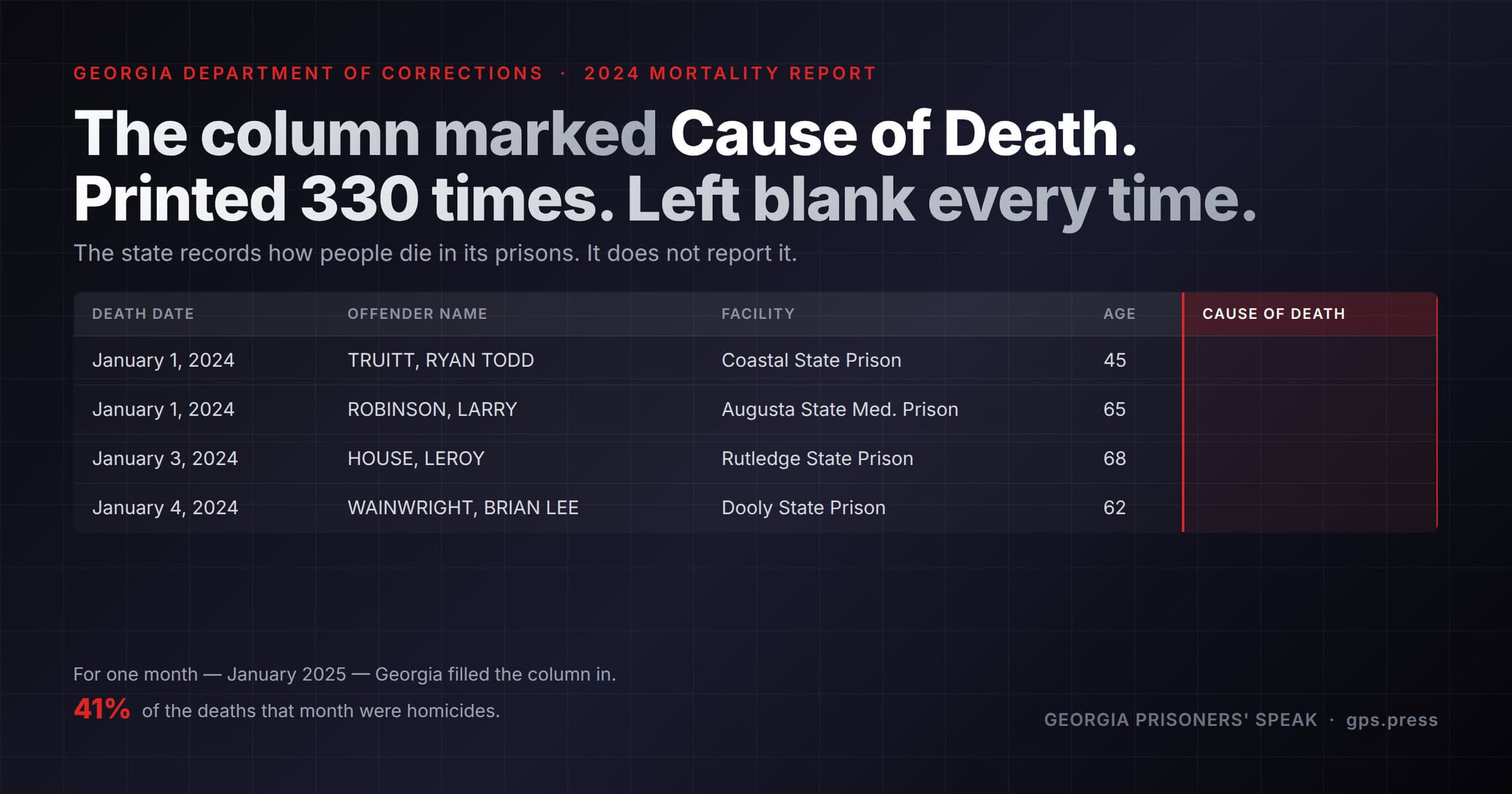
In January 2025, the Georgia Department of Corrections published a list of the people who had died in its custody that month. It looked like the lists the agency had published before, with one difference. Beside each name was a cause of death.
Freddie Calloway, esophageal cancer with metastasis. Charles Owens, ruptured abdominal aneurysm. Dontavious Carter, homicide due to a puncture wound to the heart. Alonzo Wright, homicide due to chest trauma with a large amount of blood loss. Sinjuan Harmon, homicide due to strangulation. Joshua Parrott, homicide due to strangulation. Jody Stokes, homicide due to strangulation. Deandre Moody, homicide due to strangulation.
Twenty-nine people died in Georgia’s prisons that month. Twelve of them — forty-one percent — were killed. Four were strangled.
Then the column disappeared, and it has not come back.
A field built for an answer, left blank for a year
The department’s own reports document the pattern.
The mortality report covering January 2020 through December 2023 lists five things about each death: a GDC identification number, the date, the person’s name, the facility where they died, and their age. There is no cause-of-death column. The document does not contemplate the question.
The report covering 2024 does. Its header reads: Count, GDC ID, Death Date, Offender Name, Facility, Age, Cause of Death. The department built the field.
It filled in none of it. The report numbers its entries from 1 to 330, and the cause-of-death column is empty for every single one. The words “homicide,” “suicide,” “cancer,” “cardiac,” “overdose,” “undetermined” — none of them appear anywhere in the document. Georgia produced a year-long public record of who died in its prisons with a column for how, and then printed 330 blank spaces.
The list is also short. GPS documents 333 deaths in GDC custody during 2024 — three more people than appear in the department’s own published accounting of its dead.
The January 2025 list filled that column in. Then it stopped: the February 2025 report GPS holds lists a GDC number, the date, the name, the location and the age — and no cause. The report covering the rest of 2025 is narrower still, down to two columns: date of death, and name.
Georgia built a field for the truth, left it empty for a year, filled it in for one month, and then stopped.
The point is that they know
It would be one thing if the state could not answer the question. That is not the situation.
The single month of disclosure settles it. The causes in the January 2025 list are specific, clinical, and internally consistent — “cardiopulmonary arrest, COPD, metastatic pancreatic cancer,” “end-stage non-ischemic cardiomyopathy,” “cerebral herniation due to extremely high blood pressure.” These are not guesses assembled after the fact. They are the entries of an agency that tracks how the people in its custody die, records it, and files it.
The department’s own policy requires as much: GDC maintains a standard operating procedure governing offender death and mortality reviews. Deaths in custody are examined internally. Causes are determined and written down.
They are simply not published. Georgia’s position is not that it does not know how 1,800 people died in its prisons. Georgia’s position is that the public does not need to be told.
What it costs to find out anyway
Georgia Prisoners’ Speak maintains a public record of at least 1,848 deaths in Georgia Department of Corrections custody since January 2020, as of July 25, 2026, and the count keeps rising 1. For more than a thousand of them — well over half — no cause of death has ever been established.
The roughly 800 that do carry a cause exist because they were pried loose one at a time. Not one of them was volunteered.
- 481 came from medical examiners’ records.
- 145 came from news reporting.
- 82 came from county coroners.
- 63 came from incarcerated people who wrote to describe what they had watched happen.
- 28 came from autopsy reports.
- 12 came from the Georgia Department of Corrections — the January 2025 list, and nothing else.
- 4 came from families.
That is the entire ledger. In five and a half years, the agency responsible for these deaths has accounted for twelve of them, in a single month, in what has every appearance of a document that was not meant to go out that way. Everything else the public knows about how people die in Georgia’s prisons was assembled by medical examiners, county coroners, reporters, families, and prisoners — by everyone except the institution holding the bodies.
Among what that work has established: at least 250 of these deaths were homicides, with the annual count rising sharply across the period. That figure is a floor, not a total — it counts only the killings someone outside the department managed to document. The unexplained deaths are not distributed across peaceful causes; they are simply unexamined.
Where the trail goes cold
Ask why so many deaths remain unexplained and the answer is not only that the department withholds its records. It is that the state’s own forensic system frequently declines to look.
When someone dies in a Georgia prison, the county coroner may ask the Georgia Bureau of Investigation’s Division of Forensic Sciences to examine the body. In records GPS obtained under the Georgia Open Records Act, the Division answered that request 26 times with the same sentence:
“This case has been reviewed by the medical examiner. Based on the information provided at this time, an examination by this office is not necessary.”
No autopsy was performed in any of those cases. Of the 25 that match a death in the GPS record, 21 remain classified as undetermined to this day — years later, permanently. The examination that would have answered the question was declined, and nothing replaced it.
This is not a claim that the Division never autopsies people who die in state custody. The same set of records contains 17 complete autopsies, with certified causes, manners of death, and full toxicology. The Division does this work, and does it thoroughly, when it does it. The point is that a large share of in-custody deaths are turned away at the consultation stage — leaving a county coroner to certify a cause without a state forensic examination, or leaving the record blank forever.
In at least two of those declinations, the medical examiner issued a suggested cause of death from paperwork alone, without ever examining the body.
Why a blank column is not a clerical matter
A death with no established cause is a death no one can be held responsible for.
It cannot be counted in a pattern. It cannot support a wrongful-death claim, which in Georgia must generally be filed within two years — a clock that runs whether or not a family has been told anything. It cannot be cited to a legislator, tested against a facility’s record, or compared with the year before. It cannot be investigated, because there is officially nothing to investigate.
The United States Department of Justice concluded on October 1, 2024 that conditions in Georgia’s prisons violate the Eighth Amendment, finding that the state fails to protect incarcerated people from violence and sexual abuse 2 3. That finding rests on the state’s failure to keep people alive. The department’s response, in its public record of the dead, has been to stop saying how they died.
For one month, the answer was there in the agency’s own handwriting: forty-one percent of the people who died in Georgia’s prisons that January were killed. Four were strangled.
Whether that month was typical or an outlier is unknowable, and it is unknowable by design. That is precisely what an empty column produces, and it is the condition Georgia has chosen.
What would end this
None of this requires new law. It requires the department to publish a column it already built, using data it already collects, in a report it already produces.
Georgia’s Open Records Act entitles the public to those records. The department’s own mortality-review policy already produces the determinations. The January 2025 list demonstrates the format exists, works, and can be printed. Every element of full disclosure is in place except the decision to disclose.
Until that changes, the count of Georgians who died in state custody without an official explanation will keep rising — and the only reason any of them have a cause attached to their name at all is that someone outside the Georgia Department of Corrections went and found it.
Call to Action: What You Can Do
You just read that Georgia published a cause-of-death column for one month, revealed 12 killings and four strangulations, then removed it. For 330 deaths in 2024, that column is blank. Share this now — the people inside cannot post it, and silence is what the state is counting on.
Spread the Word — It Takes One Click
Awareness without action changes nothing. Here’s how you can help push for accountability and real reform:
Join the GPS Advocacy Network — Sign up at https://gps.press/become-an-advocate/ and we’ll advocate on your behalf every week. GPS identifies your state legislators, crafts personalized letters on the most pressing prison issues, and sends them directly to the representatives who represent you. You receive a copy of every letter. It takes two minutes to sign up — we handle the rest.
Send a 60-Second Message — Pick an issue, get a ready-to-edit message with the verified facts already in it, and email your state House representative and senator directly from your own inbox at https://gps.press/send-a-message/. No signup, nothing stored — it takes about a minute.
Tell My Story — Are you or a loved one affected by Georgia’s prison system? GPS publishes first-person accounts from incarcerated people and their families. Submit your story at https://gps.press/category/tellmystory/ and help the world understand what’s really happening behind the walls.
Contact Your Representatives — Your state legislators control GDC’s budget, oversight, and the laws that created these failures. Find your Georgia legislators at https://gps.press/find-your-legislator/ or call Governor Kemp at (404) 656-1776 or the GDC Commissioner at (478) 992-5246.
Demand Media Coverage — Contact newsrooms at the AJC, local TV stations, and national criminal justice outlets. More coverage means more pressure.
Amplify on Social Media — Share this article and tag @GovKemp, @GDC_Georgia, and your local representatives. Use #GAPrisons, #PrisonReform, #GeorgiaPrisonerSpeak.
Message the Board of Corrections — The citizen board that oversees the GDC publishes no contact details for its members. GPS built the missing front door: pick a board member and a policy message and send it from your own email at https://gps.press/write-the-board/.
File Public Records Requests — Georgia’s Open Records Act gives every citizen the right to request incident reports, death records, staffing data, medical logs, and financial documents. Start with the GPS Action Toolkits at https://gps.press/toolkits/ — the Open Records Toolkit walks you through what to ask for, gives you ready-to-file request templates, and tells you what to do when the state says no. File directly with GDC at https://georgiadcor.govqa.us/WEBAPP/_rs/SupportHome.aspx.
Attend Public Meetings — The Georgia Board of Corrections and legislative committees hold public meetings. Your presence is noticed.
Contact the Department of Justice — File civil rights complaints at https://civilrights.justice.gov. Federal oversight has forced abusive systems to change before.
Support Organizations Doing This Work — Donate to or volunteer with Georgia-based prison reform groups fighting for change on the ground.
Vote — Research candidates’ positions on criminal justice. Primary elections often determine outcomes in Georgia.
Contact GPS — If you have information about conditions inside Georgia’s prisons, reach us securely at GPS.press.
Further Reading
What’s Really Behind Georgia’s Prison Crisis?
Georgia poured $2.4 billion in new money into its prisons and bought the deadliest years in the system’s history.
Rampant, Yet Compliant: The Paper Trail That Hides Sexual Violence in Georgia’s Prisons
273 consecutive audits without a single failed standard, against 15,542 allegations — the same documentary pattern applied to sexual abuse.
A public accounting of the $50.6 million the state has paid to settle claims over deaths and injuries in its prisons.
Two Commanders Say Georgia Hides Its Prison Staffing Crisis
Two former GDC commanders independently describe the manipulation of the staffing numbers the state reports to the public.
Your Rights and the GDC’s Responsibilities: What Families Need to Know When an Inmate Dies
A practical guide for families trying to obtain records after a death in custody.
GPS Intelligence System
The GPS Intelligence System maintains living research profiles that aggregate data, news, settlements, and analysis on Georgia’s prisons and the issues defining them. The profiles below provide deeper context for the issues raised in this article:
The living record of how people die in Georgia’s prisons, and how much of it the state has never explained.
How Georgia investigates itself, and what happens to the findings.
Explore the Data
GPS makes GDC statistics accessible to the public through several resources:
- GPS Statistics Portal — Interactive dashboards translating complex GDC reports into accessible formats, updated within days of official releases.
- GPS Lighthouse AI — Ask questions about Georgia’s prison system and get answers drawn from GPS’s investigative archive and data analysis.
- GPS llms.txt — A single machine-readable index of every GPS data resource, published using the open llms.txt standard. Point any AI tool (ChatGPT, Claude, Gemini, Perplexity) at this URL and the model can navigate to facility profiles, intelligence briefs, mortality records, statistics, and the full investigative archive — no other configuration needed. It is the fastest way to ground an AI conversation in verified GPS data.
For a walkthrough of how to put these resources to work with AI, see How to Use GPS Data with AI Tools — a step-by-step guide for researchers, advocates, families, and journalists analyzing Georgia prison conditions, statistics, and policy with tools like ChatGPT, Claude, and Gemini.
Contact GPS at media@gps.press for access to underlying datasets used in this analysis.
About Georgia Prisoners’ Speak (GPS)
Georgia Prisoners’ Speak (GPS) is a nonprofit investigative newsroom built in partnership with incarcerated reporters, families, advocates, and data analysts. Operating independently from the Georgia Department of Corrections, GPS documents the truth the state refuses to acknowledge: extreme violence, fatal medical neglect, gang-controlled dorms, collapsed staffing, fraudulent reporting practices, and unconstitutional conditions across Georgia’s prisons.
Through confidential reporting channels, secure communication, evidence verification, public-records requests, legislative research, and professional investigative standards, GPS provides the transparency the system lacks. Our mission is to expose abuses, protect incarcerated people, support families, and push Georgia toward meaningful reform based on human rights, evidence, and public accountability.
Every article is part of a larger fight — to end the silence, reveal the truth, and demand justice.
The Architecture Is the Evidence
Georgia built prisons for 24,657. They warehouse 52,771.
Dorms tripled. Cells double- and triple-bunked. Medical, kitchens, libraries — unchanged. Every facility, every design figure, every source.
See the receipts →- GPS mortality database, Georgia Prisoners’ Speak, https://gps.press/georgia-prison-deaths/ [↩]
- U.S. Department of Justice, Investigation of Georgia Prisons findings report, https://www.justice.gov/d9/2024-09/findings_report_-_investigation_of_georgia_prisons.pdf [↩]
- U.S. Department of Justice, Justice Department Finds Unconstitutional Conditions in Georgia Prisons, https://www.justice.gov/archives/opa/pr/justice-department-finds-unconstitutional-conditions-georgia-prisons [↩]