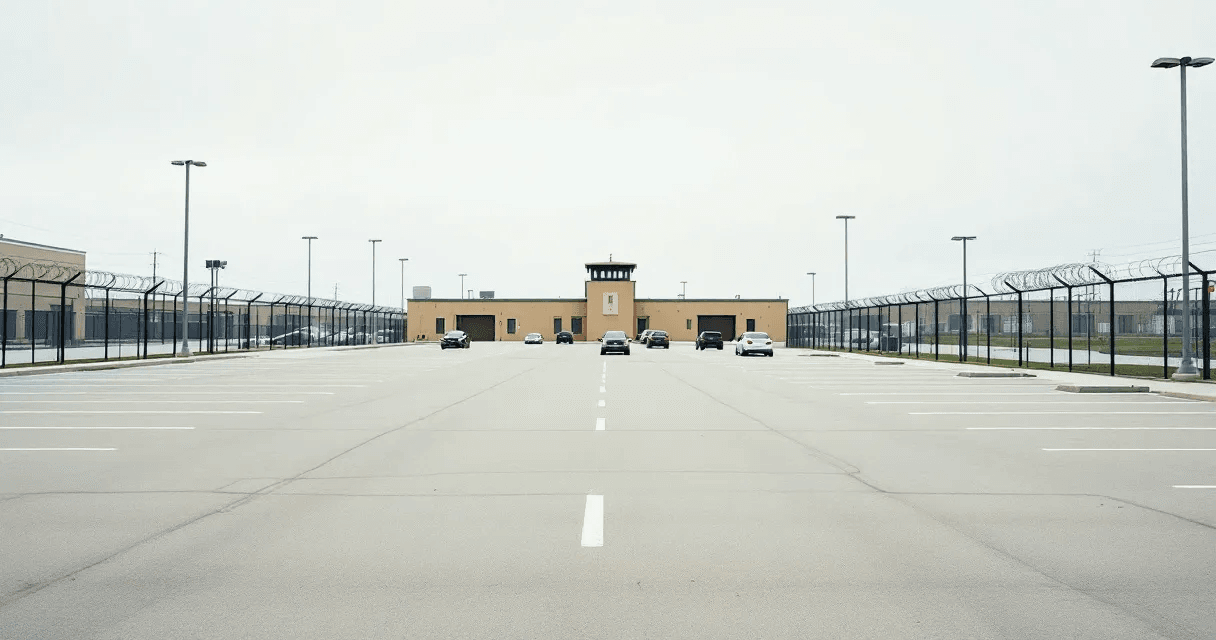
Russell Zirkle rose fast through the Georgia Department of Corrections. He started as a correctional officer in 2015 earning around $25,000 a year and, by his own account, became one of the youngest captains and then one of the youngest deputy wardens in the department — running a close-security prison of roughly 1,300 men. And then he walked away — taking a demotion to entry-level officer in another state rather than keep climbing. The reason he gives is not that the job was too hard. It is that the job required him to lie.
“What am I going to become — a warden, and some regional director’s telling me to do something that in the grand scheme of things is ethically wrong?” Zirkle said in a public interview this spring. “Going to tell me to lie on staffing reports. Going to tell me to act like everything’s okay.”
He is not the only former commander saying it. Tyler Ryals — a Correctional Emergency Response Team commander who served nearly a decade across five state prisons — put the same alarm in a sworn statement on GDC’s own form and was pushed out weeks later. The two men know each other: they served together at Valdosta State Prison. What makes their accounts matter is not that they overlap, but that they are independent, senior, and specific. Two people who ran Georgia’s most dangerous prisons describe the same machine — a staffing collapse the department does not merely tolerate, but actively conceals.
Two men who ran the same prisons
Ryals joined GDC on September 2, 2014, and served until August 13, 2024, working as an officer, sergeant, lieutenant, and finally as a CERT commander at Telfair, Valdosta, and Johnson state prisons — the teams the state sends in when a prison erupts. Zirkle joined a year later, in 2015, and climbed the custody ladder from officer to sergeant at Valdosta, to captain and chief of security at Autry State Prison, to assistant warden. These are not disgruntled clerks. They are the men the state trusted to hold its worst facilities together, and both concluded it could not be done with the staff they were given — and that their superiors knew it.
“The numbers that the state is presenting are skewed”
Zirkle’s central allegation is not that Georgia’s prisons are understaffed. Everyone knows that. It is that the department manipulates how it counts, so the public never sees how bad it is.
“Even the numbers that the state is presenting are skewed,” he said. “You might say, well, we’re 50% staffed, 60% staffed. Well, you’re skewing the numbers with the transitional centers, the halfway houses, the probation detention centers, the smaller satellite facilities. They might be fully staffed. But then you might go to Telfair State Prison, Hancock State Prison, Smith State Prison, Valdosta State Prison, Macon State Prison, Autry State Prison, Calhoun State Prison — you might go to some of them and see a 70 to 80% vacancy rate.” 1
The mechanism he describes is simple and damning: blend the fully-staffed halfway houses into the average, and a 70-to-80% vacancy rate at a maximum-security prison disappears into a reassuring system-wide figure. “The way they would present it and tell the public, everything’s okay, we’re handling it,” Zirkle said. “It’s laughable.” 2
At the close-security prison he ran, Zirkle says the vacancies were not hidden from him — only from the public. “One hundred and seventy vacancies,” he said. “At a close-security facility, 170 vacancies.” On a bad night, he says, a single housing unit of a thousand close-security inmates was covered by three or four officers, and sometimes a housing unit went an entire twelve-hour shift — 6 p.m. to 6 a.m. — with no officer assigned to it at all. 3
The warning nobody could bury
Ryals refused to let the number stay quiet. On August 1, 2024, he filed a statement on GDC’s own official witness-statement form at Washington State Prison, warning of a “downward spiral” of violence and contraband and a “major deficiency of able-bodied male officers.” He demanded concrete fixes — a three-officer rule on lockdown doors, no solo female-officer escorts without backup, a real recruitment push, and an accreditation investigation — and refused to sign off on further accreditation paperwork until safety was addressed. He wrote that he knew he could face discipline for saying so. 4
Days later, he was given a choice: “Resign now or be terminated.” He refused to resign and told them to do their paperwork. GDC recorded him as having “resigned.” He never wrote a resignation letter.
“Everything he says is completely true, man,” Zirkle said of Ryals. “Everything he says is completely true.” 5
The same chain of command
Both men trace the problem up the same chain — and neither stops at the agency. When Ryals met with Assistant Commissioner Ahmed Holt, Holt disputed none of it but reframed it as beyond Georgia’s control: “It is a system-wide issue. It is a nationwide issue.” Zirkle also rebuts an excuse he says GDC leadership gave for not calling in the National Guard — that too many Guard members are women to train quickly — as “a false narrative,” noting the Guard is overwhelmingly male. 6
Zirkle does not stop at the commissioner’s office. He faults a Board of Corrections that installs leaders with no custody experience — pointing to Commissioner Tyrone Oliver, whose background is in policing rather than corrections. And he puts responsibility at the top: “Brian Kemp is complicit in this too. The governor — he’s complicit in this too.” 7
That is the honest shape of the accountability here. The falsified staffing reports are GDC’s own doing — a choice its leadership makes and could stop today. But the conditions that make the lie necessary — a system held far beyond its capacity, chronically starved of officers — are the product of years of budget and oversight decisions by the General Assembly and the Governor, who set GDC’s funding and are supposed to hold it to account. Holding one without the other lets the real drivers off the hook.
Paperwork that says everything is fine
The falsified staffing report is not an isolated trick. It is a habit — a department that grades its own work and never fails. Zirkle described the audit culture bluntly: “A lot of their auditing, a lot of their reviews and looking-in-the-mirror stuff is their own people auditing. So how can you fully find out where you’re at if your buddy is the one looking over your stuff?” 8
The pattern is measurable elsewhere. GPS reviewed all 273 of the department’s own facility audits under the federal Prison Rape Elimination Act — every facility, every audit cycle since the standards took effect — and found that not a single standard was ever marked “not met,” even as those same facilities logged hundreds of sexual-abuse allegations a year and substantiated only a small fraction of them. 9 A department that never fails its own audit, and averages away its own vacancy rate, is not a department that lacks information. It is one that manages it.
What the numbers hide
The reason the number matters is what happens underneath it. Zirkle describes prisons where “the inmates are running the facility,” where officer-to-inmate ratios reach two or three hundred to one, and where drones now air-drop cell phones and drugs because there are not enough officers to stop them. 10 The danger is not abstract: in June 2024 a firearm that had been smuggled into Smith State Prison was used to kill a food-service worker inside the walls. 11 He read the U.S. Department of Justice’s October 2024 findings that Georgia runs its prisons unconstitutionally cover to cover, and called it “spot on… unequivocally true.” Georgia’s response, he notes, was to deny it. 12
Two commanders, from two different prisons, describe the same thing from the inside: not just a system that is failing, but a leadership that hides how far it has fallen. One put it in a sworn statement and was forced out. The other quit rather than sign his name to the lie. Their accounts are on the record. The question now belongs to the officials who write GDC’s budget and are supposed to hold it accountable — whether they will keep accepting the numbers the department gives them, or finally ask what those numbers are hiding.
Call to Action: What You Can Do
Two commanders say Georgia hides 70-80% vacancy rates in its most dangerous prisons while a sworn warning got another forced out. If you read this and say nothing, you are accepting the lie that keeps these numbers hidden. Share this story. The people inside those housing units with no officer for 12 hours do not have the option to look away.
Spread the Word: It Takes One Click
Awareness without action changes nothing. Here’s how you can help push for accountability and real reform:
Join the GPS Advocacy Network — Sign up at https://gps.press/become-an-advocate/ and we’ll advocate on your behalf every week. GPS identifies your state legislators, crafts personalized letters on the most pressing prison issues, and sends them directly to the representatives who represent you. You receive a copy of every letter. It takes two minutes to sign up — we handle the rest.
Send a 60-Second Message — Pick an issue, get a ready-to-edit message with the verified facts already in it, and email your state House representative and senator directly from your own inbox at https://gps.press/send-a-message/. No signup, nothing stored — it takes about a minute.
Tell My Story — Are you or a loved one affected by Georgia’s prison system? GPS publishes first-person accounts from incarcerated people and their families. Submit your story at https://gps.press/tellmystory and help the world understand what’s really happening behind the walls.
Contact Your Representatives — Your state legislators control GDC’s budget, oversight, and the laws that created these failures. Find your Georgia legislators at https://gps.press/find-your-legislator/ or call Governor Kemp at (404) 656-1776 or the GDC Commissioner at (478) 992-5246.
Demand Media Coverage — Contact newsrooms at the AJC, local TV stations, and national criminal justice outlets. More coverage means more pressure.
Amplify on Social Media — Share this article and tag @GovKemp, @GDC_Georgia, and your local representatives. Use #GAPrisons, #PrisonReform, #GeorgiaPrisonerSpeak.
File Public Records Requests — Georgia’s Open Records Act gives every citizen the right to request incident reports, death records, staffing data, medical logs, and financial documents at https://georgiadcor.govqa.us/WEBAPP/_rs/SupportHome.aspx.
Attend Public Meetings — The Georgia Board of Corrections and legislative committees hold public meetings. Your presence is noticed.
Contact the Department of Justice — File civil rights complaints at https://civilrights.justice.gov. Federal oversight has forced abusive systems to change before.
Support Organizations Doing This Work — Donate to or volunteer with Georgia-based prison reform groups fighting for change on the ground.
Vote — Research candidates’ positions on criminal justice. Primary elections often determine outcomes in Georgia.
Contact GPS — If you have information about conditions inside Georgia’s prisons, reach us securely at GPS.press.
Part of Something Bigger
This article is part of the GPS Reform Agenda — two active campaigns to transform Georgia’s criminal justice system.
End the Warehouse THIS SERIES
Transform Georgia’s prisons from punishment to rehabilitation. Two tracks: litigation to reduce overcrowding + evidence-based programs that work.
Four model bills for the 2027 Georgia legislature. The legislature doesn’t need new laws — it needs to enforce two dormant statutes it already passed.
Read the full GPS Reform Agenda →
Further Reading
The Georgia Prison Commander Who Warned the State
CERT commander Tyler Ryals filed a sworn warning about unconstitutional, dangerously understaffed conditions — and was pushed out days later.
GPS’s accountability brief on who built and who runs Georgia’s prison crisis, across four institutions.
How Georgia feeds the people it holds on roughly fifty cents a meal while the oversight bodies defer back to GDC.
The settlements and judgments Georgia taxpayers cover for deaths and injuries inside its prisons.
GPS Intelligence System
The GPS Intelligence System maintains living research profiles that aggregate data, news, settlements, and analysis on Georgia’s prisons and the issues defining them. The profiles below provide deeper context for the issues raised in this article:
A living profile of Georgia’s correctional-officer vacancy collapse — the data, the consequences, and how the state reports it.
The federal and state investigations into GDC, including the DOJ’s October 2024 findings of unconstitutional conditions.
Explore the Data
GPS makes GDC statistics accessible to the public through several resources:
- GPS Statistics Portal — Interactive dashboards translating complex GDC reports into accessible formats, updated within days of official releases.
- GPS Lighthouse AI — Ask questions about Georgia’s prison system and get answers drawn from GPS’s investigative archive and data analysis.
- GPS llms.txt — A single machine-readable index of every GPS data resource, published using the open llms.txt standard. Point any AI tool (ChatGPT, Claude, Gemini, Perplexity) at this URL and the model can navigate to facility profiles, intelligence briefs, mortality records, statistics, and the full investigative archive — no other configuration needed. It is the fastest way to ground an AI conversation in verified GPS data.
For a walkthrough of how to put these resources to work with AI, see How to Use GPS Data with AI Tools — a step-by-step guide for researchers, advocates, families, and journalists analyzing Georgia prison conditions, statistics, and policy with tools like ChatGPT, Claude, and Gemini.
Contact GPS at media@gps.press for access to underlying datasets used in this analysis.
About Georgia Prisoners’ Speak (GPS)
Georgia Prisoners’ Speak (GPS) is a nonprofit research organization built in partnership with incarcerated reporters, families, advocates, and data analysts. Operating independently from the Georgia Department of Corrections, GPS documents the truth the state refuses to acknowledge: extreme violence, fatal medical neglect, gang-controlled dorms, collapsed staffing, fraudulent reporting practices, and unconstitutional conditions across Georgia’s prisons.
Through confidential reporting channels, secure communication, evidence verification, public-records requests, legislative research, and professional investigative standards, GPS provides the transparency the system lacks. Our mission is to expose abuses, protect incarcerated people, support families, and push Georgia toward meaningful reform based on human rights, evidence, and public accountability.
Every article is part of a larger fight — to end the silence, reveal the truth, and demand justice.
The Architecture Is the Evidence
Across the 32 state prisons whose original design figures we hold, Georgia built for 15,737. They hold 33,805 — 215% of design capacity.
Dorms tripled. Cells double- and triple-bunked. Medical, kitchens, libraries — unchanged. Every facility, every design figure, every source.
See the receipts →- Russell Zirkle interview at 2:36, https://youtu.be/bIuwLOUA_8o?t=156 [↩]
- Russell Zirkle interview at 3:51, https://youtu.be/bIuwLOUA_8o?t=231 [↩]
- Russell Zirkle interview at 29:02, https://youtu.be/bIuwLOUA_8o?t=1742 [↩]
- GPS, “The Georgia Prison Commander Who Warned the State,” reporting on Ryals’s sworn GDC witness statement, https://gps.press/the-georgia-prison-commander-who-warned-the-state/ [↩]
- Russell Zirkle interview at 61:47, https://youtu.be/bIuwLOUA_8o?t=3707 [↩]
- Russell Zirkle interview at 55:33, https://youtu.be/bIuwLOUA_8o?t=3333 [↩]
- Russell Zirkle interview at 56:16, https://youtu.be/bIuwLOUA_8o?t=3376 [↩]
- Russell Zirkle interview at 63:47, https://youtu.be/bIuwLOUA_8o?t=3827 [↩]
- GPS Intelligence, “Sexual Abuse in Custody” — GPS’s compilation of GDC’s PREA annual reports and facility audits, https://gps.press/intelligence/issue/sexual-abuse/ [↩]
- Russell Zirkle interview at 32:35, https://youtu.be/bIuwLOUA_8o?t=1955 [↩]
- Gun violence comes to a Georgia prison, The Atlanta Journal-Constitution, June 2024, https://www.ajc.com/news/georgia-news/georgia-inmate-fatally-shoots-food-service-worker-at-smith-state-prison/DL2AXQK36RARFIRCNJFOHUXK44/ [↩]
- U.S. DOJ, Investigation of Georgia’s Prisons, findings report October 1 2024, https://www.justice.gov/d9/2024-09/findings_report_-_investigation_of_georgia_prisons.pdf [↩]
You Have Options
Free tools to take action — the law is on your side.
Demand records from the prison system. Reach the officials who set policy. File a grievance or a complaint the right way. And for families who’ve lost someone in custody, get the records that tell the truth. Plain-language, step-by-step, and free.
Explore the GPS Toolkits →