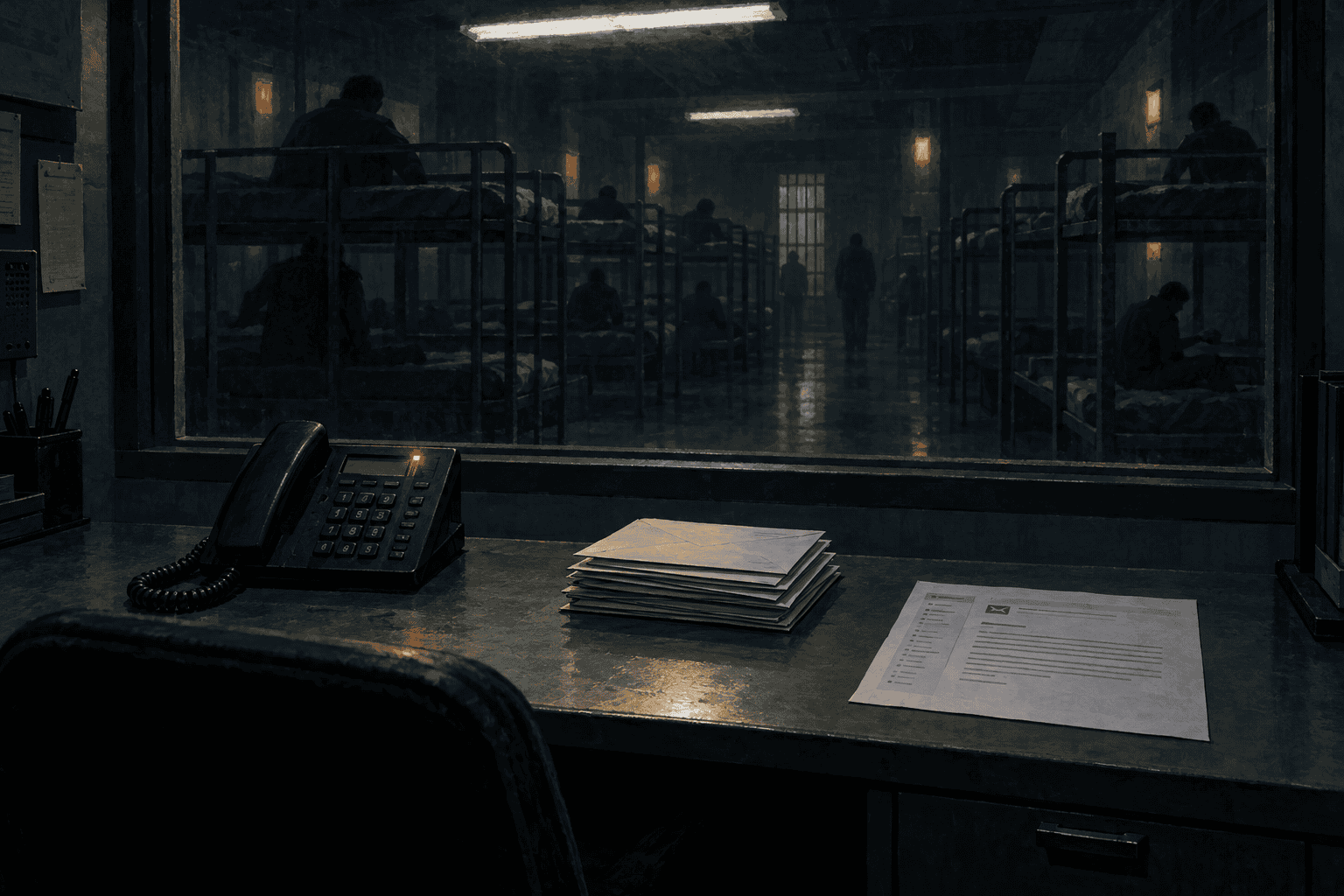
On September 23, 2024, an email went to Tyrone Oliver, Commissioner of the Georgia Department of Corrections, about a dorm at Dooly State Prison. It named two men by their GDC numbers. Both were Bloods, the email said, and both were extorting and beating other men in the dorm. It asked that they be moved to a closed-security prison right away. Two days later the same warning reached the prison’s deputy warden and a captain by phone: the gang members in that dorm were out of control and had to come out. GPS holds copies of the email and the record of the calls. No one was moved.
On the night of September 26, Zeary Davis, 31, died on the floor of that dorm. GDC’s own incident report classed his death as “Inmate Death, Homicide, By Inmate.” A Dooly County grand jury has since indicted a man held in the same prison for malice murder (Dooly County Superior Court, No. 26DR-0063). He hasn’t been tried. The law presumes him innocent.
The warden had his own warning. According to accounts GPS holds, the man now charged broke another man’s jaw at the prison on August 3, weeks before Davis died, and admitted it to the warden, Gregory Sampson. No discipline followed. He stayed in the dorm. GDC’s discipline policy requires staff to write a disciplinary report when they have reason to believe a rule was broken. It lets a supervisor hold the man in segregation until the investigation is finished. It sends any report that could lead to criminal charges to GDC’s Office of Professional Standards. 1 GPS asked GDC for his disciplinary records. It produced none. Had he been held in segregation after the jaw, he wouldn’t have been in that dorm on September 26 to kill Zeary Davis.
“Based upon the information received, the Supervisor(s) will start a preliminary investigation of the incident; determine the correct disciplinary charge; if warranted, place the offender in administrative segregation (pre-hearing detention), until the completion of the investigation, and assist in the writing of the disciplinary report.” GDC SOP 209.01, Offender Discipline
The question is what the people in charge knew, and when they knew it. The second question is why no prosecutor has asked it.
The danger isn’t a secret
On October 1, 2024, the U.S. Department of Justice published its findings. In them the Department said gangs “have unacceptable levels of control over large sections of Georgia’s prison system” and that weak policies “have allowed gangs to dictate where individuals live, who eats, who showers, who gets a job, and how units operate.” 2 GDC can’t claim it didn’t know what gangs do inside its prisons.
The same report names who carries that responsibility. According to the GDC personnel interviewed by investigators, wardens “bear responsibility for managing gangs in their facilities,” through sergeants assigned to gang monitoring who “report directly to their respective facility wardens.” 3 A gang file sits in front of the people who decide which bed a man sleeps in.
The General Assembly writes the sentencing laws and sets the budget, and the Governor appoints the Commissioner. That’s the share the people Georgia elects carry. The housing assignment is something else: GDC’s own decision, made inside its own prisons.
GPS’s death registry records at least 1,928 deaths in GDC custody since January 2020, counted as of November 3, 2026. At least 268 of them are listed as homicides, at least 56 of those in 2024. Another 570 or more have no cause of death on record as yet. At least 95 of that group were men and women under 40. 4 People that young rarely die of nothing. Until GDC states what killed them or e can obtain the medical examiners reports, each of those deaths remains a question.
The official counts run low. In the first five months of 2024, GDC’s mortality data reported 6 homicides, “even though at least 18 deaths were categorized as homicides in GDC incident reports.” 3 and DOJ found that figure short.
Some staff work for the gangs
Separating rival gangs costs nothing. Neither does keeping gang members out of dorms filled with men who aren’t in one. Both are housing assignments. GPS has asked GDC in writing, more than once, to separate the gangs. It hasn’t. When the assignments keep putting people in danger, it’s fair to ask whose interests they serve.
The record answers part of it. The Department of Justice wrote that “hundreds of employees have been arrested, including the warden of Smith State Prison in 2023, for crimes related to contraband.” 3 That warden was Brian Adams. He was fired and arrested in February 2023. 5 A Tattnall County grand jury indicted him on May 13, 2026: racketeering, bribery, false statements, evidence tampering and violation of his oath. Prosecutors say a prison gang paid him to let contraband in and to move the gang’s leader out of solitary confinement. 6 He’s charged, not convicted.
GPS has received reports from inside numerous prisons accusing staff of working with gangs, and the accusations go up to the rank of warden and above. We aren’t naming anyone—yet. We propose that prosecutors start investigating: they can subpoena records and put witnesses under oath.
The law already reaches this
A person who causes harm or endangers another “by consciously disregarding a substantial and unjustifiable risk” commits reckless conduct. 7 Let an unlawful act like that end in a death, and it’s involuntary manslaughter, punishable by one to ten years. 8 A public officer who commits a crime in office can also be charged with violating his oath, one to five years. 9 A staff member who helps an attack is a party to the crime and can be convicted of it. 10 Federal law makes it a crime for anyone acting under the authority of the state to willfully deprive a person of his constitutional rights, and when death results the sentence can be life. 11
The case file is real. In October 2022, prosecutors say, a man was stabbed inside a building at Augusta State Medical Prison after the lone officer on duty remotely opened a cell door so another man could get in. 12 That officer, Daniel Farmer, pleaded guilty to aggravated assault, unlawful acts of violence in a penal institution and violation of oath. On July 10, 2024, he was sentenced to 15 years. 13
A prosecutor has to prove what the official knew, and what he did with it. A written warning, a reported threat, an order to keep two men apart: any of those changes the picture. Once a warning is on record, a dangerous placement stops being a general risk. It becomes a known one. This is where GPS and the public comes in. We need written warnings going to wardens and officers giving them notice that by housing gang members with civilians or rival gangs, that we intend to push for criminal and civil prosecution when someone gets seriously injured.
What district attorneys owe us
Georgia law requires every district attorney “to review every individual case for which probable cause for prosecution exists.” 14 A homicide inside a state prison belongs to the district attorney’s own circuit, same as any other. But DOJ found that GDC refers most investigations to its own Office of Professional Standards. The GBI comes in only for a small number, and only when GDC asks. 3 When the agency investigates itself, the staff side of a killing rarely reaches a grand jury.
District attorneys face the voters, and they face the Prosecuting Attorneys Qualifications Commission, which holds the power to discipline them for “willful and persistent failure to carry out duties.” 15 Federal prosecutors don’t need a district attorney’s help to bring civil rights charges.
What you can do
Two warnings reached GDC before Zeary Davis died on that dorm floor, and no one was moved. If you read this and close the tab, the next warning lands on the same desk with the same silence. Send this to one person who needs to know what GDC was told.
Spread the Word: It Takes One Click
Find the district attorney for the circuit where the prison sits, then call or write that office. Put one question to it: when a man is killed inside that prison, does the office review whether staff had been warned, and what those staff did? Ask that the answer come back in writing.
If someone you love was killed after staff housed him with people they knew were a danger to him, send us what you know at gps.press/submit-a-report/. Every death where staff were warned, GPS will refer to the district attorney, the GBI and federal prosecutors. We’ll report what each of them does with it.
Zeary Davis’s death came after a warning. The next one may too. Prosecutors should be the ones asking why nobody acted.
Call to Action: What You Can Do
Awareness without action changes nothing. Here’s how you can help push for accountability and real reform:
Join the GPS Advocacy Network: Sign up at https://gps.press/become-an-advocate/ and we’ll advocate on your behalf every week. GPS identifies your state legislators, crafts personalized letters on the most pressing prison issues, and sends them directly to the representatives who represent you. You receive a copy of every letter. It takes two minutes to sign up, and we handle the rest.
Send a 60-Second Message: Pick an issue, get a ready-to-edit message with the verified facts already in it, and email your state House representative and senator directly from your own inbox at https://gps.press/send-a-message/. No signup, nothing stored. It takes about a minute.
Tell My Story: Are you or a loved one affected by Georgia’s prison system? GPS publishes first-person accounts from incarcerated people and their families. Submit your story at https://gps.press/tellmystory and help the world understand what’s really happening behind the walls.
Contact Your Representatives: Your state legislators control GDC’s budget, oversight, and the laws that created these failures. Find your Georgia legislators at https://gps.press/find-your-legislator/ or call Governor Kemp at (404) 656-1776 or the GDC Commissioner at (478) 992-5246.
Demand Media Coverage: Contact newsrooms at the AJC, local TV stations, and national criminal justice outlets. More coverage means more pressure.
Amplify on Social Media: Share this article and tag @GovKemp, @GDC_Georgia, and your local representatives. Use #GAPrisons, #PrisonReform, #GeorgiaPrisonerSpeak.
Message the Board of Corrections: The citizen board that oversees the GDC publishes no contact details for its members. GPS built the missing front door: pick a board member and a policy message and send it from your own email at https://gps.press/write-the-board/.
File Public Records Requests: Georgia’s Open Records Act gives every citizen the right to request incident reports, death records, staffing data, medical logs, and financial documents. Start with the GPS Action Toolkits at https://gps.press/toolkits/. The Open Records Toolkit walks you through what to ask for, gives you ready-to-file request templates, and tells you what to do when the state says no. File directly with GDC at https://georgiadcor.govqa.us/WEBAPP/_rs/SupportHome.aspx.
Attend Public Meetings: The Georgia Board of Corrections and legislative committees hold public meetings. Your presence is noticed.
Contact the Department of Justice: File civil rights complaints at https://civilrights.justice.gov. Federal oversight has forced abusive systems to change before.
Support Organizations Doing This Work: Donate to or volunteer with Georgia-based prison reform groups fighting for change on the ground.
Vote: Research candidates’ positions on criminal justice. Primary elections often determine outcomes in Georgia.
Contact GPS: If you have information about conditions inside Georgia’s prisons, reach us securely at GPS.press.
Further Reading
Seconds to Kill, the Rest of Your Life to Pay: The Murder Charge in Zeary Davis’s Death
The indictment in Zeary Davis’s death at Dooly State Prison, and the warnings GDC received before he was killed.
The Classification Crisis: How Four Medium Security Prisons are Killing People
How close-security men housed in medium-security prisons, Dooly among them, drive the homicide rate.
Separate the Gangs or Keep Burying the Dead
The no-cost housing change GDC hasn’t made, and the deaths that follow.
How a Smith State Prison warden came to be indicted for racketeering and bribery.
Criminal liability of Georgia prison staff when a gang member they housed with others kills someone
GPS’s research collection on the state and federal charges that can reach prison staff, with every source.
GPS Intelligence System
GPS’s living profile of the prison where Zeary Davis was killed, including the indictment and the records GDC has withheld.
Arrests, charges and accounts of GDC staff working with the people they’re paid to guard.
Explore the Data
GPS makes GDC statistics accessible to the public through several resources:
- GPS Statistics Portal: Interactive dashboards translating complex GDC reports into accessible formats, updated within days of official releases.
- GPS Lighthouse AI: Ask questions about Georgia’s prison system and get answers drawn from GPS’s investigative archive and data analysis.
- GPS llms.txt: A single machine-readable index of every GPS data resource, published using the open llms.txt standard. Point any AI tool (ChatGPT, Claude, Gemini, Perplexity) at this URL and the model can navigate to facility profiles, intelligence briefs, mortality records, statistics, and the full investigative archive, with no other configuration needed. It is the fastest way to ground an AI conversation in verified GPS data.
- GPS Public MCP Server: For AI tools that support the Model Context Protocol (Claude, ChatGPT, and others), connect directly to GPS’s data: read-only tools covering population, facilities, mortality, parole, the Georgia Code, settlements, and more. Every answer arrives with its source link and citation built in.
For a walkthrough of how to put these resources to work with AI, see How to Use GPS Data with AI Tools: a step-by-step guide for researchers, advocates, families, and journalists analyzing Georgia prison conditions, statistics, and policy with tools like ChatGPT, Claude, and Gemini.
Contact GPS at media@gps.press for access to underlying datasets used in this analysis.
About Georgia Prisoners’ Speak (GPS)
Georgia Prisoners’ Speak (GPS) is a nonprofit investigative newsroom built in partnership with incarcerated reporters, families, advocates, and data analysts. Operating independently from the Georgia Department of Corrections, GPS documents the truth the state refuses to acknowledge: extreme violence, fatal medical neglect, gang-controlled dorms, collapsed staffing, fraudulent reporting practices, and unconstitutional conditions across Georgia’s prisons.
Through confidential reporting channels, secure communication, evidence verification, public-records requests, legislative research, and professional investigative standards, GPS provides the transparency the system lacks. Our mission is to expose abuses, protect incarcerated people, support families, and push Georgia toward meaningful reform based on human rights, evidence, and public accountability.
Every article is part of a larger fight: to end the silence, reveal the truth, and demand justice.
The Architecture Is the Evidence
Across the 32 state prisons whose original design figures we hold, Georgia built for 15,737. They hold 33,805 — 215% of design capacity.
Dorms tripled. Cells double- and triple-bunked. Medical, kitchens, libraries — unchanged. Every facility, every design figure, every source.
See the receipts →- GDC SOP 209.01, Offender Discipline, https://public.powerdms.com/GADOC/documents/105928 [↩]
- DOJ findings report on Georgia prisons, October 1, 2024, https://www.justice.gov/d9/2024-09/findings_report_-_investigation_of_georgia_prisons.pdf [↩]
- DOJ findings report on Georgia prisons, https://www.justice.gov/d9/2024-09/findings_report_-_investigation_of_georgia_prisons.pdf [↩][↩][↩][↩]
- GPS death registry, counts by cause, year and age at death, query of November 3, 2026; cause totals published at https://gps.press/mortality/ [↩]
- GBI arrests Smith State Prison Warden Brian Adams, AllOnGeorgia, https://allongeorgia.com/georgia-public-safety/gbi-arrests-smith-state-prison-warden-brian-adams-relieved-of-post-immediately/ [↩]
- Attorney General Chris Carr, Carr Indicts Former Prison Warden in Contraband Smuggling Operation, May 13, 2026, https://law.georgia.gov/press-releases/2026-05-13/carr-indicts-former-prison-warden-contraband-smuggling-operation [↩]
- O.C.G.A. § 16-5-60, https://gps.press/ocga/16-5-60/ [↩]
- O.C.G.A. § 16-5-3, https://gps.press/ocga/16-5-3/ [↩]
- O.C.G.A. § 16-10-1, https://gps.press/ocga/16-10-1/ [↩]
- O.C.G.A. § 16-2-20, https://gps.press/ocga/16-2-20/ [↩]
- 18 U.S.C. § 242, https://www.law.cornell.edu/uscode/text/18/242 [↩]
- For some Georgia correctional officers, inmates are their weapons, Atlanta Journal-Constitution, https://www.ajc.com/news/investigations/for-some-georgia-correctional-officers-inmates-are-their-weapons/JXWA6JHNE5FGHKPCGFM6CDWOIU/ [↩]
- Georgia Guard Gets 15 Years for Using One Prisoner to Assault Another, Prison Legal News, https://www.prisonlegalnews.org/news/2024/oct/15/georgia-guard-gets-15-years-using-one-prisoner-assault-another/ [↩]
- O.C.G.A. § 15-18-6, https://gps.press/ocga/15-18-6/ [↩]
- O.C.G.A. § 15-18-32, https://gps.press/ocga/15-18-32/ [↩]