Corey Jose July had twenty months left. The latest date he could have walked out of a Georgia prison was February 2027. He was thirty-four years old, originally from McDonough, and he was serving a Floyd County sentence for shoplifting, possession of a firearm by a convicted felon, and obstruction of law enforcement. He was eight days from his thirty-fifth birthday. 1
On the afternoon of June 17, 2025, in the yard at Hancock State Prison, another man came for him with a homemade knife. July ran. According to the prosecutor who tried the case, surveillance footage showed him chased across the yard, cornered at a locked gate, and stabbed multiple times. 2
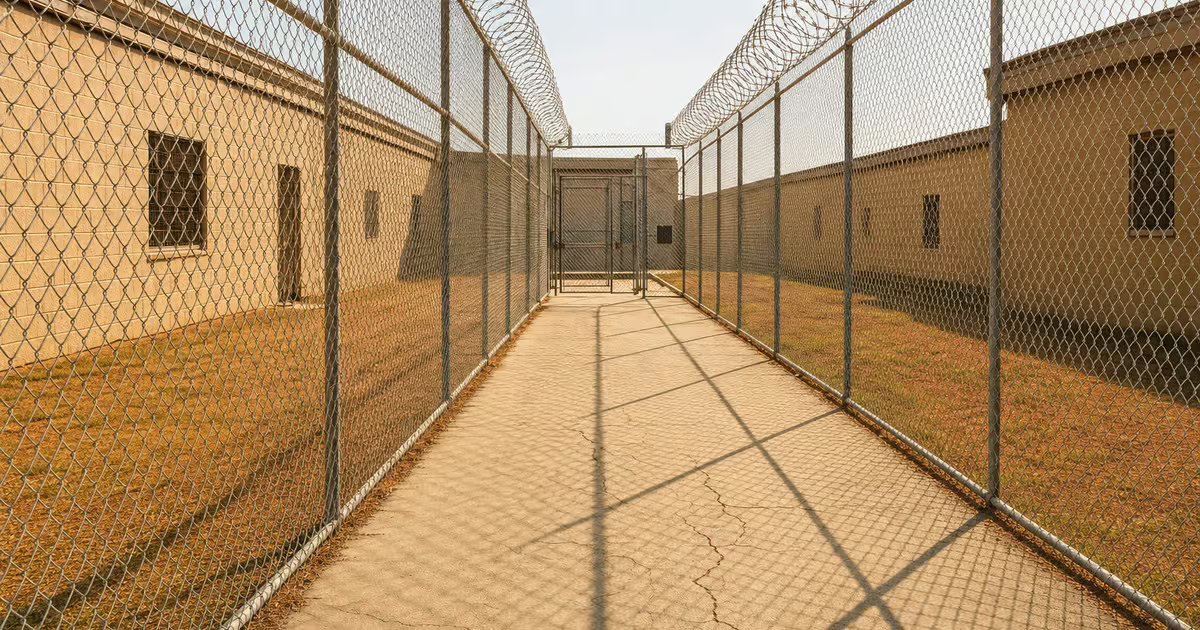
Cornered at a locked gate. Read that again, because it is the whole story. There was a fence, and at the end of the fence there was a gate, and the gate was locked, and Corey July had nowhere left to go. He did not die because a door failed. He died because a door worked exactly as the State of Georgia designed it to work.
On August 12, 2026, a Hancock County jury convicted Vershaun Smith of malice murder. Judge Alison T. Burleson sentenced him to life in prison without the possibility of parole.
The man who did it had a release date. Now he does not.
Georgia Department of Corrections records list Vershaun Smith’s year of birth as 2005. He was roughly twenty years old when he killed Corey July, and he was already serving a prison sentence for voluntary manslaughter.
He also had a way out. GDC’s own offender record for Smith carries a maximum release date of May 16, 2056, and a maximum release date is a ceiling, not a floor — he was parole-eligible long before it. He would have been in his fifties at the outside edge. He might have been home decades sooner.
That is finished now. There is no parole from life without parole. There is no clemency calendar he ages into, no board he petitions, no date on any wall. Vershaun Smith will die inside a Georgia prison, and the sentence for the eleven or twelve seconds that took Corey July’s life is every remaining day he has.
This is the arithmetic every man carrying a shank in a Georgia prison should be doing, and it is the reason this article exists:
- You have a number. Almost everybody does. Georgia’s prisons hold roughly 52,750 people, and the overwhelming majority of them will one day be released.
- One killing converts that number into never.
- Georgia charges these cases. Georgia tries these cases. Georgia juries convict in under an hour.
- The sentence is not “more time.” The sentence is the rest of your life.
These killings are being prosecuted, and the record is not close
There is a persistent belief inside Georgia’s prisons that killings behind the wall do not get charged, that the paperwork disappears into the Office of Professional Standards and nothing follows. In the Ocmulgee Judicial Circuit, that belief is now demonstrably false.
District Attorney T. Wright Barksdale III’s office has taken Hancock State Prison homicides to trial repeatedly, and juries keep returning the same verdict:
- Javaris Compton was convicted of malice murder in April 2024, after a two-day trial, for the January 4, 2021 stabbing death of Rashad Bolton, 29, who was serving a sentence out of Carroll County. Compton had been serving time for armed robbery and gang terrorism out of DeKalb County. Judge Amanda S. Petty sentenced him to life without parole. Bolton’s parents drove from Lincoln County and sat through both days of the trial. 3
- Joshua Andrew Brock, 38, described by prosecutors as a high-ranking leader of the Ghostface Gangsters within the Georgia prison system, was convicted of malice murder on April 30, 2026 for the January 2025 stabbing death of Prince Porter. Brock came up behind Porter during a fight and stabbed him once in the back. He was already serving life for armed robbery. The jury deliberated less than an hour. He was sentenced to life without parole. 4
- Vershaun Smith was convicted of malice murder on August 12, 2026 for the killing of Corey July, and sentenced to life without parole.
Three more cases are already in the pipeline. In March 2026, Hancock County grand juries indicted Lonnie Ragan for the January 24, 2026 attack that killed Steven Wood, who died the following afternoon; Octavio Pugacerantes for the February 6, 2026 killing of Jaylin Bell; and Omarion Lyles for the February 18, 2026 killing of Jerrod Johnson — each charged with malice murder, felony murder, and aggravated assault. 5
Six killings. Three convictions, all life without parole. Three indictments pending.
And there is a common thread running through them, which every person reading this from inside a Georgia prison needs to understand clearly.
The cameras are the reason
In the Brock trial, jurors were shown roughly an hour of surveillance video. Prosecutors described a new camera system at Hancock — a 360-degree overhead view that can be zoomed. The jury asked to rewatch about twenty minutes of the footage before it returned a guilty verdict in under an hour. 4
In the Smith trial, the case rested on surveillance footage showing the chase, the corner, and the stabbing.
Georgia is spending enormous sums on prison surveillance, and GPS has been sharply critical of what that money buys and who it enriches. But the deterrent implication is not complicated, and it does not depend on approving of the spending: the camera does not stop the killing. It only guarantees the conviction. A shank stops a heart in seconds. The footage lasts forever, and twelve strangers from Hancock County will watch it in a courtroom, and then a judge will say the words without the possibility of parole.
Anyone still operating on the assumption that what happens on the yard stays on the yard is working from a Georgia that no longer exists.
The other half of the sentence: Georgia builds the trap
None of that is exculpatory for the State of Georgia. A locked gate is not a bystander.
Vershaun Smith killed Corey July. And the State of Georgia put July inside a fenced enclosure with one exit, locked that exit, and then failed to staff the space in between.
“The State of Georgia” is not a euphemism for GDC alone. The Department administers a crisis it did not manufacture. The General Assembly writes the sentencing laws that pack these facilities past the capacity they were engineered for, and sets the corrections budget every session. The Governor appoints the Commissioner and the members of the Board of Corrections. The State Board of Pardons and Paroles determines how many people leave. Understaffing is not weather that befell GDC — it is the downstream consequence of choices made by elected officials who have watched correctional officer vacancies sit above 50 percent since mid-2021 and have not fixed it. GDC locks the gates. The people Georgia elects built the prisons, filled them past design capacity, and declined to staff them. Neither fact absolves the other.
Georgia’s prisons move people between buildings, yards, dining halls, and administrative areas through outdoor corridors bounded on both sides by chain-link fencing and topped with razor wire — narrow chutes with a gate at each end. GPS’s understanding of this architecture comes from years of reporting by incarcerated sources across multiple facilities, corroborated against publicly available satellite imagery of GDC prison grounds. GDC does not publish facility movement diagrams, and this article marks that reporting as GPS reporting rather than as a departmental record. GDC has not responded publicly to the design question this article raises, and GPS will update this piece if it does.
The purpose of the design is obvious and, on its own terms, defensible: control movement, prevent men from wandering into unauthorized areas, keep populations separated, contain a disturbance before it spreads across a yard.
The consequence is equally obvious. A corridor that cannot be left is a corridor that cannot be escaped. When both ends are closed and a man with a weapon is inside it with you, the fence stops being a control measure and becomes the second half of the weapon.
This is not theoretical, and Corey July is not the only case.
On November 7, 2025, at Dooly State Prison, Darrow Brown — fifty-eight years old, known inside as “Drip” — was killed on the walk while being escorted back to his building by a correctional officer. GPS’s source reporting describes him as unaffiliated with any gang. An officer was present. The walk still had no exit. This account comes from GPS source reporting and remains an allegation; GPS has not obtained an incident report or a coroner’s finding for this death.
The Department has known for years what a locked enclosure does to a person who cannot leave it. In July 2023, at Telfair State Prison, twenty-seven-year-old Juan Carlos Ramirez Bibiano was placed in a fenced outdoor recreation cage roughly twelve feet by eight and a half feet, with no shade, on a day when the heat index reached about 105 degrees. He told officers within twenty minutes that he was overheating and could not breathe. His family’s lawsuit alleges an officer replied, “if he dies, he dies.” He reached the hospital with an internal body temperature of 107 degrees and died. GDC reported the death as natural causes. 6
The Justice Department documented the same logic in a different form. At Georgia Diagnostic and Classification State Prison in January 2023, federal investigators found a man who had broken his ankle jumping from an upper-level walkway — because jumping was the only available exit from an assault. DOJ also found that GDC sometimes padlocks cell doors when the primary locks break, a practice that violates national correctional standards and that GDC’s own fire-safety inspections have flagged, and that in some prisons entire fire alarm systems are nonoperational. 7
A department that padlocks men into cells it cannot unlock, and lets the fire alarms die, has told you everything about its instincts. Containment is the reflex. Egress is an afterthought.
Hancock State Prison: sixty-five percent
GPS maintains an independent mortality database tracking deaths in Georgia’s prison system. As of August 2026 it holds at least 1,861 deaths recorded since 2020. Of those, 259 are classified as homicides — about fourteen percent.
At Hancock State Prison, the database holds 26 deaths. Seventeen of them are homicides.
Sixty-five percent. Not fourteen. At one prison in Sparta, Georgia, roughly two out of every three recorded deaths are killings.
Four of those homicides occurred in 2025. Four more occurred in the first fourteen weeks of 2026 alone — Steven Wood, attacked January 24 and pronounced dead January 25; Jaylin Bell on February 6; Jerrod Johnson on February 18; and Jacorey Pearson on April 7.
Hancock was built in 1991 with an original design capacity of 500 people. It currently holds 1,177. 8 That is 235 percent of the capacity the buildings were engineered for, in a close-security prison, inside a system where the Justice Department found correctional officer vacancy rates above 50 percent systemwide since mid-2021 and above 70 percent at ten of the state’s largest facilities.
What Georgia will not count
Ask how many stabbings happen in Georgia’s prisons each year and you will not get an answer, because GDC does not publish one.
What exists is the federal count. Between January 2022 and April 2023 — sixteen months, covering the close-security prisons and most of the medium-security prisons — the Justice Department identified more than 1,400 reported incidents of violence. Of those, 19.7 percent involved a weapon, 45.1 percent resulted in serious injury, and 30.5 percent required offsite medical treatment. 7
Roughly 631 serious injuries in sixteen months. About one every nineteen hours.
And that is a floor, three separate times over:
- It excludes minimum-security facilities and covers only sixteen months.
- It counts only reported incidents. DOJ found that GDC staff routinely wrote incident reports whose narratives plainly described an assault or a fight, then coded the incident as “injury,” “disruptive event,” or “special hospital transport” — which removed it from the violence totals entirely.
- Even the deaths are undercounted. DOJ found that GDC’s June 2024 mortality data reported six homicides for the first five months of 2024, while GDC’s own incident reports categorized at least eighteen deaths in that period as homicides. Seven deaths from 2022 were carried as undetermined or natural until GDC reclassified them as homicides in 2024.
The weapons are not hypothetical either. Between November 2021 and August 2023, GDC recovered 27,425 weapons, 12,483 cellphones, and 2,016 illegal drug items from its prisons. 9
Twenty-seven thousand knives, in twenty-one months, inside a system that fences men into corridors they cannot leave.
The number that explains everything
Here is the figure that connects the department’s failure to the prosecutors’ success.
Between January 2022 and April 2023, across twenty-two Georgia prisons, fewer than twelve percent of incidents involving a serious injury were forwarded by the facility for investigation by the Office of Professional Standards. 7
Not prosecuted. Not charged. Forwarded. Nearly nine out of ten serious injuries never reached an investigator at all.
District attorneys across Georgia told federal investigators that the share of violent crime originating inside the prisons, homicides included, has risen in recent years and is straining their offices. The prosecutors are willing. Ocmulgee has proven what happens when a case actually arrives on a DA’s desk with usable evidence attached.
The bottleneck is not the courthouse. It is the facility that never sends the file.
The question Georgia has never been asked to answer
Georgia has quietly settled on a theory of control: if you fence people into narrow channels and lock both ends, you do not need enough officers to watch them.
It is cheaper than staffing. It requires no training. It never calls in sick. And it works — right up until the moment two men are inside the same channel and one of them has a knife, at which point the state’s cost-saving measure becomes the reason the other one cannot run.
So the questions belong to the public now, not to the Department:
- Is it humane to move human beings through outdoor cages with locked gates at both ends, in a system the Justice Department has found unconstitutionally violent?
- If a corridor can be locked from the outside, who is responsible when the person trapped inside is killed there?
- Why does no fenced movement corridor in a Georgia prison have emergency egress, when every school hallway, stadium concourse, and office building in this state is required by law to have it?
- Why does GDC publish no count of stabbings and assaults, when it publishes budget figures to the dollar?
- Why did fewer than twelve percent of serious injuries ever reach an investigator, and who at each facility decided they would not?
- And which members of the General Assembly, in the 2027 session, will put their names on a bill that requires emergency egress and a published assault count?
There are other ways to control movement in a prison. Sufficient staffing. Controlled release in smaller groups. Direct supervision. Functional classification that keeps predators away from people twenty months from home. Georgia has chosen fencing because fencing is cheap, and the cost of that choice is not borne by the people who made it.
Corey July, twenty months out
He was thirty-four. He would have turned thirty-five on June 25, 2025. He had a February 2027 release date and a shoplifting conviction on his record. He was going home.
The punishment Georgia imposed on Corey July was the loss of his liberty until February 2027. Nothing more. Georgia does not have a death penalty for shoplifting, or for possession of a firearm by a convicted felon, or for obstruction of law enforcement.
He received one anyway, at a locked gate, in a fenced corridor built by the State of Georgia and left unwatched by it.
The man who killed him will now die in prison, and he should. But the gate had no key on Corey July’s side, and the State of Georgia is the one that welded it shut.
Call to Action: What You Can Do
Corey July was 20 months from release when he died cornered at a locked gate. 17 of 26 deaths at Hancock are homicides. If you look away now, the next name on this list is on all of us.
Spread the Word: It Takes One Click
Awareness without action changes nothing. Here’s how you can help push for accountability and real reform:
Join the GPS Advocacy Network — Sign up at https://gps.press/become-an-advocate/ and we’ll advocate on your behalf every week. GPS identifies your state legislators, crafts personalized letters on the most pressing prison issues, and sends them directly to the representatives who represent you. You receive a copy of every letter. It takes two minutes to sign up — we handle the rest.
Send a 60-Second Message — Pick an issue, get a ready-to-edit message with the verified facts already in it, and email your state House representative and senator directly from your own inbox at https://gps.press/send-a-message/. No signup, nothing stored — it takes about a minute.
Tell My Story — Are you or a loved one affected by Georgia’s prison system? GPS publishes first-person accounts from incarcerated people and their families. Submit your story at https://gps.press/tellmystory and help the world understand what’s really happening behind the walls.
Contact Your Representatives — Your state legislators control GDC’s budget, oversight, and the laws that created these failures. Find your Georgia legislators at https://gps.press/find-your-legislator/ or call Governor Kemp at (404) 656-1776 or the GDC Commissioner at (478) 992-5246.
Demand Media Coverage — Contact newsrooms at the AJC, local TV stations, and national criminal justice outlets. More coverage means more pressure.
Amplify on Social Media — Share this article and tag @GovKemp, @GDC_Georgia, and your local representatives. Use #GAPrisons, #PrisonReform, #GeorgiaPrisonerSpeak.
Message the Board of Corrections — The citizen board that oversees the GDC publishes no contact details for its members. GPS built the missing front door: pick a board member and a policy message and send it from your own email at https://gps.press/write-the-board/.
File Public Records Requests — Georgia’s Open Records Act gives every citizen the right to request incident reports, death records, staffing data, medical logs, and financial documents. Start with the GPS Action Toolkits at https://gps.press/toolkits/ — the Open Records Toolkit walks you through what to ask for, gives you ready-to-file request templates, and tells you what to do when the state says no. File directly with GDC at https://georgiadcor.govqa.us/WEBAPP/_rs/SupportHome.aspx.
Attend Public Meetings — The Georgia Board of Corrections and legislative committees hold public meetings. Your presence is noticed.
Contact the Department of Justice — File civil rights complaints at https://civilrights.justice.gov. Federal oversight has forced abusive systems to change before.
Support Organizations Doing This Work — Donate to or volunteer with Georgia-based prison reform groups fighting for change on the ground.
Vote — Research candidates’ positions on criminal justice. Primary elections often determine outcomes in Georgia.
Contact GPS — If you have information about conditions inside Georgia’s prisons, reach us securely at GPS.press.
Further Reading
Separate the Gangs. It Costs Nothing. Georgia Keeps Choosing the Bodies.
Classification and separation would prevent killings like Corey July’s at no additional cost, and Georgia declines to do it.
The OWL Sees All: Georgia’s $150M Prison Surveillance
What Georgia’s enormous surveillance spending actually buys, who profits from it, and why cameras convict without protecting.
Blood on Blood: Georgia Statewide Prison Lockdown
How GDC responds to waves of prison violence by shutting facilities down rather than fixing what causes it.
315 Gangs, Zero Strategy: How Georgia Abandoned Its Prisons While Other States Found Solutions
Other correctional systems reduced gang violence with proven methods; Georgia adopted none of them.
What’s Really Behind Georgia’s Prison Crisis?
The structural failures — staffing collapse, overcrowding, broken classification — that produce Georgia’s death toll.
Separate the Gangs or Keep Burying the Dead
The evidence base for gang separation as the single highest-yield intervention available to Georgia today.
GPS Intelligence System
The GPS Intelligence System maintains living research profiles that aggregate data, news, settlements, and analysis on Georgia’s prisons and the issues defining them. The profiles below provide deeper context for the issues raised in this article:
Hancock State Prison Facility Profile
The full record for the Sparta facility where sixty-five percent of GPS-documented deaths are homicides, including mortality data, leadership history, and incident reporting.
The systemwide picture of violence in Georgia’s prisons, drawn from DOJ findings, court records, and GPS reporting.
Explore the Data
GPS makes GDC statistics accessible to the public through several resources:
- GPS Statistics Portal — Interactive dashboards translating complex GDC reports into accessible formats, updated within days of official releases.
- GPS Lighthouse AI — Ask questions about Georgia’s prison system and get answers drawn from GPS’s investigative archive and data analysis.
- GPS llms.txt — A single machine-readable index of every GPS data resource, published using the open llms.txt standard. Point any AI tool (ChatGPT, Claude, Gemini, Perplexity) at this URL and the model can navigate to facility profiles, intelligence briefs, mortality records, statistics, and the full investigative archive — no other configuration needed. It is the fastest way to ground an AI conversation in verified GPS data.
For a walkthrough of how to put these resources to work with AI, see How to Use GPS Data with AI Tools — a step-by-step guide for researchers, advocates, families, and journalists analyzing Georgia prison conditions, statistics, and policy with tools like ChatGPT, Claude, and Gemini.
Contact GPS at media@gps.press for access to underlying datasets used in this analysis.
About Georgia Prisoners’ Speak (GPS)
Georgia Prisoners’ Speak (GPS) is a nonprofit research organization built in partnership with incarcerated reporters, families, advocates, and data analysts. Operating independently from the Georgia Department of Corrections, GPS documents the truth the state refuses to acknowledge: extreme violence, fatal medical neglect, gang-controlled dorms, collapsed staffing, fraudulent reporting practices, and unconstitutional conditions across Georgia’s prisons.
Through confidential reporting channels, secure communication, evidence verification, public-records requests, legislative research, and professional investigative standards, GPS provides the transparency the system lacks. Our mission is to expose abuses, protect incarcerated people, support families, and push Georgia toward meaningful reform based on human rights, evidence, and public accountability.
Every article is part of a larger fight — to end the silence, reveal the truth, and demand justice.
The Architecture Is the Evidence
Across the 32 state prisons whose original design figures we hold, Georgia built for 15,737. They hold 33,805 — 215% of design capacity.
Dorms tripled. Cells double- and triple-bunked. Medical, kitchens, libraries — unchanged. Every facility, every design figure, every source.
See the receipts →- 13WMAZ, Hancock State Prison inmate killed in prison yard stabbing, June 18 2025, https://www.13wmaz.com/article/news/crime/hancock-state-prison-inmate-34-killed-prison-yard-stabbing-birthday-coroner-says/93-d833df4d-f8b6-4c76-85a8-b5ae1792158c [↩]
- 41NBC/WMGT, Jury convicts inmate in 2025 Hancock State Prison murder, August 13 2026, https://www.41nbc.com/hancock-state-prison-vershaun-smith-corey-july-murder/ [↩]
- The Union-Recorder, Hancock Co. jury convicts inmate in murder case, April 30 2024, https://www.unionrecorder.com/news/hancock-co-jury-convicts-inmate-in-murder-case/article_40d68908-0741-11ef-9204-87d9076a3b3a.html [↩]
- The Union-Recorder, Gang leader sentenced in prison stabbing, May 7 2026, https://unionrecorder.com/2026/05/07/gang-leader-sentenced-in-prison-stabbing/ [↩][↩]
- 13WMAZ via Yahoo News, Three men indicted in fatal stabbings at Hancock State Prison in month-long span, March 25 2026, https://www.yahoo.com/news/articles/three-men-found-guilty-fatal-214841341.html [↩]
- 13WMAZ, Lawsuit alleges Telfair State Prison inmate left to die in fenced-in box in prison yard, https://www.13wmaz.com/article/news/crime/lawsuit-telfair-state-prison-inmate-left-to-die-in-fenced-in-box-in-prison-yard/93-9d9d4e7f-df4b-4bc2-b083-af38ae1d2d19 [↩]
- U.S. Department of Justice, Investigation of Georgia Prisons findings report, October 2024, https://www.justice.gov/d9/2024-09/findings_report_-_investigation_of_georgia_prisons.pdf [↩][↩][↩]
- Georgia Prisoners’ Speak, GDC Facilities Data, https://gps.press/facilities-data/ [↩]
- U.S. Senators Ossoff and Warnock, letter to GDC Commissioner Tyrone Oliver citing DOJ findings, November 19 2024, https://www.ossoff.senate.gov/wp-content/uploads/2024/11/24.11.19_GA-Department-of-Corrections-DOJ-Prison-Report-Letter-Signed.pdf [↩]