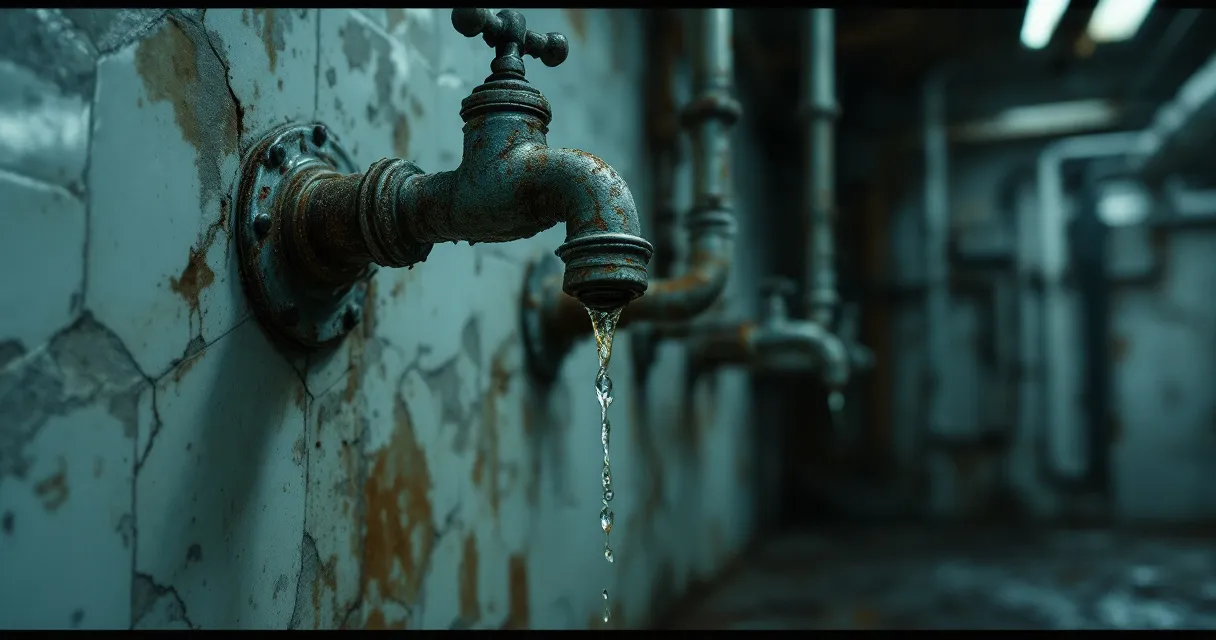
In October 2022, the Georgia Department of Public Health confirmed what men held at Autry State Prison in Pelham had suspected for more than a year: the water was contaminated with Legionella pneumophila, the bacterium that causes Legionnaires’ disease — a severe, sometimes fatal pneumonia. Local television reporting that month documented that positive tests had been surfacing at the prison for over a year. 1
Thirty days after that public confirmation, the Georgia Department of Corrections put the opposite in writing. When incarcerated men filed grievances about the water, the GDC Central Office answered — on official letterhead bearing the commissioner’s name:
There is no outbreak of Legionella at the facility.
That denial, dated November 30, 2022, is documented in the federal civil-rights complaints filed over these events — one month after the state’s own health agency and the corrections department had jointly acknowledged exactly such an outbreak.
That contradiction — a documented public confirmation, followed by a documented written denial — is the heart of this story. It is not the end of it.
The record behind it is largely public: federal civil-rights filings in the U.S. District Court for the Middle District of Georgia, the state’s own press releases and notices, contemporaneous reporting, and documents GPS has obtained. GPS is not naming the incarcerated men or their individual cases.
The water tested positive for more than a year
The first publicly attributed case dates to mid-2021, when a Georgia Department of Public Health spokesperson tied an inmate’s Legionella infection to bacteria within the prison’s water system. From that point through at least October 2022, the facility’s water was tested on a roughly biweekly basis and never produced the consecutive clean rounds that public-health protocol requires to close an investigation. The department’s stated response — raising chlorine levels and flushing the lines — did not resolve it. By 2022, the contamination had crossed from an internal record into the public one.
The prison closed. The people were moved. No one was tested.
In April 2023, GDC announced that Autry would be “temporarily vacated” while the state upgraded the facility’s “aging infrastructure systems, including HVAC, plumbing and security functions,” at a projected cost of roughly $11 million and a timeline of about twelve months. 2 The announcement named plumbing as part of the problem. It did not mention Legionella, the contamination, or the eighteen months of failed water tests that preceded it.
By the time the prison closed, it held just over 800 people — down from roughly 1,700 in earlier years — and that population was scattered to prisons across the state. Among the receiving facilities was Wilcox State Prison in Abbeville, where the facility’s medical staff and a number of the men were sent. According to the federal civil-rights complaints later filed over these events, the transfer was carried out without Legionella screening and without treatment for the years of exposure behind them. That omission matters: Legionella exposure is frequently symptom-free for months and can surface later, especially under repeat exposure. A population the state knew had spent years on contaminated water was moved into another aging prison and released back onto its water supply.
Wilcox’s own warden acknowledged the contamination — twice
Within months of the transfer, the warden’s office at one receiving prison issued two written notices to the incarcerated population — dated December 5, 2023 and March 14, 2024 — acknowledging Legionella in the water supply and warning that people 50 and older faced elevated risk. GPS holds both notices.
The sequence is its own indictment. The same corrections department that had denied an outbreak in writing in late 2022 was, by its own warden’s hand, confirming one at the receiving prison roughly a year later — in writing, to the people drinking the water.
The infections didn’t stop
Pharmacy dispensing records show repeated prescriptions of azithromycin (Zithromax) and trimethoprim-sulfamethoxazole (Bactrim) — antibiotics used to treat Legionella and its complications — to men at Wilcox running from December 2023 through at least October 2025.
Several men incarcerated at the prison have brought civil-rights complaints in the U.S. District Court for the Middle District of Georgia, alleging they were infected by the contaminated water, denied testing and adequate care, and — in at least one case — hospitalized; one is in his late seventies. The complaints also allege retaliation against men who complained, including restricted law-library access in the dormitory where they are housed. Those allegations are the plaintiffs’ claims, set out in the public federal court record and not yet tested at trial.
What is documented, independent of any one man’s account, is narrower and harder: the prison’s own notices acknowledge Legionella in the water, and the pharmacy record shows men being treated for it years after the state first confirmed the problem.
Why this keeps happening: thirty-year-old pipes built to grow it
This is not a one-prison story. Autry and Wilcox belong to a cluster of Georgia prisons built in the early 1990s that share the same water architecture: iron distribution mains, copper interior lines, central hot-water boilers, and thermostatic mixing valves that cool shower water to around 110°F — squarely inside the temperature band where Legionella thrives.
Once Legionella establishes itself in the biofilm coating the inside of aging pipes, it can become up to a thousand times more resistant to disinfection. Chlorine and flushing alone — the state’s stated fix — cannot clear it. Peer-reviewed work on the Flint, Michigan crisis maps the mechanism precisely: corroding iron consumes chlorine, the residual drops, and Legionella proliferates in the pipes nearest the tap. 3 GPS’s own January 2025 reporting on “blue water” at Washington State Prison — another facility in the same 1990s construction cohort — documented the copper corrosion that precedes colonization. 4
Specialists who have studied hospital and VA outbreaks have testified that once a building’s water system is contaminated, the contamination tends to persist for the life of the building. Georgia had fair warning of the stakes: in 2019, the state declined a public-health proposal to fold modern Legionella-management standards into its plumbing code; within months, Georgia recorded the largest Legionnaires’ outbreak in its history at an Atlanta hotel. 5
The “twelve-month” Autry upgrade is telling on its own terms. More than three years on, the prison has reopened only partially; as of spring 2026 it is operating at about two-thirds of its original design capacity. 6
What it costs everywhere else — and what Georgia did instead
Other systems have treated Legionella in custody as the emergency it is. A California prison health facility spent more than $8.5 million remediating after just two confirmed cases, one of them fatal, with much of its housing under water restrictions for months. 7 Illinois publicly disclosed positive results across six of its prisons. 8 9 In Indiana, the state paid $2.4 million to prisoners sickened by Legionella from contaminated prison water, and installed new mixing valves that alert officials when water temperatures enter the range where the bacteria thrive. 10
Georgia did something else. It confirmed an outbreak publicly, denied it in writing to the people drinking the water, moved them to another aging prison untested — and then, through its own warden’s notices, documented the problem reappearing there.
The men, for their part, say they asked again and again for something as simple as bottled water. The federal court record documents those requests being refused.
The bottom line
This is not a dispute of competing accounts. The state’s public-health agency confirmed the contamination. A television station reported it. The corrections commissioner’s office denied it in writing one month later. The receiving prison’s warden acknowledged it twice in writing. The pharmacy kept dispensing Legionella antibiotics for two more years.
Georgia’s prisons already record deaths at rates well above the national average for state prison systems. 11 In October 2024, the U.S. Department of Justice’s Civil Rights Division found that Georgia operates its prisons in violation of the Eighth Amendment, citing the state’s deliberate indifference to unsafe conditions and its failure to keep the people in its custody safe. 12 That investigation centered on violence, not water — but the constitutional standard is the same one these cases turn on: deliberate indifference to a known risk of serious harm. Running them on water the state knew was contaminated — and denying it on paper while doing so — is exactly the kind of documented failure that does not get fixed without public daylight.
Update, September 10, 2026: the state’s own outbreak records
On September 10, 2026, the Georgia Department of Public Health closed a GPS open records request and released its own outbreak records. The agency released two Outbreak Report summary sheets and withheld everything behind them. Both sheets are published here in full. Getting them took four weeks and a complaint to the Attorney General. On August 7, the South Health District told GPS in writing that district records systems are siloed and that the request belonged with the state. GPS filed with the state on August 13. DPH closed that request and referred GPS to the Department of Corrections, which does not conduct public-health investigations. The request was reopened with its original filing date, and on August 31 DPH closed it a second time with the same referral, no documents, and no exemption cited. GPS filed a complaint with the Attorney General’s Open Government Mediation Program that day and refiled the request. The two sheets arrived ten days later. 13
The first sheet, state outbreak ID 202403783, records a waterborne Legionella outbreak at Wilcox State Prison. First exposure November 9, 2023. First illness November 16, 2023. Reported to the state December 1, 2023. County environmental health, state environmental health and state epidemiology are each recorded as involved. Number died: 0.
The sheet also records that people got sick. Date of first illness, November 16, 2023. Number ill, withheld, which by the sheet’s own legend means between one and five. The definition printed on the same page treats an outbreak as two or more people with a similar illness after a documented common exposure, or, exceptionally, a single case of a disease rare or dangerous enough to investigate. DPH opened an investigation, gave it a number, recorded an illness date, and named the prison in the exposure field. Whatever it has found since, the state classified this as an outbreak at Wilcox.
The prescribing described earlier in this article begins in the same month. The pharmacy records run from December 2023 through at least October 2025. That is not a diagnosis and should not be read as one: azithromycin treats Legionnaires’ disease but treats ordinary pneumonia too, and trimethoprim-sulfamethoxazole is not a Legionella therapy at all. What the dates establish is narrower and still worth stating. The month the state opened its investigation is the month the prescribing started, and it ran for nearly two years after.
The second sheet, ID 20213040, records a waterborne Legionella outbreak in Mitchell County, where Autry State Prison sits. It was reported to the state on July 1, 2021, with the first illness on June 5, 2021, which matches the mid-2021 case described above. Its exposure-location field is blank where the Wilcox sheet names the prison. Its number-died field carries an asterisk. DPH’s own legend states that numbers between 1 and 5 are withheld to protect patient identity, and the Wilcox sheet prints an explicit 0 in that same field. We report the difference and stop there: the sheet states no number, and both sheets are stamped preliminary and subject to change.
Everything behind those two pages was refused. DPH withheld the sampling results, the lab reports, the environmental assessments and the correspondence as records “requested or collected as part of an outbreak or cluster investigation,” confidential under Ga. Comp. R. & Regs. 511-2-1-.03. Its letter is published here as written. 14
The same letter said the agency could “release the interim report in one investigation and the final report in another investigation, as one investigation is ongoing and one has been finalized.” It did not say which was which.
Four days later, WALB reported that the department says its Wilcox investigation has been ongoing since December 2023. What DPH gave the station, read closely, was general rather than specific: that Legionnaires’ investigations can take months or even years, that they involve finding the source, planning remediation and running repeated rounds of sampling, and that the steps are much the same wherever they happen. On Wilcox itself, the station reported that DPH provided no additional detail about where the investigation stands. December 2023 is the month printed on the outbreak sheet as the date the state was told. 15
Two years and nine months after the state was told, the file is still open.
Call to Action: What You Can Do
Georgia confirmed Legionella in prison water, denied it in writing to the people drinking it, moved them untested, and dispensed antibiotics for years. You just read the documents. If you stay silent, you're accepting that this is what accountability looks like. Share this story.
Spread the Word: It Takes One Click
Awareness without action changes nothing. Here’s how you can help push for accountability and real reform:
Join the GPS Advocacy Network — Sign up at https://gps.press/become-an-advocate/ and we’ll advocate on your behalf every week. GPS identifies your state legislators, crafts personalized letters on the most pressing prison issues, and sends them directly to the representatives who represent you. You receive a copy of every letter. It takes two minutes to sign up — we handle the rest.
Tell My Story — Are you or a loved one affected by Georgia’s prison system? GPS publishes first-person accounts from incarcerated people and their families. Submit your story at https://gps.press/tellmystory and help the world understand what’s really happening behind the walls.
Contact Your Representatives — Your state legislators control GDC’s budget, oversight, and the laws that created these failures. Find your Georgia legislators at https://gps.press/find-your-legislator/ or call Governor Kemp at (404) 656-1776 or the GDC Commissioner at (478) 992-5246.
Demand Media Coverage — Contact newsrooms at the AJC, local TV stations, and national criminal justice outlets. More coverage means more pressure.
Amplify on Social Media — Share this article and tag @GovKemp, @GDC_Georgia, and your local representatives. Use #GAPrisons, #PrisonReform, #GeorgiaPrisonerSpeak.
File Public Records Requests — Georgia’s Open Records Act gives every citizen the right to request incident reports, death records, staffing data, medical logs, and financial documents at https://georgiadcor.govqa.us/WEBAPP/_rs/SupportHome.aspx.
Attend Public Meetings — The Georgia Board of Corrections and legislative committees hold public meetings. Your presence is noticed.
Contact the Department of Justice — File civil rights complaints at https://civilrights.justice.gov. Federal oversight has forced abusive systems to change before.
Support Organizations Doing This Work — Donate to or volunteer with Georgia-based prison reform groups fighting for change on the ground.
Vote — Research candidates’ positions on criminal justice. Primary elections often determine outcomes in Georgia.
Contact GPS — If you have information about conditions inside Georgia’s prisons, reach us securely at GPS.press.
Part of Something Bigger
This article is part of the GPS Reform Agenda — two active campaigns to transform Georgia’s criminal justice system.
End the Warehouse THIS SERIES
Transform Georgia’s prisons from punishment to rehabilitation. Two tracks: litigation to reduce overcrowding + evidence-based programs that work.
Four model bills for the 2027 Georgia legislature. The legislature doesn’t need new laws — it needs to enforce two dormant statutes it already passed.
Read the full GPS Reform Agenda →
Further Reading
Forced to Drink: Blue Water Scandal at Washington Prison
Inside another 1990s-era Georgia prison, discolored “blue water” exposed the copper corrosion that precedes Legionella colonization.
Dunked, Stacked, and Served: Why Georgia Prison Trays Are Making People Sick
How Georgia’s prison food handling turns aging infrastructure into a recurring public-health hazard.
When the Heat Comes for the Old: Georgia’s Aging Prisoners Brace for Another Deadly Summer
Elderly people in Georgia custody face environmental conditions their bodies can no longer withstand.
Guthrie v. Evans: 13 Years of Reform, Erased Overnight
How hard-won, court-ordered reforms inside Georgia’s prisons were allowed to lapse.
Mission Failure: Georgia Spends $1.8 Billion on Prisons and $52 Per Person on Rehabilitation
Where Georgia’s corrections money goes — and where it doesn’t.
GPS Intelligence System
The GPS Intelligence System maintains living research profiles that aggregate data, news, settlements, and analysis on Georgia’s prisons and the issues defining them. The profiles below provide deeper context for the issues raised in this article:
Living research on the environmental and structural conditions across Georgia’s prisons — water, sanitation, and aging infrastructure among them.
Tracking GDC’s failures to diagnose, treat, and document serious medical needs behind bars.
Explore the Data
GPS makes GDC statistics accessible to the public through several resources:
- GPS Statistics Portal — Interactive dashboards translating complex GDC reports into accessible formats, updated within days of official releases.
- GPS Lighthouse AI — Ask questions about Georgia’s prison system and get answers drawn from GPS’s investigative archive and data analysis.
- GPS llms.txt — A single machine-readable index of every GPS data resource, published using the open llms.txt standard. Point any AI tool (ChatGPT, Claude, Gemini, Perplexity) at this URL and the model can navigate to facility profiles, intelligence briefs, mortality records, statistics, and the full investigative archive — no other configuration needed. It is the fastest way to ground an AI conversation in verified GPS data.
For a walkthrough of how to put these resources to work with AI, see How to Use GPS Data with AI Tools — a step-by-step guide for researchers, advocates, families, and journalists analyzing Georgia prison conditions, statistics, and policy with tools like ChatGPT, Claude, and Gemini.
Contact GPS at media@gps.press for access to underlying datasets used in this analysis.
About Georgia Prisoners’ Speak (GPS)
Georgia Prisoners’ Speak (GPS) is a nonprofit research organization built in partnership with incarcerated reporters, families, advocates, and data analysts. Operating independently from the Georgia Department of Corrections, GPS documents the truth the state refuses to acknowledge: extreme violence, fatal medical neglect, gang-controlled dorms, collapsed staffing, fraudulent reporting practices, and unconstitutional conditions across Georgia’s prisons.
Through confidential reporting channels, secure communication, evidence verification, public-records requests, legislative research, and professional investigative standards, GPS provides the transparency the system lacks. Our mission is to expose abuses, protect incarcerated people, support families, and push Georgia toward meaningful reform based on human rights, evidence, and public accountability.
Every article is part of a larger fight — to end the silence, reveal the truth, and demand justice.
The Architecture Is the Evidence
Across the 32 state prisons whose original design figures we hold, Georgia built for 15,737. They hold 33,805 — 215% of design capacity.
Dorms tripled. Cells double- and triple-bunked. Medical, kitchens, libraries — unchanged. Every facility, every design figure, every source.
See the receipts →- WALB-TV, Oct 21 2022, https://www.walb.com/2022/10/21/glass-half-empty-dph-confirms-positive-legionella-tests-autry-state-prison-more-than-year/ [↩]
- GDC press release, April 17 2023, https://gdc.georgia.gov/press-releases/2023-04-17/autry-state-prison-be-temporarily-vacated [↩]
- Rhoads et al., Pathogens 2020, https://www.mdpi.com/2076-0817/9/9/730 [↩]
- GPS, Forced to Drink: Blue Water Scandal at Washington Prison, https://gps.press/blue-water/ [↩]
- Circle of Blue, December 2019, https://www.circleofblue.org/2019/world/against-advice-of-health-officials-georgia-rejects-legionella-rules-in-new-plumbing-code/ [↩]
- GPS Facilities Directory, https://gps.press/facilities-directory/ [↩]
- Wes Venteicher, “Millions spent at California prison with contaminated water 7 months after inmate’s death,” Sacramento Bee, October 15, 2019, https://www.sacbee.com/news/politics-government/the-state-worker/article236211403.html [↩]
- Prison Legal News, January 2023, https://www.prisonlegalnews.org/news/2023/jan/1/potentially-fatal-legionella-bacteria-found-six-illinois-prisons/ [↩]
- InjusticeWatch, 2022, https://www.injusticewatch.org/news/prisons-and-jails/2022/illinois-prisons-legionella-outbreak/ [↩]
- Prison Legal News, November 2025, https://www.prisonlegalnews.org/news/2025/nov/1/24-million-paid-to-indiana-prisoners-sickened-with-legionnaires-disease-by-contaminated-water/ [↩]
- GPS Mortality Statistics, https://gps.press/gdc-mortality-statistics/ [↩]
- U.S. Department of Justice, October 1 2024, https://www.justice.gov/usao-sdga/pr/justice-department-finds-unconstitutional-conditions-georgia-prisons [↩]
- Georgia Department of Public Health, Outbreak Reports 202403783 and 20213040, released to Georgia Prisoners’ Speak under Open Records Act request ORR 2026-786. DPH does not publish these sheets; the copy released to GPS is reproduced at https://gps.press/wp-content/uploads/2026/09/gps-dph-legionella-outbreak-reports-orr-2026-786.pdf [↩]
- Georgia Department of Public Health, response to Open Records Act request ORR 2026-786, September 10, 2026. The agency’s letter is not published anywhere by DPH; the text as received is reproduced at https://gps.press/wp-content/uploads/2026/09/gps-dph-orr-2026-786-response-letter.pdf [↩]
- Ty Grant, “Wilcox State Prison legionnaires’ disease investigation enters third year,” WALB, September 14, 2026, https://www.walb.com/2026/09/14/wilcox-state-prison-legionnaires-disease-investigation-enters-third-year/ [↩]
You Have Options
Free tools to take action — the law is on your side.
Demand records from the prison system. Reach the officials who set policy. File a grievance or a complaint the right way. And for families who’ve lost someone in custody, get the records that tell the truth. Plain-language, step-by-step, and free.
Explore the GPS Toolkits →