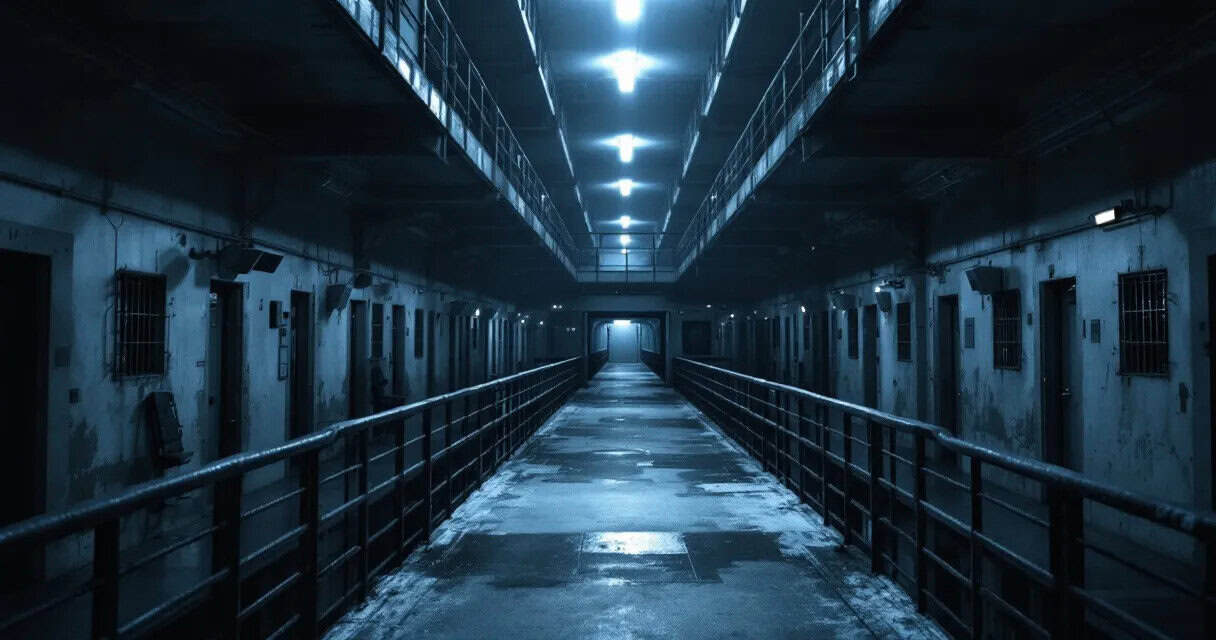
Tyler Chase Ryals spent nearly a decade inside Georgia’s prisons — not as a prisoner, but as one of the officers the state trusted to run them. He walked into Telfair State Prison, which he calls one of the most violent prisons in America, straight out of high school, and over the next nine years and eleven months he worked at five state prisons and rose to Correctional Emergency Response Team (CERT) Commander at Telfair, Valdosta, and Johnson. When Georgia’s prisons had an emergency, Ryals was the man the state sent in.
So when Ryals says the system is collapsing, he is not an outside critic. He is describing the job he was trained to do, and the conditions he says made it impossible. On August 1, 2024, he put it in writing. Twelve days later, the state’s records say he resigned. He never wrote a resignation letter. Today, he is on a hunger strike.
The man the state sent in
Ryals’s account of his own career is confirmed by his Georgia Department of Corrections service record: employed September 2, 2014 through August 13, 2024, across five state prisons, as an officer, a sergeant, a lieutenant, and ultimately a CERT commander — the officers sent into riots, cell extractions, and mass-casualty fights. He was not a disgruntled newcomer. He trained the people who did the job.
That is what makes his warning hard to wave away. It did not come from an activist or a family member. It came from the state’s own emergency-response commander.
What he swore
On August 1, 2024, Ryals filled out the Department of Corrections’ own sworn witness-statement form — three pages, signed and initialed at Washington State Prison. In it, he warned GDC leadership that the agency had been on “a downward spiral,” that violence against staff and prisoners had risen dramatically, and that drugs and contraband had flooded the institutions.
His central alarm was staffing. Ryals wrote that the prisons faced a major deficiency of able-bodied male officers — to the point that lockdown posts once manned by several officers were now being worked by lone female officers, and hospital trips guarded by two women alone. He had, he swore, already personally seen examples of this leading to bloody female officers who in most cases were saved by other inmates. In one sentence, that describes who was actually keeping order.
He asked for specific, concrete fixes:
- No solo female officer escorts without backup
- A three-officer rule before any lockdown door is opened
- An honest investigation into what the accreditation push had done to safety
- Real recruitment and support for the prisons that had been hollowed out
In the same statement, Ryals warned that inmate suicides had risen sharply in recent years — a trend consistent with Georgia’s own custodial death records. 1
The refusal
Then Ryals did something that reads, in hindsight, like a man who knew what was coming. He closed the sworn statement by refusing to keep completing the accreditation paperwork until the safety problems were addressed — and added a line acknowledging the risk:
I am aware that I could face disciplinary action for this viewpoint.
Twelve days later, he was gone.
Twelve days later
The state’s version is bureaucratically tidy: a Georgia Department of Labor separation notice, signed by a GDC human-resources analyst on August 13, 2024, lists the reason for his departure as “Employee resigned.”
Ryals says that is not what happened. By his account, he was told to resign in lieu of termination and refused; he never wrote a resignation letter; the Assistant Commissioner tried to keep him with excuses and the offer of another position; and when he declined, the department simply recorded a resignation anyway. “Zero issues were addressed, and I was asked to resign in lieu of termination,” he writes in the public account posted to his YouTube channel. “I told them to do their paperwork.” 2 GDC’s records list a resignation. Ryals never submitted one.
What the Justice Department found
What makes his warning impossible to dismiss is what happened after he was pushed out.
Two months later, on October 1, 2024, the United States Department of Justice announced that conditions in Georgia’s prisons violate the Eighth Amendment to the Constitution — a pattern and practice of failing to protect incarcerated people from violence, driven by exactly the forces Ryals had named: critical understaffing and gangs allowed to control entire housing units. 3
And the Justice Department was not the only body to reach that conclusion. The state’s own consultant, Guidehouse — hired at a cost of roughly 2.7 million dollars — found the system in “emergency mode,” with 20 of 34 state prisons at emergency officer-vacancy levels and gangs “effectively running some facilities.” 4
Ryals had described the same reality from the inside, in the plainest possible terms.
In his own words
In public interviews, Ryals has described a system where the people in charge are not always the ones wearing the uniform.
The Department of Justice is basically reporting that the gangs control the prison — that they basically run rampant.
“They tell the COs, ‘Hey, we’re moving so-and-so into this cell,’ and they get the cell moves,” he said. 5 At the emptied-out facilities, he has said, an officer might not set foot in a building for five hours at a stretch — long enough for anything to happen. He recalled a shift where “there are five officers here, and two had to go to the hospital.” 5
He has also described a single Telfair gang fight that spread to “three buildings, all at one time” — “like a war at the prison” — that put seven or eight men in the hospital. 6 He does not tell these stories to sensationalize them. He tells them because he believes nothing has changed. “I got retaliated against and exited from my career,” he said, “for raising the concerns that I raised in 2024.”
The hunger strike
Ryals is no longer paid to keep this system running. He is now trying to end it. Since early July he has been on a hunger strike — water and salt only.
I, Tyler C. Ryals, hereby declare a personal hunger strike/water fast to recognize the many lives lost in the unconstitutional conditions present inside the majority of Georgia’s prisons — and to recognize all the lives currently being affected by these inexcusable conditions. There are tens of thousands of humans in Georgia negatively affected by this ignored crisis every day: prison staff, inmates, and the families of both.
That last phrase — staff, inmates, and the families of both — is the whole of it. The families of incarcerated Georgians are now rallying behind a former officer, because for once, someone who wore the uniform is saying out loud what they have said for years. Ryals has taken his account public, posting nearly fifty videos of first-person testimony to his channel, @TylerRyalsX. 7
“If it weren’t for things getting way, way worse,” he has said, “and the state refusing to do any kind of corrective action, I wouldn’t even be here now, trying to advocate.”
He warned them on the record. The Justice Department proved him right. Georgia has still done nothing.
Call to Action: What You Can Do
You just read about people suffering in state custody. The least you can do is make sure other people read it too. Share this story.
Spread the Word — It Takes One Click
Tyler Ryals warned the state in writing, and the Justice Department proved him right — yet Georgia has done nothing. Awareness without action changes nothing. Two of the fixes he demanded are immediate and concrete: put enough officers on the floor, and separate the gang populations the DOJ found are controlling entire dorms. Here is how you can help push for that accountability and real reform:
Back the End the Warehouse Campaign — GPS’s End the Warehouse campaign targets the overcrowding and warehousing that drive the staffing collapse and gang control Ryals described from the inside. Learn it, share it, and tell your legislators to support it — including the concrete demand to separate rival gang populations rather than let them run the dorms.
Join the GPS Advocacy Network — Sign up at https://gps.press/become-an-advocate/ and we’ll advocate on your behalf every week. GPS identifies your state legislators, crafts personalized letters on the most pressing prison issues, and sends them directly to the representatives who represent you. You receive a copy of every letter. It takes two minutes to sign up — we handle the rest.
Send a 60-Second Message — Pick an issue, get a ready-to-edit message with the verified facts already in it, and email your state House representative and senator directly from your own inbox at https://gps.press/send-a-message/. No signup, nothing stored — it takes about a minute.
Tell My Story — Are you or a loved one affected by Georgia’s prison system? GPS publishes first-person accounts from incarcerated people and their families. Submit your story at https://gps.press/category/tellmystory/ and help the world understand what’s really happening behind the walls.
Contact Your Representatives — Your state legislators control GDC’s budget, oversight, and the laws that created these failures. Find your Georgia legislators at https://gps.press/find-your-legislator/ or call Governor Kemp at (404) 656-1776 or the GDC Commissioner at (478) 992-5246.
Demand Media Coverage — Contact newsrooms at the AJC, local TV stations, and national criminal justice outlets. More coverage means more pressure.
Amplify on Social Media — Share this article and tag @GovKemp, @GDC_Georgia, and your local representatives. Use #GAPrisons, #PrisonReform, #GeorgiaPrisonerSpeak.
Contact the Department of Justice — File civil rights complaints at https://civilrights.justice.gov. Federal oversight has forced abusive systems to change before.
Vote — Research candidates’ positions on criminal justice. Primary elections often determine outcomes in Georgia.
Contact GPS — If you have information about conditions inside Georgia’s prisons, reach us securely at GPS.press.
Further Reading
Crisis in Georgia’s Prisons: What Experts Say
How independent experts describe the violence, staffing, and gang control inside Georgia’s prisons.
GPS’s campaign to end the overcrowding and warehousing that fuel the crisis Ryals documented.
The mortality data behind the crisis, including the suicide trend Ryals warned about.
No Way Out: A GPS Investigative Series
GPS’s investigative series on how Georgia’s system traps people inside a failing institution.
GPS Intelligence System
The GPS Intelligence System maintains living research profiles that aggregate data, news, settlements, and analysis on Georgia’s prisons and the issues defining them. The profiles below provide deeper context for the issues raised in this article:
The collapse in correctional staffing that Ryals warned about in his sworn statement.
Tracking the gang-driven violence the DOJ and GPS have documented across Georgia’s prisons.
Explore the Data
GPS makes GDC statistics accessible to the public through several resources:
- GPS Statistics Portal — Interactive dashboards translating complex GDC reports into accessible formats, updated within days of official releases.
- GPS Lighthouse AI — Ask questions about Georgia’s prison system and get answers drawn from GPS’s investigative archive and data analysis.
- GPS llms.txt — A single machine-readable index of every GPS data resource, published using the open llms.txt standard. Point any AI tool (ChatGPT, Claude, Gemini, Perplexity) at this URL and the model can navigate to facility profiles, intelligence briefs, mortality records, statistics, and the full investigative archive — no other configuration needed. It is the fastest way to ground an AI conversation in verified GPS data.
For a walkthrough of how to put these resources to work with AI, see How to Use GPS Data with AI Tools — a step-by-step guide for researchers, advocates, families, and journalists analyzing Georgia prison conditions, statistics, and policy with tools like ChatGPT, Claude, and Gemini.
Contact GPS at media@gps.press for access to underlying datasets used in this analysis.
About Georgia Prisoners’ Speak (GPS)
Georgia Prisoners’ Speak (GPS) is a nonprofit investigative newsroom built in partnership with incarcerated reporters, families, advocates, and data analysts. Operating independently from the Georgia Department of Corrections, GPS documents the truth the state refuses to acknowledge: extreme violence, fatal medical neglect, gang-controlled dorms, collapsed staffing, fraudulent reporting practices, and unconstitutional conditions across Georgia’s prisons.
Through confidential reporting channels, secure communication, evidence verification, public-records requests, legislative research, and professional investigative standards, GPS provides the transparency the system lacks. Our mission is to expose abuses, protect incarcerated people, support families, and push Georgia toward meaningful reform based on human rights, evidence, and public accountability.
Every article is part of a larger fight — to end the silence, reveal the truth, and demand justice.
The Architecture Is the Evidence
Georgia built prisons for 24,657. They warehouse 52,771.
Dorms tripled. Cells double- and triple-bunked. Medical, kitchens, libraries — unchanged. Every facility, every design figure, every source.
See the receipts →- GPS GDC Mortality Statistics, https://gps.press/gdc-mortality-statistics/ [↩]
- Tyler Ryals, public statement, YouTube channel @TylerRyalsX, https://www.youtube.com/@TylerRyalsX [↩]
- U.S. Department of Justice, Findings Report on Georgia’s Prisons, October 1 2024, https://www.justice.gov/archives/opa/pr/justice-department-finds-unconstitutional-conditions-georgia-prisons [↩]
- Guidehouse GDC Assessment Report, https://gps.press/wp-content/uploads/2025/01/Guidehouse_Report.pdf [↩]
- Tyler Ryals interview, Yard Down Productions, https://youtu.be/EAuJuWFoRq8 [↩][↩]
- Tyler Ryals interview on the Telfair gang fight, https://youtu.be/3F2RMRDEdzE [↩]
- Tyler Ryals, firsthand testimony, YouTube channel @TylerRyalsX, https://www.youtube.com/@TylerRyalsX [↩]