There is currently a petition circulating to fire the Commissioner of the Georgia Department of Corrections. Georgia Prisoners’ Speak takes no position on this. There is a crisis in the Georgia prison system. We applaud those wanting change—it’s needed.
With certainty, we can tell you what firing the commissioner will not do. It will not fix the crisis.
Not because the Commissioner is blameless — the failures GDC owns are documented at length below and elsewhere. It will not fix the crisis because the crisis was not built inside the agency, and the parts the agency does own are not the failures of one man. All 43 of Georgia’s active state-prison wardens were promoted from inside GDC. Across the warden and deputy-warden tier, 87 of 88 rose through the agency’s own ranks. Zero came from outside. A culture that closed is not reformed by replacing the name at the top of it; at most, a capable leader can set a years-long correction in motion — and rooting out corruption is the slowest correction there is.
If you want to know who built Georgia’s prison crisis, you have to follow the money. And the money tells a story that no personnel change can answer.
Eight flat years
For eight straight years, Georgia ran its prison system on roughly $1.2 billion a year.
From FY2014 through FY2021, the Department of Corrections’ total-funds budget grew from $1,187,441,539 to $1,221,712,479 (actual, total funds) — an increase of $34,270,940, or 2.89 percent, across the entire period. That is about 0.4 percent a year, below inflation in every one of those years. In real terms, Georgia’s corrections budget shrank for most of a decade. 1 2
The prisons did not collapse in that window. They were violent, understaffed, and neglected — GPS has documented all three — but the state’s position, revealed by its appropriations, was that roughly $1.2 billion was what running this system was worth.
Then the money came.
The surge
Beginning in FY2022, the General Assembly and Governor Brian Kemp turned on the spigot. Every budget of the surge — FY2022 through FY2027 — was passed by the same legislature and signed by the same governor, in office since January 2019. No one who built this spending record has left the building.
Between FY2021 and FY2025 — realized spending, not promises — the annual budget rose from $1.22 billion to $1.91 billion. That is a 56.7 percent increase in four years, following eight years of 2.89 percent. Strip out the one-time federal COVID relief and the growth is starker, not smaller: state general funds alone rose 60.3 percent, from $1.14 billion to $1.82 billion. This was not Washington’s money passing through. It was Georgia’s own recurring commitment, enacted year after year by the legislature and signed by the governor.
Two numbers describe what happened next, and this article rests on both. State them in this order, always.
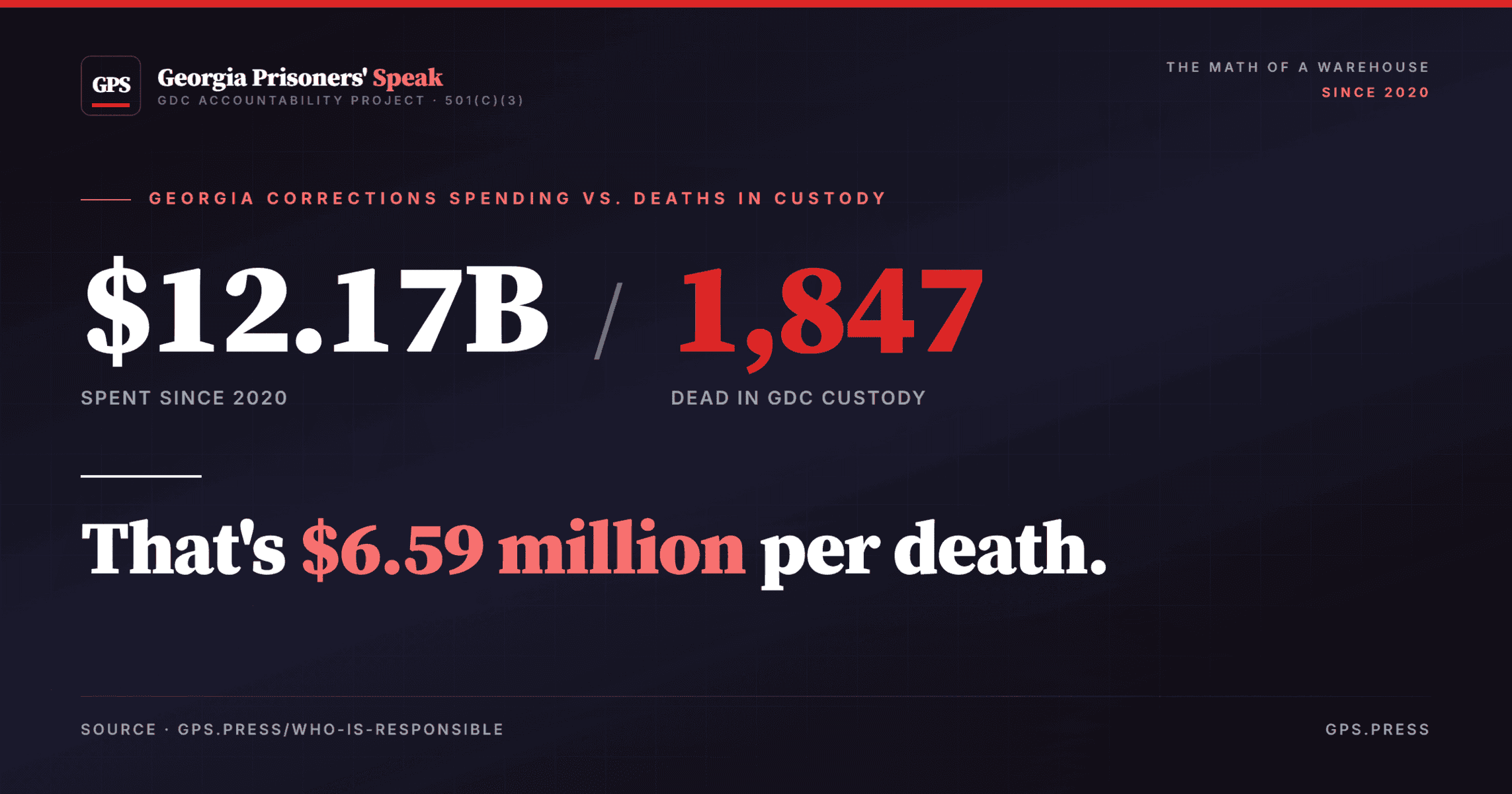
Since 2020, Georgia has spent $12.2 billion running its prison system. That is the gross figure — $12,174,087,786 in total funds across FY2020 through FY2027 — the full weight of what this system costs the public. 3 4
Of that, $2.4 billion was new money. Measured against the FY2021 baseline — the last year before the surge — cumulative spending above that line comes to $2,394,494,976 across FY2022 through FY2027. New money, on top of what the state was already spending. The largest corrections funding increase in Georgia history.
A note on basis, stated plainly because we hold ourselves to it: both figures combine realized spending for FY2020–FY2025 with the amended FY2026 and approved FY2027 appropriations — the best available basis for each year. Counting only the years already realized, the gross figure is $8.59 billion through FY2025 and the above-baseline figure is $1.25 billion through FY2025. Every component year is published, by fiscal year and basis, in the state’s own budget reports. 5 GPS republishes the same figures in a single human-readable table, and — for researchers who want the full per-year series programmatically — as machine-readable data. 6
What they bought with it
Follow the new money to its line items and Georgia’s priorities are not hidden. They are itemized.
Across the two most recent budget cycles, the state added roughly $89.7 million in prison health contracts and $49 million in correctional officer pay and staffing. More medicine. More guards.
The health money was not generosity. It was a bill coming due — twice over. Georgia’s refusal to release aging prisoners has built one of the oldest prison populations in the country, and elderly prisoners are, by an order of magnitude, the most expensive people to incarcerate. And the violence the state has lost control of generates its own invoices: every stabbing that ends in an outside hospital is a bill the state pays at hospital rates, under guard, both ways. The health line is not an investment in care. It is the cost of warehousing people into old age inside facilities the state cannot keep safe.
Now look at what the same budgets did to the programs that reduce the population instead of managing it.
Substance abuse. The FY2027 budget withdrew $8,273,423 in state funds from opioid abuse programs — and backfilled the gap with Opioid Settlement Trust Fund money. Read the maneuver precisely, because the state will call it a wash: services notionally continue, but Georgia moved its recurring, permanent commitment off its own books and onto a finite settlement pot that will run dry. When it does, the state money is already gone. That is not level funding. It is a quiet withdrawal, executed behind one-time money. 7 8
Education. The governor’s own FY2027 proposal included $953,033 for the staff required to keep the high school diploma program accredited. The legislature’s approved budget deleted it — and instead cut $104,000 from the diploma program, with instructions to “explore virtual high school options.” The point is not the size of the cut but its direction, taken in the same session that added tens of millions elsewhere. The best evidence in corrections research — a RAND meta-analysis of 57 studies — finds prison education cuts the odds of reoffending by 43 percent. It is among the most cost-effective lines in the budget, and it is the one Georgia zeroed out its own governor’s request for. 9
Read those lines together. Georgia is buying more guards and more medicine for a population it will not reduce — while pulling state money out of the two programs with the strongest evidence of reducing it. The state is paying, at enormous and growing expense, to manage the consequences of its own sentencing and release policies, and defunding the things that would shrink those consequences.
That is not a budget under strain. That is a choice, renewed annually, in writing.
What the same budgets chose not to buy
Read the same documents past the headline totals and a second story appears — not in what Georgia spent, but in what it declined to. In the amended FY2026 budget the state added $13,387,475 for managed access and drone detection systems to stop contraband from entering its prisons. The approved FY2027 budget directs a further $10,793,600 of existing funds to the same systems and adds $409,040 for five managed access analysts to run them 10.
Set against that, consider what happened to the one program in this budget designed to send someone home with something they did not arrive with. In the amended FY2026 budget the state provided $93,672 for the staff required to accredit a high school diploma program inside its prisons. The Governor’s FY2027 proposal would have built on it, requesting $953,033 for the staffing that accreditation requires.
The budget that actually passed did not fund it. Instead, the approved FY2027 appropriation reduced funds for the high school diploma program by $104,000 and directed the department to “explore virtual high school options” 11.
Georgia found eight figures to detect what comes over the fence, and could not find one million dollars to accredit a high school on the other side of it.
Neither decision is irrational on its own. Contraband kills people in Georgia’s prisons, and the drones are real. But a budget is a ranked list of what a state believes will work, and this one ranks interdiction technology an order of magnitude above education. It is the spending pattern of an institution that has decided its job is to contain a population rather than to return people to the outside changed. That is a choice, it was made in public, and it is written down.
What the money produced
Here is what $2.4 billion in new spending purchased, measured by the state’s own outcomes.
The vacancy rate did not move — and the real number is worse than the official one. As of the most recent data, 2,985 of 5,991 budgeted correctional officer positions sit empty — 49.8 percent, systemwide, after a $49 million staffing investment and years of raises. Of the officers Georgia does hire, 82.7 percent leave within their first year. 12 13
But the 49.8 percent is an average, and the average is doing work for the state. A former GDC deputy warden, speaking publicly in a recorded interview, described the mechanism: the systemwide figure blends the transition centers, halfway houses, and probation detention centers — small satellite facilities that “might be fully staffed” — with the state prisons, where he put the vacancy rate at 70 to 80 percent at facilities like Telfair, Hancock, Smith, Valdosta, Macon, Autry, and Calhoun. The dangerous facilities are the empty ones, and the safe facilities pad the average. The same former deputy warden said regional directors told him to lie on staffing reports — “to act like everything’s okay” — and described managing a thousand close-security prisoners with three or four officers and one lieutenant. “Maybe on a good day, five or six.”
The state’s own records corroborate the floor he described.
On January 11, 2026 — the day a gang war broke out at Washington State Prison — GDC’s response to a GPS open records request shows six officers were on duty at the facility.
Deaths reached a record. At least 1,847 people have died in GDC custody since January 1, 2020 — as of July 15, 2026, and rising, because GDC reports deaths roughly two months in arrears. The deadliest years in the recorded history of Georgia’s prison system are the same years as the largest funding increase in its history. GPS maintains this death count itself, reconstructing each death and its cause from county coroners, medical examiners, GBI autopsy reports, and death certificates — the primary records the state does not control — because GDC stopped publishing cause of death. The full record is public and searchable, and the methodology is documented in detail. 14
A federal investigation found the agency had lost control. On October 1, 2024, the United States Department of Justice concluded an eight-year civil rights investigation of Georgia’s prisons — opened in 2016, expanded in 2021 — and found, in its own words, that the leadership of the Georgia Department of Corrections had lost control of its facilities. The same report documented that GDC’s public homicide count could not be reconciled with GDC’s own internal incident reports. 15
Money went in. The vacancy rate held. The deaths climbed. The federal government concluded the agency was not in control of its own prisons.
“We are under-resourced” is not available as a defense. You cannot answer $12.2 billion by asking for more. And you cannot answer “$2.4 billion in new money changed nothing” at all.
The number that will be quoted against this article
Someone will respond that GDC’s budget was just cut — that the FY2027 budget is smaller than what came before, and that the state is now retrenching. Be precise about this, because the two numbers get swapped constantly, sometimes innocently.
Georgia’s current approved corrections budget — FY2027 — is $1.79 billion (FY2027 approved). The historical peak was $1.91 billion, in FY2025, on a realized basis (FY2025 actual). The FY2027 approved figure sits just below the FY2026 amended budget and below the FY2025 peak, and above every year that preceded the surge. A budget that quadrupled its growth rate, peaked, and settled a few points below that peak is not a budget in retreat. It is a budget that plateaued at altitude.
And the FY2027 figure is not final. Georgia amends its budget every January when the legislature reconvenes, and in each of the last several years the mid-year amendment has moved the corrections number up, not down. The $1.79 billion “approved” figure is the opening bid. By the time FY2027 closes, it may well stand as the new historical high — which is worth remembering the next time the approved number is offered as evidence of restraint.
The current budget and the historical peak are different numbers on different bases from different years. Any argument that uses one where the other belongs — in either direction — should be discarded, including ours.
Who owns what
None of this is an argument that GDC is blameless, and none of it is an argument that GDC is helpless. The division of responsibility is specific, and it matters, because reform aimed at the wrong institution fixes nothing.
The General Assembly and the governor own the crisis itself. The population was built in statute: the 1995 “Seven Deadly Sins” mandatory minimums, the 1997 ninety-percent policy, the 2006 law that moved parole eligibility on life sentences from 14 years to 30. The money was appropriated by the same body that wrote those statutes. The legislature built the population, then spent $12.2 billion managing it rather than one dollar reducing it.
The Board of Pardons and Paroles owns the back door. Parole release has collapsed from 69.9 percent in 1993 to 34.3 percent in 2024 — not by any change in law, but by a change in practice, made by a board that does not have to explain itself. In FY2024 it granted parole in just 4.5 percent of the life-sentence cases it considered — 93 of 2,046. When the front door is held open by statute and the back door is held shut by practice, the population accumulates no matter what the agency in the middle does. 16 17 18
GDC owns how people are treated inside — and it owns the coverup. Food, medical care, lockdowns as a substitute for management, and housing practices are GDC’s, documented elsewhere and not re-argued here. And the concealment is GDC’s alone — and it runs far past the death data.
The deaths are the known instance: the agency stopped publishing cause of death, refused open-records requests for the historical causes it had already determined, and reported homicide figures the Department of Justice found could not be reconciled with GDC’s own incident reports. But the same machinery operates on everything else. Open records requests are how the public — and this newsroom — sees inside an agency that controls every other channel of information about itself. GDC’s answer to that scrutiny has been delay past the legal deadline, categorical exemption theories, and price tags: $88,944 to see the ledger of an inmate welfare fund filled with families’ money — and that quote covered retrieval only, with GDC expressly declining to estimate the cost of review and redaction, so the real figure is higher still; $6,370.54 to learn what happened to a $45 million staffing appropriation; $1,320 for one page certifying the caloric value of a prison meal — at least $96,000 quoted across four requests to date, and rising, with a release dataset denied outright under a theory the agency refutes every time it publishes the same data itself.
The tell is the control case. When GPS requested the master commissary price file — a subject with no scandal attached — GDC produced it promptly, at no cost. The agency can comply. What varies is the subject matter: money, food, staffing, and deaths get priced, delayed, or exempted. An agency does not spend this much effort making its records unaffordable unless the records are worth that much to hide. Georgians paid $12.2 billion for this system; GDC’s position is that they may not see the receipts.
The crisis was manufactured upstream. The decision to hide it from the public — its toll, its staffing, its money — was made inside the agency.
That is why firing one man fixes nothing. The Commissioner did not write the sentencing laws, does not sit on the parole board, and did not confirm his own budget. Replace him and every one of those structures survives the afternoon. The leadership culture that promoted 87 of 88 senior leaders from within survives too — his successor will almost certainly be the 88th.
What would actually count as an answer
The test for any proposed fix is whether it touches the machinery that builds the population or only the agency that warehouses it.
Sentencing reform touches it. Parole reform touches it. Restoring the money stripped from substance abuse treatment and education touches it. An open-records regime that GDC cannot price its way out of touches the coverup. A new commissioner touches none of it — though Georgians may get one anyway, and should judge the next one by whether he tells the General Assembly the one thing no commissioner has ever told it: stop sending us people.
$12.2 billion since 2020. $2.4 billion of it new. The deadliest years in the system’s history. The money has been tried. What Georgia has not tried is changing a single one of the decisions that made the money necessary.
Call to Action: What You Can Do
1,847 people have died in Georgia prisons since 2020, and the state spent $12.2 billion to produce that record. Sharing this story is the simplest line between reading it and refusing to look away. If you stay silent, the same legislature that built this crisis will assume you are not watching.
Spread the Word — It Takes One Click
Awareness without action changes nothing. Here’s how you can help push for accountability and real reform:
Join the GPS Advocacy Network — Sign up at https://gps.press/become-an-advocate/ and we’ll advocate on your behalf every week. GPS identifies your state legislators, crafts personalized letters on the most pressing prison issues, and sends them directly to the representatives who represent you. You receive a copy of every letter. It takes two minutes to sign up — we handle the rest.
Send a 60-Second Message — Pick an issue, get a ready-to-edit message with the verified facts already in it, and email your state House representative and senator directly from your own inbox at https://gps.press/send-a-message/. No signup, nothing stored — it takes about a minute.
Tell My Story — Are you or a loved one affected by Georgia’s prison system? GPS publishes first-person accounts from incarcerated people and their families. Submit your story at https://gps.press/category/tellmystory/ and help the world understand what’s really happening behind the walls.
Contact Your Representatives — Your state legislators control GDC’s budget, oversight, and the laws that created these failures. Find your Georgia legislators at https://gps.press/find-your-legislator/ or call Governor Kemp at (404) 656-1776 or the GDC Commissioner at (478) 992-5246.
Demand Media Coverage — Contact newsrooms at the AJC, local TV stations, and national criminal justice outlets. More coverage means more pressure.
Amplify on Social Media — Share this article and tag @GovKemp, @GDC_Georgia, and your local representatives. Use #GAPrisons, #PrisonReform, #GeorgiaPrisonerSpeak.
File Public Records Requests — Georgia’s Open Records Act gives every citizen the right to request incident reports, death records, staffing data, medical logs, and financial documents at https://georgiadcor.govqa.us/WEBAPP/_rs/SupportHome.aspx.
Attend Public Meetings — The Georgia Board of Corrections and legislative committees hold public meetings. Your presence is noticed.
Contact the Department of Justice — File civil rights complaints at https://civilrights.justice.gov. Federal oversight has forced abusive systems to change before.
Support Organizations Doing This Work — Donate to or volunteer with Georgia-based prison reform groups fighting for change on the ground.
Vote — Research candidates’ positions on criminal justice. Primary elections often determine outcomes in Georgia.
Contact GPS — If you have information about conditions inside Georgia’s prisons, reach us securely at GPS.press.
Part of Something Bigger
This article is part of the GPS Reform Agenda — two active campaigns to transform Georgia’s criminal justice system.
End the Warehouse THIS SERIES
Transform Georgia’s prisons from punishment to rehabilitation. Two tracks: litigation to reduce overcrowding + evidence-based programs that work.
Four model bills for the 2027 Georgia legislature. The legislature doesn’t need new laws — it needs to enforce two dormant statutes it already passed.
Read the full GPS Reform Agenda →
Further Reading
The full accountability breakdown — four institutions, and the specific case against each, with every figure sourced to primary records.
The methodology behind the death count: why GPS reconstructs cause of death the state stopped publishing, and why the number is always a floor.
Georgia’s aging, over-incarcerated population and the decarceration case — the campaign this budget analysis feeds.
How a 4.5 percent grant rate on life cases and a wave of near-max-out releases turned parole into paperwork.
The Classification Crisis: How Four Medium-Security Prisons Are Killing People
The four prisons quietly filled with close-security men — and the death rates that followed.
GPS Intelligence System
The GPS Intelligence System maintains living research profiles that aggregate data, news, settlements, and analysis on Georgia’s prisons and the issues defining them. The profiles below provide deeper context for the issues raised in this article:
A living record of GDC appropriations, the gross-versus-new-money framing, and where each dollar of the surge went.
Tracking the vacancy rate the state averages down — facility by facility, including the reporting practices a former deputy warden described.
Explore the Data
GPS makes GDC statistics accessible to the public through several resources:
- GPS Statistics Portal — Interactive dashboards translating complex GDC reports into accessible formats, updated within days of official releases.
- GPS Lighthouse AI — Ask questions about Georgia’s prison system and get answers drawn from GPS’s investigative archive and data analysis.
- GDC Budget Comparison — The full GDC budget broken out by program and fiscal year, showing each figure’s basis (actual, amended, approved), drawn from the Governor’s Budget Reports. The per-year series behind this article’s spending figures, with a machine-readable version at the budget history API for researchers.
- GPS llms.txt — A single machine-readable index of every GPS data resource, published using the open llms.txt standard. Point any AI tool (ChatGPT, Claude, Gemini, Perplexity) at this URL and the model can navigate to facility profiles, intelligence briefs, mortality records, statistics, and the full investigative archive — no other configuration needed. It is the fastest way to ground an AI conversation in verified GPS data.
For a walkthrough of how to put these resources to work with AI, see How to Use GPS Data with AI Tools — a step-by-step guide for researchers, advocates, families, and journalists analyzing Georgia prison conditions, statistics, and policy with tools like ChatGPT, Claude, and Gemini.
Contact GPS at media@gps.press for access to underlying datasets used in this analysis.
About Georgia Prisoners’ Speak (GPS)
Georgia Prisoners’ Speak (GPS) is a nonprofit investigative newsroom built in partnership with incarcerated reporters, families, advocates, and data analysts. Operating independently from the Georgia Department of Corrections, GPS documents the truth the state refuses to acknowledge: extreme violence, fatal medical neglect, gang-controlled dorms, collapsed staffing, fraudulent reporting practices, and unconstitutional conditions across Georgia’s prisons.
Through confidential reporting channels, secure communication, evidence verification, public-records requests, legislative research, and professional investigative standards, GPS provides the transparency the system lacks. Our mission is to expose abuses, protect incarcerated people, support families, and push Georgia toward meaningful reform based on human rights, evidence, and public accountability.
Every article is part of a larger fight — to end the silence, reveal the truth, and demand justice.
The Architecture Is the Evidence
Across the 32 state prisons whose original design figures we hold, Georgia built for 15,737. They hold 34,019 — 216% of design capacity.
Dorms tripled. Cells double- and triple-bunked. Medical, kitchens, libraries — unchanged. Every facility, every design figure, every source.
See the receipts →- Governor’s Budget Reports, Georgia Governor’s Office of Planning and Budget — annual Department of Corrections appropriations, FY2014–FY2027, https://opb.georgia.gov/budget-information/budget-documents/governors-budget-reports [↩]
- Secondary, human-readable: GDC Budget Comparison, program-by-program totals by fiscal year and basis, Georgia Prisoners’ Speak, https://gps.press/gdc-budget-comparison/ [↩]
- Governor’s Budget Reports, Georgia Governor’s Office of Planning and Budget — annual Department of Corrections total-funds appropriations, FY2020–FY2027, from which this sum is drawn, https://opb.georgia.gov/budget-information/budget-documents/governors-budget-reports [↩]
- Secondary, human-readable: GDC Budget Comparison — annual totals by fiscal year and basis, Georgia Prisoners’ Speak, https://gps.press/gdc-budget-comparison/ [↩]
- Governor’s Budget Reports, Georgia Governor’s Office of Planning and Budget, https://opb.georgia.gov/budget-information/budget-documents/governors-budget-reports [↩]
- Secondary, human-readable: GDC Budget Comparison, Georgia Prisoners’ Speak, https://gps.press/gdc-budget-comparison/ [↩]
- Georgia HB 974, FY2027 General Appropriations Act (signed), Department of Corrections line items reducing opioid program funds and substituting Opioid Settlement Trust Funds, https://gov.georgia.gov/document/2026-signed-legislation/hb-974/download [↩]
- GDC Budget Comparison — FY2027 approved program figures, Georgia Prisoners’ Speak, https://gps.press/gdc-budget-comparison/ [↩]
- RAND Corporation, Evaluating the Effectiveness of Correctional Education, 2013, https://www.rand.org/pubs/research_reports/RR266.html [↩]
- Governor’s Budget Report, Amended FY 2026 and FY 2027, Office of Planning and Budget, https://opb.georgia.gov/budget-information/budget-documents [↩]
- HB 974, FY2027 appropriations as approved — Senate Appropriations Committee substitute, p. 81; program figures mirrored at GDC Budget Comparison, Georgia Prisoners’ Speak, https://gps.press/gdc-budget-comparison/ [↩]
- Atlanta Journal-Constitution, “Nearly half of Georgia corrections officers’ positions vacant,” Maya T. Prabhu, January 18, 2024 — Commissioner Tyrone Oliver’s testimony to the joint House and Senate appropriations committees, https://www.ajc.com/politics/nealry-half-of-georgia-correction-officers-positions-vacant/WX7TUMCHBRFO3FNK3RZUWRMM3M/ [↩]
- The DOJ found systemwide correctional officer vacancy rates over 50 percent since mid-2021: Investigation of the Georgia Department of Corrections, U.S. Department of Justice, October 1, 2024, https://www.justice.gov/d9/2024-09/findings_report_-_investigation_of_georgia_prisons.pdf [↩]
- Secondary, human-readable: GDC Mortality Statistics and the How We Count methodology, Georgia Prisoners’ Speak, https://gps.press/how-we-count/ [↩]
- U.S. Department of Justice, Investigation of the Georgia Department of Corrections, October 1, 2024, https://www.justice.gov/d9/2024-09/findings_report_-_investigation_of_georgia_prisons.pdf [↩]
- Georgia Department of Corrections, Prisoner Length of Stay statistical trend report (parole release rates and years served, 1993–2025), https://gdc.georgia.gov/organization/about-gdc/agency-activity/research-and-reports/standing-reports/statistical-trends [↩]
- Georgia State Board of Pardons and Paroles, Annual Report FY2024 (life-sentence parole decisions), https://pap.georgia.gov/document/document/pardons-paroles-ar-2024i3-dec-30pdf/download [↩]
- Secondary, human-readable: The Illusion of Parole, Georgia Prisoners’ Speak, https://gps.press/the-illusion-of-parole/ [↩]
You Have Options
Free tools to take action — the law is on your side.
Demand records from the prison system. Reach the officials who set policy. File a grievance or a complaint the right way. And for families who’ve lost someone in custody, get the records that tell the truth. Plain-language, step-by-step, and free.
Explore the GPS Toolkits →
Thank you…. Its all I can do but I am letting all my LO know.
And keeping them Up to date with this kind of info