A Florida sheriff says a jury-duty scam is being run from two Georgia prisons, and he wants Georgia to stop it. On September 28, the Atlanta Journal-Constitution reported that Volusia County Sheriff Mike Chitwood has arrested roughly two dozen people in the past year over a scheme he says operates out of Calhoun State Prison and Wheeler Correctional Institution. The callers tell victims they missed jury duty, that a warrant is out, and that the fix is cash fed into a Bitcoin machine. One woman near Daytona Beach lost $15,000. 1
The Georgia Department of Corrections answered that it “utilizes all resources at our disposal” against contraband phones, and pointed to new federal counter-drone authority and to “managed access systems” in some prisons. The next day, Butts County Sheriff Gary Long went the other way on the same problem. He posted publicly that another drone load of drugs, phones and weapons had been intercepted, and asked Georgia’s members of Congress for legislation allowing cell-phone blocking in prisons. 2
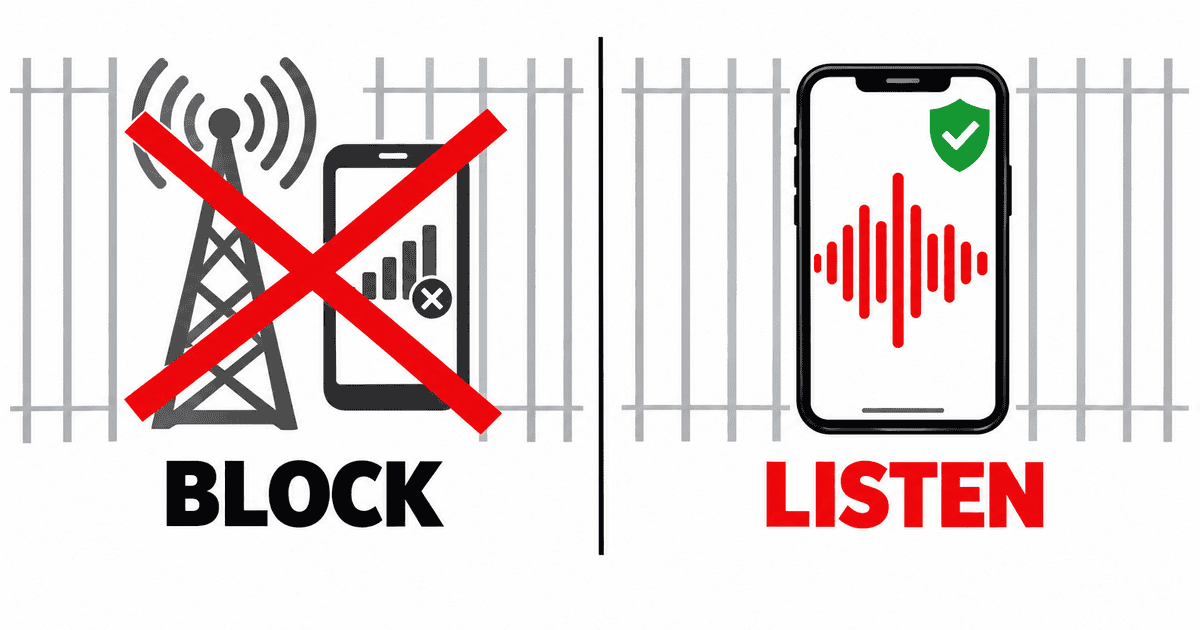
Both sheriffs are describing a real problem. We think both answers, more interdiction and more blocking, run into the same wall. GPS’s position is that Georgia should do the opposite of what the sheriff asked: allow phones inside its prisons, on a registered and monitored system, and treat everything else as unauthorized.
The Wall
Georgia’s General Assembly made an unauthorized phone in a prison a felony under O.C.G.A. § 42-5-18, and it funds the department charged with keeping phones out. The statute already lets a warden authorize a phone, and neither GDC nor the General Assembly has used that to build a legal, monitored alternative. Instead the state has spent years trying to stop phones from getting in. The U.S. Department of Justice’s October 2024 findings report counted 12,483 cellphones recovered by GDC between November 2021 and August 2023, alongside 262 drone sightings and 346 fence-line throw-overs. It concluded that “inadequate staffing and supervision, combined with ready access to contraband sources, allow incarcerated people to easily purchase, manufacture, possess, openly display, and use weapons, cellphones, and drugs.” 3
Seizures haven’t shrunk the supply. The Volusia County sheriff says his office has arrested about two dozen people connected to these scams in one year, all of it while the state was seizing phones.
One man who lived inside that business described it in a story GPS published in May through Tell My Story. “I’m typing this on a contraband cellphone from a Georgia prison cell,” he wrote. He said he was “forced into a pseudo telephone terrorist training camp” by the gang that ran his dorm, where “a 30-pound payload drone was dropping designer clothing, meth, tobacco, cell phones, electronics.” His account of the money: “One dorm in one camp would regularly gross well over $100,000 deposited into the Bitcoin wallets of gang members from contraband cell phones. There are hundreds of victims.” (The Flame) It is one man’s account, and it describes the same scheme the Florida sheriff is chasing from the other end.
What the State’s Own Arrest Reports Show
GDC publishes contraband arrest reports on its own website. GPS has built them into a searchable contraband dataset: at least 1,615 incidents in about 600 published reports, from May 2010 to July 2026. Cellphones appear in at least 501 of those incidents. The reports name the people GDC arrested, and they include the people who work there.
- As of July 2026 the reports name at least 374 GDC officers, other staff and contractors, and list 357 of them as arrested: 271 officers, 74 other GDC staff and 12 contract staff. The far larger groups of people arrested are civilians (819) and visitors (499).
- Calhoun State Prison has the most incidents of any facility, 159. Rogers has 150, Telfair 132 and Wilcox 131.
- In January 2024, GDC reported that security staff found 12 taped packages in an officer’s locker at Hays State Prison: 14 cell phones, 760 grams of methamphetamine and 222 grams of marijuana. GDC wrote that the officer “admitted to attempting to bring contraband to an offender.” 4
- In May 2026, GDC reported that an officer entering Valdosta State Prison had two phones hidden in his vest. 5
These are arrests, not convictions, and GDC doesn’t publish what happened afterward. The reports also only cover what GDC chose to announce. The Justice Department went further than the reports do. It wrote that “staff have been caught bringing contraband in through standard entry points,” that “[h]undreds of employees have been arrested, including the warden of Smith State Prison in 2023, for crimes related to contraband,” and that officers on perimeter posts are sometimes pulled to other posts or to interior duty for entire shifts, “leaving the perimeter more vulnerable to contraband introduction.” 6 The Volusia investigators told the AJC the phones get in “sometimes by the guards or with drones.” The AJC’s own yearslong investigation found hundreds of guards smuggling.
Systemwide, the DOJ put the correctional officer vacancy rate around 50 percent, and over 70 percent at ten of the largest facilities. In GPS’s reading, those vacancies are downstream of choices made above the prison: Georgia holds more people than it can staff. 7
What People Inside Tell Us About Drone Drops
GPS has heard from numerous people inside Georgia prisons who say they have taken part in drone drops. Their accounts agree on one point. The package comes down, an officer on duty turns a blind eye, and a prisoner walks out and picks it up. In their telling, the officer never touches it.
One writer put the same thing on the record in a story GPS published in July: “Some officers bring in contraband for them. Others look the other way when a drone comes in with a package.” (I’ll Take Care of It)
These are accounts. GPS hasn’t independently verified any of them, and we aren’t publishing anything that could identify who gave one. They describe what an officer did not do, and they don’t say why. They fit a record that doesn’t depend on them: a state prison system that its own federal investigators found couldn’t keep the perimeter staffed, and a dataset of hundreds of employees arrested by GDC’s own report. If you have done a drop, or watched one, and you want it on the record without your name, the Call to Action below tells you how.
What a Phone Is For, in Their Own Words
The people writing to GPS through Tell My Story, and others who have spoken to GPS directly, don’t describe phones only as tools for crime. They describe them as the line they use when no one else answers, and as the only door to the outside world many of them have.
Family
“I use a buddies cell phone to [call] my parents every day. My parents won’t be here much longer and without a cell phone i couldn’t talk to them. They can’t afford to pay for me to call them on the wall phone,” one person incarcerated in a Georgia prison told GPS.
Another told GPS: “My mother died of cancer last year. I [thank] God for my cell phone. I was able to video chat with her in the hospital every day. When she was too sick to hold the phone herself, my sister held it for her. It’s the worst thing in the world [being] in prison when those you love are dying. Cell phones at least help.”
The man who called for help for a dying fellow prisoner, in a story published through Tell My Story, wrote that “thanks to these cellphones I was able to talk to my mother in hospice before she died.” Another writer asked for exactly what this article proposes: “If they would just let us have a cellphone or a device to communicate with our families it would be a lot better, even if it has some restrictions.” (The Will to Be Free)
Staying in touch isn’t a privilege on the side of rehabilitation. It’s part of it. When the Minnesota Department of Corrections followed 16,420 people released from its prisons between 2003 and 2007, those who were visited in prison were less likely to come back: visits cut the risk of a new felony conviction by 13 percent and of a technical-violation revocation by 25 percent. 8 That study measured in-person visits, not calls. For a family that can’t afford the drive or the wall phone, a call is the contact there is.
Learning
A phone is also a classroom. People inside tell GPS they use phones to take college courses, read books the prison library doesn’t carry, learn computer science and programming, and learn to use AI. The research on what education does isn’t close. The RAND Corporation’s 2013 review of correctional education found that people who took part in education programs in prison had 43 percent lower odds of returning to prison than those who didn’t. 9 A registered device can carry that coursework the way the tablets now issued in other states already do.
The Law
“I bought a cell phone after someone told me about AI. I’m innocent and was railroaded. I don’t care if you believe me. I have been using AI to help me get evidence to prove my innocence, and to write documents and briefs for my Habeas Corpus. If I had to depend on the prison law library, I would die in here,” another person incarcerated in Georgia told GPS.
Habeas corpus asks whether a conviction was obtained lawfully. To use it, a person has to find the constitutional violation in their own record, whether that is evidence the prosecution withheld, an unlawful search, or a defense that was never investigated, and then explain it to a court in writing. Georgia gives them no right to a lawyer to do it. And they have to do it within four years under O.C.G.A. § 9-14-42(c). Forty-six states either set no deadline or let a court excuse a late filing; Georgia is one of four that do neither, and one of two of those with no lawyer (GPS’s fifty-state comparison).
DNA testing can answer one question in a case, and only where biological evidence exists. The Innocence Project reports that less than 1 in 10 crimes have DNA evidence available. 10 A constitutional violation can sit in the record of any case. AI can help a person read their own transcript, find the rules that apply and draft the filing. That’s the work a lawyer would do. It can also be wrong about the law, so its work has to be checked against the actual cases and statutes. But it reaches every case, and a phone is how it gets inside.
Calling for Help
“I had to use my illegal cell phone to call administration to tell them that he was dying and then it took them 41 minutes to get to the door. He died three minutes before they entered.” (Magazines Wrapped Around My Chest) Another writer, describing Macon State Prison during COVID-19, wrote that “in some emergency medical situations, those with cell phones called the local ambulance service, just five miles away in Montezuma Georgia, to come to the prison.” (COVID-19 in Georgia Prisons)
The Price of Getting Caught
One writer says a phone has cost years at parole: “They have a policy of denying two years for cellphones. … I really can’t understand why I’m being punished for a cellphone.” (The Nature and Circumstances) Another, in prison for 26 years, wrote: “I’ve gotten one disciplinary report in here — for a cell phone, 10 years ago. That’s it in 26 years.” (Insufficient Time Served)
The Tell My Story accounts were published with their writers’ consent. The people who spoke to GPS directly aren’t identified, and their words appear as they gave them, with three misspellings corrected in brackets. The claim about the Parole Board’s denials is the writer’s description, not a GPS finding. Together these accounts show what a smuggled phone is bought for: family, learning, the law, and help when staff don’t come. A registered, monitored phone meets that demand on terms the state controls.
What Allowing Phones Would Mean
Georgia law doesn’t ban phones in prison outright. It bans them “without the authorization of the warden or superintendent or his or her designee.” An inmate who has one without authorization commits a felony carrying one to five years, and an employee or contractor who brings one in faces ten. 11 The authorization language is already in the statute.
A managed access system, or MAS, is the technology the state is already paying for. It is a small private cell network inside the prison. When a phone tries to connect, the system checks it against a list. The FCC has described how it works: it “permits calls by known users (i.e., prison-authorized cell phone numbers) by handing them off to the network, but prevent[s] others by denying access to the network.” 12
The AJC reported that managed access systems “help identify and prevent unauthorized cell communications inside.” The proposal is to use the same tool to say yes, with conditions:
- Registered devices. A phone is issued or approved, and its identifiers are logged. Anything not on the list stays blocked.
- Registered numbers, with lawyers excluded from monitoring. Attorneys register their numbers the way they already do on the state phone system. GDC’s current telephone rule, SOP 227.01, has each person submit a call list of up to 20 people plus an Attorney Telephone Request Form. The rule already says calls to a designated attorney are “not monitored or recorded.” Privileged calls stay off the monitored side. 13
- Recording and AI review. The system can record permitted calls or pass them to AI monitoring that flags patterns such as a jury-duty script, payment instructions, threats or a planned assault. A scam that used to be discovered by a sheriff in another state a year later is on tape in a system the state controls.
- Consequences that mean something. A registered phone used to run a fraud is traced to a person, a cell and a call.
A blocked phone yields, at best, a number. A monitored one yields a call. That is the difference between chasing scammers after they finish and interrupting them while they work.
What the Law Allows
Recording. The federal Wiretap Act permits interception with the prior consent of a party to the call. 14 In United States v. Footman, the First Circuit upheld a state prison system’s recording of inmate calls where inmates signed a notice, a recorded message warned both parties at the start of each call, and approved attorney calls were excluded. That is the model: notice, consent by use, and a carve-out for lawyers. Georgia’s own recording rules and any state-law limits would need a lawyer’s review before rollout.
Blocking. Federal law is the obstacle to Sheriff Long’s request, not the answer to it. The Communications Act bars anyone from willfully or maliciously interfering with licensed radio communications, and that is why jamming has been off limits to states and prisons. 15 The FCC has approved managed access as the lawful alternative. On September 30, 2025, it opened a rulemaking that would, for the first time, authorize non-federal jamming in correctional facilities. 16 Georgia Attorney General Chris Carr has backed it. 17 That rulemaking is a proposal, not a final rule.
Federal prisons. The Cell Phone Contraband Act of 2010 made it a federal offense to give a phone to a federal prisoner or for one to possess it. 18 It covers federal facilities. Georgia’s prisons run under Georgia’s statute, quoted above.
Drones. Congress passed counter-drone authority for state and local agencies in the FY2026 defense bill, signed December 18, 2025, which is what GDC cited in its statement to the AJC. 19 It goes after the delivery by air. It doesn’t address a phone that comes through the front entry.
What Other Systems Do
No U.S. state we’ve found lets people in prison carry an open smartphone. What exists are the pieces of the same idea.
- Georgia itself. In July 2016 GDC announced that residents of all 13 transitional centers could carry cell phones, on condition that they signed a waiver allowing staff to search the phone at any time and that the center kept a record of the number, SIM and carrier. 20 The policy has changed since then, so this is history and not current practice.
- England and Wales. Prisons there have installed in-cell telephones that call only pre-approved numbers, with all calls recorded. 21 These are fixed landline handsets, not cell phones.
- South Carolina. In 2019 the corrections director introduced tablets with discounted calling and said, “This will go directly to that cellphone problem.” 22
- California, Illinois and Arizona. Almost everyone incarcerated in California now has a free tablet, and Illinois and Arizona let people make calls from tablets over prison Wi-Fi. 23 24 25
Tablet programs have drawn criticism for their costs to families, and a Georgia version would have to answer that. None of these programs is the full proposal. They show that legal, recorded, registered communication from inside is running in other systems now.
The Hard Questions
Won’t a registered phone be used for scams too? Some will try. The difference is that the call is on a system the state can review, tied to a device and a person, and monitored by software that doesn’t get tired at 2 a.m. on a short-staffed shift.
Doesn’t this reward smuggling? It takes away much of what makes a smuggled phone worth the risk. A phone that people can legally have, on a registered system, is worth far less to the people who now profit from getting one in.
Who pays, and to whom? Georgia already pays for managed access, and the state budget shows how much. Governor Kemp’s amended 2025 budget asked for $35,027,675 for “managed access and drone detection systems,” and his amended 2026 budget asked for $13,387,475 more, about $48.4 million in two years. For 2027 his budget moves $10,793,600 of existing funds to the same systems and adds $409,040 for five managed access analysts. 26 27 Those lines include drone detection, so the budget doesn’t say what managed access costs on its own. Where the money goes is harder to see. GPS found no managed access contracts in the state’s procurement registry. State payment records show GDC paid Hawks Ear Communications, which the FCC lists at Hancock, Phillips and Valdosta state prisons, $8,160,498 from FY2021 through FY2025, $2,646,648 of it in FY2025. They show nothing paid to ShawnTech, whose Trace-Tek systems the FCC lists at 28 Georgia prisons. 28 29 Whether monitoring would cost more than blocking is a question the legislature should ask GDC to answer in numbers.
What about privacy for families? GDC’s SOP 227.01 already keeps audio recordings of offender calls, and it says calls to a designated attorney are not monitored or recorded. A monitored phone doesn’t lower that standard.
Is monitoring accurate? AI flagging will produce false positives. It should point a human to a call. It shouldn’t punish anyone on its own.
Call to Action: What You Can Do
If this was worth your time, share it with someone who should read it.
Spread the Word: It Takes One Click
Awareness without action changes nothing. Here’s how you can help push for accountability and real reform:
Tell Us What You Know, Anonymously: If you have taken part in a drone drop, seen one, or know how phones actually get in, GPS wants to hear it. We protect where information comes from, and we won’t print anything that could identify you. Use https://gps.press/submit-a-report/ for a confidential report, or share your story at https://gps.press/tellmystory.
Join the GPS Advocacy Network: Sign up at https://gps.press/become-an-advocate/ and we’ll advocate on your behalf every week. GPS identifies your state legislators, crafts personalized letters on the most pressing prison issues, and sends them directly to the representatives who represent you. You receive a copy of every letter. It takes two minutes to sign up, and we handle the rest.
Send a 60-Second Message: Pick an issue, get a ready-to-edit message with the verified facts already in it, and email your state House representative and senator directly from your own inbox at https://gps.press/send-a-message/. No signup, nothing stored. It takes about a minute.
Contact Your Representatives: Your state legislators control GDC’s budget, oversight, and the laws that govern what happens inside. Ask them whether Georgia should authorize registered, monitored phones under O.C.G.A. 42-5-18, and what managed access costs today. Find your Georgia legislators at https://gps.press/find-your-legislator/ or call Governor Kemp at (404) 656-1776 or the GDC Commissioner at (478) 992-5246.
Demand Media Coverage: Contact newsrooms at the AJC, local TV stations, and national criminal justice outlets. More coverage means more pressure.
Amplify on Social Media: Share this article and tag @GovKemp, @GDC_Georgia, and your local representatives. Use #GAPrisons, #PrisonReform, #GeorgiaPrisonerSpeak.
Message the Board of Corrections: The citizen board that oversees the GDC publishes no contact details for its members. GPS built the missing front door: pick a board member and a policy message and send it from your own email at https://gps.press/write-the-board/.
File Public Records Requests: Georgia’s Open Records Act gives every citizen the right to request incident reports, staffing data, and financial documents. Start with the GPS Action Toolkits at https://gps.press/toolkits/. The Open Records Toolkit walks you through what to ask for, gives you ready-to-file request templates, and tells you what to do when the state says no. File directly with GDC at https://georgiadcor.govqa.us/WEBAPP/_rs/SupportHome.aspx.
Attend Public Meetings: The Georgia Board of Corrections and legislative committees hold public meetings. Your presence is noticed.
Contact the Department of Justice: File civil rights complaints at https://civilrights.justice.gov. Federal oversight has forced abusive systems to change before.
Support Organizations Doing This Work: Donate to or volunteer with Georgia-based prison reform groups fighting for change on the ground.
Vote: Research candidates’ positions on criminal justice. Primary elections often determine outcomes in Georgia.
Contact GPS: If you have information about conditions inside Georgia’s prisons, reach us securely at GPS.press.
Further Reading
What’s Really Behind Georgia’s Prison Crisis?
The root causes of the crisis inside Georgia’s prisons.
“Contained to One Dorm”: The Squad Left Wilcox at Noon. The Coroner Was Called at Two.
What a September lockdown at Wilcox State Prison shows about how GDC reports what happens inside.
The Commissioner’s own reasoning set against how four prisons are actually housed.
Direct Selection: The Two-Page Note Behind Georgia’s $85,585,244 Prison Purchase
How the state buys what it buys for its prisons, and what the paper trail says.
GPS Intelligence System
The GPS Intelligence System maintains living research profiles that aggregate data, news, settlements, and analysis on Georgia’s prisons and the issues defining them. The profiles below provide deeper context for the issues raised in this article:
Contraband and the Staff Supply Chain
GDC’s own arrest reports, read for what they say about who brings contraband in.
The facility with the most incidents in GDC’s contraband arrest reports, and one of the two prisons named in the Volusia County scam.
Explore the Data
GPS makes GDC statistics accessible to the public through several resources:
- GPS Contraband Data: 1,615 incidents from GDC’s own contraband arrest reports, May 2010 to July 2026, searchable by facility, year and item, with a link to each GDC report.
- GPS Statistics Portal: Interactive dashboards translating complex GDC reports into accessible formats, updated within days of official releases.
- GPS Lighthouse AI: Ask questions about Georgia’s prison system and get answers drawn from GPS’s investigative archive and data analysis.
- GPS llms.txt: A single machine-readable index of every GPS data resource, published using the open llms.txt standard. Point any AI tool (ChatGPT, Claude, Gemini, Perplexity) at this URL and the model can navigate to facility profiles, intelligence briefs, mortality records, statistics, and the full investigative archive, with no other configuration needed. It is the fastest way to ground an AI conversation in verified GPS data.
- GPS Public MCP Server: For AI tools that support the Model Context Protocol (Claude, ChatGPT, and others), connect directly to GPS’s data: read-only tools covering population, facilities, mortality, parole, the Georgia Code, settlements, and more. Every answer arrives with its source link and citation built in.
- Find Your Legislator: See who represents you in the General Assembly.
For a walkthrough of how to put these resources to work with AI, see How to Use GPS Data with AI Tools: a step-by-step guide for researchers, advocates, families, and journalists analyzing Georgia prison conditions, statistics, and policy with tools like ChatGPT, Claude, and Gemini.
Contact GPS at media@gps.press for access to underlying datasets used in this analysis.
About Georgia Prisoners’ Speak (GPS)
Georgia Prisoners’ Speak (GPS) is a nonprofit investigative newsroom built in partnership with incarcerated reporters, families, advocates, and data analysts. Operating independently from the Georgia Department of Corrections, GPS documents the truth the state refuses to acknowledge: extreme violence, fatal medical neglect, gang-controlled dorms, collapsed staffing, fraudulent reporting practices, and unconstitutional conditions across Georgia’s prisons.
Through confidential reporting channels, secure communication, evidence verification, public-records requests, legislative research, and professional investigative standards, GPS provides the transparency the system lacks. Our mission is to expose abuses, protect incarcerated people, support families, and push Georgia toward meaningful reform based on human rights, evidence, and public accountability.
Every article is part of a larger fight: to end the silence, reveal the truth, and demand justice.
The Architecture Is the Evidence
Across the 32 state prisons whose original design figures we hold, Georgia built for 15,737. They hold 33,805 — 215% of design capacity.
Dorms tripled. Cells double- and triple-bunked. Medical, kitchens, libraries — unchanged. Every facility, every design figure, every source.
See the receipts →- AJC on the Volusia County sheriff and Georgia prison scams, https://www.ajc.com/news/2026/09/florida-sheriff-blasts-georgia-for-scams-run-out-of-state-prisons/ [↩]
- Butts County Sheriff’s Office public Facebook post of September 29 2026, https://www.facebook.com/ButtsCountySheriff [↩]
- DOJ Findings Report Investigation of Georgia Prisons Oct 2024 pp 50-51, https://www.justice.gov/d9/2024-09/findings_report_-_investigation_of_georgia_prisons.pdf [↩]
- GDC contraband arrest report Jan 17 2024, https://gdc.georgia.gov/contraband-report/2024-01-17/contraband-arrests-multiple-state-facilities [↩]
- GDC contraband arrest report June 1 2026, https://gdc.georgia.gov/contraband-report/2026-06-01/contraband-arrests-multiple-state-prisons [↩]
- DOJ Findings Report Oct 2024 p 77, https://www.justice.gov/d9/2024-09/findings_report_-_investigation_of_georgia_prisons.pdf [↩]
- DOJ Findings Report Oct 2024 staffing findings, https://www.justice.gov/d9/2024-09/findings_report_-_investigation_of_georgia_prisons.pdf [↩]
- Minnesota Department of Corrections The Effects of Prison Visitation on Offender Recidivism Nov 2011, https://mn.gov/doc/assets/11-11MNPrisonVisitationStudy_tcm1089-272781.pdf [↩]
- RAND Corporation Evaluating the Effectiveness of Correctional Education 2013, https://www.rand.org/news/press/2013/08/22.html [↩]
- Innocence Project Five Facts About DNA Testing and Wrongful Convictions in 2026, https://innocenceproject.org/news/five-facts-about-dna-testing-and-wrongful-convictions-in-2026/ [↩]
- O.C.G.A. 42-5-18 Items prohibited for possession by inmates, https://law.justia.com/codes/georgia/title-42/chapter-5/article-1/section-42-5-18/ [↩]
- FCC Order 13-58 on contraband wireless devices in correctional facilities, https://docs.fcc.gov/public/attachments/FCC-13-58A1.pdf [↩]
- GDC SOP 227.01 Offender Access to Telephones, https://public.powerdms.com/GADOC/documents/105701 [↩]
- 18 U.S.C. 2511 as applied in United States v. Footman 1st Cir 2000, https://law.justia.com/cases/federal/appellate-courts/F3/215/145/608090/ [↩]
- 47 U.S.C. 333, https://www.govinfo.gov/content/pkg/USCODE-2011-title47-chap5-subchapIII-partI-sec333.htm [↩]
- FCC Third Further Notice of Proposed Rulemaking Federal Register Nov 26 2025, https://www.federalregister.gov/documents/2025/11/26/2025-21325/promoting-technological-solutions-to-combat-contraband-wireless-device-use-in-correctional [↩]
- Georgia Attorney General on the FCC jamming proposal, https://law.georgia.gov/press-releases/2025-09-26/carr-backs-new-fcc-proposal-allowing-cell-phone-jamming-technology-state [↩]
- Cell Phone Contraband Act of 2010 Public Law 111-225, https://www.congress.gov/111/plaws/publ225/PLAW-111publ225.htm [↩]
- Correctional News on the Safer Skies Act, https://correctionalnews.com/2025/12/18/congress-passes-safer-skies-act-to-combat-drone-threats/ [↩]
- GDC press release on transitional center cell phones July 1 2016, https://gdc.georgia.gov/press-releases/2016-07-01/transitional-centers-now-allow-residents-carry-cell-phones [↩]
- Prison Reform Trust on prison digitisation in England and Wales, https://prisonreformtrust.org.uk/wp-content/uploads/2025/06/Update_and_Restart.pdf [↩]
- South Carolina inmates getting tablets in attempt to battle cell phones, https://abcnews4.com/amp/news/crime-news/south-carolina-inmates-getting-tablets-in-attempt-to-battle-cell-phones-in-prisons [↩]
- CapRadio on California prison tablets, https://www.capradio.org/articles/2023/07/19/almost-all-people-incarcerated-in-california-now-have-free-tablets/ [↩]
- Illinois pilot for free prison phone calls, https://statescoop.com/illinois-pilot-free-phone-calls-pilot-program/ [↩]
- Arizona corrections on calls from electronic tablets, https://corrections.az.gov/news/incarcerated-individuals-empowered-make-calls-electronic-tablets-august-1-2024 [↩]
- Governor’s Budget Report, Amended FY 2025 and FY 2026, https://opb.georgia.gov/document/governors-budget-reports/afy-2025-and-fy-2026-governors-budget-report/download[↩]
- Governor’s Budget Report, Amended FY 2026 and FY 2027, https://opb.georgia.gov/document/governors-budget-reports-current-year/afy-2026-fy-2027-governors-budget-report/download[↩]
- Open Georgia, state vendor payments FY2018 to FY2025, https://open.ga.gov/[↩]
- FCC, Contraband Wireless Devices, https://www.fcc.gov/wireless/bureau-divisions/mobility-division/contraband-wireless-devices[↩]