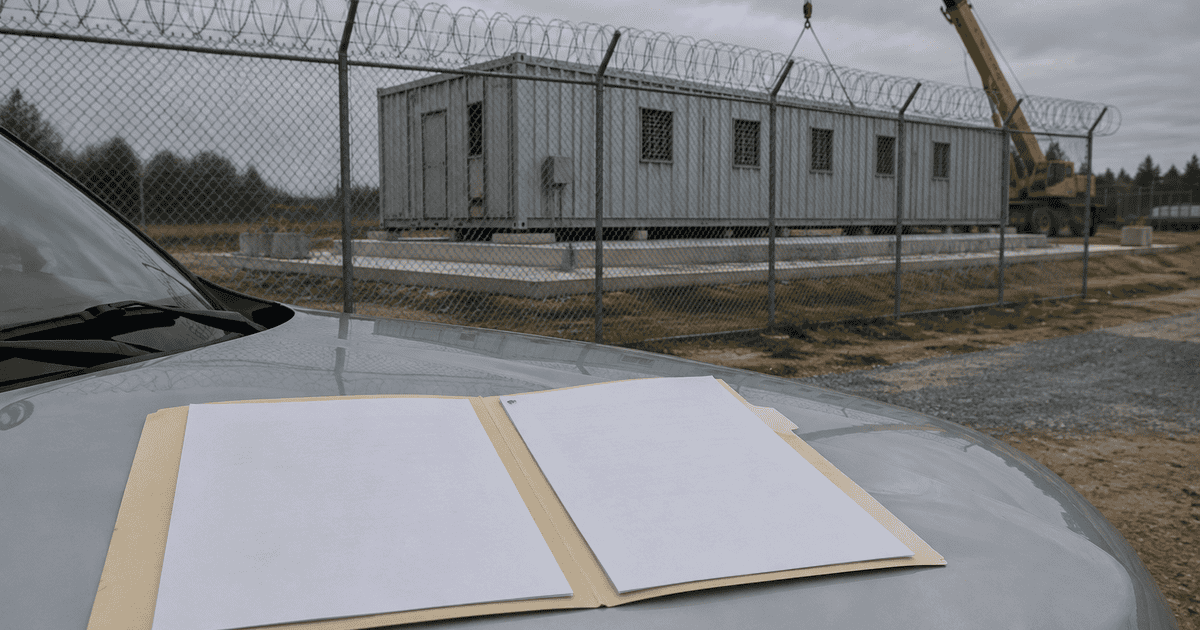
At 4:48 on the afternoon of March 4, 2025, the Georgia Department of Corrections put a request for information on the state’s procurement registry. Who could build modular maximum-security housing, it asked, and who could build a modular infirmary. Eight days was the window. 1
At 12:35 the next afternoon, nineteen hours and forty-seven minutes after the request, a state supplier profile was created for a company called ModCorr LLC. The record shows the profile was created and last modified in the same minute. It was never touched again.
Six weeks after the window closed, on April 25, 2025, the Georgia State Financing and Investment Commission signed five contracts with ModCorr LLC. The contract sums total $85,585,244. 2
For seven months GPS put the same request to the three agencies: show how that company was chosen. On September 17, one of them answered with two pages.
What GDC’s own form says about the method
The Department put out an eRFI, an electronic request for information. The state purchasing form GDC used sets out what that method is and isn’t, and it’s the Department’s own document:
“The eRFI method is not a competitive solicitation method and, as a result, does not satisfy the requirement for competitive bidding. The eRFI method is no more than an information gathering tool.” 1
On March 10, about a day ahead of the original deadline, the close moved from March 11 to March 12. No responses received, per the registry’s own audit log. At 6:00 in the morning on March 13, the event was marked reviewed. 3
Two companies responded. GDC put that in writing on September 16, 2026: “The Department received responses from two suppliers to the RFI – ModCorr and Aries Buildings.” What a member of the public finds on the registry is three documents and nothing showing anyone answered. So the public record can’t answer the question. It doesn’t say nobody responded. 4
Three agencies, September 1 to 3
GPS asked each agency for the competitive solicitation, or the sole-source justification, behind the purchase.
On September 1, GDC answered through Charles Hodges, Attorney IV, and said the same thing three times in one letter: “The Department has no documents responsive to this request. GSFIC handled the purchase and should have records responsive to this request.”
GSFIC, through Christy L. Sanders, Senior Attorney, on September 2: “GSFIC did not conduct the Procurement you referenced so we have no records of that procurement.”
On September 3, the Department of Administrative Services: no award notice naming ModCorr.
Each answer holds on its own. GSFIC didn’t run the registry event. The registry event was GDC’s information request. Put the two together and the record shows no agency kept anything on how ModCorr was picked over the other company that answered.
September 16: two productions in one day
On September 16, GDC answered who replied. It also answered what the Department holds on the choice between them. Asked for any record evaluating, scoring, comparing or ranking the two responses, and any recommendation that followed, the Department wrote: “The Department has no documents responsive to this request. GSFIC handled the purchase and should have records responsive to this request.” 4
The same afternoon DOAS closed its own file. It was asked for any request, approval, denial or determination on a sole-source award, emergency procurement, waiver, exemption or exception from competitive bidding, whether for modular correctional buildings or for ModCorr LLC: “DOAS does not have records responsive to this request.” It was asked whether any statewide, cooperative or piggyback contract could have carried the purchase. Same sentence.
DOAS produced one document instead. A six-page Intergovernmental Services Agreement between GSFIC and DOAS, dated December 2007, effective January 1, 2008. Under it, DOAS transferred its construction procurement responsibility to GSFIC. Exhibit A provides that projects for which the contract is signed by GSFIC are procured “as prescribed by prevailing GSFIC requirements for such procurements,”, and it lets GSFIC use pre-selected contractors on task or job orders where GSFIC finds that in the state’s interest. No dollar cap appears in it. GSFIC signed all five ModCorr agreements. 5
The wrong procurement was the one GPS had been asking about. The one that mattered sits with GSFIC, under GSFIC’s rules. On the evening of September 16, GPS asked GSFIC for that file: any solicitation it issued, any evaluation or selection memorandum, the record stating the basis of award, and, if it awarded without a solicitation, a short statement saying so and naming the provision that permitted it.
September 17: the two pages
GSFIC answered the next morning with a scanned document headed “Procurement Process Summary.” No date. No author. No signature. The metadata shows it was scanned at 6:48 the previous evening, an hour after GPS’s request arrived. When the document was written, it doesn’t say. 6
It says this about how the choice was made:
“Due to the urgency, GDC sent out an eRFI in February 2025 to determine possible providers for these units, while awaiting the outcome of the Legislative Session for this project request and before GSFIC was engaged on the project. While this was not an RFQ, it provided much of the information required for an RFQ. With the time sensitive nature of the project, GSFIC reviewed the information received from the 2 responsive respondents to GDC’s eRFI; followed up with both respondents to discuss specifications and to determine their capabilities to complete the project; and made a direct selection based on this information.”
Hold each phrase up. “This was not an RFQ” concedes what GDC’s own form said in March: the request was not a competitive solicitation. “Followed up with both respondents” describes conversations. “Made a direct selection” is the whole of the award.
The summary runs the two companies side by side. Both, it says, “have limited resumes and experience in ‘modular correctional buildings’,”, which it calls an emerging market. Both build from detention-grade materials and appear to meet code and accreditation standards. ModCorr, on the summary’s account, offered 10-gauge steel plate where Aries offered 14-gauge, factory-installed locking controls and cameras, an assault-testing standard Aries “was not able to confirm an equal standard in conversation follow up after RFI,”, and a filled wall panel. The summary calls ModCorr “a focused correctional provider” and Aries “a ‘broker’ to other suppliers.”
Then the basis: “Of GSFIC’s various procurement options, recommendation is Direct Purchase from ModCorr for these Prefabricated ‘modular correctional units’.” A footnote adds: “GSFIC assumed the role of the project once it was funded and defined. This RFI is not GSFICs, but GDC’s RFI.”
The summary doesn’t name who made the selection. It gives no date. It doesn’t cite the GSFIC requirement that would permit a direct purchase of this size, and it doesn’t say whether ModCorr was a pre-selected contractor. The word “Aries” is in it. The word “solicitation” isn’t.
The room in June 2024
Nine months before the eRFI posted, the company was already in the room.
GDC-172, the Department’s own contract for the Johnson State Prison infirmary, records the meeting. In May 2024, ModCorr sat down with clinical staff of Centurion Health Services to refine the infirmary concept. On June 3, 2024, “ModCorr, Centurion and the Georgia Department of Corrections met and agreed to move forward” with the layout. By February 2025, the contract says, ModCorr and Centurion had begun final layouts and reached “a final layout which is contained within” the agreement GSFIC later signed. 7
Centurion holds the Department’s prison healthcare contract. On January 10, 2023, Centene Corporation “signed and closed on a definitive agreement to divest Centurion, its prison healthcare business,” as Centene’s filing with the Securities and Exchange Commission states. 8
Centene’s filing leaves the buyer unnamed. ModCorr supplies the name. The brochure ModCorr attached to its eRFI response, which GDC produced to GPS, is the Sullivan Brothers Family of Companies brochure, and under the heading Corrections it lists Centurion Health, beside ModCorr. The Sullivan Brothers’ own website carries Centurion today. 9 10
In June 2024, when the state’s medical contractor sat with the Department to agree the layout of a building the state would buy, the party across the table was the vendor’s sister company. Whether that arrangement broke a rule, a contract term or a conflict provision is a question no agency has answered, because no agency has produced the rule under which the purchase was made. GDC’s eRFI asked each respondent about “you or any related holding companies, affiliates, or subsidiaries.” ModCorr answered for “our company.” That is a narrow answer. It isn’t a false one.
What was paid
On September 2, GSFIC produced the five executed agreements. On September 8, it produced a payment spreadsheet. The contract sums and the payments are set out below. The differences are GPS’s arithmetic on GSFIC’s own figures, not numbers the state asserted.
- GDC-171A, Hays State Prison: contracted $20,173,811, paid $20,973,619.43, paid above contract sum by $799,808.43.
- GDC-171B, Lee State Prison: contracted $20,173,811, paid $21,520,668.59, paid above contract sum by $1,346,857.59.
- GDC-171C, Montgomery State Prison: contracted $20,173,811, paid $21,232,520.91, paid above contract sum by $1,058,709.91.
- GDC-171D, Dodge State Prison: contracted $20,173,811, paid $21,714,890.60, paid above contract sum by $1,541,079.60.
- GDC-172, Johnson State Prison infirmary: contracted $4,890,000, paid $4,320,512.70, paid below contract sum by $569,487.30.
Forty-two invoices, all of them paid. Against $85,585,244 in contracted sums, $89,762,212.23 went out the door, a difference of $4,176,968.23. Not one of the five agreements contains a contingency line. GPS’s original request to GSFIC covered amendments, and on September 13 GPS asked a second time for any change order, amendment or written directive that would account for the gap. As of publication GSFIC has produced none, and it hasn’t said there are none.
The four housing sites bought two 63-bed buildings each. That’s 504 beds, at $20,173,811 a site. $160,109.61 a bed, GPS’s arithmetic on the state’s own figures. The infirmary is 20 beds at $4,890,000.
Twelve weeks later, Florida wrote it down
On July 31, 2025, the Florida Department of Corrections signed contract CM-25116 with Balfour Beatty Construction for “Design and installation of prefabricated modular medical units” at Lowell Correctional Institution and the South Florida Reception Center. The figure on the contract is $42,221,268.11. The public record carries a field headed Method of Procurement. Under that heading the record reads: “Agency Invitation To Bid [s. 255.25(3)(a), F.S.].” 11
The product is ModCorr’s medical module, one of four specification sheets in GDC’s production. Centurion is the healthcare partner. Florida broke ground on the two buildings on July 22, 2026. 12
Florida’s buildings and Georgia’s aren’t the same buildings, and the point isn’t price. The point is paperwork. Florida’s record answers in one field what three Georgia agencies spent September saying they couldn’t.
What the state has said, in order
On its own form, GDC posted an information request that the form says is not a competitive solicitation. How the two responses were compared, GDC holds no record of. No sole-source determination, no emergency determination, no waiver, no exception: DOAS holds none of them, and no cooperative contract the purchase could have ridden on. GSFIC signed the contracts under an agreement that lets it procure by its own requirements. GSFIC says it read GDC’s two responses, spoke to both companies, and “made a direct selection.”
The state’s account of how it spent $85,585,244 is two pages. No date on either. They arrived the morning after they were asked for.
Call to Action: What You Can Do
The state spent $85,585,244 on five ModCorr contracts and produced two undated pages to explain the choice. Payments ran $4,176,968.23 over contracted sums. If you read this and scroll on, you're accepting that. Share it.
Spread the Word — It Takes One Click
Awareness without action changes nothing. Here’s how you can help push for accountability and real reform:
Join the GPS Advocacy Network: Sign up at https://gps.press/become-an-advocate/ and we’ll advocate on your behalf every week. GPS identifies your state legislators, crafts personalized letters on the most pressing prison issues, and sends them directly to the representatives who represent you. You receive a copy of every letter. It takes two minutes to sign up, and we handle the rest.
Send a 60-Second Message: Pick an issue, get a ready-to-edit message with the verified facts already in it, and email your state House representative and senator directly from your own inbox at https://gps.press/send-a-message/. No signup, nothing stored. It takes about a minute.
Tell My Story: Are you or a loved one affected by Georgia’s prison system? GPS publishes first-person accounts from incarcerated people and their families. Submit your story at https://gps.press/category/tellmystory/ and help the world understand what’s really happening behind the walls.
Contact Your Representatives: Your state legislators control GDC’s budget, oversight, and the laws that created these failures. Find your Georgia legislators at https://gps.press/find-your-legislator/ or call Governor Kemp at (404) 656-1776 or the GDC Commissioner at (478) 992-5246.
Demand Media Coverage: Contact newsrooms at the AJC, local TV stations, and national criminal justice outlets. More coverage means more pressure.
Amplify on Social Media: Share this article and tag @GovKemp, @GDC_Georgia, and your local representatives. Use #GAPrisons, #PrisonReform, #GeorgiaPrisonerSpeak.
Message the Board of Corrections: The citizen board that oversees the GDC publishes no contact details for its members. GPS built the missing front door: pick a board member and a policy message and send it from your own email at https://gps.press/write-the-board/.
File Public Records Requests: Georgia’s Open Records Act gives every citizen the right to request incident reports, death records, staffing data, medical logs, and financial documents. Start with the GPS Action Toolkits at https://gps.press/toolkits/. The Open Records Toolkit walks you through what to ask for, gives you ready-to-file request templates, and tells you what to do when the state says no. File directly with GDC at https://georgiadcor.govqa.us/WEBAPP/_rs/SupportHome.aspx.
Attend Public Meetings: The Georgia Board of Corrections and legislative committees hold public meetings. Your presence is noticed.
Contact the Department of Justice: File civil rights complaints at https://civilrights.justice.gov. Federal oversight has forced abusive systems to change before.
Support Organizations Doing This Work: Donate to or volunteer with Georgia-based prison reform groups fighting for change on the ground.
Vote: Research candidates’ positions on criminal justice. Primary elections often determine outcomes in Georgia.
Contact GPS: If you have information about conditions inside Georgia’s prisons, reach us securely at GPS.press.
Further Reading
The Swing Space That Wasn’t: 524 New Beds, a Border-Wall Family, and No Contract Georgia Will Show
GPS’s first report on the five ModCorr contracts and the registry event that preceded them.
GCI: Georgia’s $326M No-Bid, $0-Wage Corp
How Georgia Correctional Industries operates without competitive bidding and without wages.
Georgia’s Family-Package Monopoly
The single-vendor arrangement that decides what families can send inside and what it costs them.
Nowhere to Put Him: How Georgia’s Bed Math Killed a Man Thirty Days From Home
The bed shortage the modular units were bought to relieve, and what it cost one man.
Georgia’s “Hardened” Solution: Another Fortress Instead of Reform
The state’s answer to overcrowding has been more maximum-security capacity.
GPS Intelligence System
The GPS Intelligence System maintains living research profiles that aggregate data, news, settlements, and analysis on Georgia’s prisons and the issues defining them. The profiles below provide deeper context for the issues raised in this article:
Where Georgia’s corrections money goes, including the capital spending behind the modular units.
Who is supposed to check the Department’s decisions, and what the record shows about whether anyone does.
Explore the Data
GPS makes GDC statistics accessible to the public through several resources:
- GPS Statistics Portal: Interactive dashboards translating complex GDC reports into accessible formats, updated within days of official releases.
- GPS Lighthouse AI: Ask questions about Georgia’s prison system and get answers drawn from GPS’s investigative archive and data analysis.
- GPS llms.txt: A single machine-readable index of every GPS data resource, published using the open llms.txt standard. Point any AI tool (ChatGPT, Claude, Gemini, Perplexity) at this URL and the model can navigate to facility profiles, intelligence briefs, mortality records, statistics, and the full investigative archive, with no other configuration needed. It is the fastest way to ground an AI conversation in verified GPS data.
- GPS Public MCP Server: For AI tools that support the Model Context Protocol (Claude, ChatGPT, and others), connect directly to GPS’s data: 12 read-only tools covering population, facilities, mortality, parole, the Georgia Code, settlements, and more. Every answer arrives with its source link and citation built in.
For a walkthrough of how to put these resources to work with AI, see How to Use GPS Data with AI Tools: a step-by-step guide for researchers, advocates, families, and journalists analyzing Georgia prison conditions, statistics, and policy with tools like ChatGPT, Claude, and Gemini.
Contact GPS at media@gps.press for access to underlying datasets used in this analysis.
About Georgia Prisoners’ Speak (GPS)
Georgia Prisoners’ Speak (GPS) is a nonprofit investigative newsroom built in partnership with incarcerated reporters, families, advocates, and data analysts. Operating independently from the Georgia Department of Corrections, GPS documents the truth the state refuses to acknowledge: extreme violence, fatal medical neglect, gang-controlled dorms, collapsed staffing, fraudulent reporting practices, and unconstitutional conditions across Georgia’s prisons.
Through confidential reporting channels, secure communication, evidence verification, public-records requests, legislative research, and professional investigative standards, GPS provides the transparency the system lacks. Our mission is to expose abuses, protect incarcerated people, support families, and push Georgia toward meaningful reform based on human rights, evidence, and public accountability.
Every article is part of a larger fight: to end the silence, reveal the truth, and demand justice.
The Architecture Is the Evidence
Across the 32 state prisons whose original design figures we hold, Georgia built for 15,737. They hold 34,019 — 216% of design capacity.
Dorms tripled. Cells double- and triple-bunked. Medical, kitchens, libraries — unchanged. Every facility, every design figure, every source.
See the receipts →- GDC eRFI 46700-GDC0001150 as posted March 4 2025, https://gps.press/wp-content/uploads/2026/09/mcp-pathimport-36b02af5ef0d.pdf [↩][↩]
- GDC-171A executed contract between GSFIC and ModCorr LLC produced by GSFIC Sept 2 2026, https://gps.press/wp-content/uploads/2026/09/mcp-pathimport-f036789afe57.pdf [↩]
- Georgia Procurement Registry event 46700-GDC0001150, https://ssl.doas.state.ga.us/gpr/eventDetails?eSourceNumber=46700-GDC0001150 [↩]
- GDC open records response R031702-091326 Sept 16 2026, https://gps.press/wp-content/uploads/2026/09/mcp-pathimport-8ccf9a108552.pdf [↩][↩]
- GSFIC and DOAS Intergovernmental Services Agreement December 2007 produced by DOAS Sept 16 2026, https://gps.press/wp-content/uploads/2026/09/mcp-pathimport-692b2e42b0ef.pdf [↩]
- GSFIC Procurement Process Summary received Sept 17 2026, https://gps.press/wp-content/uploads/2026/09/mcp-pathimport-3920a54d98f5.pdf [↩]
- GDC-172 executed contract for the Johnson State Prison infirmary produced by GSFIC Sept 2 2026, https://gps.press/wp-content/uploads/2026/09/mcp-pathimport-4efe4661ba71.pdf [↩]
- Centene Corporation Form 10-Q for the quarter ended June 30 2023, https://www.sec.gov/Archives/edgar/data/1071739/000107173923000183/cnc-20230630.htm [↩]
- Sullivan Brothers Family of Companies brochure submitted by ModCorr to GDC, https://gps.press/wp-content/uploads/2026/09/mcp-pathimport-1b83285f75c3.pdf [↩]
- Sullivan Brothers Family of Companies website, https://sullbros.com/ [↩]
- Florida Department of Financial Services contract record CM-25116, https://facts.fldfs.com/Search/ContractDetail.aspx?AgencyId=700000&ContractId=25116 [↩]
- Correctional News on the Florida groundbreaking July 22 2026, https://correctionalnews.com/2026/07/22/florida-department-of-corrections-breaks-ground-on-modular-medical-facilities-to-expand-in-prison-surgical-care/ [↩]