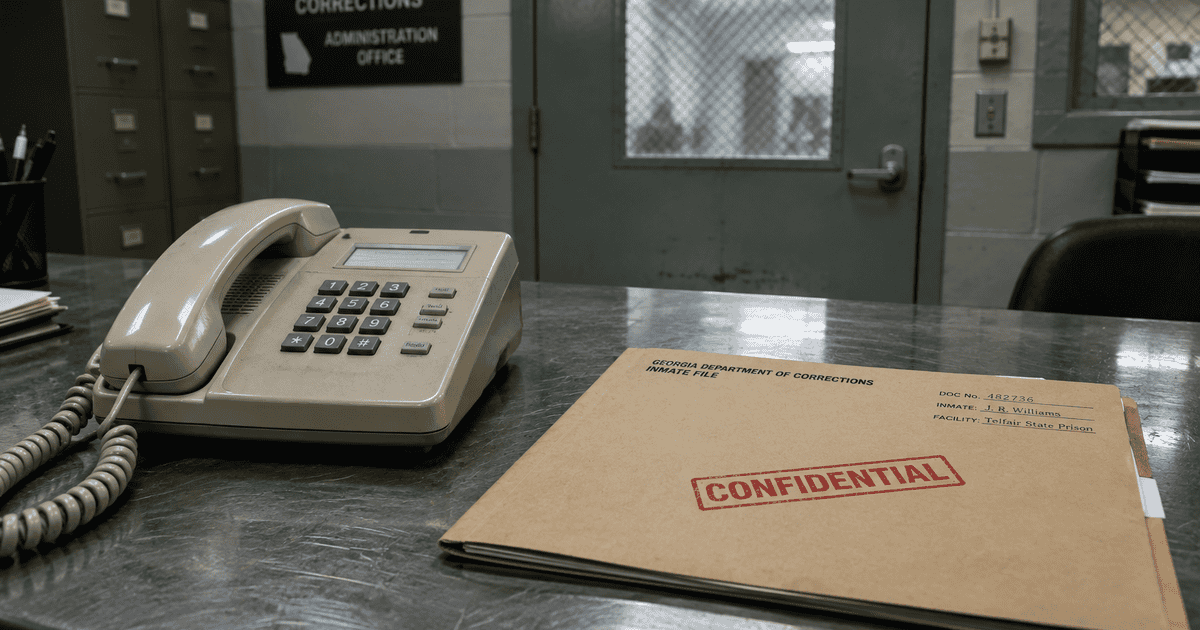
On Wednesday, September 16, two groups fought in one dorm at Telfair State Prison. By Thursday evening the Department of Corrections had its account for reporters: three men taken to local hospitals with injuries that weren’t life-threatening, since returned to the prison, a fight that was “gang related” but “confined to one dorm,” and every state prison locked down “out of an abundance of caution.” 1 2
The Department hasn’t published a word of that itself. Its press-release page that week carried two deputy warden appointments. 3 A local news page in the next county wrote Thursday night that details “remain limited, including the number of inmates involved and whether there were serious injuries,” and that it couldn’t confirm whether the lockdown had been lifted.
So families did what families of Georgia’s prisoners do. This week in one Facebook group, a member asked if anybody had heard anything going on at Valdosta. Hours later came the answer, from another parent who’d talked to her son the day before. Someone asked whether the F1 and F2 buildings at Wilcox were still locked down and got four answers that contradicted each other. A woman asked for anyone with a contact inside the Department “who can actually help” find out why her loved one’s transfer had stalled, because offender administration, the help line and the counselors “cannot give any other info.”
That is the information system Georgia built for the families of the people it holds. It did not happen by accident. It’s written down, and this is where.
The rule says the warden shall notify
On December 4, 1984, the Board of Corrections put a rule in force for what happens when a prisoner is badly hurt. It is still in force.
If an inmate is severely injured or develops a seriously acute illness, the Warden/Superintendent shall notify the inmate’s next of kin or other individual(s), designated by the inmate. The Warden/Superintendent shall keep such individual(s) apprised of any significant change in the inmate’s condition, including death. 4
A second rule, dated 1988, covers what happens when a prisoner dies. It directs the warden “will notify the next of kin and the Commissioner of Corrections promptly.” 5 Both that rule and every Department policy GPS has obtained can be searched in the GPS SOP library. At intake, GDC takes a next-of-kin emergency contact from every person, in its own words “in case of serious illness, serious injury, or death.”
Neither rule sets a time. Neither supplies a form. Neither carries a penalty. And whether anyone made the call gets recorded in the inmate’s file. Hold on to that last fact. It comes back.
On the family’s side, here is what the rule has looked like.
Roy Mason Morris got sick at Dooly State Prison. He was taken to Crisp Regional Hospital in late September 2023 and died there on October 15. His sister found out on December 19, 2024. Fourteen months. For months the family had called the Department with his identification number, and the system showed no record of him. GPS told his sister’s account in Buried Truth in January 2025.
Jamie Shahan called his mother from Washington State Prison for the last time on January 5, 2025. He told her he’d call the next day. For eleven days she phoned the prison asking for a wellness check. Nobody called her back. He had been on life support at the Medical College of Georgia since January 12. She found out on January 24, from a hospital intern. Her account is in Left for Dead.
A family described a man moved from prison to a hospital, on a ventilator, with a feeding tube. GPS published that account in February. “At first, we couldn’t even see him,” they wrote. “The guards told the hospital staff that he didn’t have family to call. We were on his visitation list. They knew we existed.” A hospital employee tracked them down on her own. Their account is Watching Someone You Love Die While the System Looks Away.
In May, at Baldwin State Prison, a man was stabbed deep enough that he was taken to an outside emergency room. His fiancée wrote to GPS: “The prison never notified me. I only found out because another inmate used a contraband cell phone to send me a picture of a note [he] wrote explaining what happened.”
Justin Dean Pulley died at Ware State Prison on May 20. The Department put his death in its monthly report in June. In August, a woman who has a child with him wrote to GPS that she found out he was dead on Facebook.
Dajhmere Hall died at Washington State Prison on January 9. His family wrote to GPS in August. What they knew of how he died came from other people. The State told them nothing.
On September 3, a man was stabbed at Wilcox State Prison, his family told WALB, in the fight that killed Maurice Antonio Brown. Nobody notified them he was critically injured. They learned it from other incarcerated men. 6 The Department had said nine men were injured. Four days later an official told the station three were still in hospital and eleven had been returned. That is fourteen, GPS’s arithmetic on the Department’s own two figures.
Since December 2024, too many families to call it a handful, in a file that kept growing the day this article went up. Five prisons GPS can name. Every one against a rule that has been on the books for forty-one years.
GDC has a written procedure that mentions next of kin. It’s the media relations policy, and it runs seventeen pages. 7 The list of what a reporter may not be given includes the “identity of any critically injured or deceased person prior to notification of next of kin.” For a death, the name is “withheld until next of kin notified.” Look at what that governs. It governs what the Department tells the press. It makes the family’s notification the gate on a press release, and it treats silence toward the reporter as proof the family knows. In the Wilcox case the injured man’s name was never released, which is what the policy requires when the family hasn’t been told. The rule was satisfied by the silence. That’s GPS’s reading of the policy. The Department hasn’t offered one.
If the Department never told you a person you love was hurt or died in its custody, GPS wants to know how you learned it: submit a report.
“There is no outbreak of Legionella at the facility”
Families aren’t the only ones GDC decides what to tell. Sometimes it’s the men drinking the water.
On October 21, 2022, WALB reported that the Georgia Department of Public Health had confirmed Legionella in the water at Autry State Prison in Pelham. The investigation began after a prisoner tested positive for Legionnaires’ disease in June 2021. For more than a year the water was tested about every two weeks, and the run of clean results needed to close it never came. The Department’s spokesperson said this in the same story: “There is no outbreak of legionella at the facility and offenders have been kept informed.” 8
Forty days after that story ran, GDC’s Central Office committed the same words to paper. Men who had filed grievances about the water received a response dated November 30, 2022, printed on the commissioner’s letterhead: “There is no outbreak of Legionella at the facility.” That letter is pleaded in the federal civil-rights complaints men from Autry later filed in the Middle District of Georgia. 9 GPS reported the full sequence in June in There’s Nothing Wrong with the Water.
In April 2023 GDC announced Autry would be “temporarily vacated” to upgrade “aging infrastructure systems, including HVAC, plumbing and security functions.” The press release names plumbing. It does not contain the word Legionella. 10 According to those complaints, the men were moved out without Legionella screening. Some of them went to Wilcox State Prison. Within months the warden’s office at Wilcox posted two written notices, dated December 5, 2023 and March 14, 2024, acknowledging Legionella in that prison’s water and warning people over fifty of the elevated risk. GPS holds both notices.
Autry didn’t stay empty. The Department’s own monthly population counts put one person inside in July 2023, eighty-seven in May 2024, and 540 by February 2026. On September 1 of this year the count read 460. 11 In July 2023 the Southern Center for Human Rights wrote to the Department with six conditions to be met before anyone was moved back in. GPS has found no record that any of them was.
Getting the public-health record took a fight of its own. The Department of Public Health closed GPS’s request for its outbreak reports twice, and neither closure cited an exemption. A public-health question came back referred to the corrections department. Two Outbreak Report summary sheets arrived after four weeks and a complaint to the Attorney General’s Open Government Mediation Program. One carries the line “Date Reported to State: 01-DEC-23” for Wilcox. On September 14, WALB reported that the Department of Public Health said its Legionnaires’ investigation at Wilcox “has been ongoing since December 2023,” and that the agency “did not provide additional details about the current status of the investigation.” 12
From June 2021 through this month, the chain contains no public notice from the Department of Corrections to the men on that water or to their families. The two warden’s notices are the only written warnings GPS has seen. This week a post in one of the family groups described Wilcox as “drinking contaminated water.” That’s one post. Nobody outside the fence can check it, and that’s the point.
Classified as confidential state secrets
None of this is paperwork that failed. The paperwork is doing what the General Assembly wrote it to do.
Start with the file. Section 42-5-36 of the Georgia Code says that “all institutional inmate files and central office inmate files of the department shall be classified as confidential state secrets and privileged under law, unless declassified in writing by the commissioner.” 13 Two things sit outside that rule: a district attorney objecting to a parole, and a court’s subpoena. Whether a warden called a mother is written into that sentence. So is the medical record of a man on life support.
The same section reaches the people who investigate the Department from the inside. “Investigation reports and intelligence data prepared by the Internal Investigations Unit of the department shall be classified as confidential state secrets and privileged under law, unless declassified in writing by the commissioner.” When a death is under investigation, the Open Records Act adds an exemption of its own for “any pending investigation,”, and the Department’s investigations stay open until the litigation that follows them is finished. 14
Then the rulemaking. Georgia’s Administrative Procedure Act requires most agencies to publish their rules, take public comment and hold hearings. Its definition of “agency” excludes, by name, “the Board of Corrections and its penal institutions.” 15 The rule quoted at the top of this article, the one that says the warden shall notify, never went through that process. It can be changed without it.
Then the Parole Board. Read its statute beside the Department’s. Everything the Board receives is “classified as confidential state secrets until declassified by the board,”, and divulging one is a misdemeanor. 16 The Board’s statute carries a sentence the Department’s doesn’t:
All information, reports, and documents required by law to be made available to the General Assembly, the Governor, or the state auditor shall be exempt from subsection (b) of this Code section.
The legislature wrote that exception once. It wrote it for the Parole Board. For the Department of Corrections, it wrote nothing of the kind. Send an auditor to the Board and the auditor reaches what the law entitles the auditor to see. Send the same auditor to the Department and the auditor meets Section 42-5-36 and a commissioner’s signature.
None of it needs a new statute at the family’s end. The Board of Corrections, whose members the Governor appoints, adopted the notification rule without a hearing. It can amend it the same way. A deadline, a form and a logged call would cost nothing. Forty-one years on, the rule has none of the three. GDC writes a seventeen-page procedure for what it tells reporters. It has written none for what it tells a mother.
GDC gets audited. The state auditor’s most recent report on the Department of Corrections is dated December 2018, a bed-demand study written at the request of House Appropriations. The last time the auditor looked at inmate health care was 2007, and that follow-up found that only 30 of 233 deaths in 2005 and 2006 had any evidence of a mortality review, and that GDC couldn’t locate the medical files for 86 of the 203 deaths it hadn’t reviewed. 17 In the auditor’s online archive, which GPS has read back to 2004, no report since has looked at a death in GDC custody. That is what an audit finds when it asks for the files. The statute decides whether it has to be shown them.
What the record says
Rule 125-4-4-.10 took effect December 4, 1984. The warden shall notify, it says. It does not say when. It does not say how. The only record that anyone did is a state secret.
Roy Mason Morris’s sister found out in fourteen months. Jamie Shahan’s mother found out from an intern. A woman in Ware County found out on Facebook. GDC’s press policy calls all three of them notified.
Call to Action: What You Can Do
If this was worth your time, share it with someone who should read it.
Spread the Word: It Takes One Click
Awareness without action changes nothing. Here’s how you can help push for accountability and real reform:
Join the GPS Advocacy Network: Sign up at https://gps.press/become-an-advocate/ and we’ll advocate on your behalf every week. GPS identifies your state legislators, crafts personalized letters on the most pressing prison issues, and sends them directly to the representatives who represent you. You receive a copy of every letter. It takes two minutes to sign up, and we handle the rest.
Send a 60-Second Message: Pick an issue, get a ready-to-edit message with the verified facts already in it, and email your state House representative and senator directly from your own inbox at https://gps.press/send-a-message/. No signup, nothing stored. It takes about a minute.
Tell My Story: Are you or a loved one affected by Georgia’s prison system? GPS publishes first-person accounts from incarcerated people and their families. Submit your story at https://gps.press/tellmystory and help the world understand what’s really happening behind the walls.
Contact Your Representatives: Your state legislators control GDC’s budget, oversight, and the laws that created these failures. Find your Georgia legislators at https://gps.press/find-your-legislator/ or call Governor Kemp at (404) 656-1776 or the GDC Commissioner at (478) 992-5246.
Demand Media Coverage: Contact newsrooms at the AJC, local TV stations, and national criminal justice outlets. More coverage means more pressure.
Amplify on Social Media: Share this article and tag @GovKemp, @GDC_Georgia, and your local representatives. Use #GAPrisons, #PrisonReform, #GeorgiaPrisonerSpeak.
Message the Board of Corrections: The citizen board that oversees the GDC publishes no contact details for its members. GPS built the missing front door: pick a board member and a policy message and send it from your own email at https://gps.press/write-the-board/.
File Public Records Requests: Georgia’s Open Records Act gives every citizen the right to request incident reports, death records, staffing data, medical logs, and financial documents. Start with the GPS Action Toolkits at https://gps.press/toolkits/. The Open Records Toolkit walks you through what to ask for, gives you ready-to-file request templates, and tells you what to do when the state says no. File directly with GDC at https://georgiadcor.govqa.us/WEBAPP/_rs/SupportHome.aspx.
Attend Public Meetings: The Georgia Board of Corrections and legislative committees hold public meetings. Your presence is noticed.
Contact the Department of Justice: File civil rights complaints at https://civilrights.justice.gov. Federal oversight has forced abusive systems to change before.
Support Organizations Doing This Work: Donate to or volunteer with Georgia-based prison reform groups fighting for change on the ground.
Vote: Research candidates’ positions on criminal justice. Primary elections often determine outcomes in Georgia.
Contact GPS: If you have information about conditions inside Georgia’s prisons, reach us securely at GPS.press.
Further Reading
There’s Nothing Wrong with the Water
The public confirmation, the written denial thirty days later, and the men moved from Autry to Wilcox without a test.
“Contained to One Dorm”: The Squad Left Wilcox at Noon. The Coroner Was Called at Two.
The September 3 killing at Wilcox, the Department’s two injury counts, and the family that learned from other prisoners.
Buried Truth: The Story of Roy Mason Morris
A death at Dooly State Prison that the family learned of fourteen months later.
Left for Dead: The Tragic Story of Jamie Shahan
A mother’s wellness-check calls went unanswered while her son lay on life support.
Watching Someone You Love Die While the System Looks Away
A family on the visitation list that the hospital was told didn’t exist.
Separate the Gangs or Keep Burying the Dead
What the Department knew about the affiliations it housed together, and what it said afterward.
GPS Intelligence System
The GPS Intelligence System maintains living research profiles that aggregate data, news, settlements, and analysis on Georgia’s prisons and the issues defining them. The profiles below provide deeper context for the issues raised in this article:
How deaths in Georgia’s prisons are counted, investigated and disclosed, and where the record goes dark.
Who is supposed to watch the Department of Corrections, and what each of them is allowed to see.
Explore the Data
GPS makes GDC statistics accessible to the public through several resources:
- GPS Statistics Portal: Interactive dashboards translating complex GDC reports into accessible formats, updated within days of official releases.
- GPS Lighthouse AI: Ask questions about Georgia’s prison system and get answers drawn from GPS’s investigative archive and data analysis.
- GPS llms.txt: A single machine-readable index of every GPS data resource, published using the open llms.txt standard. Point any AI tool (ChatGPT, Claude, Gemini, Perplexity) at this URL and the model can navigate to facility profiles, intelligence briefs, mortality records, statistics, and the full investigative archive, with no other configuration needed. It is the fastest way to ground an AI conversation in verified GPS data.
- GPS Public MCP Server: For AI tools that support the Model Context Protocol (Claude, ChatGPT, and others), connect directly to GPS’s data: read-only tools covering population, facilities, mortality, parole, the Georgia Code, settlements, and more. Every answer arrives with its source link and citation built in.
For a walkthrough of how to put these resources to work with AI, see How to Use GPS Data with AI Tools: a step-by-step guide for researchers, advocates, families, and journalists analyzing Georgia prison conditions, statistics, and policy with tools like ChatGPT, Claude, and Gemini.
Contact GPS at media@gps.press for access to underlying datasets used in this analysis.
About Georgia Prisoners’ Speak (GPS)
Georgia Prisoners’ Speak (GPS) is a nonprofit investigative newsroom built in partnership with incarcerated reporters, families, advocates, and data analysts. Operating independently from the Georgia Department of Corrections, GPS documents the truth the state refuses to acknowledge: extreme violence, fatal medical neglect, gang-controlled dorms, collapsed staffing, fraudulent reporting practices, and unconstitutional conditions across Georgia’s prisons.
Through confidential reporting channels, secure communication, evidence verification, public-records requests, legislative research, and professional investigative standards, GPS provides the transparency the system lacks. Our mission is to expose abuses, protect incarcerated people, support families, and push Georgia toward meaningful reform based on human rights, evidence, and public accountability.
Every article is part of a larger fight: to end the silence, reveal the truth, and demand justice.
The Architecture Is the Evidence
Across the 32 state prisons whose original design figures we hold, Georgia built for 15,737. They hold 33,805 — 215% of design capacity.
Dorms tripled. Cells double- and triple-bunked. Medical, kitchens, libraries — unchanged. Every facility, every design figure, every source.
See the receipts →- 13WMAZ via Yahoo News on the Telfair fight and statewide lockdown Sept 17 2026, https://www.yahoo.com/news/us/articles/gang-fight-telfair-state-prison-215210011.html [↩]
- WGXA on the three injured and the lockdown Sept 18 2026, https://wgxa.tv/news/local/3-inmates-injured-in-gang-fight-at-telfair-state-prison-all-gdc-facilities-on-lockdown-gang-inmate-violence-georgia-dept-of-corrections-crime-statewide-prison-lockdown [↩]
- GDC press releases page, https://gdc.georgia.gov/press-releases [↩]
- Ga. Comp. R. and Regs. 125-4-4-.10 Injury Illness and Death at Cornell LII, https://www.law.cornell.edu/regulations/georgia/Ga-Comp-R-Regs-R-125-4-4-.10 [↩]
- Ga. Comp. R. and Regs. 125-2-4-.20 Death and Interment at Cornell LII, https://www.law.cornell.edu/regulations/georgia/Ga-Comp-R-Regs-R-125-2-4-.20 [↩]
- WALB on the Wilcox family left in the dark Sept 8 2026, https://www.walb.com/2026/09/08/georgia-family-left-dark-after-loved-one-allegedly-stabbed-over-30-times-wilcox-state-prison-fight/ [↩]
- GDC SOP 102.01 Media Relations effective July 14 2022, https://public.powerdms.com/GADOC/documents/105670 [↩]
- WALB Glass Half Empty DPH confirms positive Legionella tests at Autry Oct 21 2022, https://www.walb.com/2022/10/21/glass-half-empty-dph-confirms-positive-legionella-tests-autry-state-prison-more-than-year/ [↩]
- Sullivan v. Ward No. 1:24-cv-00157 M.D. Ga. docket on CourtListener, https://www.courtlistener.com/docket/69243884/sullivan-v-ward/ [↩]
- GDC press release Autry State Prison to be temporarily vacated April 17 2023, https://gdc.georgia.gov/press-releases/2023-04-17/autry-state-prison-be-temporarily-vacated [↩]
- GDC Research and Reports including the monthly Inmate Statistical Profile, https://gdc.georgia.gov/organization/about-gdc/agency-activity/research-and-reports [↩]
- WALB Wilcox State Prison Legionnaires disease investigation enters third year Sept 14 2026, https://www.walb.com/2026/09/14/wilcox-state-prison-legionnaires-disease-investigation-enters-third-year/ [↩]
- O.C.G.A. 42-5-36 Confidentiality of certain information related to inmates at Justia, https://law.justia.com/codes/georgia/title-42/chapter-5/article-2/section-42-5-36/ [↩]
- O.C.G.A. 50-18-72 When public disclosure not required at Justia, https://law.justia.com/codes/georgia/title-50/chapter-18/article-4/section-50-18-72/ [↩]
- O.C.G.A. 50-13-2 Administrative Procedure Act definitions at Justia, https://law.justia.com/codes/georgia/title-50/chapter-13/article-1/section-50-13-2/ [↩]
- O.C.G.A. 42-9-53 Parole Board records as confidential state secrets at Justia, https://law.justia.com/codes/georgia/title-42/chapter-9/article-2/section-42-9-53/ [↩]
- Georgia Department of Audits and Accounts performance audits including the August 2007 Inmate Health Care follow-up and the December 2018 bed-demand report, https://www.audits.ga.gov/ReportSearch [↩]