A note before you read: this guide explains Tier the way the Georgia Department of Corrections’ written policies say it’s supposed to work. The reports GPS receives from people inside Georgia’s prisons, and from their families, describe something very different. One line shows the gap. The Tier II policy calls the program “an offender management process” that “is not a punishment measure.” For the people held in it, Tier II is punishment, and GDC’s own discipline policy points to Tier II when isolation imposed as a sanction would run past 30 days. Calling it something else is a legal label. It doesn’t change what happens inside the cell.
If someone you love is in a Georgia prison, you may have heard it on a phone call or read it in a letter: he’s on Tier. The phrase gets used as if everyone knows what it means. Here’s what it means under the rules the prison system wrote for itself.
Tier is the segregation system of the Georgia Department of Corrections (GDC). GDC says it put the system in place in August 2013 “to create a managed and measured stratification oriented pathway for offenders to transition from Administrative Segregation to lower-security levels successfully.”1 In plain words, Tier is where GDC moves people out of the general population and into segregated cells. It’s also the set of rules that decides when, and whether, they come back.
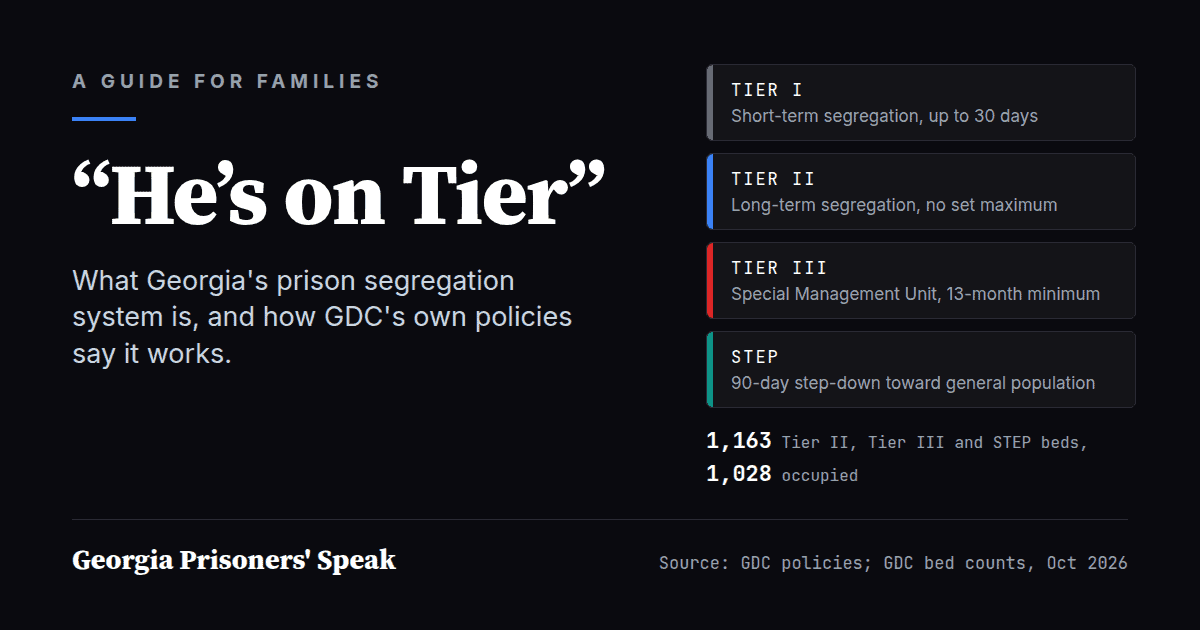
There are three levels, Tier I, Tier II and Tier III, plus a step-down program called STEP. Each has its own written policy. This guide walks through them using those policies, the Prison Rape Elimination Act (PREA) audits posted on GDC’s website, and the bed counts GDC gave GPS on October 2, 2026: 1,163 Tier II, Tier III and STEP beds, 1,028 of them occupied.2
The system at a glance
- Tier I is short-term segregation. GDC’s policy calls it “Disciplinary, Protective Custody and Transient Housing” and applies it to every kind of GDC facility, down to probation detention centers. A stay can’t run past 30 days, except in protective custody.3
- Tier II is long-term “Administrative Segregation.” It runs in three phases, and the written policy sets no maximum stay.4 GDC’s October 2026 table lists Tier II beds at eight prisons.2
- Tier III is the Special Management Unit (SMU). It’s a five-phase program with a 13-month minimum and a 24-month limit that GDC can go past in listed cases.5
- STEP, the Segregated Transition Education Program, is a 90-day step-down for people who have completed Tier II or Tier III. There’s a Tier II STEP and a Tier III STEP, each with its own policy.67
The levels differ sharply on time out of the cell. The Tier I and Tier II policies set a floor of five hours of exercise a week outside the cell. The Tier III policy sets a floor of four hours out of cell a day, Monday through Friday. Both STEP policies set four hours a day, seven days a week.3456
Tier I: the short stay
The warden, or a designee, can place a person in Tier I in eight situations. They include when the person “is noted as a threat to the safe and secure operation of the Facility,” is awaiting a disciplinary hearing or under investigation, faces a criminal charge, needs protective custody, is waiting on a transfer, or hasn’t been classified yet after arriving at a facility. None of the eight requires a finding of guilt.3
After an involuntary placement, a committee of facility staff must hold a hearing within 96 hours. A counselor checks the person’s “well-being and mental status every seven (7) days,” and the committee reviews every placement at 30 days. The stay “cannot exceed thirty (30) days from the date of assignment, to include investigation and disciplinary isolation time,” except for people in protective custody.3
On paper, Tier I keeps much of ordinary prison life. Visiting and correspondence privileges “accorded to general population shall be allowed,” and “No restrictions shall be placed upon an offender’s contact with courts or legal counsel.” Showers can be limited to three a week and commissary to the equivalent of $60.00 of items. Exercise must be available at least five hours a week.3
Tier I also connects to the discipline rules. In prisons, GDC’s discipline policy limits confinement in an isolation cell to 30 consecutive days, then points past the limit to Tier II:
“If isolation time imposed exceeds thirty (30) days due to being necessary to control and encourage behavioral change, a recommendation for placement of the offender in the Tier II program is warranted.”
The section just before it, on authorized sanctions, says any sanction “requires that the offender first be found to have committed a prohibited act.”8 The Tier II policy says Tier II “is an offender management process and is not a punishment measure.”4
Tier II: long-term segregation
GDC’s policy defines Tier II as a “Long Term Administrative Segregation stratification plan.” The version GDC posts today took effect on April 11, 2016.4
Placement is a classification committee decision approved by the warden, and the committee holds a hearing within 96 hours. In an emergency, the warden can order placement immediately. A person must meet one of 13 criteria. They include escapes, riots, weapons, repeated assaultive or disruptive disciplinary charges, contraband trafficking and “Failure in the Tier I program or refusal to participate.” The widest is the first: being “noted as a threat to the safe and secure operation of the Facility,” which the policy says can include “notoriety of crimes” and people “who have either been threatened with bodily harm or threatened others with bodily harm.” People at mental health Level IV aren’t eligible, and Level III requires a mental health screening first.4
Tier II has three phases, and people move between them based on the goals in an individualized case plan. Inside Phase 1 are “Moderated Cells,” which the policy calls “the most restrictive cells.” There, property is cut to state issue and shower shoes replace boots. The listed reasons for a moderated cell include throwing bodily fluids and setting fires. They also include “refusing to allow tray flap to be closed” and “refusing to be cuffed.”4
Daily life in Tier II, by the written rules:4
- at least five hours a week of exercise outside the cell, unless security, safety or bad weather prevents it
- personal hygiene three times a week, and food of “the same quality and quantity” as in general population
- non-contact visits only: one a month in Phase 1, up to two in Phase 2 and up to three in Phase 3, each with up to two visitors for up to two hours
- phone calls limited by phase
- legal access and a counselor
The list ends with a clause that covers all of it: “As deemed necessary by the Warden/Designee, all of the above conditions or privileges are subject to modification due to extenuating operational circumstances.”4
How long Tier II lasts
The policy sets no maximum. People who “cannot return to general population because they pose a serious threat to the safety and security of the institutional operation shall remain in Phase 3,” with a review every 90 days.4
Other documents put numbers on it. GDC’s Tier fact sheet lists a “Nine months minimum stay,” and a “Phase 3+” for people who’ve completed the program but “are not deemed fit for general population at that time.”1 A 2018 survey report by the Association of State Correctional Administrators (ASCA) and Yale Law School’s Liman Center says Georgia reported “Tier II step down units for offenders on phase 3+, who have been in restrictive housing for 270+ days.”9 PREA auditors have described Tier II at Hays State Prison as “long-term segregation/270 days.”10 At Macon State Prison, one audit described it as running “from nine months to indefinite” and a later one “from 270 days to an indefinite date.”1112
Tier III: the Special Management Unit
Tier III runs in one place, the Special Management Unit.2 GDC’s page for the unit gives a Jackson address and describes six cellblocks of “single-bunked cells.”13
Its admission criteria overlap with Tier II’s and include grounds such as killing or seriously injuring someone or taking part in a hostage-taking within five years, and being “a person of Notoriety.” They apply only to people at mental health Level II or below. People at Levels III and IV are to be considered for a Specialized Mental Health Treatment Unit instead.5
There are five phases, each in its own wing, starting in E Wing (Phase 1, “the most restrictive”). It’s “a minimum 13 month (390 days) program”: at least 60 days each in E and F Wings, then 90 each in D, C and B Wings. The policy says people “shall not be held in the Tier III Program for more than 24 months,” then lists exceptions, among them a murder committed while incarcerated and causing serious bodily injury. Anyone kept past 24 months gets a quarterly panel review, and the Director of Field Operations or the Assistant Commissioner for Facilities must personally approve keeping them. Everyone in Tier III is classified Close Security.5
Under the Tier III policy:5
- every cell is single occupancy, in every phase
- people get at least four hours out of cell a day, Monday through Friday, including at least an hour of recreation outside in the recreation pens, and staff must log it; weekend visits can’t be counted toward it
- if out-of-cell time for a wing or the whole unit is canceled or shortened three or more days in a row, the SMU warden must notify the North Regional Director in writing
- out-of-cell time can’t be denied as punishment unless the person commits a “Great” or higher severity offense during it or on the way to or from it
- phone calls run up to 25 minutes, visits are non-contact and follow a chart for each phase, and people can write and receive letters “on the same basis as offenders in the general population”
GDC’s page for the unit adds the visiting rules: no visits until a person has been at the SMU for 30 days, then only approved immediate family, on Saturdays, Sundays and state holidays from 9 a.m. to 3 p.m., scheduled in advance.13
Why Tier III’s rules read differently
The SMU was the subject of a federal class action. According to the Southern Center for Human Rights (SCHR), which represented the men held there, GDC officials entered a settlement agreement in 2018 that required a minimum amount of out-of-cell time, programming, mental health evaluations, tablets, TVs and books, and due-process protections on who could be assigned to the SMU and for how long.14 The U.S. Department of Justice’s 2024 findings report on Georgia’s prisons notes that GDC had been under a consent decree in the case since 2019, and that in April 2024 the court held GDC in contempt and imposed monetary sanctions.15 A federal judge ended the case on May 22, 2025, SCHR reported.14
Tier II’s written floor is still five hours of exercise a week.
What the court found
In April 2024, Chief U.S. District Judge Marc Treadwell held GDC in contempt of the SMU injunction. In a 100-page order he described SMU officials as “obstinately disobedient.”16 He wrote that “the defendants, in effect, were running a four-corner offense and had no desire or intention to comply with the Court’s injunction; they would stall until the injunction expired.”17 He ordered an independent monitor for the unit at GDC’s expense and, from May 20, fines of $2,500 per day until GDC met the terms it had agreed to five years earlier.16
What the court found, according to the order and the reporting on it:
- Men in the SMU stayed in their cells 22 to 24 hours a day and did not get the required minimum of two hours of classroom time a week; the judge called the plaintiffs’ evidence “overwhelming.”18
- Six men testified about being held in cells “naked or nearly naked, for days.”19
- The judge accused prison officials of falsifying documents and said they routinely placed new arrivals in “strip cells.”18
- A counselor, Kendra McBurnie, testified that she refused to sign review forms for prisoners who were not present, and that other counselors signed for men on her caseload. Prisoners testified they were told to sign the forms but not date them, “apparently,” the judge wrote, “to allow backdating so that it would appear that a review hearing was timely held.”17
- Assistant Commissioner Ahmed Holt had sworn in 2022 that prisoners were getting time out of their cells at tables. The evidence showed they were not. “Even if Holt were a credible witness, and he is not,” the judge wrote, “his vague excuses, with no supporting evidence, do not excuse the defendants’ failure to comply with the injunction.”17
Less than two months after the contempt order, the case’s lead plaintiff, Ricardo Daughtry, was found dead in his SMU cell. GDC policy required that he be checked every 30 minutes; records obtained by his attorneys show no one looked in on him for nearly seven hours before his body was discovered. The same records showed him attending “table time” outside his cell after he had already been pronounced dead.17 In an August order, the judge wrote: “The Court has long passed the point where it can assume that even sworn statements from the defendants are truthful.”17
In a later order, the court credited “court-appointed monitor Gary Mohr (and hefty daily contempt fines)” with getting most of the SMU’s problems fixed or on the way to being fixed, and found that GDC had purged its contempt.20 The policies this guide describes are GDC’s written rules. In the SMU, a federal court found, they were not followed until a judge imposed a monitor and daily fines.
STEP: the step down
Both STEP policies say the same thing about their own unit in their introductions. The Tier II version reads:
“The Tier II STEP is not a restrictive housing unit.”
The Tier III version says the same of Tier III STEP.67
Tier II STEP is for people “who have successfully completed the Tier II Program,” and Tier III STEP for people who completed Tier III. The goal of each is to move people to general population “in a safe, secure manner within ninety (90) days.” Both policies took effect in April 2019.67 GDC’s FY2019 annual report calls Tier II STEP “a step-down, incentive-based, program.”21
Under both STEP policies, people get at least four hours out of cell a day, seven days a week, including an hour of exercise. Visits are non-contact and “no less than two (2) hours in duration,” unless security or safety says otherwise. Phone calls happen during recreation time and are “limited to 15-minutes in duration.” Staff check on people every 30 minutes. The two programs differ on cells. In Tier II STEP, “Cells may be single or double occupancy.” In Tier III STEP, “All cells are single occupancy.”67
How people move through Tier, and out
Every level runs on reviews:
- Tier I: a hearing within 96 hours, a counselor check every seven days, and a committee review at 30 days that keeps the person in Tier I, returns them to general population or assigns them to Tier II.3
- Tier II: informal counselor contacts every 30 days and a formal, face-to-face committee review every 90 days. The committee can move the person up a phase, keep them, move them back, release them on completion, or reassign them “at another Level 5 facility or GDCP High Max Unit.”4
- Tier III: a review at least every 60 days in E and F Wings and every 90 days in B, C and D Wings. A 90-day review can release the person to Tier III STEP. Anyone within 12 months or six months of their maximum release date is to be considered for Tier III STEP, and a refusal needs written, specific reasons.5
- STEP: a review at least every 30 days. At 90 days, a person who completes the program “will be considered for reassignment to general population with a Close Security classification,” or the committee can recommend a stay “up to another ninety (90) days.” Neither STEP policy limits how many times that can happen.67
Leaving Tier II takes more than time. The person “must be actively participating in the O.U.T. Program (Offenders Under Transition)” and, “If appropriate,” must complete it before release.4 GDC’s fact sheet describes O.U.T. as a 200-hour cognitive-behavioral curriculum that runs 40 weeks and starts in a person’s fifth week in Tier II.1
Thirty days before release, the statewide Security Threat Group coordinator has the Criminal Investigations Division check for active investigations or criminal activity. The findings go to the Director of Field Operations, “who will make the final decision.” A person cleared to leave is “monitored in Tier I for up to thirty (30) days before his or her release to general population.” So the warden approves placement into Tier II, and the Director of Field Operations decides release. That 2016 policy doesn’t mention STEP. The 2019 Tier II STEP policy takes people who have completed Tier II.46
Where Tier runs, and how full it is
On September 14, 2026, GPS asked GDC under the Georgia Open Records Act for the prisons that run Tier II and Tier III, including STEP, and the number of people assigned to each. GDC answered on October 2 with a one-page table, at no charge.2 It counts beds and occupied beds, not people. It carries no as-of date, and it doesn’t split STEP beds between Tier II STEP and Tier III STEP. Totals are GPS’s arithmetic.
| Program | Prison | Beds | Occupied | Empty |
|---|---|---|---|---|
| Tier II | Hancock State Prison | 83 | 82 | 1 |
| Tier II | Hays State Prison | 151 | 151 | 0 |
| Tier II | Macon State Prison | 121 | 119 | 2 |
| Tier II | McRae Women’s Facility | 34 | 28 | 6 |
| Tier II | Smith State Prison | 111 | 89 | 22 |
| Tier II | Telfair State Prison | 117 | 117 | 0 |
| Tier II | Valdosta State Prison | 129 | 80 | 49 |
| Tier II | Ware State Prison | 138 | 138 | 0 |
| Tier II total | 884 | 804 | 80 | |
| Tier III | Special Management Unit | 160 | 128 | 32 |
| STEP | Georgia Diagnostic and Classification Prison | 20 | 3 | 17 |
| STEP | Hays State Prison | 59 | 59 | 0 |
| STEP | Macon State Prison | 20 | 20 | 0 |
| STEP | Smith State Prison | 20 | 14 | 6 |
| STEP total | 119 | 96 | 23 | |
| All three | 1,163 | 1,028 | 135 |
Hays State Prison holds 210 Tier II and STEP beds, and every one is occupied. Telfair and Ware have no empty Tier II bed, and Hancock has one. Valdosta has 49 of its 129 Tier II beds empty. McRae Women’s Facility is the one women’s prison on the list. GDC’s fact sheet lists Tier at seven prisons, Hancock, Hays, Macon, Smith, Telfair, Valdosta and Ware; the table adds McRae.1 The table leaves out Tier I, which any GDC facility can use, so its totals aren’t Georgia’s total segregation beds.
The table shows 128 of 160 Tier III beds occupied. GDC’s monthly population report counted 154 people at the Special Management Unit on September 1, 2026.22 The two figures count different things on different dates.
What GDC publishes, and what it doesn’t
GDC’s monthly population report lists the SMU as a facility, so its headcount is public. The report doesn’t contain the word “Tier.” It counts people by prison, and Tier I and Tier II units sit inside ordinary prisons.22
GDC does track Tier II person by person. Its FY2019 annual report says a “TIER 2 SCRIBE module went live March 2019 to effectively track offenders in Extended Restrictive Housing.”21 Its FY2020 report calls Tier II “The Restrictive Housing Program” and says GDC added the “number of days an offender has spent in restrictive housing Tier II” to the SCRIBE Warden’s Dashboard.23 GPS hasn’t found those day counts in any GDC publication. Asked for the number of people in each program, GDC sent bed counts.
GDC’s FY2014 annual report says it implemented Tier “at all Level V facilities,” and “2,721 beds were converted to Tier beds.” That’s a count of beds converted when the system was built, not a count of people.24 The FY2018 report says that “Since January 2017, the number of offenders in extended restrictive housing has decreased by 41 percent (671).” It credits several measures together: specialized protective custody housing, Specialized Mental Health Treatment Units, STEP, administrative reviews, changes in the discipline process and “restructuring of policies and procedures.”25 Both STEP policies define STEP as “not a restrictive housing unit.”
In its answer to the 2019 ASCA-Liman survey, Georgia reported 2,147 people in restrictive housing out of 44,073 in the facilities it reported on, or 4.9 percent.26 Georgia didn’t answer the 2021 survey, which lists it with “No 2021 Survey Response.”27 SCHR reported that as of October 2025, “more than 2,100 people were housed in Georgia’s ‘tiers,’ including almost 1,000 people in the long-term tiers.”28
What families can ask
The written rules give families concrete questions to ask a loved one, and dates to keep track of.
- Which level, and which phase or wing? In Tier II, the phase sets visits and phone limits. In Tier III, the wing shows how far along the 13-month minimum someone is.
- Did they get the paperwork? In Tier II, the person is to be served a copy of each 90-day review decision once the warden approves it. The assignment memo, review forms and appeal forms go into the person’s case history file.4
- Was an appeal filed in time? Tier I and Tier II appeals are due within three business days of the notice, and a Tier II appeal goes through the assigned counselor. An appeal of the first Tier II placement goes to the Director of Field Operations, who has 14 business days. An appeal of a 90-day review goes to the warden, who has seven.41
- Is the person enrolled in O.U.T.? Release from Tier II depends on it.
- Is out-of-cell time happening? The Tier III policy requires staff to log it for every person, and the STEP policies set a daily four-hour floor.5
- When can you visit? Tier visiting days can differ from the rest of the prison. At Hays State Prison, general population visits on weekends, while Tier I, Tier II and STEP visits are on Wednesdays and Fridays, 9 a.m. to 3 p.m., by appointment only.29
- Can they reach a lawyer? Every level protects legal access. The Tier II and Tier III policies require it under GDC’s Access to Courts policy.45
If what you’re hearing doesn’t match the written rules, write it down: the dates, the phase, the reviews held or skipped, the out-of-cell time canceled. You can send it to GPS through Submit a Report or share your family’s account through Tell My Story. GPS’s research collection on the Tier system holds the policies, audits and GDC’s bed table in one place.
Call to Action: What You Can Do
You just read that GDC calls Tier II 'not a punishment measure' while its own policy sets no maximum stay, and that 1,028 of 1,163 Tier beds are occupied. If you don't share this, the people in those cells stay invisible. Share it now.
Spread the Word: It Takes One Click
Awareness without action changes nothing. Here’s how you can help push for accountability and real reform:
Join the GPS Advocacy Network: Sign up at https://gps.press/become-an-advocate/ and we’ll advocate on your behalf every week. GPS identifies your state legislators, crafts personalized letters on the most pressing prison issues, and sends them directly to the representatives who represent you. You receive a copy of every letter. It takes two minutes to sign up, and we handle the rest.
Send a 60-Second Message: Pick an issue, get a ready-to-edit message with the verified facts already in it, and email your state House representative and senator directly from your own inbox at https://gps.press/send-a-message/. No signup, nothing stored. It takes about a minute.
Tell My Story: Are you or a loved one affected by Georgia’s prison system? GPS publishes first-person accounts from incarcerated people and their families. Submit your story at https://gps.press/category/tellmystory/ and help the world understand what’s really happening behind the walls.
Contact Your Representatives: Your state legislators control GDC’s budget, oversight, and the laws that created these failures. Find your Georgia legislators at https://gps.press/find-your-legislator/ or call Governor Kemp at (404) 656-1776 or the GDC Commissioner at (478) 992-5246.
Demand Media Coverage: Contact newsrooms at the AJC, local TV stations, and national criminal justice outlets. More coverage means more pressure.
Amplify on Social Media: Share this article and tag @GovKemp, @GDC_Georgia, and your local representatives. Use #GAPrisons, #PrisonReform, #GeorgiaPrisonerSpeak.
Message the Board of Corrections: The citizen board that oversees the GDC publishes no contact details for its members. GPS built the missing front door: pick a board member and a policy message and send it from your own email at https://gps.press/write-the-board/.
File Public Records Requests: Georgia’s Open Records Act gives every citizen the right to request incident reports, death records, staffing data, medical logs, and financial documents. Start with the GPS Action Toolkits at https://gps.press/toolkits/. The Open Records Toolkit walks you through what to ask for, gives you ready-to-file request templates, and tells you what to do when the state says no. File directly with GDC at https://georgiadcor.govqa.us/WEBAPP/_rs/SupportHome.aspx.
Attend Public Meetings: The Georgia Board of Corrections and legislative committees hold public meetings. Your presence is noticed.
Contact the Department of Justice: File civil rights complaints at https://civilrights.justice.gov. Federal oversight has forced abusive systems to change before.
Support Organizations Doing This Work: Donate to or volunteer with Georgia-based prison reform groups fighting for change on the ground.
Vote: Research candidates’ positions on criminal justice. Primary elections often determine outcomes in Georgia.
Contact GPS: If you have information about conditions inside Georgia’s prisons, reach us securely at GPS.press.
Further Reading
Above the Law: GDC Defies Courts, DOJ, and Legislators
How GDC handled the federal settlement over the Special Management Unit, and the other courts and oversight bodies it has stonewalled.
What enforced idleness and isolation do to people inside Georgia’s prisons, and the despair the state declines to count.
Nowhere to Put Him: How Georgia’s Bed Math Killed a Man Thirty Days From Home
What happened at one prison when every segregation bed was full and a man needed protecting.
The Punishment for Speaking Up in Georgia’s Prisons
How segregation, transfers and write-ups follow grievances, lawsuits and reports, drawn from GPS’s own case files.
The Warden Shall Notify: Who Georgia’s Prisons Keep in the Dark, and the Law That Lets Them
The rule that says the warden shall notify a family when a loved one is badly hurt, and the families who found out some other way.
GPS Intelligence System
The GPS Intelligence System maintains living research profiles that aggregate data, news, settlements, and analysis on Georgia’s prisons and the issues defining them. The profiles below provide deeper context for the issues raised in this article:
Solitary Confinement in Georgia Prisons
The policy floor, the litigation, the Tier II admission rule and the records GDC holds, gathered in one living profile.
The facility profile for the unit that runs Tier III, including the fight over its settlement and its mortality record.
Explore the Data
GPS makes GDC statistics accessible to the public through several resources:
- GPS Statistics Portal: Interactive dashboards translating complex GDC reports into accessible formats, updated within days of official releases.
- GPS Lighthouse AI: Ask questions about Georgia’s prison system and get answers drawn from GPS’s investigative archive and data analysis.
- GPS llms.txt: A single machine-readable index of every GPS data resource, published using the open llms.txt standard. Point any AI tool (ChatGPT, Claude, Gemini, Perplexity) at this URL and the model can navigate to facility profiles, intelligence briefs, mortality records, statistics, and the full investigative archive, with no other configuration needed. It is the fastest way to ground an AI conversation in verified GPS data.
- GPS Public MCP Server: For AI tools that support the Model Context Protocol (Claude, ChatGPT, and others), connect directly to GPS’s data: read-only tools covering population, facilities, mortality, parole, the Georgia Code, settlements, and more. Every answer arrives with its source link and citation built in.
For a walkthrough of how to put these resources to work with AI, see How to Use GPS Data with AI Tools: a step-by-step guide for researchers, advocates, families, and journalists analyzing Georgia prison conditions, statistics, and policy with tools like ChatGPT, Claude, and Gemini.
Contact GPS at media@gps.press for access to underlying datasets used in this analysis.
About Georgia Prisoners’ Speak (GPS)
Georgia Prisoners’ Speak (GPS) is a nonprofit investigative newsroom built in partnership with incarcerated reporters, families, advocates, and data analysts. Operating independently from the Georgia Department of Corrections, GPS documents the truth the state refuses to acknowledge: extreme violence, fatal medical neglect, gang-controlled dorms, collapsed staffing, fraudulent reporting practices, and unconstitutional conditions across Georgia’s prisons.
Through confidential reporting channels, secure communication, evidence verification, public-records requests, legislative research, and professional investigative standards, GPS provides the transparency the system lacks. Our mission is to expose abuses, protect incarcerated people, support families, and push Georgia toward meaningful reform based on human rights, evidence, and public accountability.
Every article is part of a larger fight: to end the silence, reveal the truth, and demand justice.

The Architecture Is the Evidence
Across the 32 state prisons whose original design figures we hold, Georgia built for 15,737. They hold 34,019 — 216% of design capacity.
Dorms tripled. Cells double- and triple-bunked. Medical, kitchens, libraries — unchanged. Every facility, every design figure, every source.
See the receipts →- GDC Tier Segregation System fact sheet, https://gdc.georgia.gov/document/fact-sheets/tier-management-fact-sheet/download [↩][↩][↩][↩][↩]
- GDC response to GPS open-records request R031710-091426 (2 October 2026), https://gps.press/research-library/georgias-tier-segregation-system-tier-i-tier-ii-tier-iiismu-and-the-step-programs-architecture-conditions-scale-and-the-solitary-confinement-population-gdc-does-not-publish/ [↩][↩][↩][↩]
- GDC SOP 209.07 Segregation – Tier I, https://public.powerdms.com/GADOC/documents/105950 [↩][↩][↩][↩][↩][↩]
- GDC SOP 209.08 Administrative Segregation – Tier II, https://public.powerdms.com/GADOC/documents/105951 [↩][↩][↩][↩][↩][↩][↩][↩][↩][↩][↩][↩][↩][↩][↩]
- GDC SOP 209.09 Special Management Unit – Tier III Program, https://public.powerdms.com/GADOC/documents/105973 [↩][↩][↩][↩][↩][↩][↩][↩]
- GDC SOP 209.45 Tier II STEP, https://public.powerdms.com/GADOC/documents/535920 [↩][↩][↩][↩][↩][↩][↩]
- GDC SOP 209.55 Tier III STEP, https://public.powerdms.com/GADOC/documents/536189 [↩][↩][↩][↩][↩]
- GDC SOP 209.01 Offender Discipline, https://public.powerdms.com/GADOC/documents/105928 [↩]
- ASCA-Liman 2018 Nationwide Survey of Time-in-Cell, https://law.yale.edu/sites/default/files/documents/pdf/Liman/asca_liman_2018_restrictive_housing_revised_sept_25_2018_-_embargoed_unt.pdf [↩]
- PREA audit Hays State Prison Cycle 2, https://gdc.georgia.gov/document/prea-audit-location-report/prea-hays-audit-cycle-2/download [↩]
- PREA audit Macon State Prison Cycle 2, https://gdc.georgia.gov/document/prea-audit-location-report/prea-macon-sp-audit-cycle-2/download [↩]
- PREA audit Macon State Prison Cycle 4, https://gdc.georgia.gov/document/prea-audit-location-report/prea-macon-sp-audit-cycle-4/download [↩]
- GDC Special Management Unit facility page, https://gdc.georgia.gov/locations/special-management-unit [↩][↩]
- Southern Center for Human Rights on the end of the SMU case June 23 2025, https://www.schr.org/federal-judge-terminates-decade-long-smu-case-and-calls-out-gdcs-management-problem-and-lack-of-will/ [↩][↩]
- U.S. Department of Justice findings report Investigation of Georgia Prisons 2024, https://www.justice.gov/d9/2024-09/findings_report_-_investigation_of_georgia_prisons.pdf [↩]
- Georgia Public Broadcasting on the SMU contempt order April 23 2024, https://www.gpb.org/news/2024/04/23/in-scathing-order-federal-judge-finds-georgia-prison-officials-in-contempt-of-their [↩][↩]
- Atlanta Journal-Constitution Georgia prison system engages in deception as crisis builds December 2024, https://www.ajc.com/news/investigations/georgia-prison-officials-have-repeatedly-presented-false-or-misleading-information-to-federal-investigators-state-lawmakers-and-a-federal-judge/H76M74I6L5F5DKXEYSSZEQSLGY/ [↩][↩][↩][↩][↩]
- FOX 5 Atlanta on the SMU contempt order April 2024, https://www.fox5atlanta.com/news/georgia-prison-officials-in-flagrant-violation-of-solitary-confinement-reforms-judge-says [↩][↩]
- The Atlanta Constitution print edition April 23 2024 page A6, https://www.newspapers.com/image/1064430278/ [↩]
- Daughtry v. Emmons No. 5:15-cv-41-MTT M.D. Ga. order on attorneys fees via CourtListener, https://www.courtlistener.com/opinion/10704856/ricardo-daughtry-et-al-v-shawn-emmons-et-al/ [↩]
- GDC Annual Fiscal Report FY2019, https://gdc.georgia.gov/document/gdc-annual-fiscal-report/gdc-annual-fiscal-report-2019/download [↩][↩]
- GDC Inmate Statistical Profile of all active inmates 1 September 2026, https://gdc.georgia.gov/document/monthly-statistical-reports/profile-all-inmates-2026-08/download [↩][↩]
- GDC Annual Fiscal Report FY2020, https://gdc.georgia.gov/document/gdc-annual-fiscal-report/gdc-annual-fiscal-report-2020/download [↩]
- GDC Annual Fiscal Report FY2014, https://gdc.georgia.gov/document/gdc-annual-fiscal-report/gdc-annual-fiscal-report-2014/download [↩]
- GDC Annual Fiscal Report FY2018, https://gdc.georgia.gov/document/gdc-annual-fiscal-report/gdc-annual-fiscal-report-2018/download [↩]
- ASCA-Liman Time-in-Cell 2019, https://law.yale.edu/sites/default/files/area/center/liman/document/time-in-cell_2019.pdf [↩]
- ASCA-Liman Time-in-Cell 2021, https://law.yale.edu/sites/default/files/area/center/liman/document/time_in_cell_2021.pdf [↩]
- Southern Center for Human Rights Georgia Calls It the Tier Program, https://thesoutherncenter.substack.com/p/georgia-calls-it-the-tier-program [↩]
- GDC Hays State Prison facility page, https://gdc.georgia.gov/locations/hays-state-prison [↩]